The
Oscars are this weekend (Lord, help us!) and there are a couple of Best
Picture winners I haven't re-published from "The Olde Site." So, rather
than doing anything "newish" I'll opt, instead, for "timely."
I'm
not a fan of The Oscars (like everybody), but I watch it (like
everybody) and I complain about it the next day (like everybody). You
can't seem to have one without the others. People enjoy complaining
about them but wouldn't dare miss watching them. Everybody has some Oscar-decision that's an obscenity in their eyes...and there are some that are questionable (my Saturday "Trash" post will be one of them)*.
But, most of the time, I just don't care. The Oscars, being voted on
within a year of each film's release, are always going to be
short-sighted, with absolutely no chance of being able to judge a film's
lasting legacy. The decisions are always factored by politicking or
prestige. Maybe trendy. But probably not. They'll always be there
whether one watches them or agrees with them.
Written at the time of the film's release. And there's some post-Oscar bashing at the end.
"Crossing Your Threshold" or "Let's Take it from the Top: 'In Our Darkest Hour...'"
One of my favorite observations from Jerry Seinfeld was his remark that more people are scared of public-speaking than of death: "In other words, more people would rather be IN the coffin, than delivering the eulogy..."
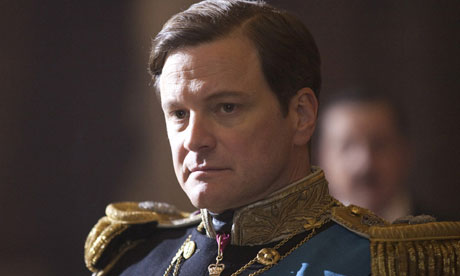
In The King's Speech, this year's Oscar-bait from The Weinstein Company, King George VI (Colin Firth, spot on, really) would rather be dead than speak in public. It's too bad, then, that his father, George V (Michael Gambon) beats him to the choired invisibule, and the next in succession, Edward (Guy Pearce, in an extraordinarily adroit performance) is too much of a self-absorbed ponce to sacrifice "the woman he loves" for such a small thing as the welfare of all of Britannia.
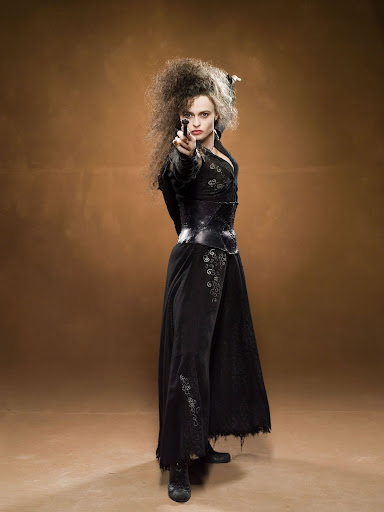
George VI, or Albert, the Duke of York (as he is dubbed before coronation), has a persistent stutter, and a concurrent inferiority complex, given his heightened awareness of his condition and his responsibility—director Tom Hooper makes it clear in his direction and editing choices that we are constantly aware of his audiences' reactions to his stammers, faults and failings, even the portraits of his forebears stare in frozen, condescending judgement.*It is up to his wife, Elizabeth (Helena Bonham Carter, bi-polarly different than her roles for Hubby Burton and Harry Potter)—"Call me 'Liz'" she sweetly says at one point late in the movie—wants to fix the problem, not because her husband is the man who could be King, but because the underlying psychological whipping he imposes on himself is making him miserable. He doesn't even have the wherewithal to blurt out a bedtime story to his two adoring princesses, Elizabeth and Margaret.
With a capricious older brother and an ailing father-king, he is not the most confidence-inspiring potential potentate who can, as his father bellows "stand between us, the jack-boots and the proletarian abyss." And given that the position is more public than ever, what with the King needing to address his subjects via radio, the air of confidence is more important than ever, and Albert's failings as such are even more readily apparent in the Theater of the Mind. Not only is the Empire shrinking for the Royals, but the world is, too, and their enemy's reach is the range of a V-2 rocket.
Presentation is all now, sometimes even more than the message. During the viewing of a newsreel, the Royal Family gets a glimpse of the Player on the Other side, Adolf Hitler at the Nuremberg Rally. "What's he saying, papa?" asks a daughter.
"I don't know," replies the envious Albert. "But he says it rather well."
What do the simple folk do, when they have to carry the burdens of the entire Nation on their backs without hesitancy, and with grace. The short answer is, they don't—the situation is somewhat unique.
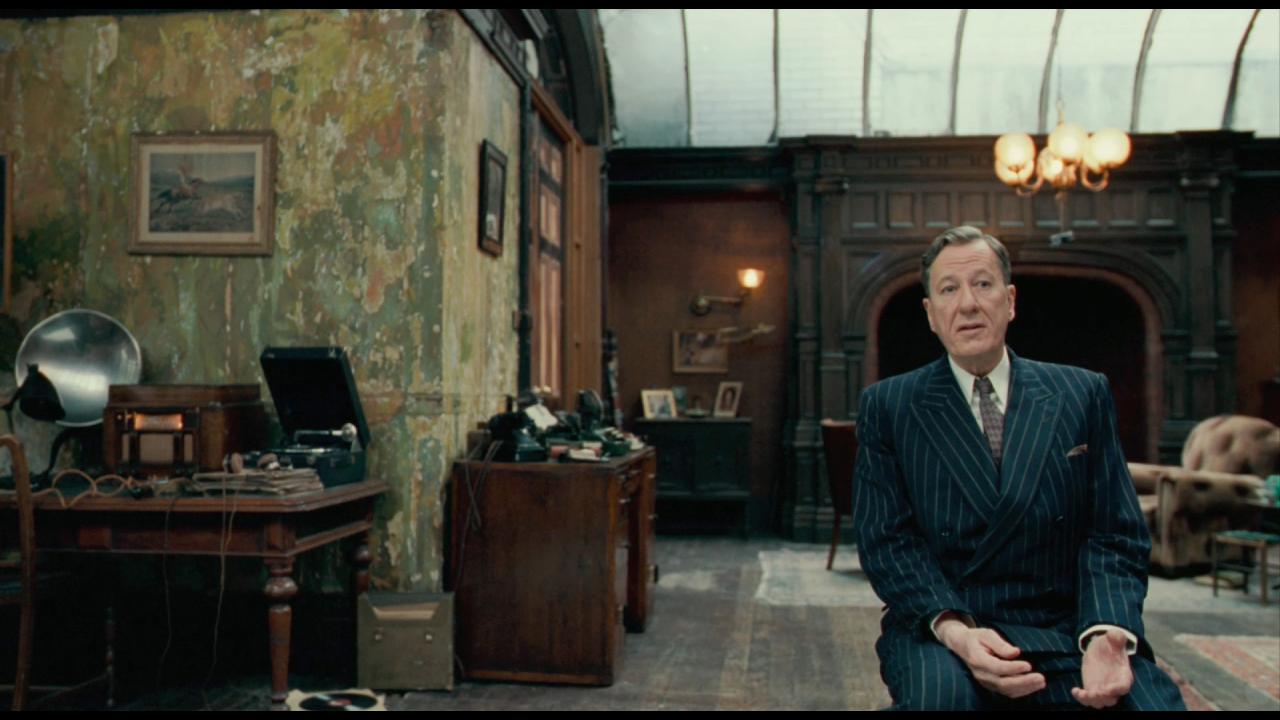
Enter Lionel Logue (Geoffrey Rush), full-time vocal coach, hopeful actor...Australian. He is visited by one "Mrs. Johnson"—the future Queen-Mum—to enquire about services, all the royal outlets proving inefficient, taxing and embarrassing for Albert. Logue has no idea who he's really dealing with—in all senses—explaining that his methods are "unorthodox and unusual."
"Not my favorite words," she sighs.
This is a cracklingly well-done film, subtle and efficient and literate—the script (by David Seidler) leading down as many paths as Logue has techniques, but the most interesting aspect is how the two men, Lionel and Albert (who Logue insists on calling "Bertie" to allow mutual approachability) must rise and lower each other to the occasion, Logue relying on his actor's discipline to gain respect, while Albert uses Logue to gain insight to the common man, essential to his tutelage. And the actors are terrific, not only the ones mentioned, but a small delegation of familiar faces maximizing their small roles. Derek Jacobimakes an early appearance, Anthony Andrews appears as P.M. Stanley Baldwin, Claire Bloom as Queen Mary, and Timothy Spall, doing a fair turn as Winston Churchill It culminates in a moving sequence as the new King must make a radio address to reassure the public after the declaration of war on Germany. Incongruously set to the second movement of Beethoven's Seventh Symphony, George VI, alone, with his coach conducting, must pick his way through his speech, every syllable a struggle to maintain control—the music behind him halting and building. I tell ya, I dropped tears, it's an extraordinary last act to an extraordinary movie.
Now...the rating. The King's Speech is rated "R" (in the United States) for the silliest of reasons—a short sequence where Logue badgers Albert into cursing like a sailor, including a string of "F"-bombs that kept it from achieving the lighter "PG-13," although the film really credits an ever lighter "PG." Don't be put off by the prigs of the Ratings Board. This is a fine, fine film.
* ...but in a style not as annoying as his work on the HBO series "John Adams," and less conventional than his work on The Damned United.
Post-Oscar Bashing: Best Picture? Nah. Not in that gang of 10. But a safe, respectable choice. You can't complain about the script or the performances (I could about director Hooper's win, but as was clear in his acceptance speech, without Hooper—and his Mum—there would have been no film, and the script was certainly worthy). But, ultimately, it's the Best Picture Harvey Weinstein could buy...as has been the case before. Still. Great film. But not Best Picture...not with 127 Hours, True Grit, Toy Story 3 in the running.
The Battle of Mrs. Miller ("Whose Side Are You On?") or "What Becomes a Legend Most?"
"We are such stuff as dreams are made on" says Prospero in "The Tempest." Prospero and Shakespeare run throughMy Week with Marilyn(the latest confection of young love and fictionalized reality—with appearance by Judi Dench—from the Weinstein Company) like Caliban, a spirit of confused form and intent in Shakespeare's play. All the revelers in Simon Curtis' film (written—especially well by Adrian Hodges) are real, based on real individuals and events, but how true they are to the source is questionable, given as they are to interpretation and expectations, and to the dreams of the participants, for whom the movies and fame is a business, an art, as well as personal obsessions.
None more so than Norma Jeane Baker, who inhabited our world and our dreams as Marilyn Monroe, a free spirit trapped in prison bars formed of klieg lights, a vessel that men poured their love and lust onto and women their princess dreams of being the most popular girl in the world. Heavy, heavy burden, that, and she bore it from the lowliest, sleeziest agent in Hollywood to Kings of the Sports World and Men of Letters. She also bore it from other film stars, who looked at her fame and wanted a piece of it (and maybe her, as well), including Sir Laurence Olivier, who insisted on casting Marilyn in his production of The Prince and the Showgirl, a trifling movie if ever there was one, despite being written by Terence Rattigan, and despite having had a success of it on the stage.
What Marilyn saw in doing the movie was obvious; she was working with the world's greatest Shakespearean actor and director on a film written by an acknowledged writer. Why Olivier wanted to do this is less so: financial success for his un-barded film; name recognition to draw the crowds for a film out of his metier; maybe he just wanted Marilyn, as so many men did, and the new bride of American playwright Arthur Miller (not the best looking guy in the world) might have provided a world to conquer for the actor who played so much ambitious Shakespearean royalty. Whatever the reason, Olivier was constantly frustrated with the fragile, neurotic actress, who had other concerns besides working with the exacting director—it was the only film she made outside of her protective home studio, 20th Century Fox, the only film she made outside of the United States, and the first film of her fledgling production company—all unique concerns that might have distracted the actress, on top of her new marriage to Miller and a hushed-up pregnancy during filming that resulted in a miscarriage.
The film that Hodges and Curtis have crafted from the events and a tell-all written about it by filmmaker Colin Clark (played by Eddie Redmayne), is one of the better ones to be made of this type. Casting has a lot to do with it. Michelle Williams is not the first person I would picture as Norma Jean, but the versatile actress manages to capture the presence of the human being at the core of the starand suggest the winsomeness that charmed so many in her orbit.
Kenneth Branagh has been linked with Olivier for most of his career, paralleling the legendary thesp by making his own film directing debut with a gritty, strapping version of Olivier's own first directorial effort of Henry V.His portrayal of Olivier might seem too easy, but there was nothing about the man that was 'easy," and Branagh has a fine time, mixing Olivier voices, accents, and mercurial swings throughout the film—his Olivier is never consistent in mood, manner or method, just as you'd expect a Master Thespian to be (he maximizes the precision of great lines like "Teaching Miss Monroe to ACT is like trying to teach URDU to a BADGER!"), but undermined with the idea that Monroe's "presence" on-screen had nothing to do with his efforts behind the camera.
Rounding out the cast are such fine performers as Toby Jones (hilariously indecent as Marilyn's publicist and future Planet of the Apes producer Arthur P. Jacobs), Dench—playing a woman she once acted with, Dame Sybil Thorndike, Dougray Scott as Arthur Miller, and Weinstein go-to girl Julia Ormond as Olivier wife-partner, Vivien Leigh, as well as turns by Zoë Wanamaker, Derek Jacobi, Emma Watson, and one of my favorites, Michael Kitchen. Redmayne is fine and callow, as he's supposed to be, eyes always a little bit wide at a new turn of events in the film business, and a tentative, crooked half-smile his constant fall-back.
The script is full of great zingers about fame, fortune, the madness of the movie business, and how hard people work to make things look effortless (and on-time), as well as loads of gossipy references for "the blue-hairs." It also has a nice undercurrent that touches on fantasy and reality—hence the Prospero—and the process by which reality and the illusion of reality can really mess us up...if we believe our own "press." Sometimes the illusion of reality is nothing more than fantasy—the very stuff that dreams are made on. And the makers of fantasy are just as susceptible as the rest of us—maybe even more. My Week with Marilyn brings to the imagination such thoughts, beyond just being a tale of the Myth of Marilyn.
She did exist in reality. And her reality had little to do with her fantasy. The camera loved her and made us love her image. And that's what killed her.
Olivier and Monroe on-set and Monroe at the premiere party
The Laboriousness of Hercule
or "Not No Much a WhoDunnit as a WhyDoIt?" Agatha Christie was loathe (and that is the precise word) to have her books adapted by Hollywood. She wasn't crazy about the "Ten Little Indian" versions, and absolutely despised the Margaret Rutherford-starring Miss Marple films (especially when Tony Randallcameoed as Hercule Poirot in one of them). She reconsidered towards the end of her life after a personal appeal by Lord Mounbatten (father-in-law of one of the producers) that resulted in Sidney Lumet's1974 all-star version of "Murder on the Orient Express", starting a series of fims and a flood of adaptations for British television, featuring Marple and Poirot. CBS broadcast a modern-dress version starring Alfred Molina (which was clueless and terrible and would have produced a train-like shriek from Miss Christie from beyond the grave). When the "Poirot" series (with the dedicated David Suchet) did its adaptation a few years ago (with Barbara Hershey, Eileen Atkins, Hugh Bonneville, and Jessica Chastain among the suspects), it was head-and-shoulders more satisfying than the multi-million dollar film version. But, on the heels of that was announced a new film version to be directed by (and starring) Kenneth Branagh and one could only wonder what the possible reason might be.
The Detective
Having sat through the new version ofMurder on the Orient Express, I can only guess that it was to provide work to a lot of film technicians and actors. It's product, but nothing Earth-shaking, and for that, it isn't even a great adaptation. The script is quite good—thank you, Michael Green, Hollywood's busiest script-writer/doctor—but the presentation leaves much to be desired. Maybe the film-makers were merely trying to attract a young audience to a version where the actors weren't aged or deceased (in which case, we'll always have Dame Judi Dench and Derek Jacobi), but I think the film will mostly appeal to the blue-haired matinee-goers, who have a history with Christie so that, even if the film does become a tent-pole production (they hint at a version of Death on the Nile next), it will probably suffer the same fate as the 70's movie series, which faded after a couple of lackluster productions.
It also might have been an attempt to resuscitate Poirot as they did with Robert Downey jr's steampunk Sherlock Holmes (directed by Guy Ritchie)—there are certain indications of this as this version of Poirot sizes up people with a glance ("You're a prostitute..." "Yes, I am!") and has a habit of anticipating events five steps ahead of his suspects. That's new, and certainly outside of Christie's envisioning. But, aside from purloining some aspects from other Christie stories, there's nothing very new—or original—except for getting the character a bit wrong.* Poirot is described as a mountebank (read "snake-oil salesman") by Christie, so although he might be fastidious to a fault, he is no tall, imposing presence. The mind is what is supposed to impress about Poirot, not his appearance. If anything, he shouldn't be too impressive at all.
And we'll get to "the mustache" in a few minutes.
The Victim
Poirot is in Jerusalem investigating a theft involving a priest, a rabbi, and an imam (like "the joke" he comments). Exposing his dramatic side by doing his presentation of evidence in front of a crowd at The Wailing Wall—seems a bit extreme—Poirot solves the crime. Given the ecumenical divisions of the suspects that's at least all-inclusive, but it's a fairly risky procedure to do this so publicly. Why would he do this in front of strangers who have no clue (literally) of the particulars of the case.
The show over and the exposed non-denominational thief caught, Poirot decides to take a last-minute trip back to London and uses his friendship with Bouc (Tom Bateman), roguish son of the director the Orient Express to gain passage. He takes the place of a "no-show" and in transit, strikes up a casual friendship with governess Mary Debenham (Daisy Ridley) and a doctor named Arbuthnot (Leslie Odom, jr.) who seem to be more than familiar with each other. It is enough to cause more than a tickle in his little gray cells, as the two are making pains to not seem familiar.
Once he gets to the Calais Coach, he makes note of the other passengers cutting across all sorts of ages and strata of society, princesses and practical men—the usual disparate suspects. He is approached by a dealer of art named Rathcett (Johnny Depp, channeling Ray Liotta in Goodfellas) who asks for Poirot's protection—he fears for his life, but Poirot, despite sharing a dessert with the gangsterish fellow, refuses for the most basic of reasons—"I do not like your face." In the middle of the night, he will be murdered, stabbed repeatedly and the train will be stopped by an avalanche, keeping the occupants conveniently trapped aboard. It will be up to Poirot to discover who aboard could have committed the crime before the train can be freed and continue on its way to waiting authorities.
There are clues aplenty and the reasonable assumption that the murderer is still on-board, as a couple of random attacks, none fatal, make it suspicious that one of the others could be next. But, who could be the perpetrator of such a vicious murder? As Poirot interviews everybody on the train, he finds threads and suspicions, but most of them seem to be distractions rather than real clues.
There are attempts to make the film less claustrophobic, but they seem a trifle desperate to create some action in a scenario that is mostly talking and thinking. And Branagh (the director) tries to inject some mystery and resonance by making use of the di-optic qualities of the glass partitions in the carriage—a bit too much, actually. Like most of the film it is mere obfuscation to a denouement that answers the questions, but creates an ethical dilemma that is the real center of the story. That dilemma is resolved by a tricky maneuver by Poirot (not in the book, which ends abruptly with the solution of the murder without any sort of hand-wringing about justice) that is a tad simplistic and more than a bit impractical in matters of weight. Versions had resolved it "similarly," but Poirot's deliberate entrapment creates a scene that makes him seem more decisive and conniving, and does so without a lot of talk. Personally, when the subject is justice and right versus wrong, I much prefer talk.
At least, Branagh's is not as perversely celebratory as the 1974 Sidney Lumet version—a murder is committed, after all—but it is not as brave and resolutely moral as the Suchet television version, which has the detective shaken and fighting tears by his own actions (or lack of them) in the service of what might be justice. The detective is trapped by his own catholic history (far beyond the aspirations of Christie) and feels complicit in the whole affair. Now, that is something of some import. "The Murder on the Orient Express" has one more victim; it kills something in Poirot.
Now...the mustache. A review can't seem to go by without a mention of the very large and ferret-like mustache that Branagh's Poirot sports throughout the movie. Such is the sort of thing that dominates internet criticism or what passes for it. The cliche is the dainty little handlebar curl of Albert Finney and David Suchet. Branagh's winding "extreme" Imperial is a distraction—maybe that's why it's there, dramatically. But, there is one other reason it might be a part of this film. Dame Agatha was alive at the time of the 1974 Lumet version and her one criticism of it was thus: "It was well made except for one mistake. It was Albert Finney, as my detective Hercule Poirot. I wrote that he had the finest moustache in England — and he didn't in the film. I thought that a pity — why shouldn't he?" I guess that is the answer to the ultimate mystery—why do it? I just wish the answer was something more than "why shouldn't they?"
* ...for instance, in a couple of scenes, Branagh is seen clutching a locket with a portrait of his lost love, Catherine. Who? No such person existed in all of Christie. The closest Poirot came to "the woman" (how Sherlock Holmes referred to the woman he most admired, Irene Adler) was the Countess Vera Rossakoff. Setting something up for another movie. Well, to do that the first one has to be good.
The Day of the Jackal(Fred Zinnemann, 1973) Not to be confused with the lousy 1997 retread (rather than remake)The Jackal with Bruce Willis and a ludicrously accented Richard Gere "acting the maggot" that was dumbed down for its target audience (Assassinate General DeGaulle? Who's that? Make it the First Lady, instead!). This one actually is based on the Frederick Forsythe best-seller, and done in as nondescript a way as possible, almost a prettified documentary style lacking stars (although Michael Lonsdale and Edward Fox would emerge from it with solid character-actor careers), but adhering stoically to the plot and its amoral assassin (Fox), both as cold as they come. The Jackal is teflon—never been photographed, only rumors to his existence, but, he is hired to take out France's President by a cadre of disgraced French Foreign Legion Generals. Their own clumsy attempt having failed, they turn to an outsider, anonymous, unknown but to have been involved with earlier assassinations. Because it is a once-in-a-lifetime "hit," he demands half a million dollars on which to retire.
The movie then runs along two parallel paths of suspense, as the Jackal arms, plans, and sneaks his way into France, while the authorities, led by the cool-as-a-cucumber-sandwich Lebel (Lonsdale), after hearing rumors about an attempt, try to find information within their own circle about a man that no one has seen.
They might as well be chasing a ghost. The Jackal assumes identities, habits and companions, then discards them like an unneeded skin as he moves inexorably to a point in time and place that only he knows, with murderous equipment well-hidden, to meet his target. He is one man. But, the police and government authorities are many, though at times it seems less an advantage. What is fascinating is the amoral methods of the two opponents, Jackal and Lebel. The former is a determined sociopath, leaving a trail of bodies that are found only days behind him, while Lebel, entrusted with the life of the most powerful man in France, has no qualms about disrupting those of others, refusing to let decorum, jurisdiction, or bureaucratic bumbledom stand in his way. He is, after all, fighting someone he doesn't know in order to prevent a crime he doesn't know where and he doesn't know when.
The script (by Kenneth Ross) is also morally ambiguous—not commenting either way on the actions of hunter and hunted. In one astounding scene (only in that it is not astounding at all), The Jackal discards a temporary lover in a manner that seems like an embrace, only her stillness informs that she is, in fact, deceased. Cerebrally chilly, and damned clever, the absence of stars might have made it less successful at the box-office (Michael Caine, Jack Nicholson, and Roger Moore were considered potential Jackals, but the producers went with the less-well-known Fox so he could "blend"), but The Day of the Jackal is still a film exercise in meticulous suspense, and becomes the novel well. Even if one already knows the outcome based on historical facts (DeGaulle died of a ruptured blood vessel two weeks shy of his 80th birthday, in 1970), it stills mesmerizes and keeps one on a taut edge, and that is a measure of good film-making, transplanting reality with illusion..
Looking for Richard(Al Pacino, 1996) Early on, actor Al Pacino is waiting in the wings, waiting to go on-stage in a small theater. He peeks through the curtain, only to see William Shakespeare sitting (alone) in the middle of the theater, waiting to see his performance. He lets loose one long crudity of indeterminate origin (Anglo Saxon? Flemish? Germanic?) that the Bard never used in one his plays, comedy or tragedy (although he did skirt around it quite a bit). It's as good a view as any of actor intimidation, looking at a text and being confronted with the mystery of what the author might have meant and of that same author's passing judgment on any possible misunderstanding. Plus, Shakespeare was a director...and actor. And his voice (being dead and all) is silent. Except for what is there on the page. The actor is left, very much alone on-stage.
Looking for Richard is a unique film. A documentary (and barely that—a docu-drama? docu-tragedy? vanity project?), not a staged play, of Al Pacino "finding his way" through Shakespeare's "Richard III," which, as Pacino's friend and co-conspirator Frederick Kimball describes it, is "Shakespeare's most popular play" (as it's the most often produced).
The movie is, at once, enormously ego-driven—it's all about Al and how cutely eccentric he is—but it is also just as much a display of humility and quite generous in its company-feel. For as much as Pacino is ever-present in the film, he is rarely alone and almost never in the position of authority—he's always the inquisitor. One rarely sees actors seeking, rehearsing "in the raw" (usually it's staged to make the process seem seamless), but Looking for Richard frequently has impassioned table-reads in which subtext is debated, and that is interesting. Pacino is enthusiastic about exploring the complexities of the play, especially in regards to the other characters involved in this supposedly "one-man play", and he gives a lot of screen-time to not only the actors picked for his own iteration (like Alec Baldwin, Kevin Conway, Winona Ryder, Penelope Allen, Estelle Parsons and especially Kevin Spacey), but also interviews with other actors, in interviews, renowned for their mastery of the Bard: John Gielgud, Vanessa Redgrave, Derek Jacobi, James Earl Jones, Rosemary Harris, Viveca Lindfors, Kenneth Branagh and Kevin Kline.
That's a cast bigger than most Shakespeare plays—with maybe the exception of "Julius Caesar"—and corralling them is a tough endeavor for the movie's stated task, which is to make Shakespeare accessible to the man on the street (and the "man on the street" interviews are fascinating, veering between the extraordinarily articulate to the kid who might like it if it were a first-person shooter). But, the way to make Shakespeare accessible is for it to be performed well. And so the fallback becomes the thespian exploration of character and relationships, breaking it down, getting inside the skin of the character through their expressed words. 'Twas ever thus.
With all the advice and words of wisdom, the one who comes off the worst is Pacino. He's excellent in most scenes playing Richard, but once he ascends the throne, he drops the measured wiliness too far, affecting a smirking blitheness while giving orders of "head-offing," that seems to indicate he has forgotten all the history that has gotten him to where he's sitting, and with little regard to the impression that would leave with any Lancaster that might want to snuff out that son of York. Bad playing on both the actor's and the character's part. One should be leavening the other...if it is to be true with what has gone before. Especially with the exceptional way Pacino has played the part up to that point.
But, overall, despite that hump, the interpretations are a success, lending understanding to the feud between the Yorks and Lancasters, an empire-defining feud that has long since past in its importance, other than in providing lessons on the dangers of acquisitiveness. Shakespeare still speaks to us 400 years past his passing, bringing us cautionary tales that still resonate and are given new breath by whatever voice utters those words. It doesn't matter what voice, in what era—the plays the thing wherein they capture our conscience.