Showing posts with label Damien Lewis. Show all posts

Saturday, March 25, 2023

Your Highness

Saturday is traditionally "Take Out the Trash" Day. And I remember this one distinctly because it's one of those comedies that didn't make me laugh much, but, instead, only filled with me a great resentment for whatever hack studio executive green-lit this mess. I'm usually charitable to movies because they are the work and coordination of many people and only some can achieve some sort of magic greatness. But, I can't even be charitable about this one. This crap-fest was a waste of everyone's time...but evidently not their talent.

Written at the time of the film's regrettable release.
 
"Du-uh..."
 or   
"Natalie Portman's Post-Oscar Slump, Part 1"

I've needed a laugh lately. I've been second-and third-guessing myself, not sure which way to go on all sorts of matters. And after seeing two movies, good and bad, in which anyone can be tread upon by the Government (The Conspirator and this Saturday's "Take Out the Trash" entry*), I needed something light, something frothy, something not Hanna or The Lincoln Lawyer.
 
I needed a comedy, dammit! After playing pin-ball in my head for a week and a half, I wanted a new thought to tilt me out of my doldrums. It would be appropriate, too, as every scene we've looked at Sundays of this April Fools Month has been a comedy (this week will be no exception), so a comedy might be just the thing to kick my torpor in the ass, or at least make it slip on a banana peel. 
 
Wish I'd found one, because this isn't it.
Your Highness, in fact, makes me wish I was living in a different era—not the one depicted in the film, of course, but also not in a time when such a movie, with big stars (every Briton who isn't in the "Harry Potter" series, like Charles Dance and Damian Lewis), sumptuous locales and elaborate costuming can be so sloppily put-together that one gets the impression that at every stage the film-makers said "Eh...good enough" and moved on. 
I noticed myself laughing exactly twice, and longing for something—anything—to be half-way clever or even half-way executed.
* I like my comedy to have a brain in its head, and something to say besides what could shock your grandmother. Despite the cast, this one has so little going for it, you start to worry that at least the cast were well compensated. Because it couldn't have been for love.
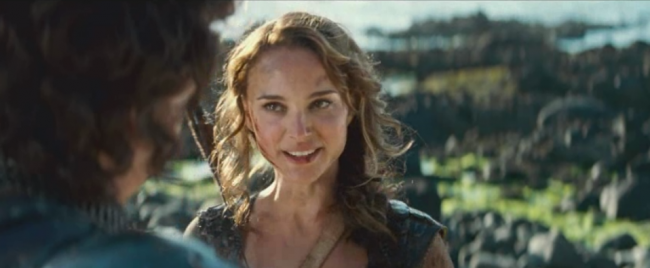
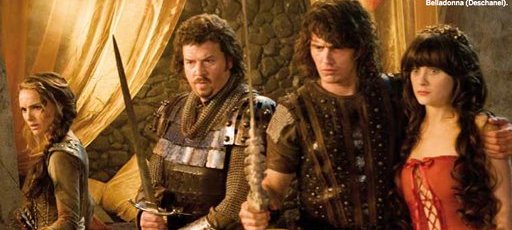
I'm a fan of James Franco, Natalie Portman and Zooey Deschanel, but why they should play second-fiddle to Danny McBride (who's usually lousy...Land of the Lost...and who barely registered as the reluctant groom in Up in the Air) is beyond me. Sure, Franco probably owes director David Gordon Green for his role in Pineapple Express (which I haven't seen, but have heard good things about), but he seems a bit lost in this, although gamely appearing cluelessly cheery throughout.
Borrowing heavily from every fantasy-adventure movie from the last 20 years (and liberally from Star Wars—their take on Yoda is particularly nasty, and they have
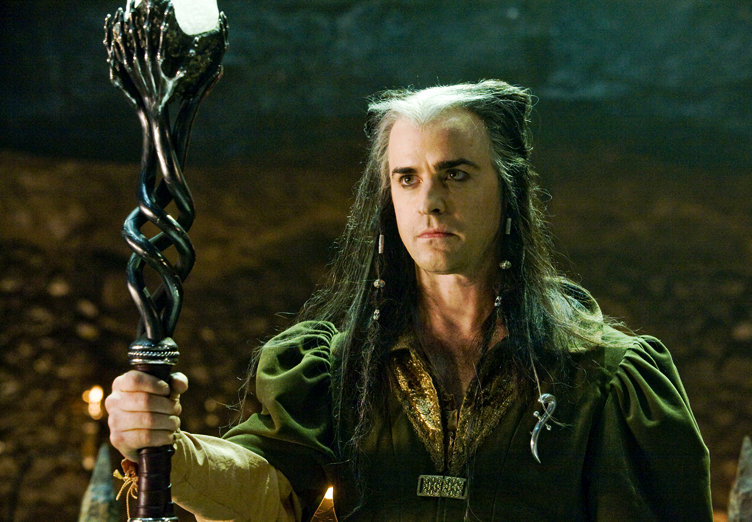
a clockwork bird-familiar after the original Clash of the Titans), Highness tells the story of the sons of King Tallious (Dance) and his two sons—the heir to the throne, Fabious (Franco), and the ne'er-do-well younger Thadeous (McBride) who would appear to be "Your Lowness." Fabious' bride Belladonna (Deschanel) is kidnapped by the evil sorcerer Leezar (Justin Theroux, who co-wrote Tropic Thunder, another high-concept low-result comedy) for his own nefarious plans. Fabious recruits Thadeous to go on the search for Lezar, despite the fact that the younger Prince can't fight, doesn't travel well, and is in all things incompetent. Plus, he's the "troop griper/whiner." Good planning. Dick jokes ensue.
Between the puerile humor
there are some action sequences, but Green has a hard time deciding whether he's playing them for laughs or for jolts. Not that it matters, as they succeed in neither, not even in the way that competent directors can achieve both or even one. And, although things are accomplished, nobody really learns anything so character arcs are as flat as a crushed pixie (the only clever idea I saw in the whole thing).

But, one thing Your Highness did accomplish: I had no second thoughts about it.


Maybe Hanna would have had more laughs.***
"I just won an an Oscar. You want me to what?"

* A complete execution...of me...was what I wanted after seeing this movie!  One thing that is mentioned in all the write-ups I've seen is that the crew went into production with  only a story and everything was ad-libbed on-set.  Really, they shouldn't be boasting about that. Oh...and the film I hinted at for the Saturday "Take Out the Trash" candidate that week was the latest version of Atlas Shrugged (Part 1).

 ** Okay, okay. I dump on Danny McBride—or Danny R. McBride, as he's calling himself these days—a lot. Because I don't see the talent. I don't find him funny, and mostly find him a little desperate. But...he was okay in Up in the Air. And he was superb in Alien: Covenant. When the man is firing on all thrusters—as he had to do in the "Alien" movie—he can be really good. (Here's what I wrote about him then—"I have to confess: while one shouldn't walk into movies with prior expectations, I was really looking forward to a scene where Danny McBride gets offed by one of the xenomorphs—I rarely have seen McBride in anything where I found him with an ounce of talent or charm, he's one of those few actors I actively don't like. But, here, he's terrific, taking an under-written part and bringing a lot of good choices and subtle nuances to the role. I'm now a fan.")

*** It didn't.


Friday, August 9, 2019

Once Upon a Time...in Hollywood

Id, Ego, and Super-Ego ("The names have been changed to protect the innocent...")
or
"Nothing's Too Good for 'the Man Who Shot Liberty Valance'"

I run hot and cold on director Quentin Tarantino. Because he runs hot and cold in his movies. He started out as a grand cribber of cinema, achieving success right out of the gate by using ideas that he'd seen in foreign films that few others had seen—his years as a video-store clerk stood him in good stead and he had a marvelous ability to see good quality, even in mediocre films, and parlay that in his films.

I've always seen the Quentin Tarantino success story as a bit like "The Emperor's New Clothes," another of those where if you outlast the folks who remember your source material, you'll do just fine, and I've seen it happen time and again, not only in film-making but in music, as well. One can say that there's only so many notes in the scale and only so many ways you can photograph something, but that gives lie to those movie-story-tellers and composers who still somehow manage to make something unique, distinctive, and artistically personal.

But Tarantino can surprise you. He does me. After being largely "ho-hum" about Reservoir Dogs and Pulp Fiction, I found his version of Jackie Brown impressive and heart-felt. There was hope. I thought his half of the "Grindhouse" double bill—Death-Proof—was a better version of the exploitation films he was trying to emulate, and I was amazed at what he did with Inglourious Basterds. I considered that the best movie he's ever made. Judging from the last line of the movie, Tarantino thought so, too. 

If it wasn't for mis-steps like the Kill Bill movies and junk like The Hateful Eight, I'd be more confident walking into one of his movies. And there were never any lingering doubts about what I'd just seen, good or bad with Tarantino. The fact that I HAD lingering doubts about Once Upon a Time...in Hollywood was actually a good sign. The movie had enough good things—smart things—that it stuck like a burr in my cortex, and let me suss it out, rather than dismiss it.
Forget Inglourious Basterds (well, don't—it's a good absurdist film about movies with a lot of catharsis thrown in). Once Upon a Time...in Hollywood may be his best movie. Born of his love for that grimy corner of L.A. immersed in movie-making where he grew up, Tarantino has culled pertinent details and coalesced them into a tale of two Hollywood discards, who, despite their circumstances and their frailties, just might make a difference and do some good in the world, aside from the negligible jobs of making fantasies for themselves and others. 
The film has the basic structure of Sergio Leone's Once Upon a Time in the West (a title borrowed by Tarantino and quite a few others) that set its own events in a fairy tale narrative setting. Disparate characters orbit around each other until an inevitable collision creates a unified favorable result. The interactions depend largely on Fate and the separate machinations of those involved. It so happens that they share the aspect that two individuals of experience act as agents to ensure the future of a third whose life is just beginning.
Rick Dalton (Leonardo DiCaprio) is a youngish actor having a mid-career crisis—too old to be thought of as in his young heart-throb days and too young to be considered a good character actor—having seen success starring on an early 60's western series called "Bounty Law." He could be Steve McQueen from "Wanted: Dead or Alive" but without the successful transition into big movies. Or Clint Eastwood ("Rawhide") without the Leone "spaghetti" westerns. Or Clint Walker ("Cheyenne") or James Garner ("Maverick") or Burt Reynolds  ("Gunsmoke" and "Riverboat")—it really doesn't matter "who," DiCaprio's Dalton has aspects to all of them, but without the mainstream success transitioning to movies after TV. He has a narcissistic streak—he's an actor, after all—that sees more bad than good and he drowns the career disappointments (like losing the lead in The Great Escape to McQueen, which Tarantino has the generosity to show what it would've been like) with booze and smokes and self-recrimination.

He's done a couple cheap exploitation films, but sees them as a step downward, opting, instead, to guest-star on some TV shows—like "The FBI" and the upcoming pilot for "Lancer" starring James Stacy (Timothy Olyphant) and Wayne Maunder (Luke Perry—his last role before his death). Even this doesn't enthuse Dalton, who's just scraping by to make it to the next "Pilot season" where he might (but probably won't) score a lead in a series. Even an offer by producer Marvin Schwarz (Al Pacino) to go to Europe and star in some foreign films is seen by Dalton as giving up and "settling."
That actually sounds pretty good to Cliff Booth (Brad Pitt), who has moved from being Rick's stunt-double on "Bounty Law" to being the guy "who carries his load"—acting as go-fer, handy-man, and chauffeur for Rick (Rick can't drive owing to an earlier DUI). Cliff is the guy who gets things done, doing odd-jobs around Rick's house on Cielo Drive (while living in a trailer behind the Van Nuys Drive-In, where he dotes on his trained pit-bull, Brandy). Cliff abides. He's never had the chances that Rick has had and things that Dalton might be grieving over, he sees as a pretty good life. If Dalton thinks the glass is half-empty, Cliff is just happy to have a glass.
The two might be twins of each other, while polar opposites—like the twin aspects of Edward Norton in Fight Club—one self-involved and indecisive, the other pragmatic and decisive. It's not clear who's in charge of who, with Rick giving orders and Cliff giving pep-talks ("Hey, you're Rick fuckin' Dalton! Don't you forget it!"), but the two are close—real close. You can't have one without the other.
Cliff and Rick watch the latter's performance on "The F.B.I."
(Burt Reynolds originally appeared in the featured episode)
The movie takes place over three days—Saturday and Sunday, February 8th and 9th, 1969, and then six months later, on August 8th, 1969 (a date that will live in infamy). The first two take a look at the day-to-day lives of Rick and Cliff, as the latter ferries Dalton to take a meeting with Schwarz and to the studio set of "Lancer" where the former series star is set to guest-star as "the heavy" in an attempt to expand the range of roles being offered to him.

For Cliff, it's a mildly frustrating experience as there won't be any stunt-work for him to do on the shoot, as Dalton's role doesn't require any—and because the stunt-coordinator (Kurt Russell) is reluctant to hire him, given Cliff's past—there's the incident about the death of Cliff's wife (of which Cliff was accused and acquitted) and the rhubarb that ensued when Cliff was stunting for Rick on an episode of "The Green Hornet" TV series, where he had a little too much of co-star Bruce Lee's boasting and roughed him up in a fight.* Instead, Cliff is assigned to fix Rick's TV aerial. We also get to see a bit of Cliff's solitary existence.
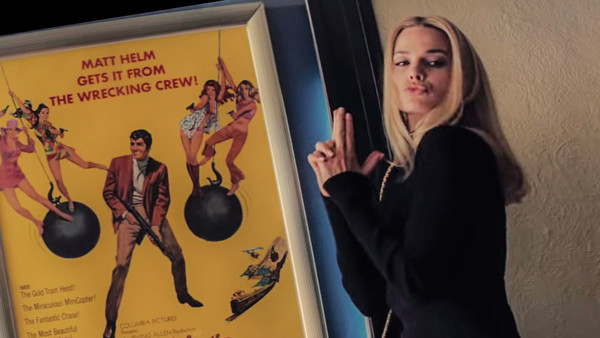
We also get to see a bit of the life of Rick Dalton's neighbor on Cielo Drive, Sharon Tate (Margot Robbie), who has come back to Hollywood after appearing in a movie for director Roman Polanski and subsequently marrying him. We mostly observe her, a beautiful young actress, returning to her roots and enjoying an upward spiral of success. At one point, she talks her way into a showing of the Dean Martin vehicle The Wrecking Crew (and Tarantino shows scenes of the movie featuring the actual Sharon Tate—not Robbie posing as her—which is a lovely touch) and basking in the reaction of the audience to her performance. 
We also see her join Polanski at a party at the Playboy Mansion, dancing with the likes of Michelle Phillips and Mama Cass of The Mamas and the Papas while being observed by the likes of Steve McQueen (Damien Lewis) and Connie Stevens (Dreama Walker) and being speculated about in the bitchy coveting way of Hollywood—"Well, she has a "type:" prosperous men who look like ten year old boys, while McQueen offers a calculating scenario of how she broke off with hairdresser Jay Sebring, who's maintained a close relationship: "All he (Polanski) has to do is fuck up and she comes back to him." Hollywood isn't such a friendly town that it isn't covetous or catty.
So, these three—Rick the craving, Cliff the competent and Sharon, the girl in the spotlight. But, there are others. Not working towards a dream, but sponging off the spoils of it. At one point, a grungy looking Charlie Manson (Damon Herriman) appears at the Polanski driveway, looking for record producer Terry Melcher (his work with Paul Revere and the Raiders appears all over the film) and Brian Wilson, friends of his that used to live there. He's turned away. But, he's never far away.
For example, in his ramblings while Rick is at the studio, Cliff encounters a pack of young women, dumpster-diving and attracting attention. They're part of Manson's coven—"The Family"—currently squatting at the Spahn Ranch, a former movie set owned by an acquaintance (Bruce Dern) of Cliff's. Cliff's repeated encounters with one of the Manson followers (Margaret Qualley) makes him curious, and a bit concerned, leading him to go out there and try and check up on the old man, which is hostilely resisted by the "Family." Cliff doesn't care, brushing past objections and the defiance of Squeaky Fromme (Dakota Fanning) to find Charles Spahn blind, practically bed-ridden and entirely dependent on the Manson family.
Cliff's trip out there is the stuff of fears, intimidation and threat, a seemingly loving and organized group of free-thinkers, who, when challenged, become a mob of primitive zombies, brain-washed and untethered except to each other, and Tarantino does a masterful job of creating an underlying sense of primal dread in his shot choices and a creeping sound design that gets under the skin. Cliff is a skeptical observer, implacable in his mission to find out Spahn's condition and doesn't care what he has to do to accomplish it, and he doesn't care how many "dirty hippies" he has to go through to find out for himself.
The third day of the film's timeline is where the crux of the movie plays out. And given the "history" of the Manson "family," that date of August 8th, 1969 should put an anticipatory fear into any movie-goer. That date, six months after the first two days, sees changes in the lives of all three protagonists, and, in its history, signals the end of an era, of transitions from which nobody came back. That date, historically, has marked the end of the 60's and when L.A. changed from a dream factory to the end of dreams and free-love innocence—the death of "The Summer of Love," suffocated by a predatory, anarchic savagery.
But, this is Tarantino's movie and his love-letter to the Los Angeles of his youth. Just as he re-wrote history in Inglorious Basterds, he refuses to let that third act play out in reality, and subverts it into an equally savage last act, that manages to re-align the timeline, and keep Hollywood—HIS Hollywood—the stuff of dreams, rather than satanic nightmares.
It leaves one in a semi-happy Twilight Zone of hope, where...no, not everything is perfect, as the world can still be cruel and unfair, but it isn't turned upside down in favor of the devils, rather than the angels the city was christened for.

Once Upon a Time...in Hollywood is a superbly realized, great film of slavish detail and loving devotion. It may even be better than its director, Quentin Tarantino, thinks it is—which, given his penchant for giddy self-aggrandizement, is something one never...ever...thought could be said.


The pilot—the original version—for the "Lancer" TV series directed, indeed, by Sam Wanamaker.
Around about 27 minutes in, things will start to get mighty familiar to those who've seen OUAT...IH.

The actor is Joe Don Baker.

A gallery of Rick Dalton's Italian films
Sharon Tate...once upon a time.
* The incident is uncharacteristic of Lee and, at the behest of Lee portrayer Mike Moh and Brad Pitt, the scene was toned down considerably so that "The Dragon" isn't bested by Cliff in a fight, but it is interrupted in a draw.