War is Not Romantic
or "No, Assassinate. Murder Implies He Has a Life Worth Living."
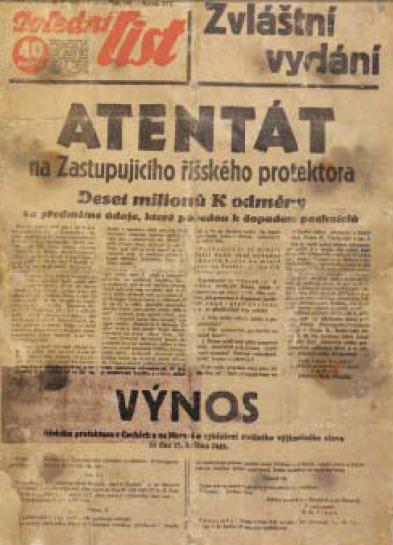
When I first saw the trailer for Anthropoid (and it was on TV), I got excited. I knew the story from a fascinating book on the history of spies during World War II, "A Man Called Intrepid" by William Stevenson. One of its amazing stories is about the assassination (by Czech resistance fighters) of Reinhard Heydrich, a name (fortunately) lost to history, but at the time he was considered Hitler's right-hand man and eventual successor. Affectionately known as "the Hangman" and "the Butcher of Prague," he was Evil's "company man"—head of the Gestapo and the architect of The Final Solution, the eradication of Jews from the European continent. If the Nazi's are the epitome of evil in the 20th Century, Heydrich was the worst of the worst, and the story of the conspiracy to kill him had all the hallmarks of a "Mission: Impossible" story, exciting, tense, in constant danger of being revealed and at great risk to those involved. The aftermath of the attempt was particularly grisly and Heydrich died a very slow, painful death (thankfully), but the assassination so enraged Hitler, he started a systematic, almost biblical, purge to punish the Czech populace, first ordering that 10,000 random citizens be rounded up for execution, and, when told this might be economically impractical, started the systematic execution of any Prague "suspects" and, acting on false intelligence, burned the nearby town of Lidice to the ground, killing all the males over 16 and sending the women and children to concentration camps. Similarly, in the town of Ležáky, every single adult was murdered.
Heydrich's car after the assassination attempt.
To commemorate these events, Hitler had mementos struck for those soldiers who took part, whether in the executions, the bulldozing, or in the recording of the events—a medallion that had Heydrich's profile on one face and on the other the single word "Rache," which means "revenge."
The Lidice Children's memorial
This story fascinated me and I always thought it would make an incredible movie.*A "downer" (to use a critical term) to be sure, but an abject lesson in bravery and the consequences of "revenge-seeking." With seemingly every movie showing up in the cineplex being a "revenge" piece, this little dose of history, documenting real carnage from and the horrors that come with it, would be a dash of cold water to hot tempers.
Sean Ellis is a London-based writer-director (and also cinematographer), mostly known for his short Cashback and its feature-length expansion. His co-author, Anthony Frewin, served as assistant to Stanley Kubrick for every film from 2001: a Space Odyssey to Eyes Wide Shut (with the sole exception of Barry Lyndon). With such a pedigree, it's not a surprise then, that Anthropoid is a solid film that manages to tell the story effectively while keeping the budget from going into the stratosphere (it was financed by British, French, and, of course, Czech production houses).
The film wastes no time, starting (after some archival footage and some back-story) with boots hitting the ground. Jan Kubiš (Jamie Dornan) and Josef Gabčík (Cillian Murphy), two Czechoslovakian fighters-in-exile, have just parachuted into Czechoslovakia, part of a nine man team trained in London to assassinate Heydrich as part of what has been termed "Operation: Anthropoid." Already things are not going well; Gabčík has landed in a tree, creating a deep laceration in his foot that will hobble him and keep him from moving far—they're a couple dozen kilometers from their destination of Prague. They're found by a local partisan who drives them to a nearby cabin. The two men are helpful and discuss what can be done with Gabčík's foot without attracting attention. It's a wonder, then, that when one of them goes into another room, they find him getting ready to use the phone. Maybe he's phoning a contact or maybe he's phoning for aid, but unannounced behavior is suspicious, and Gabčík wastes no time determining that the man was going to turn them in and shoots him. The other escapes leaving Kubiš to give chase. But, when it comes time to deliver the killing shot, his hand begins to shake in anxiety and the man gets away.
With an absconded truck, the two drive into Prague, seeking their contact. When they arrive at the appointed address, a nervous woman tells them he is no longer there, only giving them the address to a local veterinarian for Gabčík's foot, saying that he is "a good man."
Gabčík gets his foot sewn up and the vet offers them his office to stay the night. In the morning, they're visited by some of the Czech resistance, Vanek (Marcin Dorocinski) and "Uncle Hanjsky" (Toby Jones), who treat the two soldiers with a great deal of suspicion—their contact has been missing for weeks, abducted by the Gestapo, so seeing these two newcomers only heightens their worry; perhaps they're plants for the Nazi's. And when the two tell them their plan is to assassinate Heydrich, they immediately protest that the Czech government-in-exile has no idea the stranglehold the Nazi's have on the country and reprisals will certainly come of Heydrich's killing.
Despite resistance protests, Henjsky sets up Gabčík and Kubiš with a sympathetic family in Prague, so they can track Heydrich's movements and, being that he's a Nazi, that's easily done and they soon have alternate plans in place. Of the assassins, Kubiš is the cooler of the two, thinking on his feet, and able to improvise quickly. For instance, when Jan shows an interest in the family's maid (Charlotte Le Bon), Josef uses it, asking if she has a friend for him, so they can walk around the Prague streets without attracting the attention two lone males would attract in a country at work and at war. And when Anna shows up at a restaurant meeting with her friend Lenka (Anna Geislerová) dressed to the nines, Josef stages an embarrassing incident for the benefit of the Nazi officers whose attention has been attracted. It's a lesson she learns that pays off later in the movie.
It's a handy talent to have, as with any plan, things can go wrong, plans change, signals mix and tensions increase. Ellis stays focused on the assassins in their preparations and hesitations; little time is spent on Heydrich—he is merely a target, a monster in human form and thus vulnerable. But, if Heydrich is vulnerable, they know that they are even more so, with the growing realization the longer they're in Prague, that they're on a suicide mission.
I want to address the dismissal of this film by members of the critical press, some of whom I respect, most I don't. There has been a lot of criticism of Ellis' hand-held cinematography during the early part of the film. That hand-held camera covers a lot of ground. The movement keeps things tense and changing in a beginning of the movie that is heavy on exposition and needs to set up a certain level of paranoia that will be the undercurrent for the entire film. In sequences where Josef is walking the street, suspecting every stationary male of being an informant, that hand-held is essential. The tightness of the shots helps to keep things focused and helps to focus on details appropriate to the period of the film, limiting the chances of showing something contemporary and taking you "out" of the film. It works well and lends the "discovery" portion of the film a certain energy. Perhaps the criticism is because it's actually NOTICED by these critics as opposed to the latest "Bourne" film (Greengrass' entire shooting style is to do this type of shot) or the "Star Trek" films where J.J. Abrams lends the film energy by basically hammering on the camera...and it never produces a mention.
I've also seen an awful lot of critics say the film is "dull." Really? It is, of course, a matter of opinion, but sometimes—as we've seen plenty this election year—an opinion can merely be just plain wrong. Maybe they've been de-sensitized to film rhythms that don't have a "tent-pole" action sequence every ten minutes. Maybe the constant "super-hero" crush has made these writers numb to indecision and human weakness. Maybe there aren't enough explosions. Maybe Michael Bay should have directed (why, Heydrich's car didn't even flip over—it didn't in reality, but when have films followed reality?). Much praise has been put on the film's last half-hour which provides plenty of action and quite a couple of explosions, and Ellis treats it with an ever more claustrophobic sense of dread. That stuff is hard to do. At least without being pretentious and arty about it. Or cavalier. Or worse, taking gratuitous glee in it.
It is nice to sit back and watch something where stuff matters, but doesn't serve as a prelude to a quip, a sneer, or a cheap laugh. There's been quite enough of that this Summer of Dogs in a seemingly endless spiral downward. I will heartily recommend a fine, professional film like Anthropoid, while the rest of the critics give better ratings to the likes of Sausage Party. Talk about the madness of the Mob.
The wanted poster for Heydrich's assassins.
* It has. It will. The year after Heydrich's assassination, expatriated German director Fritz Lang joined forces with Bertolt Brecht to make a movie based on the incident called Hangmen Also Die! In 1975, Lewis Gilbert made Operation Daybreak, and a second film about it is coming out this year, entitled HHhH (for "Himmlers Hirn heißt Heydrich"-"Himmler's brain is called Heydrich"), which will star Jason Clarke and Rosamund Pike as Mr. and Mrs. Heydrich. Sounds cozy ("I'm being sarcastic!").
Dancing About Architecture or "Woah! Woah!.....Wooooow" Phillipe Petit's astounding personal goal of walking a line between the towers of the World Trade Center (which occurred on August 7th, 1974 while the world was engaged in watching Richard Nixon's imminent resignation that evening) makes for an astounding movie by Robert Zemeckis in, what is simply entitled,The Walk—the story of Petit's inspiration and the subsequent six year plan to do something amazing, astounding, heroic and fool-hardy...and for damn sure illegal...and pull it off without a hitch, a wobble, and no harm done. It captures the imagination, the brio, the craziness, and the sheer over-arching artistry the event encompasses that can only leave one shaking their head in wonder. The story has been told in the wonderful documentary Man on Wire, which is a fine telling of the event, itself so much bigger than a simple presentation could do justice to. But, there is some magical about The Walk, one of the few movies designed to make maximum advantage of both the 3-D process and IMAX that seeing it in any other way might diminish it somewhat—the too-visceral recreation of real objects that no longer exist and the vertiginous sensation that must be a part of the experience (and enhance the drama) are entwined in the format and make them part of the DNA in a way that few movies could compete with. It begins with a shot of such chutzpah and imagination it immediately sucks you in, a combination of setting and presentation that only a vivid imagination with a dramatic sensibility would even conceive of, knowing full well that it might evoke laughter for its outlandishness, bur daring to do it anyway. very appropriate that it is our first introduction to Joseph Gordon-Levitt's portrayal of Petit, explaining his philosophy of life—and not death—while standing in the torch of the Statue of Liberty while in the background New York spreads out, the Twin Towers its centerpiece, as it will be for the entire movie. That is one wacky way to introduce the movie, but with a protagonist like Petit, who provides a running commentary throughout the film, it sets a tone of wildly big ideas and challenges, with just a touch of the romantic.
The movie begins with Petit's fascination with tightrope artists and how he teaches himself the fine art of walking a line. He becomes a street performer, silent except for his juggling and balancing skills in Paris, which Zemeckis throws all of the special effects and 3-D tricks he can to keep the sequence amusing. He is mentored by a long-time circus performer, Papa Rudy (Ben Kingsley), who teaches him the pointers on presentation and rigging, which will become critical throughout his career and particularly for the still-in-the-future WTC walk.
A fateful trip to the dentist's office is where the vision hits, when Petit first sees an artist's rendering of the proposed Trade Center, and immediately, like love at first sight, Petit's vision only sees the buildings with a line across it and himself walking across that line. It becomes his obsession and his raison d'etre, which Zemeckis illustrates with a special effect so subtle it might be missed—Petit steals the picture from the magazine and, at home, traces a pencil mark between the proposed towers. At one point, the shot becomes from the picture's perspective of Petit drawing the line, with the audience looking through the now-transparent paper at the concentrated Petit, drawing the vision in his mind and making it complete for the first time.
There's enough wizardry going on, story-wise and movie-wise—and Gordon-Levitt's portrayal is so radiantly buoyant that this section still manages to entertain, even going through the obligatory love story and the recruitment of a "posse" who are enthralled with Petit's scheme and want to be a part of it. Eventually, Petit and crew travel to New York to live and do the scouting and detail work associated with the mammoth undertaking.
Months of preparation go into the planning, with Petit daily going to the towers, still under construction, becoming a fixture and a familiar face to the workers and officials, who never suspect he has no business being there other than to learn the secrets and intricacies to getting up the towers to the top where he plans to stage his coup. Along the way he gathers confidantes and specialists who are intrigued and, more importantly, can keep their mouths shut, as Petit's stunt is completely and thoroughly illegal.
The main reason for the movie, of course, is that walk between the towers, so anything else is prologue. Fortunately, the elaborate planning and skull-duggery that go into the engineering and realization of the stunt is just as intricate and plays out like a "Mission: Impossible" movie with elaborate plans and unforeseen road-blocks that manage to get in the way of Petit's vision.
But, once there, after a sleepless night of preparing and rigging, Petit has only himself and his goal, and Zemeckis makes the most of the feat, with a dramatic presentation as the fog rolls in off the harbor at dawn and Petit must make good on his vision. He has one chance to do it, as no one could conceive of such a thing, but once attempted, it would never be allowed to happen again. There are no second chances and no room for screw-up's. It comes down to one man, his talent, and his will.
It is at this point one should mention that The Walk is stunning to look at—beautiful in its presentation and cinematography throughout and, of course, ingenious in the elaborate effects it took to recreate the event from every conceivable—and inconceivable—angle. There have been reports that people (probably those "sensitive" people everyone has to be mindful of these days) have gotten dizzy and even vomited at the sequence. It seems silly to me. For me—someone who's not so much scared of heights as FALLING from them—it is thrilling and, yes, beautiful...as Petit has always described it. It is almost unbelievable, were it not for the abundant photographic evidence and the witness testimony—especially of the NYPD (those poor cops!) who could only watch from the edge of the towers and marvel, unable to do anything but bear witness.
Once he placed both feet on the wire, he says, he was no longer afraid—he was in his "element," familiar, friendly, joyful—and it was a place to perform, like any other.
Once on the wire, Petit lost all fear of the feat. He walked across once, and sitting on the opposite tower and contemplating what he had done, he was compelled to do it again, and again, and again...at one point, kneeling on the wire to salute the horizon, the City of New York and the audience below gaping at him. He went so far as laying down on it, even toying with the police, getting close to them, then neatly pirouetting and scampering away from them. It was a performance...and it was a coup, one that captured imaginations.
The Wire may be the most enjoyable film I've seen this year. I'm often unsure of the films of Robert Zemeckis—he's-hit and-miss with me—(I say this, of course, on the day everybody is thinking of Back to the Future, and, of the trilogy, Back to the Future II is my favorite, for retreading and warping the original like a Möbius strip). One of his most popular movies, Forrest Gump, I thought was an enormous bore, and worse, a movie that seemed to believe its own "simplistic" wisdom—Being There but without the satire. More often than not, I see his movies as technical exercises without much heart—they're merely an excuse to solve a narrative problem or to show off some special effect wizardry (which he employs very well) that makes the movie seem more like the tail wagging the dog. But, not The Walk. It IS a fine balancing act keeping the movie afloat before you get to the third act, but Zemeckis pulls it off amazingly well, and there's not an aspect of the film I didn't think was inspired...and just a little mad, not unlike its protagonist. Run, don't walk, to see it...and see it in as big and as dimensional as you can. This movie fills the frame.
I was in New York in 1990 in the home of the brother-in-law of the friend who accompanied me. Gene ran a chain of Midas Muffler stores throughout New York State. He asked what we planned to see and my answer was probably vague. Gene didn't like "vague." "You are NOT leaving New YORK until you have TAKEN the Staten Island FERRY!" Yeah, but... "LISTEN. You are NOT leaving New YORK UNTIL you have TAKEN the Staten Island FERRY!!" Yeah, but... "Listen! (pause) YOU...are NOT leaving NEW YORK...UNTIL you have TAKEN the Staten Island FERRY!!" I looked over at my companion, Gene's brother-in-law, Walter (who grew up in Brooklyn) "You up for a trip on the Staten Island Ferry?" Walter replied "Might as well..." "You will not regret it" was Gene's response, satisfied. So, we did. We drove all the way from Brooklyn to Staten Island in the early morning dawn and joined the bustling commute into Manhattan. Pretty soon, it became apparent what "the draw" was. Sailing past Ellis Island and the Statue of Liberty were awe-inspiring, tracing the route so many had taken traveling to America. But Manhattan and its familiar skyline was the next stop. Dominating it all was the World Trade Center, gleaming—glowing—in the early morning sunlight. The ferry churned towards it as if being drawn like a magnet and the towers grew from a curiosity to an awe-inspiring sight to a wonder. Impossibly tall. Elegantly structured like a gate without a limit. Your eyes were drawn to the towers and you could not take your eyes off them as they beckoned, grew, loomed, and dwarfed you, majestically. It was a simple beckoning that became a challenging welcome to the country's greatest city. It moved me as the best moments traveling do, and, yes, not only did I not regret it, it became the most vivid memory of the trip, now as then, without any dimming or coloring in the passing of time and events. Those towers are still there in my mind. And they will never leave.