Showing posts with label Boyd Holbrook. Show all posts

Friday, December 27, 2024

A Complete Unknown (2024)

How Does It Feeeeeeeeeel?

or
The Freewheelin' (Inscrutable) Bob Dylan
 
"Seven simple rules of going into hiding: one, never trust a cop in a raincoat. Two, beware of enthusiasm and of love, both are temporary and quick to sway. Three, if asked if you care about the world's problems, look deep into the eyes of he who asks, he will never ask you again. Four, never give your real name. Five, if ever asked to look at yourself, don't. Six, never do anything the person standing in front of you cannot understand. And finally, seven, never create anything--it will be misinterpreted, it will chain you and follow you for the rest of your life."
Bob Dylan
 
Musicians performing on-stage use something called "foldback speakers" so that they can hear themselves accurately against the wash of sound coming from auditorium reverberation or the cacophony of crowd noise fighting against them—modern musicians use ear-buds to have their music pumped backed to them without any deleterious feed-back from similar music sources competing. 
 
That little bit of insider trivia is what I was thinking about walking out of A Complete Unknown, the new bio-pic of a slice of Bob Dylan's life as he was becoming more known and making a name (and history) for himself prowling around the Greenwich Village clubs, riding a burgeoning folk-music wave and expanding the subject matter of the genre like his heroes, Woody Guthrie and Pete Seeger into advocacy-folk or what would become known as "protest songs," which formed the soundtrack of the youth movement of the early 1960's.
 
Dylan has been mixed up with movies before—the documentary Bob Dylan: Don't Look Back, various music videos, he wrote the music for and played in Pat Garrett and Billy the Kid, wrote and starred in Masked and Anonymous, and Renaldo and Clara, and although not mentioned by name is seen through a prism of stories and interpreters in I'm Not There.
Well, this one has his seal of approval, sticks to one actor as Dylan, and covers January 24, 1961 to July 25, 1965 (when Dylan first arrived in New York City at the age of 19 to his controversial performance set at the 1965 Newport Folk Festival). And it does a pretty good job of clearing away all the myths about Bob Dylan, his absences from the public eye (hard to believe these days, he's even done commercials), his changing personas more than Madonna or Bono, and just concentrates on that initial section where he became a performer, then The Brand New Thing, then The Highly Exploitable Thing, to The Voice of His Generation, all the while navigating the rigors of performing, the inanities of being a product, and the desire to start breaking things and doing something fresh.
Frankly, that's enough. It was never his mission to be understood, and the movie never tries to psychoanalyze or explain his actions, but merely the context into which he arrived and the way things changed once he started performing. He came in with talent and a poet's way of putting thoughts into words in a way no one had ever done before, inspired by folk music and its tendency towards metaphor. 
That is immediately recognized by practitioners of the art—Pete Seeger (
Edward Norton, wonderfully essaying the man as appeaser rather than rebel) and a hospitalized-by-Huntington's Woody Guthrie (Scoot McNairy, in a non-verbal performance), and he is promoted, signed by a label (Dan Fogler plays Columbia A & R guy Albert Grossman), and starts playing bigger venues, all the while already established folkies like Joan Baez (Monica Barbaro) start interpreting his material for the mainstream. The maxim is "it's the singer, not the song" but Dylan's "voice" (as far as his writing) was so distinct, he bobbed up through the commercialization as the Genuine Article quickly and, with his ungussied-up vocal stylings, bereft of soothing harmonies and homogenizing orchestrations.
So...back to that foldback speaker: Imagine you're putting yourself out there, performance after performance, and you're leading the field. Then, you start hearing yourself over and over again and not necessarily your voice. People are singing your songs, and then imitating your songs—Pete Seeger's "Where Have All the Flowers Gone" begets your "Blowin' In The Wind" and then that begets Phil Ochs' "There But For Fortune"—or imitating your composing-process, and then parroting and parodying your songs and then you're suddenly surrounded by the newest versions of "you" while (as movie-Dylan gripes) "you just want me singing 'Blowin' In The Wind' solo for the rest of my life." It's stifling. It's maddening. It makes you want a change.
But, that's not what your label wants. It's not what your manager wants. It's not what your fans want. They want the rebellion and the "new" sound to be what they're comfortable with...or what they're making money with. You want to create. They want to cash in. Or get their comforting nostalgia. No one gets it.
But it gets creepy. There's a scene in Don't Look Back where Dylan is talking to a fan and the exchange is this:
Fan: I just don't like any of the "Subterranean Homesick Blues" stuff. 
Bob Dylan: Oh, you're that kind - I understand, right now. 
Fan: It's not you. It doesn't sound like you at all! 
Bob Dylan: But, my friends, my friends were playing with me on that song. You know, I have to give some work to my friends too. I mean, you don't mind that, right? Huh? You don't mind them playing with me if they play the guitar and drums and all that stuff, right?
Fan: It just doesn't sound like you at all. It sounds like you're having a good ole laugh. 
Bob Dylan: Well, don't you like to have a good ole laugh once in awhile? Isn't that all right with you?
 
"That's not you." How the "homesick blues" does he know? Because he attended a concert? Because he bought himself a record? It's no wonder that at one point Dylan just blurted "Just because you like my stuff doesn't mean I owe you anything." See it as ingratitude if you must or see it as not "playing the game" but "you gotta do you" because "you" is what got you there in the first place. All artists go through this. Some have even rebelled. Some have got away with it. Some have not. Some have walked the tight-rope of practicality where you're either an "artist" or you pay the bills (you know...like we non-artists do).
A Complete Unknown is wonderful in every way for putting you not in Dylan's head but in his head-space. And if the man is still an enigma after you see it, you can, at least, understand why. If I have anything negative to say about it, it's that Ricky Nelson said the same thing in just over three minutes.* That's efficient.

Now, I've gotta pay the bills, do what's expected of me: how is Chalamet? Spot on. Pretty amazing, actually, but I've never ever been disappointed by a Chalamet performance. Of course, he's prettier than Dylan, but, like Joaquin Phoenix did with Johnny Cash in director Mangold's previous music bio-pic I Walk the Line, he suggests Dylan rather than does a full-on imitation. He has a less-is-more approach which is entirely appropriate for the subject, but there's a nice touch that he brings to his Dylan which is lovely—a defiant, almost predatory stare, observing, analyzing, like a biding-his-time hawk. And, considering his vocal talents in Wonka, of course he can do a dead-on imitation of Dylan's singing style. You have to listen very closely to tell the difference between Chalamet's versions of Dylan's songs and the memories of the real deal.

I mean, the real "real deal."

"I'm not angry. I'm delightful."
Bob Dylan 
*
 

Tuesday, June 25, 2024

The Bikeriders

The "Wisdom" of the Tribe ("Whatta Ya Got?")
or
"It'd Be Funny If It Weren't So Tragic..."
 
Look. I get it.
 
I blog about movies because I love it. So, of course, I joined a movie-loving-cluster of bloggers—The Large Association of Movie Blogs (I've participated in a podcast for them about this very movie) and there is comfort there. It's a joy to commiserate with other people—of other ages, of other backgrounds, from other countries—who share a love of movies. We all have opinions. Sometimes we don't agree, and you can ignore that or you can learn from the different perspective. It's all about the process of understanding this thing you love. There's safety there, too. Sometimes you can share something in those discussions that it would be a fool's errand to try to communicate with your family and friends. For most of them, "movies" is something to do on a date-night, or when you want to just 'veg'. The last thing they want to do is to study the film and try to find out why (or why not) it communicates its message. For others, that's like assigning yourself homework. For me, it's something I "gotta" do.
 
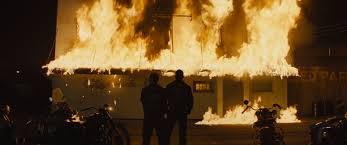
So, here's The Bikeriders, written and directed by Jeff Nichols. It's a movie about a motorcycle club—the Vandals MC —that operated (in its hey-day) between 1965 and 1973, and was immortalized by the picture book of the same name by Danny Lyons.
It's a movie about a motorcycle gang. Haven't we seen enough movies (and bad ones) about those?

Sure. But, this is Jeff Nichols, one my favorites of the "younger" crop of directors, and his subjects are interesting, and if they're not box-office sure-things, they're at least interesting in the way he presents them. He made Mud, Take Shelter, Midnight Special, and Loving, all movies I'd recommend seeing (especially Loving) because of the way he tells stories so well. All his movies are about ostracized outsiders, and The Bikeriders is no exception.
We first meet Benny (
Austin Butler) quite a ways into the story, but this is like a thesis statement for the movie. He's sitting in a bar, smoking, drinking, minding his own business. Then two beefy "townies" walk into the bar and object to the fact that Benny is wearing "colors"—his motorcycle jacket—and suggest that he take it off. Benny—as in the way of movie bikers—looks from one of the guys to the others—clenches his jaw and says "You'd have to kill me to get this fuckin' jacket off." 
So, there's a fight, seeing as there's no negotiation between the parties. It starts in the bar, then goes outside. It's starts as a fistfight, then Benny pulls out a knife and slashes one of the guys' face, then the other grabs a shovel and swings it at his head.
Just before it connects—and it IS going to connect—Nichols freeze-frames and we begin the movie proper with an interview (we're still not at the beginning of the story) and Danny (Mike Faist) is talking to Kathy (Jodie Comer) about the incident and about her relationship to Benny and of how the Vandals came to be—Johnny (Tom Hardy), a blue collar worker with a wife and two kids, saw The Wild One on TV and, like so many others, liked the freedom of the lifestyle depicted (ignoring the underlying message) and formed the club. It was about how a bunch of outsiders formed a community of like-interests, ignoring the typical organizations like churches, PTAs, and Elks. The reason? They're all outsiders who wouldn't fit in those clans, so why not form their own? "What's not to like?" (which is as much of a nothing sandwich as "Whatta ya got?").
The through-line of the movie is the passage of time and how the group changes, following Johnny's lead, which has some basic things like wearing the distressed leather jacket that serves as a uniform, and some arbitrary rules about being loyal to each other, and if there are any issues that are disagreed upon, they'll have a fight—"fists or knives" is the only specifics that need to be addressed—and whoever wins, gets their way, much in the way it worked in Black Panther (which sounded like a good system in that movie, but here smacks of "rule by minority").
While these things are going on, Johnny weighs the responsibility that being leader of such a group imposes on him, and Kathy realizes that Benny will always be conflicted whether to choose her or the club, even as that club faces challengers from a couple of fronts—the incoming Vietnam vets with chips on their shoulder and a disdain for authority and the young kids who see the power in numbers and want in on it. The "outlaw" mythology starts to get the better of the Vandals and it starts changing as time gets longer and meaner. It leaves Johnny with one of the few articulate insights in the movie: "You can give all you got to a thing" he tells Kathy at one point. "And it's always gonna do what it's gonna do" and it applies for Kathy to Benny and it applies for him to the club.
But, that's about it for depth. Things happen. Things get worse. And the vague rules of the club seem to go by the way-side as its reputation swells and new members begin to dilute its purpose and turn it into a gang. The rules don't apply to anybody anymore. And any good intentions are drowned out by bad behavior.
That's the gist of it. And as good as the performances are—although the actors' recreations of their characters' voices may produce giggles, they're based on Lyons' tapes of interviews with them—and as okay as the visuals are and as strenuously Nichols tries to recreate the books' look, it doesn't amount to much. One gets left with the impression that The Bikeriders is less about the gang than it is about Kathy's observations of them, and that's an outsiders' perspective (like, frankly, the guy who made the book). We see her struggle for the soul of Benny, but we really don't get to know him—he's a James Dean wanna-be—and the audience doesn't really get to know the Vandals—do they have jobs? how do they get the money for all that beer? They own a bar, sure, but there never seems to be anybody in it—because they're a bit of a mystery—and an antagonist—to Kathy. Like Brando's challenging non-answer of "Whaddaya got?" there's no "there" there. And the story of the Vandals is just another cautionary tale of what happens when you don't apply the brakes every once in awhile. Or check the gas-tank.
If Nichols wanted to make a film of a picture book, he accomplished it. But, it's all captions with nothing between the lines and nothing between the pictures. The Bikeriders is more of a scrapbook than a fully fleshed-out movie, with a veneer of remove as he's trying to recreate what somebody already documented—"The Golden Age of motorcycle clubs"...but that age is long gone. Thomas Wolfe said you can never go home again. Apparently you can't make a movie of it, either.
 
But, Nichols is a fine director. This time he merely took a spill. And I look forward to his next one


Friday, June 30, 2023

Indiana Jones and The Dial of Destiny

Once More Without Spielberg
or
The Adventures of Old Indiana Jones
 
Released right before "Indy-pendence Day," Indiana Jones and the Dial of Destiny comes with a lot of promise and a few new wrinkles—and not just the ones on star Harrison Ford's face (although the opening sequence takes pains to "de-age" him as it takes place during World War II). This is the first of the adventures (with the exception of 28 episodes of "The Young Indiana Jones Chronicles") not to be directed by Steven Spielberg—instead it's overseen by James Mangold, who's no slouch having directed Logan and Ford vs. Ferrari. It also promises—with all the credibility that goes with the words "Farewell Tour"—to be the last of the Indiana Jones series.
 
Ford is getting "up there"—he'll be 82 on July 13th—and he's been joking since The Last Crusade that he'd prefer any next "Indy" film to be called "Indiana Jones and the Really Comfortable Bed."* Dial of Destiny doesn't prove to be that (although, he does spend some melancholic time sprawled out in a barcalounger). But age is catching up to the old whipper-snapper, and we find him in the year 1969—just after the Apollo 11 moon landing—doing more than the requisite small steps and giant leaps, certainly more than a man his age should be attempting.
Indiana—or as the world knows him Dr. Henry Walton Jones, Jr.—is spending "Moon-Day" in New York—the date of the Apollo 11 astronauts' ticker-tape parade—dreading it. He is retiring from his teaching post at Hunter College where his students are now bored by antiquities (including him!) and his teacher-prep consists of hitting the bottle rather than the books. He's alone; among the clutter of his dreary apartment are the unsigned divorce papers from Marion, one more separation in a life (and film-series) full of them. But, his class has one new auditor, Helena Shaw (
Phoebe Waller-Bridge), god-daughter to Dr. Jones and daughter of another of his allies during the second world war, Basil Shaw (Toby Jones). 
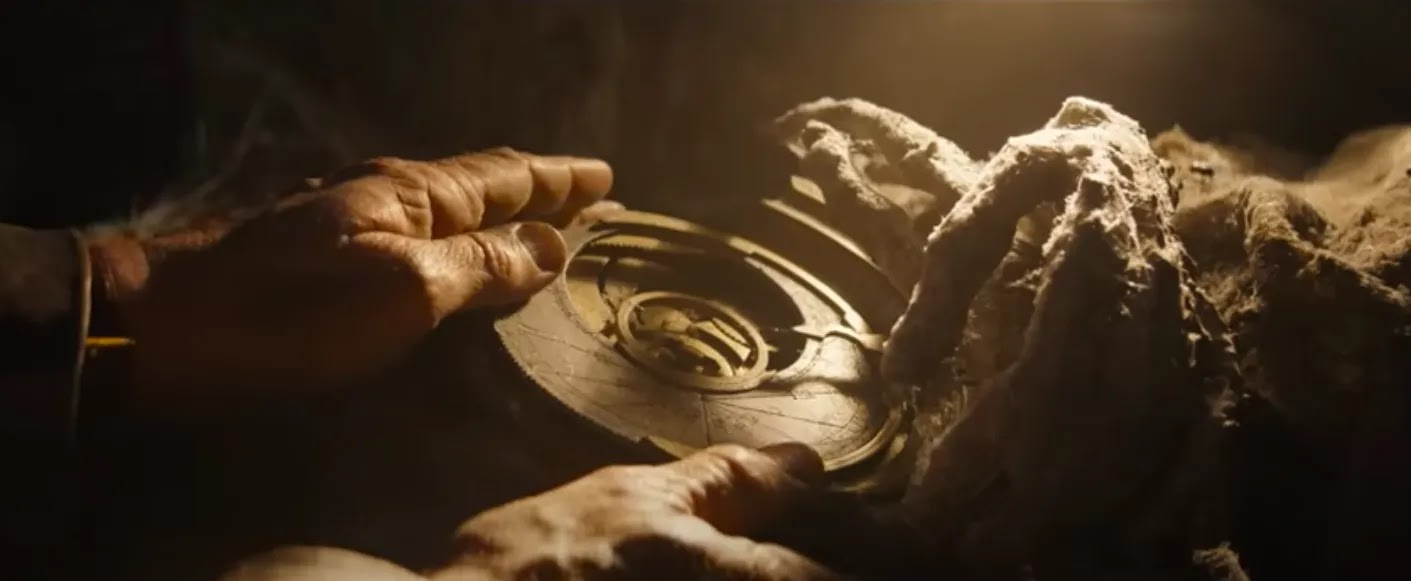
We've met Basil in the film's first sequence—a protracted chase of planes, trains, automobiles, and motorcycles to try and claim back treasures from a Nazi plunder-train to satisfy Hitler's fascination with the Occult. First, they're after the "Lance of Longinus" (which turns out to be fake), then attention is shifted to Archimedes' Dial—the Antikythera—which is of particular interest to a young Nazi physicist named Jürgen Voller (Mads Mikkelsen). The Dial was considered the first computer, constructed around 87 B.C. and was designed to calculate astronomical positions, eclipses, and the movie would have you believe it can predict geological upheavals and...time-fissures.** The trick of it is, though, that the Nazis only have half of it. They need the other half to make it work.
Anyway, Voller wants it, and Indy and "Bas'" want to keep it from him. Indy has been captured by the Nazis (of course) and they want information and he thinks all those antiquities should be in museums. While he's being threatened by the Nasties, Basil gets captured, as well, and is carted onto a train for any information about the Lance. After Indy survives an execution (several times), it becomes his mission to 1) get on that train 2) rescue Basil and 3) get all those baubles while surviving machine guns and bombing runs by the allies. All done at night, the better to hide the extensive special effects it takes to pull the sequence off, somewhat credibly.
One becomes aware, almost immediately, that Mangold is directing this entry and not Steven Spielberg (although George Lucas—who thought up the series—and Spielberg are listed as Executive Producers, they're not involved in the picture-making). It is in the DNA of Spielberg-as-director to make any sequence a playful series of complications that his shot-choices link one to the other. There's a flow that he intentionally puts into his action scenes that instantly telegraphs information to his audience. Mangold tries to do that, here, but there's a disconnect between elements that is often confusing and, at times, seems jarring to the point of obfuscation. The initial action set-piece immediately lowered my bar for expecting a superior Indiana Jones movie—as good as the other four, certainly—and those who have criticized the previous films may find themselves re-appraising their gripes (although I doubt it).
That's the set-up and the 1969-situated remainder of the movie involves the efforts to retrieve the other half of the Antikythera, which necessitates globe-trotting looking for clues to where that might be. I've always loved that element of the Indiana Jones—the tricks, the clues, the puzzles and translations unearthed from the vagaries of time and Nature. There's mounds and mounds of that, with the concomitant parallel of villains riding the research coat-tails that get in the way and delay the satisfaction of the reveals. 
In this case, its the older
Jürgen Voller, who has spent his time helping NASA with their rocket program and has gotten the co-operation of the U.S. government (specifically the C.I.A., in the form here, of Shaunette Renée Wilson doing a great "Foxy Brown" impression), and a couple of thugs (Boyd Holbrook, Olivier Richters) who have their own agenda, which is a bit more contemporary, even if they are less dramatically interesting. Throw in a kid-sidekick (Ethann Isidore) who starts out annoying and becomes gradually more entertaining.
Toss in helpers like Antonio Banderas (in too short a role) and old pal Sallah (John Rhys-Davies), and you have a nicely well-rounded cast.
Most valuable player, though, is Waller-Bridge, whose character, frankly, brings most of the energy to the whole enterprise, completing a series that seems to depend on complicated females of divided loyalties to play off Ford's adventurer-archaeologist. Sure, she probably employed just as many stunt-doubles as Ford, but her quick-witted delivery and expressions has the advantage of youth and energy. Ultimately, where Ford was previously the lynch-pin for audience identification, here, she's the character that may (eventually) engender trust to make things right, while Indy becomes something of a liability in terms of age and attitude.
The end-sequences usually are where things get a bit dicey in these things (especially where "the Wisdom of the Fan-Tribe" weigh in), where the adventurers reach the end of the road and cross over into mysticism, myth and science-fiction. And although, credulity will be snapped to the breaking-point for many, I found that sequence to be the best part of the film, worth even enough to sit through the tedious bits (although I tend to be an apologist for this series, thinking quite highly of Kingdom of the Crystal Skull).
No spoilers here, but given the rather depressed nature of the older Dr. Jones Jr. throughout the film, the fourth act makes perfect sense, story-wise and emotionally, and presents an opportunity—although one hyper-fantastically reached—to complete a series-long character arc of learning and yearning. Okay, maybe I don't "buy" how they got there, but, dramatically, the ends justify the means and presents something unique to say,
with some real resonance, about this character we've followed from youthful arrogance to wistful dotage.
And the end-sequence before the credits? (there is no post-credit scene, thank you). I'm not ashamed to say I teared up, and it made me glad I saw the two hour-twenty-minute-movie even if two hours of it I found wanting. There was no reason for a fifth Indiana Jones movie—other than the thought that maybe they shouldn't go out on the fourth one—and the whole thing is an exercise in nostalgia. The coda only emphasizes that point. But, sometimes nostalgia is pretty important. Memories of the past warm the heart, enrich the soul, and make one step into an uncertain future with the hope of finding more treasures for the memory. Nostalgia isn't "what it used to be". It can also be a beacon to face the future.
But, I can't end this without acknowledging 81 year-old Harrison Ford for making another one of these when most of us hovering around decades of his age are worried about walking the stairs of the multi-plex without using a hand-rail. That's some stamina, man, I don't call how many stunt-doubles and digital-face-replacements were used to pull it off. That should be celebrated, along with the score by 91 year old John Williams, that still manages to raise goose-bumps and make the heart soar. 
 
If this is their mutual last movie, bravo. And thank you...for the memories.

* Me, skewing towards the time-chronology of the Indiana Jones series, wanted the 1960's adventure to be titled "Indiana Jones and the Electric Kool-Aid Acid Test". Oh, well.
 
** Sure, you'll call bullshit. But, you loved the Ark of the Covenant melting Nazis, cheered when rafts were used to bail out of airplanes and sled on the Himalayas...not to mention pulling beating hearts out of chests, and were awed by the Last Surviving Knight Templar. But, you couldn't get past "nuking the fridge." The suspensions of disbelief among fans are more rickety than the bridges Indy repeatedly has to cross. How can one love the one and hate the other? I think it has to do with being a fan as a child and a jerk as an adult—you grow up but never mature. Anyway, I'm long since done trying to understand fans of the "fantasy" genre. They seem determined to destroy what distinguishes the genre from the rest—imagination and wonder. End of lecture. No, I don't have office hours and I won't meet you for a fight in the parking lot. (And...I stole your lunch).

Wednesday, September 21, 2022

Higher Ground

Written at the time of the film's release...

"Blessed Assurance"
or
"Jesus Is __________"

The first thing I ever saw Vera Farmiga in was The Departed in "the girlfriend" role, and I was none too impressed. Then, came Up in the Air and her wistful performance as a "fellow traveler" who hooks up with George Clooney—two "stop-overs" that pass in the night—and it was an amazing performance.

Now, with her first film as director, Higher Ground, she stakes out indie territory as something of a maverick. It's a film about religion without hysterics, without condescension, without judgement, without prejudice...which is a far cry from the scripture Hollywood habitually reads from.
Higher Ground tells the story of Corinne (Farmiga, and played at younger ages by her sister Taissa and McKenzie Turner), daughter of divorced parents (Donna Murphy and John Hawkes), who answers the call of her minister (Bill Irwin) to accept Jesus into her life ("He's knocking at your door...") but finds herself standing at the threshold, believing but not wholly accepting, finding herself, as a woman, relegated to a role "submitting" to her husband and the male hierarchy of her church, seeing her best friend, the earthy Annika (Dagmara Dominczyk) finding her own personal way in Life and Faith and coveting it (When Annika effortlessly speaks in tongues—an act frowned upon by her church—Corinne blurts out "I want that!" but never manages it-in fact, one of the best scenes is Corinne, alone in the bathroom, exorting Jesus to speak through her, and finally schlumping out in frustration).
What makes her study of a woman struggling with Faith
(with a capital "F") within a strict Christian community (albeit of somewhat counter-cultural "flower"-children) different is that it never wavers from the precept that religion is good.  People are flawed, yes, as her believers are, but faith is a nurturing, fulfilling way of Life that sustains and helps throughout our trials. This is a far cry from the way faith is usually portrayed these days, where the Believer is at least a hypocrite and at worst, some kind of predator. One could argue the point, but Higher Ground revealed to me some of the conditioning such repetition has achieved over the years in me, an agnostic. Here, one expectantly waits for any hint of a gouge in the old wooden cross, where any of the characters is guilty of anything, but sanctimony—the most intense that fear occurs is at a talk with an in-faith marriage counselor who insists on seeing Corrine alone without her husband (
Joshua Leonard), which makes one wonder if he's going to fulfill the role of "the creepy one," but, no, all he wants to do is good, offering sage advice more for her faith than for her marriage.

Not that there aren't others who fulfill those roles, and, Lord have mercy, if it isn't the non-believers who turn out to be the hypocrites and suspicious ones (exemplified by a welcoming neighbor who stops by to warn Corinne and her visiting Mother of "religious nuts" who might live nearby, while the woman of faith keeps her counsel, instead stuffing her face on a gift of offered doughnuts that might have a bit of a bitter quality to them), and
the Irish mailman on her block who takes such an interest doesn't turn out to be all that's delivered. The points are not written with judgmental heaviness or pulpit-pounding, but are merely observations of a perpetual outsider looking in.

As someone who has struggled with religion all his adult life, I found refreshing the simple expression that faith can lend grace to one's life, without hammering the point home as many of the "message" movies have a tendency to do.
And that the film chooses to portray Corinne's struggle as difficult, even heart-rending, and faith being anything but easy, only makes the faith of those not embroiled in such a battle seem stronger by comparison. I admire that so much. If there are any complaints to be made, it is that sometimes the film veers into Corinne-fantasy mode for easy laughs, or too-easy satire. The film doesn't require or it or need it, and director Farmiga should have had more faith in the simple power of her film to stay clear of it.


Can't wait to see what she does next.

2022 Update: Still waiting....

Tuesday, March 28, 2017

Logan

Just Claws
or
That Old Man Logan...He Just Keeps "Shnikting" Along...

The X-Men series of films have had their good and bad editions, while the off-shoots of the most popular character from the comics and the films—Hugh Jackman's Wolverine—haven't had a really good film at all.

Until now.

Better late than never, I say, and it's extremely fortunate in that Jackman has stated Logan is his last appearance as Wolverine (yeah, we'll see...never say never). What is ironic is that, in this last Wolverine film, the best thing about it is that it strays from X-Men lore and comes up with a new concept that takes risks, if only because there is no continuity that needs to be saved and no sequel that degrades the stakes the character must overcome by ensuring his return. Logan treads No-X-Man's Land and that territory bears no marks of previous vehicles and feels as entirely fresh as an open road. 
The year is 2029 and all the X-Men are dead. No mutants have appeared in their wake. Their evolutionary pace has been stilled. John Howlett (Jackman) is making his way through life as a limousine driver-for-hire. He's older and not much wiser, suffering now from years of wounds as his healing powers are starting to shut down, while the adamantium lacing his bones is slowly killing him and he keeps himself going through the pain with pills and booze. His fares are enough to allow him to purchase special drugs from a surreptitious hospital contact.* But, they're not for him. They're for a special patient being secreted in Mexico.
That patient is Charles Xavier (Patrick Stewart), former head of the Xavier School for Gifted Children. Elderly now, and suffering from dementia, the old Professor X needs to be heavily sedated, or his mental powers, now erratic, will cause seizures that will paralyze everyone in a very large area surrounding him. One such seizure killed the last remaining X-Men and Xavier is wracked by guilt and depression. He is kept medicated and watched over by Caliban (Stephen Merchant), an albino mutant-tracker, who must stay out of the sun or face debilitating burns.
But, Wolverine is being triangulated: first, he is being sought out by a nurse named Gabriela (Elizabeth Rodriguez), who has with her a young girl named Laura (Dafne Keen)—Gabriela wants to hire Logan to take them to Canada where a secret facility named "Eden" can protect them; the second is Donald Pierce (Boyd Holbrook), a "modified" security agent for an organization named "Alkili Transigen" who is also looking for Gabriela, if only to find Laura, and knows that Logan has been contacted by her. He also seems to know that Professor X is in Mexico and has a great interest in him, as well.
Before you know it, Gabriela is dead, and all parties are in Mexico duking it out, and it is only then that the truth about Laura is known—she is a mutant, raised in the facility of Alkili Transigen to create a new line of weaponized "muties" bred from the ones who have gone before, and she has been cloned from a very specific DNA strain—Logan's. She has the healing powers and the claws, but being female, has a bit more—as in nature, the claws in her hands are for attack, but the ones in her feet, are for defense. Laura, designated "X-23," is a fighting machine, and her skills are ferocious and often devious.
A prolonged attack in Mexico sets the mutants on the run, ostensibly to Canada, but, for the short term, out of the way of Pierce and Transigen's gang of bio-mechanically enhanced "Rievers." But, they're never too far away, having captured Caliban and torturing him to track the fugitives. At the same time, Logan the loner must learn to deal with the possibility of being a reluctant hero for the ones under his charge, something he resists for all the death and destruction in his wake; as he tells Laura, "Bad shit happens to people I care about" "Then I'll be fine," is her aware reply..
It is the best of the Wolverine films, and it might be the best of the X-Men films (they've all blurred in my head these days). Since their inception (X-ception?), Marvel's mutant movies have been plagued by a fuzziness that has more to do with the inability to focus on any one member or conflict because the things are stacked from fade-in to fade-out with too many characters all demanding some amount of screen-time (you can see the same thing happening with the Avengers line of films, only two in). Here, Logan doesn't spend the whole movie ignoring the platitudes of dozens of pep-talkers, it's just him being "Mad Max" wrestling with his own conscience to get in the fight rather than being lectured to, constantly. Just as sure as the adamantium inside is killing him, he's shredding himself internally over his reluctance to commit.
Perhaps taking some courage from the box-office of Deadpool (there is a short, goofy interlude featuring that character pre-film), Logan is rated R—and a hard R—for violence and pervasive shnikting.** It is a problem with the X-Men films—and Wolverine in particular—that this most popular character is also the most violent, slashing, carving, dicing, gashing, eviscerating, and disembowling anything that comes across his path. The comics get away with it by showing the side of the victim that isn't being shredded or by hiding it in a swing-arc. The movies get away with it by keeping the action off-frame or (dare I say it?) "cutting away," thus (dare I say it again?) "under-cutting" the character and his ginzu-power. Logan's Wolverine cuts off hands, heads, guts people, rams his claws into eyes, foreheads and delivers one nasty upper-cut. 
"One nasty uppercut." They should have named him "Pierce"
...and curses like a sailor with a limited vocabulary. But, it's the surgeries that earned the rating. It lends the movie and the character a bit more desperation than we've seen previously and, in so doing, raises the stakes (ouch...can't get away from the puns) of the film.
Director James Mangold did the last unimpressive 'Wolverine-in-Japan" film which managed to not bring to mind any of the strong iconography of the comics in that setting. Here, however, telling a more personal story, with a much-weakened character and with less X-ephemera, that works far better than any previous attempts. And he ends it with a late, craggy Johnny Cash song (not "Hurt" as in the trailers—Mangold directed Walk the Line, the very good Cash bio-pic, by the way) that couldn't be more apt as a coda. Logan is tough and tender, and finally, does the character some justice, and makes the task of replacing Jackman a little bit more daunting. Good on them.
* And, seemingly, an endless supply of gasoline. That limo gets a lot of miles on it, and it's mileage must be incredible, as we never, ever see Logan fill the tank.

** I know, it's supposed to be "SNIKT!" but I was a sound-designer, dude, and when those claws go through wolverine's knuckle skin, it's going to make a "sch" sound so I think it's "SHNIKT!"