Showing posts with label Anne Bancroft. Show all posts

Wednesday, April 17, 2024

Don't Bother To Knock

Don't Bother To Knock
(
Roy Ward Baker, 1952) The McKinley Hotel in New York is apparently not what it used to be. For example, there's no baby-sitting service, and that vexes the Joneses (Lurene Tuttle and Jim Backus), who are attending a soiree in the joint's ballroom. But, elevator operator Eddie Forbes (Elisha Cook Jr.) has a neat solution: his niece, Nell (Marilyn Monroe) has just come into town and needs a job. Eddie asks her to look after the Jones' kid, Bunny (Donna Corcoran) and she shows up to look after the kid while Mom and Dad are downstairs.
 
That's all neat and tidy...seemingly. What isn't neat and tidy is the on-going non-relationship between Skyways airline pilot Jed Towers (Richard Widmark) and a singer employed at the hotel, Lyn Lesly (Anne Bancroft, in her screen debut). Lyn had sent Jed a "Dear John" letter ending their six month relationship, sending him into a tail-spin. He's checked into the McKinley to confront her about it and doesn't like it when she tells him that he doesn't "have an understanding heart." Of course, he doesn't understand, so he goes back to his room to sulk ("The female race is always cheesing up my life!").
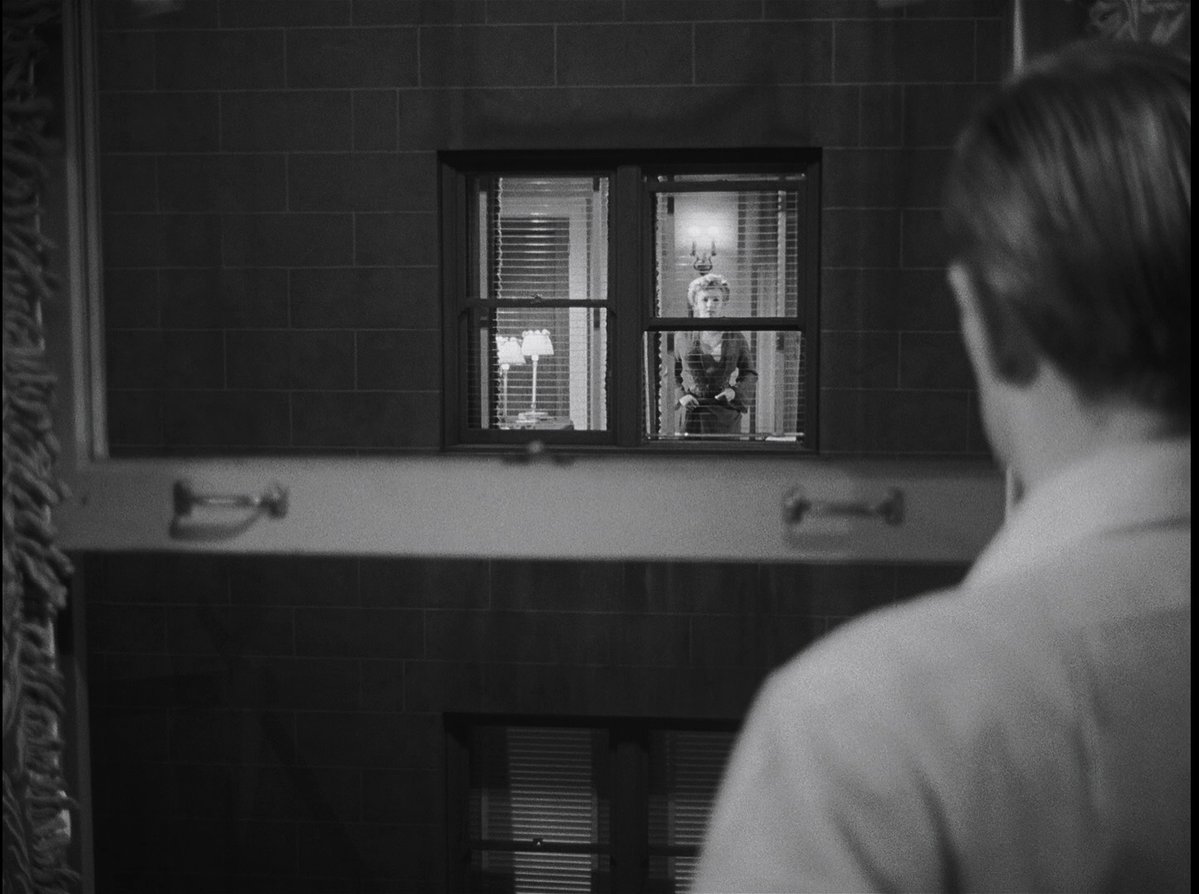
Across the way is the Jones' apartment, where Nell is baby-sitting, and makes herself at home. That means different things to different people, but to Nell it means trying on Mrs. Jones' negligee and earrings, lipstick, and shpritzing the woman's perfume. It's clear that Nell may not be the best sitter that could have been hired, and might actually need a sitter herself, given her disregard for the personal property of the folks who hired her. Dolling herself up, whatever her reasons, is enough to attract the interest of Jed, who's nursing the earlier break-up and a bottle of whiskey.
When Nell catches him peeping, she draws the blinds, which only amuses Jed. This being the 1950's and Jed being a "man's man" pilot and all, he calls her up on the house phone and tries to talk his way over for a night-cap, but Nell, after initially being interested, hangs up on him.
Meanwhile Eddie (because he knows "her history") stops by to check up on her and is shocked to find her in Mrs. Jones' "things" and tells her that she has to put everything back—he's had his job 14 years and he doesn't want her to do anything to risk it. Besides, if she wants the finer things in life she should stop mooning over her dead boyfriend and move on. She changes, but when Eddie leaves, she puts everything back on.
 
Then, she calls Jed and invites him over.
Even though the film is 70 years old, we'll stop there for spoilers because it's the surprises that make Don't Bother To Knock an interesting see. Nell is such a mystery with hair-pin turns that you wonder what could possibly happen next...and then you get jolted again. "I can't figure you out! You're silk on one side and sandpaper on the other!" Jed yammers in frustration. The truth is he won't figure her out, even Nell can't figure herself out. She's stuck in a loop and all people can do is follow her down her rabbit-holes.
Which is why it's amazing that it's Marilyn Monroe playing Nell. Monroe performances you always take with a grain of salt—at least a grain of sympathy or empathy—and not to make a pun of it but she's graded on the curve, allowances are made. And just as frustrated directors found out the hard way, Monroe knew that the camera loved her and knew how to use it. The camera was the one thing in Hollywood she could trust. With the bar of excellence seemingly lowered, you come away more than a little impressed.
What had she done before? Cameo's basically. In The Asphalt Jungle and All About Eve, she'd had scenes where she made an impression when she was on the screen, which was minimally. And the parts called for sexy but not voraciously so. Her dramatic role in Fritz Lang's Clash By Night was small, but Don't Bother to Knock, despite its pulp origins and low budget was a huge...if somewhat daunting... role—play "crazy" but sympathetic.
And she's pretty amazing at it. Even with sympathy filters up, there's a lot of work here that tosses the control that she maintained in most of her performances and you're struck by how genuinely alarming it is. Even on-set Bancroft was impressed: "It was a remarkable experience. Because it was one of those very few times in all my experiences in Hollywood when I felt that give and take that can only happen when you are working with good actors. There was just this scene of one woman seeing another woman who was helpless and in pain, and [Marilyn] was helpless and in pain. It was so real, I responded. I really reacted to her. She moved me so that tears came into my eyes."
Almost immediately, she would use her energies for the artifice of star performances that would turn Elton John's "candle-in-the-wind" into kleig lights.

Tuesday, June 6, 2023

The Graduate (Post-Graduate Studies)

Ever re-visit a film from your youth and realize that it was saying something you hadn't realized at the time? The movie hadn't changed (unless it was directed by George Lucas), but you had. You'd gotten older, maybe wiser, but certainly had learned a few things as you gained time and experiences in the intervening years. The Graduate was one of those films for me. I wrote this a few years ago—but neglected to bring it over from the old blog-site—and things keep changing, but the movie—and it's message—still remains. It just wasn't the vision that was planted in my brain when I first saw it as a self-obsessed romantic youth.


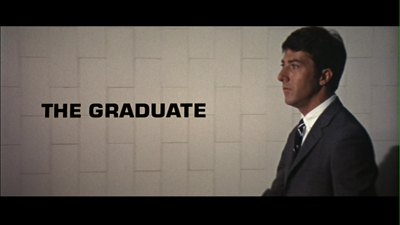
The Graduate (Mike Nichols, 1967) During the summer of 2009, the small rom/com (500) Days of Summer contained a line that hit home on many fronts. The romantic hero (says the police blotter-like narrator) formed his romantic ideas at an impressionable age due to "a mis-reading of The Graduate."

An easy thing to do.

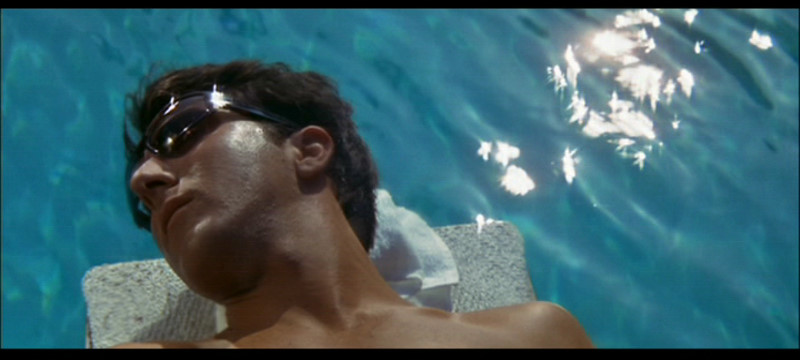
Lots of young romantic kids—I was one of them—grooving on the surface-tension of the movie, missed Mike Nichols' (and scenarists Calder Willingham and Buck Henry's) wise, dispassionate warning of a life led for instant gratification, something that went right over the heads of a clan preparing for "The Summer of Love." When we first find Benjamin Braddock (Dustin Hoffman) he's going nowhere mighty fast: first, stuck in a plane seat, then on an airport's "moving sidewalk"—life going by, him standing still. He'll spend his first summer out of college in much the same way. His first night home, he'll be hiding in his room (to avoid his parents' celebratory welcome home party) "worried about (his) future."
But the world will have none of it. Along with the free advice ("plastics...") and the pinched cheeks that will continue through his adulthood, Ben is coerced into driving the wife of Ben's father's partner home from the party. Once there, "things get a little weird." Dressed in her leopard-print coat,* Mrs. Robinson (Anne Bancroft) reveals herself to be quite the predator, as well as revealing that she's neurotic, alcoholic and...oh, by the way, Mr. Robinson (Murray Hamilton) won't be home for hours. Yes, as a matter of fact, she is trying to seduce him,** and Ben barely makes it home uncompromised by Mrs. and Mr. Robinson, who gets home sooner than expected.
But Ben is feeling pressure at home. Dad wants him to think about graduate school and is trying to hook him up the Robinson's daughter, Elaine (Katharine Ross). To an extent he does a little bit of both by spending time in post-graduate studies with Mrs. Robinson, who becomes fiercely adamant against Ben dating her daughter. He also finds out that the Robinsons have a marriage of convenience as she became pregnant with Elaine and that was the thing to do.
It's pretty apparent that after four years of schooling, Benjamin doesn't listen very well. Forced into a date with Elaine, he's determined to screw it up, succeeds all too well, then, having reduced her to tears, decides that he can't be that much of a heel and makes it good to her. A romance begins to take shape, but is quashed when Ben reveals to Elaine that he has had an affair with her mother.
Against all odds (or reason) Benjamin begins seriously pursuing Elaine, making it his goal, and, despite her initial reservations, culminating in a rescue at the church of her wedding, where they famously escape on a bus, having defied convention, their parents, and get things their way.
Orson Welles has said any story can have a happy ending...depending where you end it. If Nichols had ended with Ben and Elaine flush with revolution bussing away to their future, it would have been a happy ending.
But he doesn't. He stays on his shot of the two rebels as their expressions change from elation to confusion to...what? Ben has been so focused on the prize and Elaine, confused and pressured into marriage, that they don't have a plan...they don't even know where the bus is going. The story will go on, and Nichols doesn't cut away until the last moment—he lets us see their expressions change, her looking at Ben unsure, Ben just looking forward still in an adrenaline daze of what he's done.
And what he's done is risk something the whole movie has been warning against—becoming like his parents. Mrs. Robinson has aspirations and dreams that were exploded when she became pregnant with Elaine and she became dependent on a man for her well-being. Elaine, with no degree, is now dependent on
the adrift Ben and the only thing on his mind is domestic bliss, although how he'll get there, he probably doesn't have a clue. Their impulsive act of rebellion is a trap to becoming their parents. A lot of people missed that message in the 60's, but it's always been there for anybody not blinded by the comedy and the attraction of its stars.
It occurred to me (after loving the movie for 30 years) when someone professed to not liking it much because the character of Elaine is so ill-defined and confused. It is not a strong woman's part, despite its screen-time and seems more a fantasy—a screenwriter's convenience, her change of attitude towards Ben being a mystery and ultimately she trades one controlling force—her family—for another—Ben. And Ben is simply a mess—single-minded, shallow, without much motive other than selfish ones. He's very much his parents' son.
So, when (500) Days of Summer came out, with its shallow male pursuing a female through friendship and assuming forever is part of the bargain, and its female character who enjoys the friendship but doesn't see it "safe" enough to be permanent,*** the connection to The Graduate clicked, all too finally. It is a comedy (in the classical sense), as its protagonists don't even know that by pursuing their course of what they see as rebellion, they've condemned themselves to living the quietly desperate lives of their parents.
On the occasion of its 30th Anniversary, a lot of critics who could do so, re-evaluated The Graduate, and down-graded it accordingly. Given the new "reading between the frames," I'd actually up-graded as being far more subtle and wise than the comedy aspects of the film would suggest. Perhaps it's time to pay a visit to Sam Mendes' Revolutionary Road, as well.
What did "The Bard" say? "You say you want a revolution, well, you know/we'd all love to see the plan..."
"Everybody puts Benjy in the corner:" Dustin Hoffman and Anne Bancroft "Graduating"

* This was the 1960's—the term "cougar" would show up forty years later. Bancroft was only six years older than Hoffman at the time.

** We dissected this scene in "
Don't Make a Scene: The Graduate."

*** (500) Days of Summer has a telling scene, he takes her to see The Graduate and she ends up sobbing; what he sees as romantic, she sees as frightening, terrifying...and her situation.

Wednesday, March 29, 2017

84 Charing Cross Road

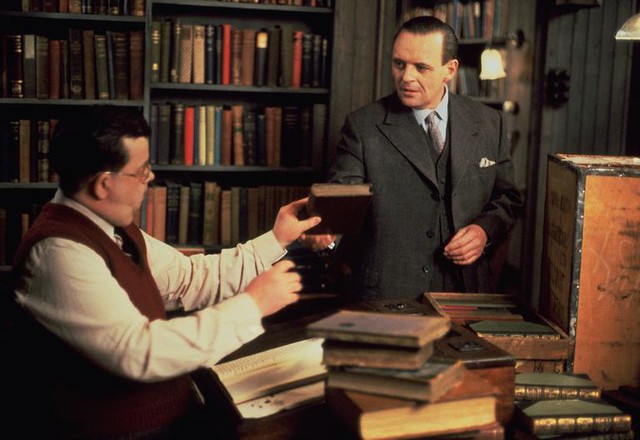
84 Charing Cross Road (David Hugh Jones, 1987) You never know where something delightful might come in, like a parcel of unexpected mail that can lighten one's mood, or found money in a not-recently worn garment, or the spurious act of kindness.  The "nice" surprise. 84 Charing Cross is one of those, one of the films I've known about, mostly for its score by George Fenton, and that's about it, save that it starred Anne Bancroft and Anthony Hopkins, both of whom were in a popularity valley, Hopkins doing TV movies at that time (four years away from The Silence of the Lambs), she doing one movie a year, often at the behest of her producer-director husband, Mel Brooks (who produced this one).  

Good property, too. Brooks tended to bankroll movies from stage-plays (or based on stage-plays), and 84 Charing Cross made it to the boards after being published in book form by author Helene Hanff, documenting her decades long relationship with a London book store. This was in the day before the Internet, before Amazon, even before Barnes & Noble or Tower Books or the massive retailers who would buy books by the case-load to over-populate bargain bins. These were Mom & Pop operations, or even older, in dark rooms that smelled of dust and yellowing paper, where books had cloth or leather bindings, and even opening one of them was an adventure. I could spend an entire day in one of these hovels, marveling at what one could find waiting on the heavy oaken shelves. Before they actually became warehouses, it was the closest thing to a warehouse of information and just following a line across the Dewey Decimal System could lead you to an amazing surprise. 
The Marks and Cohen Secondhand Bookseller at 84 Charing Cross Road

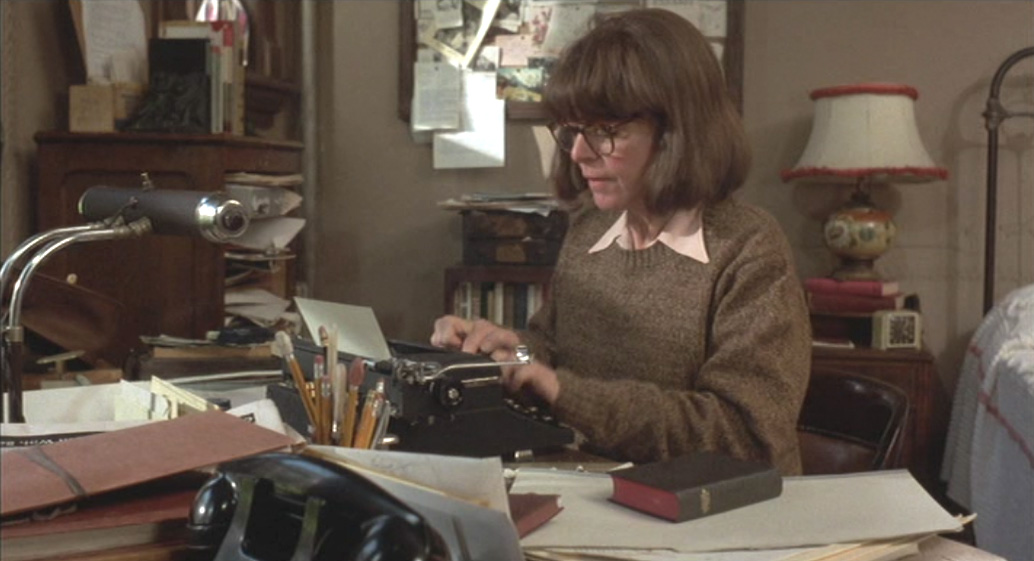
The story begins in New York, 1949. Hanff, an editor by trade a playwright by desire, is looking for specific books around the city and coming up with bupkis. A stray ad in the Saturday Review of Books mentions the bookseller in London, Marks & Co, at the 84, Charing Cross Road address and she writes to the place looking for her treasures. She is answered by Fred Doel, buyer, who sends her what he has, mentions the price and the two work out a pounds to dollars conversion with some sloppage in change here and there, with a relationship of immediate trust established, and an expertise that Hanff comes to rely on and marvel at.

Before long, her hearing of food shortages in Britain inspires her to send food-stuffs to the store, which are distributed amongst the employees and generally making their life increasingly special. Before long, everyone is on a first name basis in correspondence and the letters and orders from Hanff become a special treat for the business. It becomes a long distance love story of mutual kindnesses and respect.
Hanff (Anne Bancroft) leaves a long ash watching Brief Encounter (in a theater, kids!)

Lovely story, and certainly something that anyone who has a favorite place of business or customer for whom business is never usual can relate to.  And it's one of those movies that would particularly appeal to the blue-haired old ladies in matinees for whom the shocks should not be roller-coasterish or beyond community standards. The performances are comfortable—Bancroft's verbose and brazen, Hopkins, donnish and in that automaton-ically restrained emotional manner he'd perfect in Remains of the Day, Judi Dench has very little to do as his wife, other than dignified fretting, but does it with an immediacy and a good-natured bantering with Hopkins that feels right.

If there is one complaint, it is that, after awhile, the director gets weary with the cutting back and forth and gets a little cutesy with the transitions, at one point Hanff addresses the camera which is jarring, and then there is a sequence where both characters are talking to the camera with no pretext of papyrus, writing or reading interpolated as voice-over. They appear (God help us) to be on Skype, and by that time the illusion and some of the magic disappears. They're not talking to each other anymore, as we've gotten used to. Instead the fourth wall is broken and they're talking to us, right at us, and, frankly, the movie treating the audience as an unnecessary go-between is rather a step-down from our previous role as omniscient viewer.  I didn't appreciate it much.

But other than that little spoiler, it's fun, nicely unique, and quite refreshing.

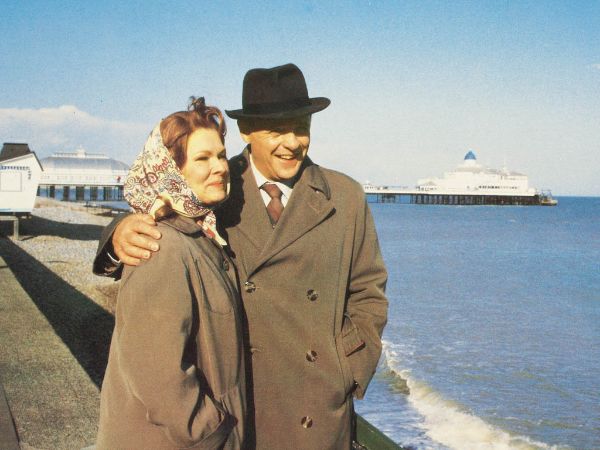
                         Helene Hanff                                                   The Doel family, Frank to the right