Well, We All Shine On (Like Moon-light and The Stars, and You)
or Wait'll the Talent Scouts Get Wind of Him
There was no reason for there to be a sequel to "The Shining," either the book or the 1980 film adaptation. It told its story and ended. Each told it differently, but there was no ambiguity to either one. King ended his story by having the Overlook blow up in a boiler-room conflagration. And Stanley Kubrick's movie kept the Overlook in one piece, but put the story to an end. There ARE no reasons to make sequels of any of Kubrick's films—he ended his stories, having said all that needed to be said, even if the ending was ambiguous. There was no next chapter because there was no point. And if you did do a "sequel"—like the ill-considered 2010: The Year We Make Contact—you basically cheapen the story with considerations that are not central to the first conceit and the whole thing gets watered down. "Oh, yeah, and by the way, this could happen tangentially...only it's not as important as the first story, but...blah blah blah—people will have jobs so let's make a sequel." And so..."Heeeere's...Danny!"
Danny Torrance (Ewan McGregor), of Jack (E.T.'s Henry Thomas) and Wendy Torrance (Alex Essoe), is not doing well. One could say he's following in the family tradition—a victim of PTSD from his experiences when his parents were caretakers at the haunted Overlook Hotel, he is drinking and drifting, short-time jobs, the money of which he'll squander on booze and start the cycle again to losing the work and moving on. But, Danny (as we know) has been gifted—or cursed—with "the shining," a psychic ability of some indeterminence, but which played a large part in saving the life of himself and his Mother when father Jack became swayed by the spirits haunting the Overlook. A "very willful boy," he has lost his will since his Mother's death and shines far less brightly these days, the booze having doused it, like water to flame.
For Danny has been plagued by nightmares. Not just nightmares, but the returning spirits of the Overlook, who have followed him and his Mother to Florida—they never wanted to see snow again—and beset Danny until one day he's given a coaching by Dick Halloran (Carl Lumbley), his friend "in shining" at the Overlook, who teaches him about what he used to do as a boy, a trick taught to him by his grandmother. If one of those old spooks comes back to haunt you, you think up a box and just lock them in it, and they'll never bother you again.
Now, for fans of the original Shining—book and/or film (and they're not exactly a group that like both), you know there's an issue: Halloran appears in the book of "Doctor Sleep" because he survived in the book of "The Shining." But, (can it be aSPOILER ALERT for a movie that's 39 years old?), in the movie, Halloran gets cleaved by an ax in an attempt to rescue Danny and Wendy from their predicament. And yet, he appears in Mike Flanagan's movie ofDoctor Sleep, to give little Danny that advice about the mental boxes. Flanagan does a bit of finagling to do justice to both book and film, and satisfy the expectations of both (which is no small task) but he does a fairly good job of keeping his feet on both banks of the river simultaneously, but in the process, he kinda hasta change what "the shining" actually is—not that we knew in the first place.*
Problem solved, and if I remember correctly (and I probably don't because I couldn't get through King's novel), that happened in the first twenty pages. Now, Danny may be able to box those demons, but he can't box the ones inherited from his father. And so he spends most of his life wasted and drifting, until he comes to one town, Frazier New Hampshire, where under the stewardship of Billy Freeman (Cliff Curtis) he gets a job, a room of his own, and starts going to A-A where he meets Dr. John (Bruce Greenwood), who becomes impressed with Dan and offers him a job as an orderly at a hospice that seems to suit him. That's where the cat comes in.
The hospice has a therapy cat, who has a strange ability. At night, when everything is quiet, the cat will wander the halls of the hospice and open a door and jump on the bed of one of the patients. The cat, named Azrael, has a reputation among the internees—when the cat visits you at night, it means you're about to die. Despite this, the cat seems to be popular and not kicked off beds right and left. Soon, Danny starts to follow the cat on its rounds, and comforting the about-to-die, giving them peace in their last moments. And he gets a nickname—"Doctor Sleep." Roll credits.
All well and good, if that was all there was to it. Danny finds peace giving peace, his "shining" bringing comfort like a spooky version of Last Rites. But, there are other shiners who don't give comfort at all; they're The True Knot and over the years—and there have been many, many of them—the Knot led by its cult leader "Rose the Hat" (a particularly on-point Rebecca Ferguson) have been luring children with shining abilities and ritualistically killing them...slowly, so as to absorb their shining abilities like a life-force, that manifests itself as a mist, giving them rejuvenation and renewed life. They're like vampires, but for shining, not blood. This is a new wrinkle, that the "Shining" has a physicality, that—with an expanded range of abilities—makes it feel more like George Lucas' midichlorian-based "The Force."
The activities of The True Knot psychically alerts a shining adept teen, Abra Stone (Kyliegh Curran), who is traumatized by the murder of a child (the always amazing Jacob Tremblay) by the group. Abra has been in psychic contact with Danny, the way a HAM radio operator talks with other stations around the world. But the night of the boy's murder, Danny is blasted by Abra's terror and the blackboard the two have used to communicate is covered with the word "MURDER" which Danny first sees in a mirror as an all-too familiar word—"REDRUM"
The movie then turns into a three-way struggle between Danny and Abra and the Knot, and particularly its leader, Rose, a fight that escalates from merely invading each other's thoughts to more murderous physical contact. Pretty soon, everybody is tracking the movements of everybody else and Danny decides to take Abra and stage a last stand at the one place that might be suffused with enough evil energy to defeat Rose—the Overlook Hotel, containing all the ghosts and memories that have haunted Danny's past, including the restless spirit of his father.
Director Flanagan has done a very creditable job of directing Doctor Sleep, making an intriguing film that stands on its own without depending on the very heavy shadow of Kubrick's film (although he does fall back on it a lot—which we'll talk about later). If there are gripes, they can be directed at King's novel, which gives far more substance (literally) to The Shining ability, which now allows astral projection, mind and body hijacking—"pushing" to use King's phrase from the book and from his novel "Firestarter"—and the capacity to get into people's heads, even those that shine, and messing around with their "files."
That's a big jump from the psychological manipulation and thought-reading that had been the extent of the earlier versions. Think about it: if the shining ability was originally presented the way it now is, little Danny wouldn't have had to do what he did in the original to spare himself and his Mother. All he would have to have done is take over Daddy Jack's mind. Problem solved.
That aside, there is a bit of diffusion of the original story—the True Knot is too big a group that has lasted too long to not be noticed, even at the time of the first book. In a way, it overshadows the first story, even threatening to swamp it.
Flanagan ignores that, giving the Knot its due, and deftly combining both versions of The Shining, book and film. He takes a lot of tricks from the Kubrick film, not just in creating a near duplicate of the Overlook sets—that was probably a chore—using key images, like the swooping Main Title sequence, digitally altered for effect, recreating the "Here's Johnny" sequence that is so spot on, you will initially think they used the sequence with Shelley Duvall, but, no, that's Alex Essoe playing it perfectly. The film is also bracketed with the same music (Wendy Carlos' distortion of "Dies Irae" and the old tune "Midnight, the Stars and You") as well as the thumping heart-beat Kubrick used to underscore tension.
But, his best weapon is employing the same creepy technique Kubrick used in The Shining, which is purely cinematic—the framing. Kubrick imbued his film with his usual trope, the one-point perspective.** But, with The Shining, he gave it an extra element—nothing. For much of the film, Kubrick centers his one point on a negative space, giving the film a vertiginous depth despite its horizontal perspective.
Most of the time it works, but there are moments when it's jarring—like a shot of Greenwood's Dr. John in his office that is so influenced by Kubrick's shots of the Overlook's manager, Ullman, in his office—in the Overlook Hotel, mind you—that for a moment it took me right out of the movie. That seemed a bit slavish...and unnecessary—an irrelevant echo that is a complete mis-match, despite its adherence to the original.***
But, we can overlook that as maybe taking a good idea too far. For the most part, Flanagan has taken an old haunt and managed to bring it back to creepy life. Maybe Kubrick was right—how could The Shining be a down-beat movie when it suggests there is life after death? Perhaps there's a corollary of that thought to sequels, as well.
* I suspect it has something to do with midichlorians, but I might be confused... **
The Story: I have a friend (Hey, Walter) who would always have an ace in the hole when playing trivia games. It was: "What's the last line of The Maltese Falcon?" The answerer would confidently say: "The stuff dreams are made of." Of course. But, they'd be wrong. The last line of The Maltese Falcon is "Huh?" spoken by Ward Bond's Sgt. Polhaus at detective Sam Spade's rare attempt of poetic irony.* "Huh?" Exactly. Think you know movies? "Huh." But, that's an amusing aside. The classic finale where tough-guy detective Sam Spade (who doesn't like guns despite the movie poster) does the right thing but betrays the woman he's working for and had a romantic tryst with was always a part of the story, which started as a novel by Dashiell Hammett. Falcon had been filmed by the Warner Studio twice before, but—owing to Hammett's previous movie success being the larky adaptation of his "The Thin Man"—it had been treated broadly and with more of a winking joviality with the audience. But, Falcon was a different story from "The Thin Man", and when writer John Huston decided to move to directing, he wanted this Warner property because 1) it was available and 2) the studio had already botched it up twice. The studio took the risk because they'd already filmed it twice before and as long as Huston kept the costs down, there was relatively little risk. They didn't count on it becoming a classic and one of the studios' proudest achievements. So good, in fact, that it never had to be remade again. It spawned a genre called "film noir," where the inky blacks of the urban night-time seemed to be suffused with something more than just dark, mixed with some German expressionism, a dash of neo-realism, and with a whiff of the pulp-paper of crime fiction writers who took the lessons of the Depression and the War and leeched the good intentions and happy endings of escapism and hammered home a cynical world-view. It threw out the happy ending where the guy gets the girl and substituted where the guy gets the girl hanged. She's a murderer and he knows it and he does the right thing, despite that it might feel wrong, and it spells it out in a lengthy speech that goes into the fine detail about two people who have been stringing each other along for the entire length of the movie and why there would be no reason, no reason at all that any other decision is impossible. This is the long-hand that made the short-hand of subsequent noir's possible—the potential of blackmail and murder that might come in the future...if there is a future. I took pains on this one to get the dialog right. What ended up on the screen moves away from the Huston screenplay (that you can find online) and even from transcripts on other sites. There's a complicated rhythm to the language which feels better than what's on the page, and it was probably refined on the shooting stage—which necessitated adding words rather than cutting them. But, I did keep Huston's directions and descriptions from the screenplay and put them in, because I found them fascinating. They feel like pulp writing of a definite purple tinge. But the other thing that's interesting is that Huston's screenplay directions read like they're for a love scene. It feels perverse, but it is absolutely right, given the high dudgeon of emotion going on in the scene. Huston's career is full of muted love scenes, the kind you don't hear strings behind, but here the passion is high, but it doesn't end in a clinch, unless it's the snapping shut of hand-cuffs.
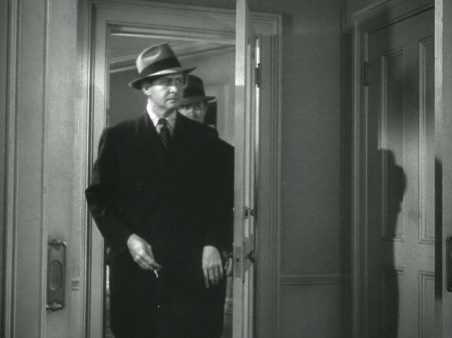
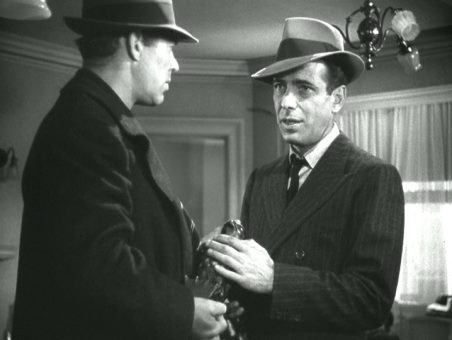
The Set-Up: Detective Sam Spade (Humphrey Bogart) is up to his sweating neck in a case that's had lots of consequences and lots of bodies fallen by the way-side, including that of his business partner, Miles Archer. What's turned from a missing persons case to a smuggling matter with mythic proportions has had a colorful cast of characters, but, now, they've all left the party, the object they've coveted proving to be a fake, leaving Spade with the person who first brought the matter...or A matter...to his attention, Brigid O'Shaunessy (Mary Astor), formerly Miss Wonderly, formerly Miss LeBlanc, formerly...who knows? She's pretty, but the circumstances aren't. Action.
122. CLOSE SHOT - SPADE AT TELEPHONE
Spade takes the receiver off the hook and dials a number. Brigid watches him, a slight frown on her face.
SAM SPADE: Hello. Sergeant Polhaus there?
Yeah. Put him on. This is Sam Spade.
(He stares into space, waiting, then:)
SPADE: Hello. Tom? Now, listen. I've got something for you. Here it is:
Jacoby and Thursby were killed by a kid named Wilmer Cook.
Yeah.
SPADE: He's about twenty years old, five-foot-six wearing a gray overcoat.
SPADE: He's working for a man named Kasper Gutman.
SPADE: You can't miss Gutman. He must weigh three hundred pounds. That fellow Cairo's in with him, too.
SPADE: They just left for the Alexandria Hotel. But you'll have to move fast. They're blowing town. Now watch yourself when you go up against the kid.
Yes, that's right. Very.
Well, good luck, Tom.
Spade slowly replaces the receiver on the prong. He fills his chest with air and exhales. His eyes are glittering between narrowed lids. He turns, takes three swift steps toward Brigid O'Shaughnessy. The girl, startled by the suddenness of his approach, lets her breath out in a little gasp. Spade, face to face with Brigid, looks at her hard of jaw and eye.
SPADE:They'll talk when they're nailed about us. We're sitting on dynamite.
SPADE: We've only got minutes to get set for the police. Now give me all of it fast! When you first came to my office, why did you want Thursby shadowed?
BRIGID O'SHAUNESSY: I told you, Sam!I thought he was betraying me. I wanted to find out.
SPADE:That's a lie! You had Thursby hooked and you knew it and you wanted to kill him before Jacoby came with the loot so you wouldn't have to split it with him. Isn't that so?
SPADE: What was your scheme? BRIGID: I thought if he knew someone was following him, he'd be frightened into going away.
SPADE: Miles wasn't clumsy enough to be spotted the first night.
You told Thursby he was being followed.
BRIGID: I told him.
BRIGID: I told him.
BRIGID: Yes, but please believe me, Sam.
I wouldn't have told him if I thought Floyd would kill him.
SPADE:If you thought he wouldn't kill Miles, you were right, angel.
Miles hadn't many brains, but he'd had too many years experience as a detective to be caught like that, by a man he was shadowing up a blind alley with his gun in his hip and his overcoat buttoned. (he takes his hand away from her shoulder, looks at her for a long moment, then:)
SPADE:But he'd have gone up there with you, angel.
He was just dumb enough for that.
He'd have looked you up and down and licked his lips and gone...grinning from ear to ear.
SPADE: Then you could have stood as close to him as you liked in the dark and put a hole through him with a gun you got from Thursby that evening.
- Brigid shrinks back from him until the edge of the table stops her. BRIGID: Don't, Sam! Don't say that! SPADE: Stop it! The police'll be here any minute! Now talk!
BRIGID:Oh, why do you accuse me... SPADE: This isn't the time for that schoolgirl act! We're both of us sitting under the gallows! He grasps her wrists forcing her to stand up straight in front of him. Her face becomes suddenly haggard.
SPADE: Now, why did you shoot Miles? BRIGID:(voice hushed and troubled)I didn't mean to at first, really, I didn't.
But when I found out that Floyd couldn't be frightened...
BRIGID: Oh, I can't look at you and tell you this! (she starts to sob, clings to him)
SPADE: You thought Thursby would tackle Miles and one or the other of them would go down.
If Thursby was killed, you were rid of him.
If it was Miles, you'd see that Thursby was caught and sent up for it. Isn't that right? - (She nods) BRIGID: Something like that.
SPADE: When you found that Thursby wasn't going to tackle him...you borrowed his gun and did it yourself, right? And when you heard Thursby was shot, you knew Gutman was in town!
You knew you needed another protector, somebody to fill Thursby's boots, so you came back to me.
She puts her hands around the back of his neck pushing his head down until his mouth all but touches hers.
BRIGID: Yes! No, sweetheart, it wasn't only that!
I'd have come back to you sooner or later.
From the very first instant I saw you, I knew.
He puts his arms around her holding her tight to him.
SPADE: Well...if you get a good break, you'll be out of Tehachapi in years...
SPADE: ...and you can come back to me then. She draws away from him slightly, throws her head far back to stare up at him, uncomprehending.
SPADE: I hope they don't hang you, precious, by that sweet neck.
-He puts his hand up and caresses her throat. In an instant she is out of his arms back against the table crouching, both hands spread over her throat. Her face is wild-eyed, haggard. Her mouth opens and closes.
BRIGID: You're not... (she can get no other words out) - Spade's face is damp with sweat now. His mouth smiles and there are smile wrinkles around his glittering eyes. SPADE: Yes, angel, I'm gonna send you over.
SPADE: The chances are you'll get off with life. That means if you're a good girl, you'll be out in twenty years.
I'll be waiting for you.
SPADE: If they hang you, I'll always remember you. Brigid drops her hands, stands erect. Her face becomes smooth and untroubled except for the faintest of dubious glints in her eyes. She smiles back at him.
BRIGID: Don't, Sam!
BRIGID:Don't say that, even in fun!
BRIGID: I was frightened for a minute. I really thought...
You do such wild and unpredictable things. She breaks off, thrusts her head forward and stares deep into his eyes. The flesh around her mouth shivers and fear comes back into her eyes. She puts her hand to her throat again. Spade laughs. His laugh is a croak.
SPADE: Now, don't be silly.
You're taking the fall.
BRIGID: You've been playing with me...just pretending you cared to trap me like this.
You didn't care at all!
You don't love me! The muscles holding his smile stand out like walls.
SPADE: I won't play the sap for you!
BRIGID: You know it's not like that!
SPADE: You never played square with me for half an hour at a stretch since I've known you! Brigid blinks her tears away, takes a few steps backward, stands looking at him, straight and proud.
BRIGID: You know down deep in your heart that in spite of anything I've done, I love you. He puts his hand back on her shoulders, the hand shakes and jerks.
SPADE: I don't care who loves who! I won't play the sap for you!
I won't walk in Thursby's, and I don't know how many others' footsteps!
SPADE: You killed Miles and you're going over for it. She takes his hand from her shoulder, holds it close to her face.
BRIGID: How can you do this to me, Sam?
Surely, Mr. Archer wasn't as much to you as...
He is no longer smiling. He pulls his hand away from her. His wet face is set hard and deeply lined. His eyes burn madly.
SPADE: Listen.
SPADE: This won't do any good.
You'll never understand me, but I'll try once and then give it up.
SPADE: When a man's partner is killed, he's supposed to do something. It makes no difference what you thought of him.
He was your partner, and you're supposed to do something about it...
SPADE: ...and it happens we're in the detective business.
Well, when one of your organization gets killed, it's...it's bad business to let the killer get away with it...bad all around, bad for every detective everywhere.
BRIGID: You don't expect me to think that these things you're saying are sufficient reasons for sending me...
SPADE: Wait'll I'm through. Then, you can talk.
SPADE: I've no earthly reason to think I can trust you and if I do this and get away with it, you'll have something on me that you can use whenever you want to.
SPADE: Since I've got something on you I couldn't be sure that you wouldn't put a hole in me someday.
SPADE: All those are on one side.
Maybe some of them are unimportant. I won't argue about that.
SPADE: But look at the number of them.
What have we got on the other side?
SPADE: All we've got is that maybe you love me and maybe I love you.
BRIGID: You know whether you love me or not.
SPADE: Maybe I do. He looks hungrily from her hair to her feet and up to her eyes again.
SPADE: I'll have some rotten nights after I've sent you over, but that'll pass.
(He takes her by the shoulders, bends her back leaning over her)
SPADE: If all I've said doesn't mean anything to you then forget it and we'll make it just this:
I won't, because all of me wants to regardless of consequences...and because you've counted on that with me the same as you counted on it with all the others. (He takes his hands from her shoulders, lets them fall to his side) She puts her hands up to his cheeks, draws his face down towards her again.
BRIGID: Would you have done this to me if the falcon were real and you got your money?
SPADE: Don't be too sure I'm as crooked as I'm supposed to be.
That sort of reputation might be good business...bringing high-priced jobs and making it easier to deal with the enemy...
She looks at him, says nothing. Spade moves his shoulders a little.
SPADE:...but a lot more money would have been one more item on your side of the scales.
BRIGID: If you'd loved me, you wouldn't have needed any more on that side.
She puts her mouth to his slowly and is in his arms when the doorbell RINGS. Before he releases her he calls:
SPADE: Come in.
123. MED. SHOT - ROOM - ANGLE ON DOOR
Lt. Dundy, Tom Polhaus and two other detectives enter. They look back and forth from Spade to the girl.
SPADE: Hello, Tom. Got 'em?
POLHAUS: Got 'em.
SPADE: Swell!
SPADE: Here's another one for you.(he pushes Brigid forward) She killed Miles.
SPADE: Oh, and I've got some exhibits: the boy's guns, one of Cairo's...
SPADE: and a thousand dollar bill I was supposed to be bribed with...and this black statuette here that all the fuss was about.
He turns to Dundy, draws his brows together, leans forward to peer into the lieutenant's face, starts to laugh.
SPADE: What's the matter with your playmate?
SPADE: He looks brokenhearted.
SPADE: I bet when he heard Gutman's story, he thought he had me.
POLHAUS: Cut it out, Sam. (he looks uneasily at his superior) (Spade picks up his hat, puts it on)
* Bogart's last line, based on a line of Prospero's in Shakespeare's "The Tempest" did not come from Dashiell Hammett's novel nor from John Huston's screenplay. It was suggested to Huston by none other than Humphrey Bogart, according to film noir aficionado Eddie Muller.