The Story:Marlon Brando was fat. That was the problem.
You look at the planned shooting script ofApocalypse Now, and that ending just blows you away. It would have been a battle extravaganza, tinged with LSD and morphine, and protagonists warring against both sides. That's what John Milius was looking for—a big, beautiful blow-out of a night fighting scene, not unlike the big cavalry charge at the end of a Western—The Alamo with a happier ending. Day-glo carnage.
But Marlon Brando arrived in the Phillipines overweight—his mass had ballooned since his recent relatively svelte appearances in The Missouri Breaks and Superman. Brando had shaved his head, and was extremely shy about being photographed heavy. And his character, Colonel Kurtz, was supposed to be in shape, frail but, with a long scraggly head of blonde hair. Nor had Brando read the script, or its source, Joseph Conrad's "Heart of Darkness." For his several million dollar salary (in exchange for his presence to acquire investors), Brando merely showed up, completely unready to play his part.
And Francis Ford Coppola, already hip-deep in a big muddy of an out-of-control movie shoot, only had him—his star attraction—for one week. Brando ultimately didn't like the script—Coppola was also having doubts about it—and so director and star hunkered down to try and re-shape the part of Kurtz to Brando's satisfaction and the ending of the film to Coppola's. With so much money at stake, it was a wild gamble with bad odds, but Coppola was never afraid of taking chances.
He devised a way of shooting Brando that was mostly in the shadows, hiding his body, while he and Martin Sheen—who'd already suffered a heart attack shooting the movie—discussed matters philosophical. After the intense journey, it was a disappointment to sit through a series of disjointed chats where you barely saw Brando. But even a shadow-Brando can do some interesting things—the tightening fist after Willard calls him insane, the way he pushes through the shadows like parting a curtain to finally reveal his face, the soft-pallette voice belying the threat of the man. It's an eerie, unsettling scene that pushes the bounds of absurdism at times.
But, it holds your gaze, challenging it. As Brando always did.
The Set-Up: After a long trip up the Nung River aboard a PBR with a slowly disintegrating crew (Laurence Fishburne, Frederic Forrest, Albert Hall and Sam Bottoms), Captain Willard (Martin Sheen) has finally reached his destination—the Montagnard village in North Vietnam that is the base for Col. Kurtz (Marlon Brando), who's been waging his own unauthorized war. Willard's mission: "terminate the Colonel's command...with extreme prejudice." At this point, he hasn't even had a chance to see the Colonel. He's just been a dossier, some blurred photographs, a whisper on a hissing tape recording. A ghost in the dark.
A legend.
Action!
INT. KURTZ HEADQUARTERS - DAY Willard, hands tied behind his back, is guided down a long corridor, followed by two Montagnards, both armed. WILLARD (V.O.)It smelled like slow death in there. WILLARD (V.O.) Malaria and nightmares. This was the end of the river, all right. They turn into the main room. The natives indicate for Willard to kneel down on the floor. The CAMERA MOVES, REVEALING KURTZ lying in shadow on a bed. We will SEE him only in darkness and shadow throughout the scene. KURTZ: Where you from, Willard? WILLARD: I'm from Ohio, sir. KURTZ: Were you born there? WILLARD: Yes, sir. KURTZ: Whereabouts? WILLARD: Toledo, sir. KURTZ: How far are you from the river? WILLARD: The Ohio River, sir? KURTZ: Uh-huh. WILLARD: About two hundred miles. KURTZ: I went down that river once when I was a kid. There's a place in the river, I can't remember...must have been a gardenia plantation, or a flower plantation at one time. It's all wild and overgrown now. But for... KURTZ: ...about five miles, you'd think that heaven just fell on the earth, in the form of gardenias. Kurtz reaches down and picks up a bowl full of water. He splashes water on his face and head. KURTZ: Have you ever considered, any real freedoms? KURTZ: Freedoms from the opinions of others. KURTZ: Even the opinions of yourself. KURTZ: Did they say why, Willard? KURTZ: Why they wanted to terminate my command? WILLARD: I was sent on a classified mission, sir. KURTZ: Well, it's no longer classified, is it? What did they tell you? WILLARD: They told me, that you had gone...totally insane. WILLARD: And that your methods were unsound. KURTZ: Are my methods unsound? WILLARD: I don't see any method...at all, sir. KURTZ: I expected someone like you. What did you expect?
Willard shakes his head. KURTZ: Are you an assassin? WILLARD: I'm a soldier. We finally SEE KURTZ'S FACE. KURTZ: You're neither. You're an errand boy, sent by grocery clerks... KURTZ:...to collect a bill.
Doctored Images The list of movies based on the novels of John Michael Crichton is impressive—The Andromeda Strain, Jurassic Park (all parts), Congo, Disclosure, Timeline, Rising Sun (I like to call it "Rising Sean"), Sphere, The Terminal Man...as successful as the novels were on the Best Sellers lists, there are not a lot of "hit movies" there for a "hit-maker." The truth is, Crichton was a "must-read" author (whichever psuedonym he wrote under--Jeffrey Hudson, John Lange, or Michael Douglas) that did "okay" in other media, up until Jurassic Park—and Crichton's partnership with Steven Spielberg and Amblin to create the television series "E.R."—catapulted him into the job where he was most successful—as a producer/creator.*Crichton had a knack for conceptualizing great ideas, but he wasn't always good making compelling drama out of them—noticeably, in characterization. His geeks, techs, and Ph.d.'s were always a little dull, to the point where, reading Crichton, you would struggle remembering the characters in the book. It would take others to make his novels breathe and "matter" on dramatic levels beyond concerns about science and sociology.
In between, after his association with the filming of The Andromeda Strain, Crichton began angling for working in the movies, which he achieved fairly quickly and efficiently. But despite having created a library of viable projects, Crichton rarely adapted his own work, only directing two of his novels (and doing producorial tinkering on another), adapting other ideas that seemed less suited for fleshing out in novel form. His directing career has an odd look to it:after his initial success, he worked on B-films with limited budgets and "pulp-ish," exploitative themes, with interchangeable characters, who seemed to be more "jobs" than people. As his literary career advanced to more complicated scenarios, his film career took the opposite tack, devolving into the pulp field in which he started his writing. Crichton died of lymphoma on November 8, 2008. He was 66.
Pursuit(1972)An ABC "Movie of the Week," late edition,*which Crichton directed from his own novel (entitled "Binary," written under the nom-de-plume John Lange) about far-right radicals (played by E.G. Marshall and Martin Sheen) attempting to kill the sitting President at the Republican convention for his dealings with Communist countries. Three federal agents (Ben Gazzara, William Windom, and Jim McMullan) trace their activities to an apartment where two canisters of gas are contained and equipped with a timer and booby-traps. Analysis reveals that the two gases are harmless separately, but when combined are a deadly nerve gas that can wipe out San Diego. How do they stop it in time...especially as the room is sealed with enough of the combined gas to kill whoever enters it. A nifty trap, that. And Crichton, in his first directing gig, manages to make a spare, taut little thriller, with a budget, long on casting and short on frills. Pursuit also features a primitive score by Jerry Goldsmith, who would figure in quite a few Crichton films.
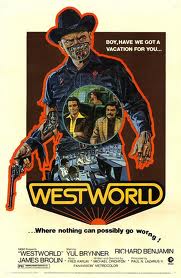
Westworld(1973) Crichton came up with the scrap of a story about immersive theme-parks with robots (ala Disneyland's audio-animatronics) and brought it to M-G-M (then being run—into the ground—by James Aubrey, Jr., who was busy turning the film studio into its own version of Casino-world). It's a cautionary tale of putting too much faith in technology as two buddies (James Brolin and Richard Benjamin) spend $1000 per day to go to the Delos Corporations' Westworld theme-park (there is also Roman World and Medieval World) where, among the activities are shoot-outs with a Gunslinger (Yul Brynner, straight out of The Magnificent Seven). A computer virus infects the facility and "things" start to get out of control (you can see the dinosaur bones of what would be Jurassic Park in the basic plot of the film). Crichton wrote about his experience directing the film in his published screenplay, and was quite honest in his frustrations dealing with a constantly shrinking budget and time constraints. But, despite the headaches, the film turned into one of M-G-M's few hits at the time. Westworld is a mildly amusing diversion and spawned a sequel—Futureworld—which the writer-director had nothing to do with and a TV series—Beyond Westworld—in 1980. that was cancelled after three airings. There have been frequent threats in the trades that a remake is in the works, but plans are now for it to be turned into an HBO series (adapted by Jonathan Nolan and his wife "Burn Notice" creator Lisa Joy) debuting in 2016. It should also be noted that Westworld is the first movie to feature digital pixelization of previously filmed images (showing the robots POV).
Coma(1978)Crichton takes on a directing job from someone else's work, in this case Robin Cook, known for writing medical thrillers—something close to Crichton's experience as a medical student and internist (Crichton and Cook were acquaintances). Genevieve Bujold and Michael Douglas star as two surgical residents who stumble onto an odd epidemic—healthy young people entering the hospital are going into unexplained comas following surgeries, from which they never come out! They're shipped off to the Jefferson Institute for extended care. Bujold's character talks her way into a tour of the facility and finds that it's more of a warehouse for coma patients with no rooms, no beds, but is more of a low-cost suspended life support system for care of indeterminate length that is the stuff of medical nightmares (one of those patients is a pre-stardom Tom Selleck). Her suspicions lead her to her hospital's chief of surgery (Richard Widmark) who becomes her ally in getting to the bottom of what is going on. Crichton's directorial hand is far more sure than it was in Westworld (he admits he was going for genre cliche with the earlier film), and the film is genuinely creepy and suspenseful.*** It was remade as a mini-series for A&E (by the Scott Brothers) in 2012.
The Great Train Robbery(aka The First Great Train Robbery, 1979)Nasty little version of the Crichton book, which takes on every detail of the book and its elaborate train heist...EXCEPT its tone. Crichton wrote his own adaptation for producer Dino DeLaurentiis and kept to his plot (based on "The Great Gold Robbery" of 1855) with much fictionalization going on. Sean Connery plays Edward Pierce, a larcenous gentleman who conspires with Robert Agar (Donald Sutherland), several Victorian low-lifes and his mistress, Miriam's (Leslie Anne-Down) to abscond with the contents of a diabolically complicated safe—they carry the gold that is intended for funding of the Crimean War. The plot involves several minor subterfuges as a prelude to the big score and that exercise takes on a "Mission: Impossible" tone as anything that might go wrong does, despite the group's elaborate planning. The big difference between novel and film is dialog—there is an almost schoolboy emphasis on sex in a lot of the discussions, and the by-play between Pierce and Miriam fairly crackle with none too subtle innuendo. Connery can only do so much with this before it wears thin. Where Connery was invaluable was doing the actual stunts on top of the train during the climax, which look incredibly dangerous and sometimes threaten to lop his head off. This has a rollicking score by Jerry Goldsmith. This was the second-to-last film of famed British cinematographer Geoffrey Unsworth.
Looker(1981)Albert Finney stars in a film about Society's quest for perfection and Industry's quest to exploit it to manipulate human beings. And it has some nudity, too. Finney plays Dr. Larry Roberts, a successful Beverly Hills plastic surgeon who usually cuts and forgets, but who becomes suspicious when three of his former patients end up dead, having committed suicide. The victims either merely wanted to leave a beautiful corpse or something nefarious is going on. So Roberts follows up with another of his patients Cindy Fairmont (Susan Dey), which leads him to a research firm called Digital Matrix. The models had been using digital scans as benchmarks for the plastic surgeries to "perfect" their looks, but Roberts discovers that the scans are also being used to replace the models with digital replicas for commercials, making the women replaceable in the marketplace. Twelve years later, CGI would be used to make fully believable dinosaurs for the movie adaptation of Crichton's Jurassic Park, and, eventually, to replace human actors in films, making Looker, if not a great film, at least prescient.
Runaway(1984)Tom Selleck, having seemingly come out of his Coma from 1978, plays Sgt. Jack Ramsey, a future-cop specializing in deactivating the latest electronic conveniences when they go astray—more of a "'bot squad" than a bomb squad. He faces his toughest challenge when a robot wipes out an entire family and he and his new partner (Cynthia Rhodes) are sent out to investigate what appears to be the first robot murder. Their investigation leads them to a cyber-sicko, Dr. Charles Luther (played by Gene Simmons of KISS), a former defense contractor who's making all types of mass-produced killer-bots smart enough to target individual humans and track them thermally. Even though he's a genius, he seems to have lost some of his crucial circuit templates to a former lover (Kristie Alley). Ramsey and his team start to become targets of Luther's attacks, some of which seem dangerous, and some of which just seem very silly. It doesn't hold very much interest, either as sci-fi or thriller. Features the first all-electronic score by Jerry Goldsmith.
Physical Evidence(1989)Crichton's last directorial work is this courtroom mystery featuring Theresa Russell as a public defender, assigned to defend an ex-cop with anger issues (Burt Reynolds), accused of killing an informant he's had past dealings with. He's evasive with the truth, but she's determined to get to the bottom of the crime, despite the complications it causes in her personal life. It's not a great film to go out on, although Reynolds rises to the occasion, at least treating the project with respect. Russell, however, comes off as being petulant and stilted. But, she's not the only one, a lot of the actors are over-the-top in this one (including, incredibly, Ned Beatty), as if there was an attempt to have as many suspects as possible, if "anger issues" was a prime component for a suspect. John Alonzo does fine camera work and it boasts a score (however lackluster) by Henry Mancini, but the film is a mis-fire, and, except for one instance, where Crichton stepped in to shepherd an adaptation of one of his novels, it would be the last work of Crichton as a film-maker.
The 13th Warrior(1999)The adaptation of Crichton's "Eaters of the Dead"****was a project helmed by John McTiernan, but a ballooning budget and poor audience previews, caused the studio to fire McTiernan and hire the author (for whatever reason) to oversee re-shoots and post-production of the film in order to "save" it. The result was a name change from the books title to the less provocative The 13th Warrior, re-shoots, re-edits, and replacing Graeme Revell's score with one by Crichton's frequent collaborator, Jerry Goldsmith. Despite the latter efforts, the movie still performed poorly at the box-office and has garnered a reputation as a box-office "dud." The thing is, it's not bad, a gritty fish-out-of-water story as Antonio Banderas' Arab translator and ambassador (based on Ahmad ibn Fadlan) is taken captive by Vikings and roped into an adventure to save their village from "mist-warriors," the bestial and cannibalistic "wendol." The characters are fairly well-distinguished from each other (something that can't often be said for Crichton) and the look and feel of it recalls what Peter Jackson produced for his "Middle Earth" movies. It does fall down slightly in the action department, despite the sword-play; it's just hard to determine who's fighting whom if it weren't for the costumes. Still, it's a cut above what passes for sword-and-sandals films these days.
* Crichton began writing while he was studying medicine and using the advances to pay for his education. He wrote under psuedonyms lest the medical bureaucracy he was studying within kick him out, and began using his own name with "The Andromeda Strain". Crichton also believed it was just as well. He would cite Dr. Jonas Salk telling him "you're a better writer than a doctor."
** The series of 1 1/2 to two hour TV-movies launched many TV-series concepts as well as the career of Steven Spielberg, when his "Duel" became one of the early popular "Movies of the Week." *** When Crichton expressed nervousness about working with the British crew for The Great Train Robbery, cinematographer Unsworth suggested showing them a print of Coma, which immediately garnered some respect for the "yank" director.
**** Crichton's conceit in the story was to create a new version of "Beowulf," and, as he'd done with other novels, faked the references to convince that it was somehow real.
Deus X Menschina or Apocalypse Then and Now (I Am Third)
At one point inX-Men: Apocalypse,*young mutants Scott Summers, Jean Grey, and Kurt Wagner are seen out doing "teen" things and are coming out of a theater showing Return of the Jedi. Jean Grey has the line "Let's all just agree that the third film in a trilogy is always the worst." Cute line. Very meta. The third of the X-Men films—the one not directed by Bryan Singer (who directs this one) was indeed the worst film of the series. That line made me laugh, but I also thought it was a bit snarky. And premature. And a bit of a self-fulfilling prophecy. The problem is when you point out something's flaws most of the fingers are pointing back at you, even if your mutant hand only has three fingers. After all, this is the third film in this current incarnation of the X-Men franchise (2.0 on this one) and although we might not all agree, it is the worst film of this trilogy.
Not that it's bad or incompetent. Director Bryan Singer has done four of the six films and is quite gifted (he keeps coming back to the X-Men franchise because his ambitious, non-genre films don't quite do the business)—in fact, he's so talented that he's managed to do so many of the films of this franchise without seeming to go stale. Of course, he's helped by the voluminous story-lines and characters of Marvel's diverse Mutant-line, and that, after just three films, the series went through its first re-boot, going back to the past to mine history stories of the characters already established in the first X-Men film back at the turn of the century.
Magneto's mad at mankind again. Jeez......He's like an old man with a property line.
The break-out star of that film was Hugh Jackman, who caught a lucky break when he was cast last-minute to replace Dougray Scott, who couldn't get out of his Mission: Impossible II schedule (John Woo was running a bit late). The series then turned into "Wolverine and Some X-Men" and the swarthy, schnikting Canadian went on to his own (muddled) film series, with returns to his adamantium roots.
And because you can't make an X-Man movie without Hugh Jackman...
It fell to director Matthew Vaughn to re-invent and recast the "X-Men" films with the well-done X-Men: First Class film, which showed you could make an interesting X-Men film without Wolverine, which allowed Singer to come pack to the franchise and bridge the new X-Men with a final bow from the old cast and move forward with tales of the "lost years" of the group before its 2000 debut. The series now serves the function of filling in the holes of the group's history puzzle, the cinematic equivalent of putty.
Havoc gets something off his chest
Given that, there's not much the series can do, and so the latest presents an "Untold Tale of the X-Men" digging up a story of the original mutant from Egyptian times, a priest (Oscar Isaac), known as Apocalypse, with four mutant acolytes, who has found a way to transfer his life energy into a new host to become, for all purposes, immortal. At the point of transfer, he is buried in his temple (at the machinations of some rebellious Nile-lists) and imprisoned for hundreds of years (despite the powers he supposedly possesses) until he is released during the Reagan years to try to re-establish his world-wide rule. Lucky for him, such a being as Professor Charles Xavier (James McAvoy) exists that he might be able to achieve mental control over the entire human populace.
You can tell the bad guys from the good guys in the X-Men movies by a simple visual representation: The bad guys make dramatic entrances with low camera angles The good guys just sort of amble on-set.
His first step is to establish his "four horsemen" which he does by accentuating the powers of mutants Angel (Ben Hardy), Ororo (or as she's called "Storm," now played by Alexandra Shipp), Psylocke (Olivia Munn), and Magneto (Michael Fassbender), who is once again polarized against mankind for one more crime against him. Magneto seems to attract bad human behavior as well as metal.
"Meanwhile," back at Xavier's School for Gifted (and Callowly Attractive) Students, they're picking up new recruits: Havoc (Lucas Till) brings in his brother Scott (Tye Sheridan) who has begun to shoot destructo-beams from his eyes (you know those teenage hormones); Mystique (Jennifer Lawrence) has rescued a fellow blue mutant named Kurt Wagner (Kodi Smit McPhee), Nightcrawler, a devil-tailed transporter (*BAMF!*) from a German mutant fight-club; Quicksilver (Evan Peters)—who must have grown into the Russian accent he had in Age of Ultron—runs in just in time to have an extended super-speed demonstration when the School is attacked (again—"once every two years" as they said in Deadpool).
And then there's little Jean Grey (Sophie Turner), the Princess Elsa of the X-Men (who seems to be preparing to star in a Disney musical called "Flamin'"), who is reluctant to give full throttle to her powers (and since they're bringing it up, you know that it won't be long before she lets "it" go). When Xavier is abducted from the School (Hey! Ally Sheedy teaches there! Where's Judd Nelson?) by Apocalypse (after hacking into his brain to launch all of Earth's nuclear missiles into space—Hey, thanks, Apocalypse!), he is transported to Cairo, while the Egyptian King uses Havoc to destroy the X-Mansion—cue Quicksilver for the rescue.
While the students are standing around moping about the school being destroyed, not thinking about how they're super-powered so they might (ya know), clear some debris, then eventually make a trip to Home Depot to buy some cement for a foundation or something (even an impromptu frisbee game might be appropriate instead of just hanging around doing nothing..."mutant kids these days"), Col. William Stryker shows up in a Huey and kidnaps (let's see) Beast, Raven, Quicksilver...and non mutant CIA agent Moira McTaggart (Rose Byrne), either because he knows of them, or they're the ones who seem to have the least lethargy of the mutant lawn ornaments. Cyclops, Phoenix, and Nightcrawler go off in hot pursuit (*BAMF!*)
"Meanwhile," back in Egypt, Magneto is convinced to start building Apoc's city and temple from all the metal building materials in the world, causing world-wide destruction (evidently Singer didn't get the memo about extensive casualties in super-hero movies and to stage these things AWAY from civilization!). Once his temple is constructed, he intends to take over Xavier's body in order to be able to have control over EVERY MUTANT IN THE WORLD...In the world...in the world.
To what end is hard to fathom besides absolute power for absolute power's sake...(not unlike the current presidential campaign). But, Apoc's determined to do it, and so once the Phoenix/Cyclops/Nightcrawler team rescue the Mystique/Beast/Quicksilver/CIA gal team from Stryker—and prompt a Wolverine cameo by releasing Weapon X from Stryker's mutant experimentation facility (check off the X-Men Origin: Wolverine gap from Singer's list**), all the X-ers go to Egypt to have the final showdown so they can end the movie, while the countdown ticks as Apocalypse does his "katra" transference to Professor Xavier—a process that is so elaborate and time-consuming that it provides that much more time for it to stop.
Can't we just throw a SWITCH or something?
The fight is pretty perfunctory, mutie e mutie, where folks get dirty, but that's about it, so you can be assured that the next movie will be just as crowded (especially considering that the contracts for Lawrence, Fassbender and McAvoy are up with this film). Opponents are paired up, without much cross-fighting, ala Civil War, so this movie has the appearance of being behind the curve despite it being in production simultaneously—it's just that the Roussos decided they'd do everything CGI rather than green-screen like Singer does...probably because they were more interested in a really cool battle royale than identifying the participants.
The Apocalypse group all make big dramatic entrances, and the rookies have to find their courage, which they do the closer the near-misses come, and, as these things go, they find that they are most effective if they put their differences aside and work together, but they have to be convinced to do that (like they do every movie). This is usually where the X-Men movies cheat a bit by making the motivations as simple as "you don't HAVE to do this..." (the conversation I usually have with myself before going to an X-Men movie). The transitions are a little quick and convenient, but when you've got people who have mental powers, I guess it's a bit easier. Evidently Professor X wanted me to spend my money. Jerk.
Dramatic entrance: check
The thing is the film is really hollow. There's lots of sturm and drang, but very little of consequence that doesn't involve property damage happens—we're spared seeing the casualties of all that metal extraction (which, although it gets repetitive and numbing to see, not to mention a bit of a cheat) to the point where you think that world is absent of anybody but X-Men. The biggest result of all of this is a new X-team is configured and Professor X loses his hair. Not sure a multi-million dollar movie was needed to mark that event (although I can't remember the last time I saw a movie about male pattern baldness).
Dramatic entrance: check
The most frustrating thing about X-Men: Apocalypse is its seemingly incomprehensible sense of loyalties. In the Marvel Mutant Universe, you are either an activist or a commingler, a radical or an appeaser, Malcolm X or Martin Luther King. Professor X is always among the latters, but the more radical types like Magneto and Mystique are the agitators, until such times, that is, as the movie-makers deem them to be hypocritically antithetical. Convenient to do so, I'm sure, but it sure makes those characters look like flakes, or at the least weak-willed flip-floppers.
ZAP! "Missed" ZOTZ! "Missed."
You don't need mutant genes to do that. Heck, that trait is all too human. And I'm sure the convictions will stick as long as the writer-directors aren't in some sort of creative jam. They appear to be in one now, as X-Men: Apocalypse fulfills its own critique of being the worst of its trilogy.
* Although I've taken to calling it "X-Men: Isaacalypse." ** Wait, wait, wait...Professor X appeared in that film and he looked like Patrick Stewart. Now, at the same point in time, he looks like James McAvoy. There's a discrepancy in the continuity cameo continuum.
 The Story: Marlon Brando was fat. That was the problem.
 Willard, hands tied behind his back, is guided down a long corridor, followed by two Montagnards, both armed.
 WILLARD (V.O.)It smelled like slow death in there.
 WILLARD (V.O.) Malaria and nightmares. This was the end of the river, all right.
 KURTZ: Where you from, Willard?
 KURTZ: Whereabouts?
 KURTZ: How far are you from the river?
 KURTZ: I went down that river once when I was a kid. There's a place in the river, I can't remember...must have been a gardenia plantation, or a flower plantation at one time. It's all wild and overgrown now. But for...
 KURTZ: ...about five miles, you'd think that heaven just fell on the earth, in the form of gardenias.
 Kurtz reaches down and picks up a bowl full of water. He splashes water on his face and head.
 KURTZ: Have you ever considered, any real freedoms?
 KURTZ: Freedoms from the opinions of others.
 KURTZ: Even the opinions of yourself.


 KURTZ: Did they say why, Willard?
 KURTZ: Why they wanted to terminate my command?
 WILLARD: I was sent on a classified mission, sir.
 KURTZ: Well, it's no longer classified, is it? What did they tell you?
 WILLARD: They told me, that you had gone...totally insane.
 WILLARD: And that your methods were unsound.
 KURTZ: Are my methods unsound?
 WILLARD: I don't see any method...at all, sir.
 KURTZ: I expected someone like you. What did you expect?
 Willard shakes his head.
 KURTZ: Are you an assassin?
 WILLARD: I'm a soldier.
 We finally SEE KURTZ'S FACE.
 KURTZ: You're neither. You're an errand boy, sent by grocery clerks...
 KURTZ:...to collect a bill.