Showing posts with label Nicholas Ray. Show all posts

Thursday, April 15, 2021

On Dangerous Ground (1951)

On Dangerous Ground (Nicholas Ray, 1951) Big city detective Jim Wilson (Robert Ryan) is a one-man "good cop/bad cop" shake-down. Of all the detectives on his night-time beat, he's the one who takes the work home, studying mug-shots, knowing the rules, keeping his nose clean.

One little problem—he's taking his work home with him. The job's weighing on him, poisoning his mind. All he sees are the mean city-streets, and the nighthawks who scurry through it. It's being noticed. "All we ever see is crooks, murderers, wino's, stoolies, dames—all with an angle." muses his new partner. "You get so you think everybody's like that. 'Til you find out different, it's kind of a lonely life...Jim just takes it harder than the rest of us." There's been a cop-killing recently—Wilson's partner, in fact—and it's gone unsolved. He knows why: "Everybody hates cops," he tells his captain (Ed Begley). "On either side of the law."
He's not helping the image: When a guy running down the street matches the description of a robbery suspect, he gets pulled over, gets cleared, he starts squawking about "Dumb cops" and Wilson's ready to take a poke at him before he gets held back by his partners; and when he finds an associate of the more likely cop-killers, he beats the information out of him. "Why do you make me do it?" he yells at the guy before laying into him. "You're know you're gonna talk. I always make you punks talk! Why do you make me DO it?"
Well, now the guy's got a ruptured bladder from the beating and Wilson's captain has an ulcer from another civil suit, not Wilson's first. And he's not showing any remorse or any inclination to change. He gets results. He's got a medal. "For being judge, jury and executioner?" grumps his captain. "Make up your mind to be a cop. Not a gangster with a badge." 

So, Wilson gets sent up-state for awhile—"Siberia" he calls it—as there's been a murder of a little girl up there. He needs the space. He needs to get out of the city. And, although he doesn't suspect it, he's going to be particularly well-suited for the job, as he has no pity. And he'll find himself in the odd position of not being the worst thing that could happen.
Once he gets to the county, he finds a scared populace with a mob mentality. Visiting the Brent family, whose daughter is dead, he finds few leads as the girl's sister is too traumatized to offer any help identifying the killer. And the victim's father, Walter Brent (Ward Bond, playing the role with all the reactionary fervor natural to the actor) finds the detective's presence and questions just a delay to vigilante action: "No trial by jury. No sob-sisters. I'm just gonna empty my gun into his belly. Anybody try to stop me'll get the same thing." Up there, Wilson actually finds himself a voice of reason.
A snowy chase into the back-country causes both cars to spin out and ditch. And Brent and Wilson must continue the pursuit on foot following tracks in the snow. The way leads to a cabin with only one light on. The inhabitant is Mary Malden (Ida Lupino) who welcomes the men into her house and it's a few minutes before Wilson realizes that Mary is blind and has been for some years. Brent is suspicious and goes out to track Danny, leaving Wilson and Mary alone in the cabin, where she gets tea for the two of them. Wilson just observes.
She notes this, suspecting she's not the first blind person he's known. When Wilson asks why, she says he didn't offer her help and there's no pity in his voice. She asks him what it's like to be a cop, and he says you get to where you don't trust anybody.

"You're lucky," she says. "You don't have to trust anyone. I do. I have to trust everybody."
For Wilson, out of his element and having to deal with nuance and honesty, the case becomes one of negotiation, between two individuals—without angles—who either want the culprit alive or the culprit dead, and his understanding the cases for both sides. The extremes must coalesce if justice must be served...if only one can trust.
On Dangerous Ground (it's original title was "Mad With Much Heart", as per the original novel by Gerald Butler) boasts a great script by director Ray and A.I. Bezzerides** (one of the better noir screenwriters), which was originally a three-act structure, with the upstate scenes bracketed by the city action with a downbeat ending. But Howard Hughes, in charge of RKO at the time, was in a tinkering mood, and moved the last episode, earlier in the picture, so any inspiring words have to be recalled in echoed memory, rather than told to him for the first time, making Ryan's Wilson a cop who doesn't listen too good. And a tacked-on happy ending doesn't help things as far as a consistent tone, which makes it tough for both Lupino and Ryan, who does some mighty subtle work on a character who doesn't go in for subtle. The film already treads the noir landscape of cynicism, paranoia and naive romanticism, but, in the ecstatic ending, it doesn't remain true to the characters and their core souls.

The film also has a great score by Bernard Herrmann which gives a hastily shot scramble up a bunch of rocks that are standing in for a mountain a sense of urgency and largeness; it foreshadows his work on North By Northwest. It elevates the film several notches above its roots and has the verve of another movie entirely.
Just the music from the chase scene On Dangerous Ground
** Bezzerides wrote the scripts for Thieves Highway and Kiss Me Deadly.

Thursday, December 12, 2019

In a Lonely Place

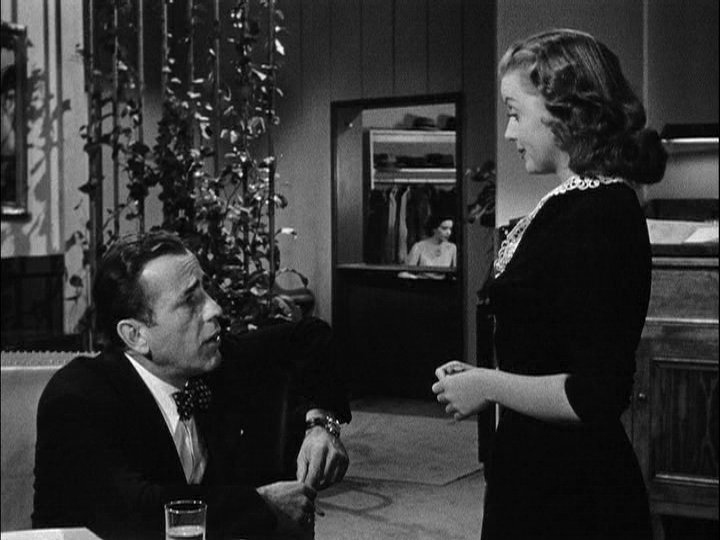
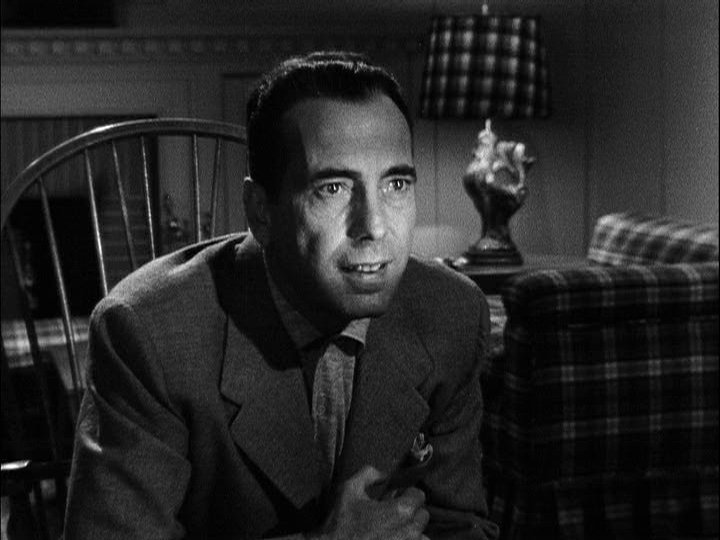
In a Lonely Place (Nicholas Ray, 1950) Risky Hollywood-noir/murder mystery/psychological drama produced by Humphrey Bogart's Santana Production Company and directed with a sure grip by the great Nicholas Ray. Bogart plays Dixon Steele, a hot-headed screenwriter on a cold streak. His temper has gotten him into a lot of violent scrapes that the studios have managed to sweep under the rug. Now, a hat-check girl that was in his apartment the night before has turned up strangled and the police are certain he was the culprit.

His one alibi is his neighbor, Laurel Gray (
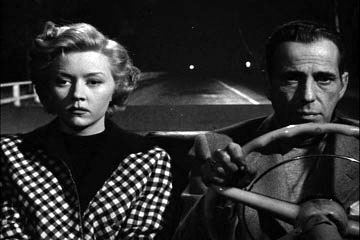
Gloria Grahame), part-time actress, who has a fairly air-tight alibi for Steele, and the two of them subsequently begin an affair that keeps Steele on the straight-and-narrow and the police suspicious. They'd be less tenacious if he didn't have that long rap sheet, the sick sense of humor and the unhealthy glint in his eyes when the subject of murder comes up. Steele is an odd bird who can't control his temper and pretty soon the police's suspicions make Laurel have her doubts which Dix only amplifies by his actions.

Can love survive?
Can Laurel?

This is a great mystery in which the central murder ultimately doesn't matter; the players and their ability to destroy each other in a cynical battle of survival when they're at their most vulnerable does. Gloria Grahame, who would endure a career of also-ran women's roles, displays the gifts of a great character actress in the lead. And Bogart exploits his dual persona playing a bad-good man (or is that the other way around?) who has no control and betrays a self-loathing that's painful to watch. 
He and Grahame are great together—she's one of the few women who doesn't kiss Bogart awkwardly, and their relationship feels real and not phony—and the screenplay crackles with the good dialogue that makes great Bogart movies. That the movie is taking shots at Hollywood and the loungy L.A. lifestyle is merely a refreshing bonus (What was it about 1950 that turned out all these anti-Hollywood movies?). Bogart is at his best when he's taking chances with his material, and In a Lonely Place provides a wealth of opportunities: a creative murder mystery with a great romance and the possibility of mutual self-destruction. It's a stunning noir that's a highlight of the careers of all parties.

Wednesday, June 21, 2017

The American Friend

The American Friend (Wim Wenders, 1977) Of all the "Talented Mr. Ripley's" that emerged from the poison-pen of Patricia Highsmith, there was never one so unusual as this adaptation. Wim Wenders had been looking for a Highsmith property to adapt, and came up trumps—all the writings of the author of "Strangers on a Train" had been secured for adaptation. And when the elderly Highsmith met with Wenders, she was suitably impressed to present him with a prize she'd been saving, the galley of the unpublished "Ripley's Game," her third novel in the exploits of Tom Ripley, American A-type (amoral, asexual) sociopath, who's managed through murder, masquerade and machiavellian tactics to make himself a very rich, cultured man in the selling of forged paintings.

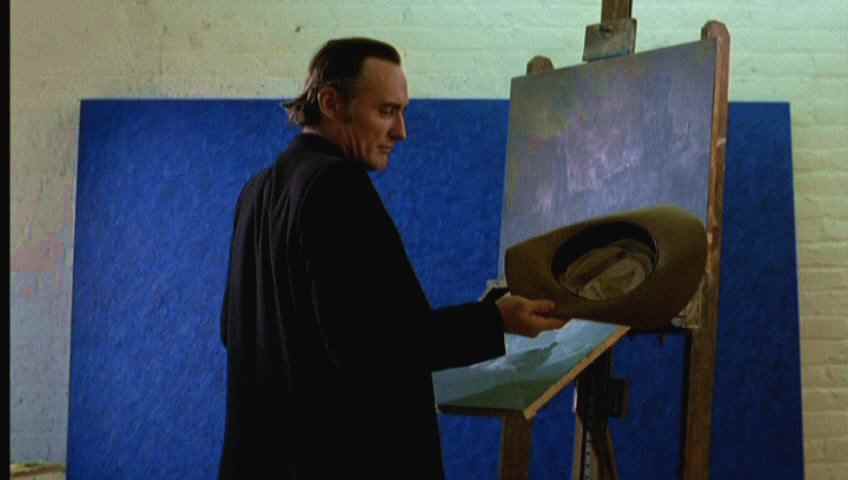
There've been many Ripleys: you could say that Robert Walker's Bruno Antony in Hitchcock's adaptation of Strangers... was a good blueprint, but then Alain Delon had played the character in René Clément's Purple Noon, Barry Pepper in Ripley Underground, the almost-respectable adaptation of the first book starred Matt Damon, and John Malkovich portrayed him in the remake of Ripley's Game. She initially didn't like Dennis Hopper's portrayal of "a cowboy in Hamburg," but she came around.
This was Hopper's first movie after the strung-out (in all meanings of the term) work he'd done as the fried photojournalist in Apocalypse Now, and the contrast couldn't be more striking. Hopper's Ripley is quiet, almost shy, highly observational—check out the once over he gives Bruno Ganz in the gallery—and highly self-reflexive.
His Ripley seems to believe that a movie is being made about him, and he's constantly recording himself, and taking self-polaroids. But, in action, his Ripley is fast, savage, uncompromising, and truly scary.
He's matched, step by clumsy step, by Bruno Ganz as the hapless picture framer, Jonathan Zimmermann, who becomes entangled in Ripley's scheme to provide for his family as he's dying. 
Wenders has fun with the film, casting many directors in prominent roles, most notable to American audiences, two experts of the crime film, Nicholas Ray (he portrays Ripley's one-eyed genius of a forger) and Sam Fuller, who plays the snakish gangster at the center of the plot. 


Also of note is the incredible work of director of photography Robby Müller, who manages to make every location suffuse with an unnatural glow of evil.
Ultimately, though, it is a love story. Whatever Ripley's motivations, his squiring of Zimmermann through a series of plots, murders and misadventures, secures the man a fortunate death. In the Malkovich Ripley's Game, the character celebrates his accomplishments by luxuriating in a sumptuous concert performance, but The American Friend is much more heart-breaking. Ripley observes the final act of Zimmermann on a beach, embracing a pier support, a sad, satisfied smile on his face, alone with his triumph. Simple, poignant, and a glimpse into a monster's heart, it is the one I prefer.