 The Red Shoes (The Archers, 1948) A film considered by many toilers in the field (including Brian DePalma and Martin Scorsese) to be the most beautiful film ever made. It's also one of the most ingenious and ambitious (typical of of the writer-director-producer team of Powell and Pressburger), combining Hans Christian Andersen's story of a compulsively dancing set of ballet slippers (told in dance form) that takes over the soul of a woman, and couching it in a modern re-telling of the story, where magic is replaced by ambition, and the story parallels the real-life story of Russian impresario Sergei Diaghilev and his relationship with a British ballet dancer, Diana Gould. Fantasy becomes psychology, and the Fates stay the same; that's a pretty bold statement on the power of myth and myth-making, both in the worlds of fairy-tales and The Arts. And it's the kind of Deep Thought that Powell and Pressburger brought to the conception of their films. Modern audiences may find them overwrought (and TOO "British?"), but that's missing the forest for the trees. Let's agree to call it hyper-theatricality. The Archers made exquisite films of subtlety and sophistication, and imaginatively bridged the fine cinematic line between reality and fantasy...and sanity and madness.*

The story is an expansion of Andersen's tale of a woman who loves to dance, is given a pair of magical shoes that fulfills her desires...only too well...finally dancing her to her doom. Here, Vicky Page (the vivid...there's no other way to say it...Moira Shearer) is a dancer of great ambitions, but circumstances bring her into the orbit of ballet impresario Boris Lermontov (Anton Walbrook), who, impressed by her devotion to "The Dance" brings her into his company. Given the chance to be a prima ballerina, she is also torn by her love for young composer Julian Craster (Marius Goring), who composes her signature ballet ("The Red Shoes", natch') for her, specifically. The pressures of touring, and the constant strains both physical and emotional, spurred on by the controlling Lermontov, conflict with her love for Julian, but it's a metaphor, as much as The Red Shoes is, she is conflicted between her love of dancing and her love for the man.
And then, there are the images:
 They are startling. Each frame could be hung on the wall of a gallery. With the deep tones of a black-and-white film, but in eye-popping, arresting Technicolor, composed with equal attention to composition and detail. Each advances the story-line, but moves deeper into the very psychology of the actors on stage.
But, they're moving in three-dimensions, and each edit to another shot is a new revelation that startles and pleases the eye.** This is incredible, sumptuous film-making using the combined skills of art and photo-chemistry. Every time I hear someone extolling the virtues of today's digital bleaching and leeching of color, I know they haven't seen this film and its full-to-dripping palette.
 |
| Choices that hurt the brain: In the middle of a performance, reality and fantasy merge in the conflicted heart of dancer Victoria Page (Moira Shearer). The stress in the face is manifested by the dancer's physical exertions by beads of sweat and welling tears. |
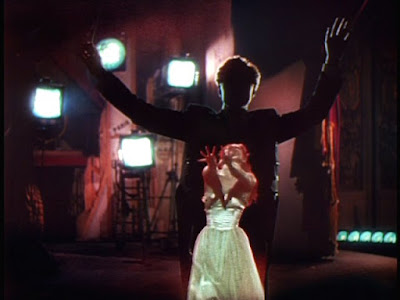 |
In one of the most startling images/special effects in The Red Shoes Vicky, in performance, imagines an image of her composer-lover, which she rushes to and falls through, a dream-like nightmarish image of the traps of love.
Lermontov (Anton Walbrook), a dark figure in the shadow of the wings
Helen's conflict in a single image
|
The body of a dancer must be that of an athlete's. Strong, focused, and tough, as tough as the soles of their feet...as calloused as their toes. But what can come of that pirouetting figure, spinning, when it is in mortal conflict between a romantic heart and an artistic soul for possession of the self? Which ever way the music turns, love conquers all. That is the heart of The Red Shoes, and like the cautionary folk-tale that inspired it, that does not necessarily mean that everything ends "happily ever after."
One of those movies you should see before you kick, balletically or not.
* I can't help but think that Darren Aronofsky's Natalie Portman ballerina psycho-drama Black Swan (which we'll look at tomorrow) has also been massively influenced by this film, as well (although, given the trailer's theme of "You Must Find Your Passion," it sounds a bit more like "Red Shoe Diaries"), but one hopes Aronofsky's dark sensibilities (and dabblings in theory, both mathematical and sociological) will be the dominant underpinnings.
** Yeah, yeah, I know. The previous sentences are as generic as they could be; that is what film-making SHOULD be, after all. Unfortunately, as the better the technology has become, the fundamentals of film-making as ticked off in those sentences seem to be lacking in most product. The Red Shoes is a shining (one might even say, glowing) example of taking the art to a new level.
 Cameraman: The Life and Work of Jack Cardiff (Craig McCall, 2010) I love films about cinematography and there are damned few of them; I tend to come away with a new appreciation of light and vision, and the world looks fresh and new, bright and awash with color. It happens so rarely when I watch films where the world seems different post-movie—the films of Orson Welles or Nicholas Roeg do that to me...and films about cinematography.*


