Showing posts with label James L. Brooks. Show all posts

Wednesday, October 21, 2026

Update: Now I've Seen Everything Dept.: James L. Brooks

"Throw It in the Air and See Where It Lands"


James Lawrence Brooks, the writer, pens things that James L. Brooks, the director, finds hard to bring to the screen. Brooks will tinker and hone, experiment and kibitz, noodge and futz, then re-think, re-edit, even re-shoot his movie to steer it more towards his original vision (which, in the process, probably changed, as well).

Polishing, always polishing.

Starting out in journalism, then moving to TV, where he helped to create "The Mary Tyler Moore Show" (and its spin-offs, "Rhoda" and "Lou Grant") and "Taxi," Brooks garnered enough Emmy Awards to crack the sturdiest mantelpiece, then moved to films, first writing and co-producing Starting Over, then settling into the director's chair for a series of films that garnered critical acclaim and substantial box office. From his first film, he has garnered acclaim and awards, and if his films draw less attention than they have in the past, maybe it's because if you get too much quality...you might get bored with it after awhile.

Oh, yeah?    Bring it on.


Terms of Endearment (1983) This is the better version of Steel Magnolias. A movie about independent free-thinking daughters and the clinging mothers they drive crazy, it features some unpleasant people in unpleasant circumstances and a great deal about cancer and yet, it still defied that formula for box-office poison and made zillions of dollars, with good reason. Smart, funny, poignant to the point of producing tears, and even tough, it went on to win the Academy Awards for Best Picture, Best Supporting Actor (Jack Nicholson) and Best Actress (Shirley MacLaine, although if there was any latitude in the Academy rules, Debra Winger should have been a co-winner).  Based loosely on Larry McMurtry's very good novel, Brooks took the Houston locale added Nicholson's character as an aging lothario-astronaut, who is brought temporarily to Earth by MacLaine's Aurora Greenway, still imagining herself a rose in full blossom. The script is tart, funny, and not afraid to challenge an audience's perceptions of how lead characters should act. It feels real...like life, only much better written. Terms of Endearment is a "chick" film that any sex can enjoy.


Broadcast News (1986) Brooks looks at the "new" TV journalism that started to tip into flash over substance and heat over illumination with this rom-dram-com about a triangle of news people with different styles. Everybody loves perky news producer Jane Craig (Holly Hunter), but who'll get her: Aaron (Albert Brooks) the smartly acerbic reporter with substance who Jane respects (even though he's something of a schlemazzle, or Tom (William Hurt), the dimly hunky anchor who skates on his looks and provokes lust in Jane? The answer is that one must follow one's heart, however painful that may be. That Brooks ties the fates of Jane and The Truth together is risky but brilliant, and Broadcast News has both food for thought and the soul. It also catapulted Holly Hunter (in a brilliant performance) into the A-list after Raising Arizona, but everybody does a great job in this one—it certainly showcases how great Albert Brooks can be given proper material. Jack Nicholson has a cameo as a national news icon. The script is full of smart clever dialogue that is imminently quotable.*

And then, "The Simpsons" happened. Brooks hired Matt Groening to do interstitials for his production of "The Tracey Ullman Show" and the characters took off, spawning the longest-running animated show in television history. It created an empire for Fox, and a supervising responsibility for Brooks, who has shepherded the show throughout its run, directing the cast of talent for the inevitable The Simpsons Movie, which only came out in 2007.


I'll Do Anything (1994)  I'm sure someday we'll see a restored version of this film,** which started off as a musical (starring Nick Nolte??) at a time when folks hated musicals and stayed away from them in droves. Brooks always tinkers with his film obsessively, but after bad previews, he savaged this film, taking out all traces of musical numbers, and filming new segments to bridge the considerable gaps. The story of a self-obsessed actor, who suddenly finds himself in charge of the life and (oooh, bitter irony!) burgeoning acting career of his pint-sized daughter,*** the film is full of wit and and wisdom, but feels a bit rarefied. And losing the connective tent-poles of the songs really hurts the film. Try as Brooks did to stitch it together, the film feels anemic and "not very there," a carcass of a film. The songs, by the way, were contributed by Carole King, Jackson Brown, Prince and Sinéad O'Connor and were staged with choreography by Twyla Tharp. Brooks has mentioned that he'd like to do a "Director's Cut" putting the numbers back in, but it has never come to fruition.


As Good As It Gets (1997) Melvin Udall (Jack Nicholson) is absolutely the worst person in the world. A writer (of romance novels)
he leads a self-imposed cloistered existence: he's obsessive-compulsive, an hysterical germaphobe, and a complete and total jerk. He has his routine down, and everything else—including relationships of any kind outside service-work—is too messy to be bothered with.****

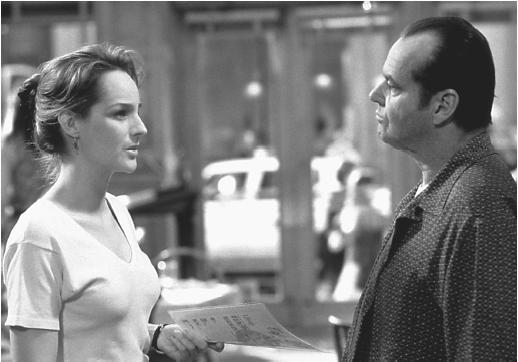
Well, as Brooks displays again and again, life is messy. The only waitress who'll wait on him (Helen Hunt) he becomes attached to, paying for her son's treatment of asthma. Then when his gay neighbor (Greg Kinnear) is seriously injured in an assault, Melvin has to take care of they guy's dog. As with his unwillingness to step on cracks in the sidewalk, Melvin starts to take baby-steps to accomplish his goals and enter the world of humanity again. Cracks start to form in his own shell, as he bonds with the dog (everything, it seems, is helped with bacon), and begins to think altruistically...sort of. It's an unsettling kind of heart-warming story (almost veering into heart-burn), and quite messy in itself, but the players are note-perfect (Nicholson and Hunt won Oscars for Best Lead Performances)


Spanglish (2004) After avoiding this one for years due to its bad word-of-mouth, I finally saw it and fell in love with it. Shows ya what "the experts" know. Successful chef John Clasky (Adam Sandler, remarkably restrained and warm) is having panic attacks over a new restaurant he's opening, his wife (Téa Leoni, remarkably off-putting in a brave performance) is a neurotic control freak, and the only semblance of normalcy in their lives is the insertion of an immigrant housekeeper (the enchanting Paz Vega) and her precocious daughter who acts as interpreter. Again, Brooks takes a situation with high-end professionals and makes them down to Earth with foibles and flaws, but the emphasis here is on responsibility and dedication of duty to the important matters of life. There are the inevitable culture clashes and meldings that put strains on all relationships, but Brooks keeps it entertaining while not ignoring the grit that makes things...interesting. Love this movie.*****


How Do You Know (2010) This one probably should have had the title "Trouble with the Curve" (instead of the Clint Eastwood-Amy Adams movie). It's a bit early for Brooks to be repeating himself with the "Who is she going to end up with?" formula from Broadcast News, but that's what How Do You Know most resembles, but without the substantial background of the earlier film. Reese Witherspoon plays a baseballer who is drummed out of the league, while her boyfriend (Owen Wilson) still has a successful career. Meanwhile, Paul Rudd plays an executive who is fired from his father's (Jack Nicholson) company due to a federal investigation and is at a loss, professionally and in his love life. Witherspoon and Rudd date, but the results are a disaster. Still, they're drawn to each other in a weird "if we're falling off a cliff, maybe it'd be better to hold hands" way. It feels forced, as with any comparison the movie tries to make between the baseball and corporate milieus, and both worlds are rather sketchily drawn to have any real depth of meaning. It's trying to say something about the trials and tribulations of transitioning between first and second acts in life (post-Wall Street crash) but falls prey to the same problem, dramatically. Not a very successful film, and it seems to be an issue with the script than with the execution.
 
 
Ella McCay (2025) Brooks' first film in fifteen years follows the arc he established in Broadcast News, but the workplace setting this time is in the world of politics, which is as compromising an environment to an individual's ethics as one can be. Politics is, at its heart, compromise.

The titular Ella (Emma Mackey in a terrific performance) is the lieutenant-governor of an unspecified state. She is, in her heart, a civil servant, a "policy wonk," not a career politician, a "community organizer" type focused on tackling issues as opposed to being a figurehead politician like her mentor, Governor Bill Moore (Albert Brooks), who has been offered a cabinet position in the current federal administration. Moore is going to resign his post to take the job and wants Ella, his next-in-line, to fill out the gubernatorial chair for the rest of his term, despite her not being popular in her party's establishment. Seems she's not too good at delivering "sound-bite messages."
 
Her unpolished political image gets her in trouble early, especially when she's challenged with the self-interests of personal relations, specifically her man-child of a husband (Jack Lowden) and her sociopathic father (Woody Harrelson). That it all happens under the glare of news-cameras and a hostile political hierarchy, escalates the stakes and blows things out of proportion, beyond Ella's capacity to cope. Even with the help of her cynical aunt (Jamie Lee Curtis).
 
In many ways, Ella McCay feels like the product of a bygone age, even though it's quite up-to-date depicting the ruthlessness of politics, elected officials spending so much time in phone mills shilling for contributions, and out-of-control relatives risking their own better-connected golden gooses. Perhaps Brooks is trying to say that power corrupts even the un-empowered, in which case, "yeah, I watch the news". And "opportunism' is highlighted in my dictionary. Nothing surprising here, other than the message that, in today's politics, in order to make a difference, you have to fall on your own sword if it means doing any good. Which may explain why we have a do-nothing government run by senior-center inmates. Or not. It's a bit vague on what it's trying to say other than 'politics sucks' and nobody's a good judge of character. In which case, to repeat what I said earlier, "yeah...etc."

 
Shhhh!  Ba-da-dum-da-dumdum-dah-dumdum

* My favorite: After staff cut-backs at the network, an exec puts on his "bad news" face to ask if there's anything he can do for a laid-off employee.  The old veteran newsie, box-in-hand, pauses and says: "Well...you could die soon."

** Yeah, but then, that would depend on the idiosyncratic Prince, who wrote the songs, to give permission to allow that to happen.  Brooks made a documentary about the making and unmaking of this film, but due to the same Prince-ly issue, it has never been released.

*** The situation was brilliantly but succinctly put in my real life by an actor-friend who commented on the life-transforming birth of his daughter: "I thought I was President of the United States. Now, I realize I'm just the Secret Service."  

**** Of COURSE, he writes romance novels!  He has no reality to dim the fantasy!


***** And, for some reason, one of the most memorable things about Spanglish is"The Ultimate Sandwich" that Clasky makes at one point. Here's the remarkable recipe.


Sunday, July 18, 2021

Don't Make a Scene: Broadcast News

The Story:
It's been a tough time for the news business. The internet has dried up the source-revenue of classified ads for newspapers, and broadcast news outlets have to compete with 24-hour-a-day news channels that scroll headlines if the President gets a hang-nail. Then, there's the clowns and bone-heads bleating about "fake news" whenever it's a story that they don't like or doesn't fawn enough—it was ever thus—or if it conflicts with their own lies or junk headlines.

So, it's tough—tougher—to make a living trying to get substantial information float above the swill of opinions or advertising posing as news. And as revenues drop, so do staff, whether they group tries to hang in there, or whether it gets bought up by a conglomerate, who then take even more draconian measures to please investors or themselves. And when costs get cut, it's usually the lower-paid staff who are let go, because it's so much "easier" to cut costs in little dribs and drabs than to drop any higher-paid management—which always makes business sense. "Penny-wise..."

This scene from Broadcast News came to mind with all the "Tax the Rich" talk that's been going on. In it, Jack Nicholson's high-profile news anchor pays a visit to "the trenches" to buck up morale on the day a big lay-off happens. And as Dave Barry once wrote: "You can tell it's bad news when the network anchor has his frowny-face on." Nicholson had just won his second Oscar for Brooks' Terms of Endearment and paid it back by agreeing to be in what is essentially a cameo roll—for no money (he was about to get a big pay-out playing The Joker in 1989's Batman and was prepping The Two Jakes, the long-anticipated sequel to Chinatown, at the time). And his reaction to the news exec's little quip is full of (what the script describes as) "grace and dignity." And more than a little dismissal. At least, he didn't start a diatribe about "destroying capitalism" and "creeping Socialism." Nicholson's Jake Gittes would ask "...how much better could you eat?..."

Meanwhile, the less-prestigious workers have to display the same "grace and dignity" while they have their worlds turned upside-down.

My reaction would be more like the newsie who responds to Paul's regretful sentiment of "If there's ANY-thing I can do..." with "Well...you could DIE soon..."

The Set-up: The Network is cutting back news-jobs today, and the National Anchorman Bill Rorish (Jack Nicholson) has come back to show his support. Network Exec Paul Moore (Peter Hackes) escorts him through his old haunts.

5, 4, 3, 2,...

116 INT. NEWSROOM - DAY
BILL ...be my pleasure... 
116 Paul arriving with Bill Rorish. The first time we have seen the multi-millionaire anchorman in the flesh. He has the grace and dignity of a man who spends every waking moment working on grace and dignity. He and Paul are in the midst of an important conversation -- muted and ominous.
MAIL-ROOM Guy: Mr. Rorish? 
BILL Just when do you start telling people? 
PAUL Almost immediately, Bill.
BILL I’d like to take everyone out after the show.
PAUL: Fantastic.
BILL: Hello, Donnie!
DONNIE: Bill! What a surprise!
BILL: Good to see you again...
STAFFER: Mr. Rorish! 
PAUL Bill...This is hard on all of us... 
PAUL: ...and it’s no time for compliments. 
PAUL: But I think it’s extraordinary of you to come down here for this. 
BILL If we’re not here for each other during the tough times, we’re not a news organization.
BLAIR: Bill! 
Blair ENTERS scene. The smallest flicker of interest from Bill, but more than enough to justify her going into hock for the outfit. 
BLAIR Welcome...
BLAIR ...back to Washington...
BLAIR ...Bill. 
BILL Well, thank you. Thank you.
BILL Thank you... 
A self-conscious look of greeting to Paul and she’s gone. 
BILL I’ve forgotten. Was she on the list?
Paul nods “yes” 
BILL This is a brutal layoff...
BILL And all because they couldn’t program Wednesday nights. 
PAUL (can’t resist) You can make it a little less brutal by... 
PAUL: ...knocking a million dollars or so off your salary. 
AS Bill turns: 
PAUL Just a bad joke. I’m sorry. Awful. It’s a miserable day...
PAUL ...and that was some kind of totally sick-joke defense mechanism
PAUL ...which does not indicate any of my feelings 
PAUL -- not one -- 
PAUL ...but just shows the kind of stress... 
PAUL ...this represents... 
PAUL ...for all of us.


Broadcast News is available on DVD and Blu-Ray on Twentieth Century Fox Home Entertainment and the Criterion Collection.