Showing posts with label Frank McHugh. Show all posts

Wednesday, September 26, 2018

The Dawn Patrol (1930)

The Dawn Patrol (aka "Flight Commander")(Howard Hawks, 1930) Howard Hawks was a director-producer adept at many genres of film—adventure, detective (including noir), gangster, comedy, musical, even sci-fi—but what is surprising is that Hawks rarely made a war film, despite having a style-template that would prove a natural of that genre—a Hawks film usually features a disparate collection of individuals from different backgrounds and different attitudes coming together with a common goal. That summation forms the basis of most war films that one could name, but from other film-makers taking the Hawks play-book as its core. Hawks wasn't interested in war, he was interested in the challenges of creation, of the challenge itself and achieving a goal, not destruction. For Hawks, as evidenced by omission, war seemed to be a waste...and a waste of time. Even during World War II, when Hollywood was cranking out war films, Hawks made only one of his three—Air Force, which told the story of a "lost" flight that takes off with the United States at peace and lands with the United States under attack.* And when he did make war films, they were different—Sergeant York celebrated an American hero who did not want to go to war, Air Force about the challenges when the world has changed and there's no infrastructure. And The Dawn Patrol—1930 edition—is about the brotherhood of pilots at the dawn of flight who are learning the nuances of fighting in the air...but are being decimated by a combination of bureaucratic impatience and incompetence and...not giving a damn. 
A war film that celebrates the bravery of the fighters while also decrying the waste that sends them to an early grave? That's an anti-war film.

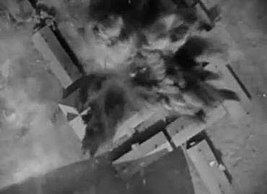
Remember The Dawn Patrol? Eight years earlier, Howard Hawks made the first version during the "Pre-Code" era, based on a story by John Monk Saunders and his own experiences as an aviation instructor during the first World War—Hawks piloted and appeared as one of the German fighters in this film—so impressive were the aerial scenes of the Hawks version that many of the flying sequences were directly incorporated into the remake. But, there are differences, although the story is basically the same.
Mostly, it's a difference in how it is played. The Erroll Flynn-David Niven-Basil Rathbone version is a bit more larky, and the relationships between Richard Barthlemess, Douglas Fairbanks Jr. and Neil Hamilton (playing the same characters) are quite a bit different, particularly in the character of Major Brand. Rathbone plays him with a stiff upper lip and a martinet's cool. But, Hamilton's Brand is a man snapping under pressure, and although the actor's playing of it is (to put it charitably) over the top, it speaks more to the point of the film's central theme—although the pilots are the targets, it is Brand who is in the barrel, fighting a battle he cannot win and only seeing casualties, confronted with it every day, ("It's a slaughterhouse out there and I'm the executioner!") paying the price for overseeing a revolving door of death which he must oversee.
The film begins with a foreword: "The late Fall of 1915 in France, when a great country was forced to entrust its salvation to youth -- painfully young, inexperienced, bewildered--but gloriously reckless with patriotism -- proud and eager to rush hopelessly into combat against the veteran warriors of the enemy."

That's the last we'll hear in the movie of patriotism. The rest will be personal honor and respect among the fliers extended even to the enemy who salute the pilots they shoot down. And, as in Only Angels Have Wings, little to no time is wasted on sentimentality—mourning is bad taste and bad for morale—instead, the dead are celebrated in impromptu wakes at the aerodrome's bar, which does a steady business long into the night.
The conflict is done less in the air and against the enemy as it is against "the system." In a dark page out of "Catch-22," the aerial missions are usually dangerous—the pilots are targets for anti-aircraft guns and the German fliers on the other side determined to shoot them down. There are inevitable casualties among the fliers, and replacements are called upon to replace them.

Those recruits become increasingly younger and less experienced. And the main conflict that Richard Barthlemess' Courtney has with Brand is that the new kids are sent into the air with absolutely no training for the missions, making them easy targets and to the veteran pilot's mind unnecessary ones. But Brand is under orders to send them up as soon as possible and his vehement protests are ignored by the commanders giving the orders over the telephone, not even making an appearance so close to the front lines.
It is the unseen commanders that Hawks obviously has the most contempt for, and sees as the real enemy of the war, above even the Germans on the other side. Years later, in The Big Sleep, Hawks would have Bogart's version of Philip Marlowe bitterly curl his broken lip when describing a high society gangster as "a killer by remote control"—unwilling to take responsibility or get his hands or reputation dirty by doing the act himself. Hawks doesn't even give the officers and generals any screen-time, allowing their voices to be heard over the phone—they're not even there—just emotionless button-pushers with no regard for the fliers they send to their death, and have no repercussions for their actions.
Brand cracks under the pressure and strain, but that doesn't stop him being promoted, and taunting Courtney that, as senior pilot, he has been chosen to replace him, so that he can be placed in the same impossible bind of his adversary. That "promotion" will also separate him from the other fliers, as he is now seen as responsible for the deaths that the pilots regularly drink to forget. 

One could say that Courtney, too, "cracks" under the strain of the job, but in an entirely different, "professional" manner that Hawks would approve of, solving a problem that his duties demand of him, but not the essential one of a conflict that wastes lives and talent that would seem intolerable to a director who chose to celebrate life, even in the darkest of times.

* Hawks did make Sergeant York starring Gary Cooper before the attack on Pearl Harbor—sailors at Pearl were watching it on December 6th—but Hawks was hired as director in a project he didn't initiate and at the behest of Gary Cooper. 

Tuesday, July 3, 2018

The Roaring Twenties

The Roaring Twenties (Raoul Walsh, 1939) 
Forward: "It may come to pass that, at some distant date, we will be confronted with another period similar to the one depicted in this photoplay. If that happens, I pray that the events, as dramatized here, will be remembered. In this film the characters are composites of people I knew, and the situations are those that actually occurred. Bitter or sweet, most memories become precious as the years move on. This film is a memory—and I am grateful for it."  Mark Hellinger.

Every decade is full of event, often to the point where the world of the 0's is very far afield of the one in the 9's (of course, if you're "of an age" you can always find an exception to the rule—Hell-o, '80's). The 1920's started with troops coming home from World War I to become "the lost generation" while the country was experimenting with Prohibition. Rather than the temperance leagues creating a heaven on Earth by exorcising the demo rum, everything went to Hell with the rise of illegal liquor manufacturers, the rise of organized crime to gain some monetary control over the free-for-all, "the jazz age," flappers, wild dancing and, as with any "bender," a collapse...of the Stock Market in 1929. The Nation went from speak-easy's to soup kitchen's. Prohibition wasn't nearly as sobering as the Wall Street Crash.
It's the time of World War I, and trench soldiers Eddie Bartlett (James Cagney),  George Hally (Humphrey Bogart), and Lloyd Hart (Jeffrey Lynn) are spending the last few hours of the War To End All Wars, just trying to survive it. They have no idea that their last acts in the conflict will be their final as soldiers and they're already thinking to what they'll be doing in peacetime. Hart had just graduated from Harvard law school and that's what he'll be doing; Eddie just wants to get back to being a mechanic; Hally ran a saloon. Hart takes aim at a German soldier and hesitates—"He looks like a kid, about 15 years old." Hally fires. "He won't be sixteen."

Another soldier dives in to the "hold." The war is over. Peace-time begins.
Not that peace-time will be easy. Lloyd does become a lawyer, Hally comes back to the States when the country is in the fever to make the country dry through Prohibition—not a good job prospect for a saloon-keeper—so he becomes a bootlegger and Eddie can't get his job back as a mechanic, so he starts driving a hack to get by. 
His fortunes change a bit when a fare hires him to deliver a package to Panama Smith (Gladys George), who runs a speakeasy and that "package" turns out to be a shipment of booze. Eddie has the bad luck to deliver it right before the place is raided by the cops and he and Panama are escorted to jail. At trial, Panama gets acquitted, but Eddie takes the fall without revealing he was an innocent dupe. He does time, but once he's out, Panama repays the favor of not ratting her out by taking him on as a business partner in her own bootlegging enterprise. Taking a note from experience, Eddie starts buying up a fleet of cabs to used for "distribution" and the two start to prosper, Eddie becomes a bit of a high-roller.
Around this time, he runs into Jean Sherman (Priscilla Lane), a gal he knew from her writing to him in the war when she was in high school. She's all grown up now and he takes enough of an interest that he gets her a job as a chanteuse at the club Panama is propping up as the hostess.
Eddie does very well with taxi-delivery business, but he makes a mint as a boot-legger; he has sure-fire ways to solve the supply and demand issues of the industry—besides watering down their own product, he also takes advantage of the enterprise's illegality by tipping off the constabulary to the shipments of competitors, then raiding the warehouses where said constabulary keep it as evidence for disposal. This creates some tensions among the competing distributors—Eddie gains a lieutenant in Jeff, when he finds him on one of their raids, but Eddie's buddy Danny Green (Frank McHugh) is killed when he tries to broker a deal between the rivals.
That's Eddie's professional life. His personal life doesn't go so well. He's sweet on Jean, his singer-friend, but she'd rather be with Lloyd, now Eddie's lawyer, who's successful, good-looking and who doesn't stink like bathtub gin. Eddie barely stops himself from changing his reputation by way of smacking him in the face. He wants what's best for Jean, and if it's Lloyd, that's the way the drink is poured.
Wall Street literally melts, thanks to Warners FX wizards in The Roaring Twenties
The name of the movie, though, is The Roaring Twenties, so the stock market crash can't be too far in the future—and it's represented by surrealistic effects shots of Wall Street skyscrapers melting off the screen. The Depression manages to kick Eddie's assets and he's forced to humiliate himself by asking Jeff to buy him out so he can pay his debts. Jeff, being the vindictive sort, does so gladly, leaving Eddie with only one remaining cab with which he can eke out a living.
It's a precipitous come-down for Eddie, and, combined with the repeal of Prohibition, he falls prey to the very vice that he has earlier profited from—he becomes a drunk and susceptible to sentimental foolhardy urges that he was always too careful, too smart and calculating to indulge in before.
It's another of the Warner Studio's cautionary tales where the smart guy gets his comeuppance, and the street-wise becomes confronted with events far beyond his capacity to control, and is punished, all the while the film revels in the very exploits, good and ill, that he is ultimately judged for. Eddie will eventually die on the steps of a church, just shy of its doors and any possible redemption.

He won't make it to the '30's.