Showing posts with label Dev Patel. Show all posts

Friday, October 6, 2023

Roald Dahl Short Stories by Wes Anderson

Wes Anderson (as we've been saying repeatedly with every new film of his) has a child-like glee and sensibility to his film-making. They are informed by, suggest, and embrace the point-of-view of a child, his films frequently featuring children, reflecting nostalgia for pop-culture touchstones be they arcane film-making techniques like stop-motion animation, or technologies like 45 record-players, or memories like TV specials that actually were special. More and more his movies take place in carefully constructed stages that act like complicated play-sets, cantilevering and hoisting and changing backgrounds like a grade-school auditorium stage that has practiced Union stage-hands. Or the invisible hands of a child re-arranging a doll-house.

That he should turn his attention to the short stories of Roald Dahl isn't so surprising—he'd already adapted Fantastic Mr. Fox in stop-motion animation. And Dahl's adult sense of what children like fits comfortably in his director's chair—funny, frightening, surrealistic, but an eye that wanders towards and reveres goodness, even in the face of challenges. An embracing of the wonder of it all. A raised eyebrow at the foibles of his characters, a wisdom that encompasses but that can also be disappointed. The slight touch of cynicism that reassures children they're not being bull-shitted.
So, I was looking forward to "The Wonderful Story of Henry Sugar" that he was adapting for Netflix.* But when it dropped, imagine my delight that he included three other stories, all with the mechanical precision of place, a child's sense of play, and a complete disdain for the fourth wall. Filmed in studio, they follow the same tack as his set transitions in The French Dispatch and Asteroid City, where the actors stay stagnant while the surroundings change around them. All of the actors read the text/perform the text as if they were narrating their own story with asides, glanced at notes of action, and acknowledgment of the audience in the telling of the tale. He'd done this for brief swatches of other films, but here, it is the film. In their brio and multi-media stage-craft, they have the same delightful effect as Orson Welles' presentation "for the tube" for Desilu Studios called The Fountain of Youth.
As one can see from the video above, Welles did very little that was cinematic or had any depth of field, but made his story for the square TV tube of low resolution, fitting the presentation to the strengths—and weaknesses—of the medium. Anderson does the same thing, making his short stories for a medium that can be either a computer screen or (god forbid!) a phone app. Of course, one could miss little details—like Benedict Cumberbatch twitching his mouth in "Poison" or that a "Missing" poster in "The Rat Catcher" has a drawing of Owen Wilson—but, seeing it on a larger monitor than an Android does yield benefits.
 
The cast is limited in number: Benedict Cumberbatch, Ralph FiennesBen Kingsley, Dev PatelRichard Ayoade, and Rupert Friend (who take roles in more than one of the stories and, as in "The Wonderful Story of Henry Sugar," more than one role in the piece) as well as a clutch of extras and "stagehands" who fill out the illusion and dispense with unnecessary "business," respectively. 

Here are the stories:

The Wonderful Story of Henry Sugar The longest of the shorts—at 29 minutes—it's a nesting doll of stories. A writer (Dahl, from the look of things, played by Fiennes) tells the tale of Henry Sugar (Cumberbatch) of whom the writer says “Men like Henry Sugar are to be found drifting like seaweed all over the world. They can be seen especially in London, New York, Paris, Nassau, Montego Bay, Cannes, and San Tropez. They are not particularly bad men, but they are not good men either. They are of no particular importance; they’re simply part of the decoration.” 
 
Sugar is a gambler of no great success until he comes across a slim volume in the library of an acquaintance. The title is "A Report on Imdad Khan: The Man Who Can See Without His Eyes by Z.Z. Chatterjee, December, 1935, Calcutta." Reading it, he discovers a strange story, a case study by a doctor (Patel) who met a man with a singular talent—with his eyes completely covered, this Imdad Khan (Kingsley) is able to discern objects quite clearly, navigating without aid of sight, either by foot or by bicycle, in his act he can thread a needle while his head is covered by a large metal drum. After the act, the doctor, Chatterjee asks Khan how he acquired such skills and the old man tells him his story.
Khan tells the story of how, at the age of 17, he encountered a yogi who could, during his concentrations, levitate in the air by a foot/foot-and-a-half. The yogi, miffed that his private hut has been found, and regretting it, teaches the young Khan his secret, a gradual practice of concentration that allowed the mind to focus
on a single thought until he was able to perceive with more than just his senses. After decades of practicing, Khan realizes that he can read cards from the back, navigate without the use of his eyes, read maps and even whole books in this method. "Well, well, well" says Henry as he reads the account. He has focused on only one aspect of the tale: the man had become able to read cards.
Henry rushes back to his London flat with one purpose on his mind—to use Imrad Khan's methods until he is able to read the backs of cards. He never leaves the flat—except for food and drink—and after 3 years, 3 months he is able to realize his goal to his satisfaction, which is to be able to read the back of a card within 5 seconds flat. Once he does that, he heads to the casino.
Once there, Sugar buys £10,000 worth of chips and goes to the blackjack table. When he is dealt a 19, Sugar flabbergasts the dealer by drawing on his cards. You don't draw on 19. You stick. Only eight cards of the standard 52 can be dealt which will not "bust" your hand—aces and twos. But, Sugar draws anyway—knowing what card will be next in the dealer's shoe—and receives a 2. He has 21. Although he has won, he's done so in such a way as to attract attention and he must change his strategy and his way of thinking.
 
How does it end? That would be telling.
 
But, the journey is thrilling. It's not done "in real time"—in one single delirious take—but it sure feels like it as it zips along from one happenstance to another. The pressure is really on the actors to get it precisely right while also keeping a pace about 50% faster than "reading along." At this, Cumberbatch (very much Cumberbatch!), Kingsley and Patel are quite adept, and it is only a few minutes after it is over that one considers the amount of time it must have taken to rehearse the damn thing! All of the shorts are like that—fast, breezy, precise—and it is only after the things are over that one starts to think about what they've just seen.

The Swan
"Some people," says the writer (Fiennes, again) "when they have taken too much and have been driven beyond the point of endurance, simply crumble and collapse and give up. Others however, though they are not many, who will for some reason always be unconquerable. You meet them in time of war and also in time of peace. They have an indomitable spirit. And nothing, neither pain, nor torture, nor threat of death will cause them to give up. Little Peter Watson was one of these."
 
Little Peter Watson is played by two actors (three actually, if you count the animated one): Asa Jennings (standing mute and play-acting) and Rupert Friend, who plays the older Peter recounting the tale and recreating (quite deftly) the voices of all the dramatis personnae: they are Peter, an avid bird-watcher and Ernie and Raymond, "dangerous, crazy, stupid boys," in possession of a rifle, given to Ernie on his birthday. The bullies proceed to shoot birds with their firearm and then turn their attention to a woodpecker that young Peter is spying at through binoculars, and, once the woodpecker has flown away due to their loud voices, they begin to threaten young Peter.
None of their dastardly behavior towards the boy—including tying him to a railroad track—is depicted at the boy, which would have been unsettling, but by Friend, who, by playing the older Peter assures us that he will survive, but also gives us the boy's inner thoughts which are resolute and determined. It's a story of the principled against the thuggish and provides a touch of surrealism that is a substitute for hope.

Poison
This one has been filmed twice before: as an episode of "Roald Dahl's Tales of the Unexpected" and as an episode of the original "Alfred Hitchcock Presents" directed by The Master himself. Anderson switches from Academy ratio box format to widescreen—the better to photograph the prone Cumberbatch who plays Harry Pope, an unfortunate man who is having an unfortunate night not getting to sleep. He is found by his associate Woods (Patel) prone in bed and speaking in a panicked whisper. When Woods creeps—at Pope's urgent instruction—to Pope's bed, the scared, sweating man informs him that a krait has slithered into his bed and is sleeping on his stomach. He's been laying there for hours daring not to move lest the deadly snake bite him and he'll be dead in seconds. Through clenched teeth, Harry implores his associate to get a doctor and Woods calls up Dr. Ganderbai (Kingsley) in the middle of the night to come to the bungalow to try to help his friend before it can become too late.
Woods and Ganderbai discuss what they can possibly do to help poor Harry. They dare not move him, the bed, the sheet covering him or anything to get to the snake. All they can do is give Harry the anti-venom first in the hope that if he DOES get bit he might survive, but the chances of that are about 50%. Together they devise a risky way to extricate the krait from Harry's body before it can attack him.
Two things of note: if you take a look at the bit of Hitchcock's version below, you'll see that there's a sub-text—in the adaptation by Casey Robinson—that Harry is a lush, and that Woods is a bit of a sadist, something that Anderson leaves out. This version does leave in Harry's innate racism. The pace of the thing is like the others—very quick and very precise—but Anderson puts in a few stretches of silence and held shots to ramp up the tension.
Here's a bit of Hitchcock's version from Season 4 (Episode 1) of "Alfred Hitchcock Presents"
 
The Rat Catcher
A "rodent operative" (Fiennes) is called when the Cubbage petrol station starts noticing a problem with the vermin. The station owner, Claud (Friend) answers the "rat-man's" questions, all of which are noted by the editor (Ayoade) of the local "News of the Day," which is located next door to the station (and presumably has the same problem).
 
It is obvious that the rat-man knows his profession, has much history with it,  and, in particular, knows rats...and very well. He takes great pride in his work, dismissing any amateur speculation, respect for his nemeses and for their ways and habits. He is like a military general analyzing the maneuvers of an enemy combatant. "You got to be clever on this job, cleverer than a rat and that's sayin' sumfin'" he says, through the two oversized upper teeth in the front of his mouth. If the old saying about what you become when you hunt dragons, is true, the rat-man has almost become what he has spent years hunting.
"You gotta know rats on this job"
But, the rat-man's fool-proof method of disposing of rats doesn't yield any positive (or one should say deadly) results. There are no rat bodies to dispose of and the rat-man is despondent. More than that, his pride is hurt and to puff it up again, he digs a little deeper into rat-lore and his history with rats until he takes it a bit too far...a move that turns the townspeople against him, let alone that he hasn't solved the rat-problem.
"The Rat Catcher" is mischievous, creepy, and just a little...no it's a lot twisted...with a lovely little performance by Fiennes, and some of the stop-motion animation that Anderson has employed in other movies thrown in for ratty measure. And like all of the shorts in this collection, Anderson ends it with a little Dahl factoid that gives context.
They're all lovely. And I think Dahl would have been proud.
 
 * It turns out Anderson wasn't entirely happy with the prospect, but when he was approached, the properties had already been sold to Netflix by the Dahl Estate.

Friday, August 13, 2021

The Green Knight (2021)

Getting Ahead for Christmas
or
Won't You Tell Me What's Gawain On...
 
I'm a big fan of the works of director David Lowery (Ain't Them Bodies Saints, Pete's Dragon, A Ghost Story, The Old Man and the Gun) which are diverse and visually strong and striking. He makes movies that respect viewers and give them something lovely to look at and something to chew on. They're not exactly "easy sells" for the studios, but with The Green Knight, we're getting as close to a super-hero movie as Lowery is ever going to get.
 
And it's a stunner.
 
It's the old Arthurian legend, "Sir Gawain and the Green Knight" written 700 years ago by an anonymous scribe, who tells the story of a young knight-lite, who accepts the challenge of a Christmas intruder at Camelot, and, in a year's time, must pay the price of retribution.
 
It's a story about honor and self-sacrifice, which is also a tough sell at the box-office these days.

But Lowery has taken the basic frame-work, done a lot of research, read the interpretations (like Tolkien's) and put a spin on it that has been there all along, but folks might not have recognized because they were concentrating on the men-folk.
At the time of the film's beginning, Gawain (Dev Patel) is hardly a noble knight, rarely spending time at the court of Camelot, although King Arthur (Sean Harris) is his Uncle, and, instead, holding his own court at the local brothel, where his regular partner is Essel (Alicia Vikander). She loves Gawain, but is quite aware of their difference in stations. Indeed, when she suggests that nothing would make her happier than being his lady, Gawain responds with silence.
Visiting his mother, Morgan le Fay (Sarita Choudhury), on Christmas, she gives him grief for not attending the King's holiday feast and he relents, only to find that the King requests him to sit by his side during the proceedings. Quite an honor, but why? Unbeknownst to Gawain or anyone else, his Mother has been performing a ritual in her tower, which may or may not have produced a guest at the gate. A gnarled, wood-veined figure, The Green Knight, rides on horseback into the hall full of royalty, knights and the famous round table, with a challenge.
Is there any knight so bold and so brave to take him on in a fight? But, before you answer, there's a catch: Should that knight survive, in a year's time, he is beholdened to travel to the Green Chapel, where whatever blow the strange figure has received will be reciprocated in kind. Gawain accepts the challenge and the King hands him Excalibur for the task. To Gawain's surprise, the Green Knight kneels and bears his neck...and Gawain chops off his head with one swift stroke.
But the Green Knight does not die. He picks up his head, reminds Gawain of his obligation and leaves...laughing. The die is cast. The challenge is clear. It is not so much besting the Green Knight as it is making good on the promise to accept the fate that awaits him and keep his appointment. With (as the film's chapter title says) a "too-quick year"'s anticipation of the event, he who undertakes the journey to the Green Chapel must truly be a brave knight...and a man of his word. But, is that Gawain? He hasn't demonstrated such nobility before.
Arthur has something to say about it: "I don't know any great man to march to death before his time...do not waste this." And so, Gawain sets out to make his way to The Green Chapel. For the journey, his mother braids a girdle that, she says, will prevent any harm to him while he wears it. That doesn't guarantee, of course, that he will be completely safe. Along the way, he is robbed of his horse, the Green Knight's battle-axe, and the girdle, and left bound and gagged while the robbers caper off.
It is here that we see a neat visual story-telling trick from Lowery cluing us in to the sort of man Gawain is—and giving us a better handle on the story he's trying to tell. The director's camera circles the woods where Gawain is helpless and once we've made the full revolution, we come across him again—a full skeleton left to rot. Circle again and Gawain is there, still alive, flesh AND bone, but now, with the vision of what could be if he does not act, he painfully crawls along the ground to his sword in order to attempt to cut his bonds.
Lowery will pull this idea again, later in the film, showing us an alternative future should Gawain falter, and that he has a choice to make if he is to succeed in his quest. He is not an instinctual knight, of pure thought, bold, brave and chivalric. He can go either way, and it is his choice that will decide his fate, to take action and do the right thing, the honorable thing, the sacrificial thing, the knightly thing.
On his journey he will meet a ghost (and do it a kindness), encounter giants and trust their counsel, meet a companionable fox, and encounter a castle that offers welcome, but also a tempting means of escape. But, he goes on, rewarded by his trials by getting back all that was taken from him.
It's a weird, fantastical tale, told with simple, startling images that are in danger of distracting from the story's point: given a choice, would we do what is right, what is noble, or would we chicken out, be weak, give in to our baser instincts, or be lazy slobs and not disciplined, principled actors. It's a question that we should put before all of us, if we have the wherewithall to listen, to admit that we might be wrong, might be weak, and that we can do better, whether it's not to cut someone off in traffic, or withhold that snarky tweet, or consider the fate of others as we would our own.
 
Gawain is put to the test. So are we all, even if we bear no armor, wield no axe, and will never have poetry written about us.

Tuesday, April 30, 2019

Slumdog Millionaire

Oh, don't worry. There's a review of "it" very soon. In the meantime...

Written at the time of the film's release and it's winning Best Picture at the 2009 Oscars.

"Is That Your Final Answer?"
or
"My karma ran over your dogma"


There's a backlash against Slumdog Millionaire. There had to be. Showing up at the end of the year with such a positive critical reputation and so many glowing reviews, a few noses-out-of-joint had to be lifted in the air to pronounce that it couldn't be "that good."

But it is.

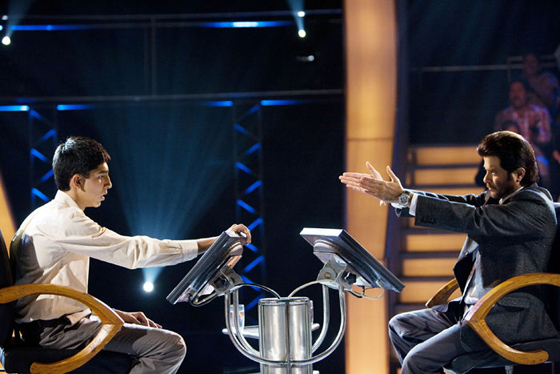
The irony is that these clowns' dismissal roughly parallels the story of director Danny Boyle's (and co-director Loveleen Tandan's) energetic film where it is assumed that a seemingly humble chai-wallah for a cell-service call center could not possibly know the answers to go (as the pompous host intones) "from rags to raja'" on the Hindi version of "Who Wants to Be a Millionaire."
*


When we first meet Jamal (Dev Patel), he is one question away from winning it all...and losing his life. Strung up like a piece of meat, he is being tortured by the local authorities*** to find out how he's cheating—he must be as so many others (of more worth) haven't done as well on the game-show as he has. Sounds like the "feel-good" movie of the year ala Forrest Gump, or as Time Magazine blurbles: "A Poignant Hymn to Life." **
Obviously, it's more complex than either view.

The movie even begins with its own "Millionaire" question for how he manages to do it: A. He cheated; B. He's lucky; C. He's a genius; D. It is written.

Is that your final answer? Really? (feigned look of concern)
You'll do a lot better with the movie if you don't pick just one, or pigeon-hole it into being this type or that, for the answers have too many facets, too many colors and shadings, and offer up the extremes of life—the ebullient and the tragic. In the end, it's a little bit of all of them.
This movie would seem like an odd tangent for Danny Boyle if every step of his career weren't punctuated by abrupt changes of pace. Especially lately after splitting from his writing partner John Hodge. To go from the zombie epic 28 Days Later... to the sublime kid's parable Millions, then to the sci-fi allegory Sunshine to this are as stunning turn-arounds as the dervish-like camera moves he is constantly spinning in Slumdog Millionaire. Boyle lived in India for five years, and so his camera-eye goes right to the colors and exoticism of Indian street-life.
In a dizzying chase sequence early in the film, a five year old Jamal and his older brother Salim are running from the police through the back-alleys of a shanty-town on the outskirts of Bombay. Boyle (and his Indian co-director Loveleen Tandan) films a wide variety of shots in different styles and speeds, sometimes step-editing the shot, twirling the camera, changing perspective, while out of the corner of your eye you see odd little details of street life going on (at one point, he cuts away to a close shave at a barber's, while in the alley behind the shop the kids streak by). But one never loses perspective on the chase, despite the wildly disparate angles and frenetic pace—something sadly lacking from the Bond-movie chase masters in Quantum of Solace****—and the result is exciting and masterful.
We follow the two boys as they become orphaned in a religious attack on their Muslim slum, live lives of begging and thievery on the street and the garbage dumps with their "third musketeer," a street-girl named Latika, then get picked up by gangsters who organize rings of street-beggars, blinding the best ones because they'll bring in double. The boys escape, but Latika is left behind, and that becomes an obsession for Jamal who is determined to find her again, while Salim follows his instincts into the Mombai underworld.
Sound like fun? Some critics seem to think so. Even without the beatings and torture that start the film. But Slumdog Millionaire follows its own karmic path to a pre-determined destiny in tune with the mixture of sweet and rancid of Indian life. And what these jaded writers don't get is the dharma of it all: when things are good, you better recognize it and enjoy it while it lasts.

Because it won't.

Doyle manages to capture the sense of India—an acid-trip without the acid (or so I've been told)—and communicate it on-screen—the colors, the desperation, the joys that crash through the crust of grinding poverty—to a delirious ending that would please Ganesh. Stay through the closing credits.

Enjoy it while it lasts.


* Although it no longer dominates the American air-waves, I've seen it in Spain ("Who Wants to be a Mult-multi-Millionaire?" and Austria. No matter where you go in the world, "Who Wants to be a Millionaire?" plays just the same.


** Although did I ever tell you about the time my Mother and her sisters went to see Martin Scorsese's Casino because they thought it was a musical? Fuggedabaht Joe Pesci being bludgeoned to death, or the guy with his head crushed in a vice--there's a sex scene between Pesci and Sharon Stone! Eyeeeww!

*** The Inspector in charge of the interrogation is played by Irffan Khan—memorable in The Namesake  and The Darjeeling Limited , but absolutely essential to the effect of A Mighty Heart. His unstated power and ability to internalize conflicting emotions across his face makes him fascinating to watch.


**** Funny that I made this comment: Boyle up until the end of last year was the working director of what is currently called "Bond 25" until disagreement with the producing Broccoli kids lad the director and his script-writer John Hodge to leave the project. Quite a few screenwriters have revised the script and American Cary Joji Fukunaga began filming this week in Jamaica.

Saturday, March 21, 2015

Chappie

Switching Psyches (The Ol' Good Bot/Bad Bot Routine)
or
Because I'm CHAPPiE...(Like a ROM Without a Roof)

The director of the brilliant District 9 (and the more ordinary Elysium) now has a third visionary sci-film under his belt. Neill Blomkamp is a great visual stylist—none of his movies look like anything else out there, and just when somebody takes up his concepts, he pushes things further into his bleak concept of the future as an extension of the strife of Johannesburg (or Jo-burg, as it's called in his movies, eschewing the Dutch influence) despite technology continuing to move forward. His movies always have a sense of wonder about the future, but it's always along the lines of "Wonder why everything is so shitty, still," (which is a variation of "If we can get to the Moon,* why can't we fill in the blank??")

CHAPPiE is no different, even though the ads make it seem like a winsome version of a distopian "Mad Max" movie. It is anything but. Yes, the performance of Sharlto Copley as the title character is a marvel, innovative and often very charming (Copley, who is Blomkamp's "go-to" actor for...everything...does a marvelous performance of the "motion capture" variety (the thing that Andy Serkis, of Peter Jackson's movies and in the new "Planet of the Apes" series, does so extraordinarily). The movie itself is a depressing look at technology and Society, while containing a couched message about the malleability of the human spirit and a cautionary one of being too fixed to expectations.
SCOUT (CHAPPiE, specifically)
Blomkamp plops us back into the world of Elysium where the city-slums are policed by robo-cops on a set pre-program. The main defense if the Scout-droids—tall, angular humanoid shapes that patrol the streets (as outlined in the de rigeur video-fed prologue). But, all ready to go online are the Moose-droids, which are big, elephantine machines, controlled by remote human handlers using a helmet—plugged-in gamers in their own version of an urban first-person shooter. The Scouts' development team is led by Deon Wilson (Dev Patel of Slumdog Millionaire and The Best and Second Best Exotic Marigold Hotel) while the competing Moose designs, spear-headed by Vincent Moore (Hugh Jackman, in a way that we'll talk about later) are still in the development stage. Moore is impatient to get them on-line to the point where he'll sabotage the successful Scout program to do it. Boss Sigourney Weaver goes with whatever works and the Scouts, for now, are working. 
MOOSE 
But Deon is not satisfied with success, and with merely working to sets of parameters and protocols. He wants his Scouts to be more human—real-live-boy Scouts—with artificial intelligence that learns and grows as it does its job. The Boss is less than encouraging about advancing the product, as much as churning them out to meet demand. Deon conspires to develop them off-site, taking a disabled Scout, a new program he's developing, and the most guarded of the firm's gizmo's, the chip to program the 'bots.
Office politics in Jo'burg: Patel and Jackman
Wouldn't ya know it? When Deon has all that gear is precisely the time he gets kidnapped by car-jacking street punks Yo-landie (played by South African punk-rapper Yolandi Visser—real name Anri du Toit) and her partners, Ninja (played by South African punk-rapper Ninja—real name Watkin Tudor Jones) and Yankie, (played by honest-to-god actor Jose Pablo Cantillo). They're scheming, too. They're in the debt of Hippo (Brandon Auret, who adapts a patois so thick, he's actually sub-titled in the movie, even though he's speaking English). Their operations are going so poorly, thanks to the Scouts, that they decide to fight fire with fire, by getting their own Scout as a defense against the robo-force. Basic math belies this (1≠zillions), but then, if these guys were any good at numbers, they wouldn't be in debt (especially considering they're living expenses amount to bling, and stolen bling at that).
Perp walk, Jo-burg style:
Yolandi, Ninja, Yankie, and CHAPPiE
Deon is forced to fix his little experiment at gun-point and under less than ideal conditions, but the re-constituted droid comes to life with basic programming, like that of a child, and quickly learns to imprint himself on the humans, interacting with them.
What CHAPPiE sees
This is good in the case of Deon and Yo-lande, semi-okay with Yankie, and downright harmful in the case of Ninja, who tends to over-react when things don't go his way, usually with violence.** This is where the movie becomes really uncomfortable and begins to feel like watching child abuse. Look, it's a movie, okay? It's about robots. I get it. But, one is supposed to connect emotionally with a movie—that's the intent. And my reaction to watching Ninja abusing the still-in-development Scout (Yo-lande calls him "Happy Chappie," which Deon hates) creates a feeling of revulsion. Blomkamp plays rough—his settings have all the charm of a refugee camp and his environments combine grinding poverty with sci-fi tech, a not mutually exclusive reflection of reality, but amped up on both sides of the spectrum.
There's a warning label that says:
"Never fist-bump with a Scout-droid"
Yo-lande and Ninja live in a gutted out industrial site, and even as Deon tries to nurture Chappie in his intellectual growth, Ninja teaches him how to live on the streets, but when Chappie's employed to do some car-jackings, the media picks up on it, sending the city of Jo-burg into a panic. Moore is pressed (actually he does the pressing) to bring the Moose on-line, and his interests are more than stemming the tide of unrest, he wants to wipe out the gangs, Deon, and Chappie for his own career advancement. It's clear that Moore is an HR nightmare. And it's interesting to note that while Copley is busy being the title character, Jackman is copying Copley's jibbering, flinty acting style for the role that (if he wasn't busy wearing a CGI suit) would have been played, equally as manically, by Copley. It's a different (and alarming) side of Jackman that's fun to watch him pull off, even while his character is being seriously psycho.
"Walk like a man/Fast as you can"
Ninja teaches Chappie to "walk street"
That backstage swapping of personalities is a bit like a sub-plot of the movie, a variation of the Sci-Fi/Horror trope of mind-swapping (only in the new vernacular, it's "up-loading" and "down-loading"); whatever the term, it's a borrowed device, but CHAPPiE (the movie) only really does anything different, and has any spark of wonder and the fantastic (or even ingenuity) in those sections. That, and in the stunt-casting of the South African rap duo Die Antwoord as themselves (think of it in the same light as casting Prince, The Beatles, or Eminem to play fantasy versions of their personas) are the only aspects where CHAPPiE isn't terribly derivative, and becomes something more than the ol' Sci-Fi zap-'em-up with Rock'em Sock'em Robots, and becomes a sort of sweetly reversed "Frankenstein," with a conclusion that says "what matters lasts."

But, it's a lot of torture getting there.

* Or it's "conspiracy theory" variant: "If we can fool the world into thinking we went to the Moon, why can't we mass-produce tin-foil hats for the Masses?"  

And yes, I am watching you while you're reading this.

And so are they.

**  This puts him at odds...and odd kinship...with Deon, who also wants things "just so" as he defines it, and explodes when they're altered, to the point where he has enough and buys a gun. The one character who "goes with the flow" is Yo-landie.