Showing posts with label Andy Muschietti. Show all posts

Friday, June 16, 2023

The Flash

The Blade of Grass is Always Greener in the Other Meta-verse
or
Whatever Happened to The Scarlet Speedster?
 
Let's start with a bit of history: when I was a kid (and older), I loved "The Flash" comic books. The character had a lot of history, and (for some reason) was usually the lynch-pin for any big comics event. They re-invented the character (in the comics, his identity was police scientist "Barry Allen") with a more scientific basis to create what was dubbed "The Silver Age" of comics. In 1961, when "The Silver Age" Flash managed to traverse dimensions and meet "The Golden Age" Flash from the 1940's comics, it ushered in DC Comics Multiple Earths, a fictional representation of the Multiverse Theory. When sales of his comic weren't (shall we say?) "up to speed" the publisher decided to kill the character off in "Crisis on Infinite Earths" (designed to eliminate the multiple Earths and simplify the comics line for new readers. 
 
Demand for the Silver Age Flash to be resurrected led to that happening, and then soon after DC decided to "re-boot" its entire line of comics (the idea was called "The New 52"), they decided the catalyst for the change would be The Silver Age Flash, who —due to the machinations of one of his villains—finds himself in an altered reality where he has no powers, there is no Superman, there is a Batman (but he's Thomas Wayne, as it was Bruce who was shot in the alley in that reality), there is a war going on between the Atlanteans and the Amazons, where Wonder Woman assassinated Aquaman, and so on. And the Flash has to fix all of it, and get it back to his reality...which of course, would be the "New 52" revamp. That all happened in a comics "event" called "Flashpoint"
Got all that? You might think that comics are stupid, but they sure can get complicated.
So, this movie, The Flash, has its origin-bones in that "Flashpoint" story but grafts it into the DC Movie Universe sticking to the one "changing history" aspect of it and going its own way. In it, Barry Allen (Ezra Miller), on the eve of a potentially losing appeal by his father (Ron Livingston now)—in prison for being falsely convicted of killing his wife, Barry's mother (Maribel VerdĂș*)—discovers that he can go back in time, and, in fact, pick-and-choose many time-lines, and affect what has happened in his past. Cautioned by Batman/Bruce Wayne (Ben Affleck) that he could haphazardly "destroy...everything," Barry figures out a way that he can alter events without actually being seen or interacting with that time-line in order to prevent his mother's murder.
Yeah, well, going back in time to change things is...never easy. In fact, the only thing tougher is pleasing a rabid movie/comic fan-base with singular expectations of what would make a "good" Flash movie—is it related to the TV show? ("why not?"), Michael Keaton's Batman is in it? How about Val Kilmer's? ("why not?") What about "poor" Henry Cavill?—and for every "slight" to their expectations, the "Rotten Tomatoes" meter will drop closer and closer to a green blotch (as if that mattered). No, The Flash will not meet an awful lot of people's "wish lists." It's not world-building. Quite the opposite. It's not setting up the next chapter of a franchise (like we're used to). It is a self-contained story that could conceivably not have—or need—a sequel. It's just considering the possibilities. It's what DC used to call in the Silver Age "An Imaginary Story." Writer Alan Moore ("Watchmen," "V for Vendetta," "Batman: The Killing Joke," "From Hell") had the best rejoinder: "Aren't they all?"
So, how is it? I'll use a word that hasn't been much used since comic-movie-makers have been striving to make their super-heroes "credible"—"Let's dress them in leather!" "Let's make them bad-asses!"—it's hilarious.
And hilarious in a good way! From it's opening sequence where Barry Allen (Miller) aka "The Flash" must spend an excruciating amount of time waiting for his carb-filled PB&J order and gets interrupted by a call from the Justice League (well from Wayne butler, Alfred—Jeremy Irons) to race over to Gotham City where thieves have stolen a toxin from a local hospital. Thieves being so smart they're dumb, they've managed to undermine the foundation of the hospital where it's at the brink of collapse. While Bat-fleck goes after the thieves, Barry-Flash must save the people trapped in the hospital. What ensues is a sequence straight out of Rube Goldberg by way of Buster Keaton, as The Scarlet Speedster, must save falling babies out of maternity ward by "any means necessary." And in Barry's perceived bullet-time, all those babies each have their own individual perils that he must solve in the—to him—excruciatingly long time it takes them to fall.
Director Andy Muschietti has filled the sequence with such giddy malice that one cannot take any of it too seriously, especially when he and scenarist Christina Hodson build on the sequence, complicating it with more dangers that Flash has to solve. Sure, Batman gets to use all his toys for an extended chase, that strains credulity, dragging him along Gotham highways in the sturm-and-drangy way we've become accustomed to, but The Flash sequence sets up an atmosphere that dilutes suspense in favor of a pell-mell momentum that's rather exhilarating.
We'll stop there for a synopsis over-view because to say anything more would be like spoiling the punch-line of a joke. It's not as funny—or, at its core, surprising—if you can anticipate how it all ends. There are just too many twists and turns and laterals and feints that will be telegraphed, ruining little moments and small that are intended to take you places you had no idea were coming, or even existed. If you think you know what's coming, you're just wrong, even for all the hints and speculations that leaked out in the marketing.
Key to making this work is Ezra Miller. I've always had problems seeing him as The Flash and his presentations in both versions of Justice League (but especially Joss Whedon's) where he was a manic goof-ball and grating comic relief. But, Miller comes out of his supporting-role comfort zone and proves that he can carry a big splashy movie with amazing ease. And he's a hell of a performer, playing two versions of the same character, but with two different histories and stages of development. That's a trick in itself, but Miller makes it look easy, with a gutsy level of letting himself look stupid without losing the basic integrity of the character and making the drama and emotion of the thing work. And for all the manic energy that he throws out, he still manages to have one of the best dead-pan reactions for comedy. Say what you will about him (and everybody has!), but he's just damned good in this.
What else are people talking about? Oh...cameos! Yes, there are cameos, both voluntary and not. And, yes, Keaton is great—he always is. And the "Supergirl" we're introduced to (
Sasha Calle) is terrific.
And the special effects? There's been a lot of kvetching about that, but an early sequence in what will be called the chrono-globe (or some such—maybe we should call it "The Uncanny Valley?") sets up a non-photo-realistic quality that carries out throughout the rest of those sequences (assuming that's what everybody is talking about—I have no previous experience with what constantly shifting time-lines actually look like, so I couldn't judge!) that generally smudges perceptions of what we think we should be seeing.
I could quibble with a prolonged sequence based on Man of Steel where Michael Shannon seems less than engaged, but director Muschetti has always had an observable weakness when it comes to big set-pieces. One would have thought if he could juggle a bunch of falling babies, he could handle a super-hero slug-fest on four fronts, but it falls just shy of being super. I wasn't crazy about the "never-ending battle" in Man of Steel for that matter.
But, was I entertained? Heck, yeah. As much as when I used to close the cover of a good comic-book. So much so that I didn't mind when Muschetti pulls off a final "gotcha" that was just as amusing as its meant to be, upending people's pre-concieved notions and messing with their minds. It's a story, after all. One with limitless possibilities and a perverse willingness to "go there."
 
Aren't they all?
 
Well, no. But, they should be.

* One of the many joys of The Flash is to see VerdĂș again, who was in Coppola's Tetro, del Toro's Pan's Labyrinth, and Y Tu Mama Tambien.

Saturday, September 14, 2019

It: Chapter Two

(Insert Witty Verb) It
or
Pennywise and Poundfoolish

Well, you can tell Halloween season is approaching because the movie-theaters are starting to get an infusion of horror movies in anticipation. I'm not a fan of the genre (although I do my time in the dungeon during the month of October), but lately, things have been mighty thin in the "Coming Soon" department, so there's no way I can avoid it. It's Horror or Nothing.

It: Chapter Two would have been seen, anyway, although I hadn't seen the "First Chapter" in the theaters. Frankly, I wasn't interested. I'd been a devotee of Stephen King's writing in his first couple decades, then around about the time of "Needful Things" and "It", I stopped reading him, mostly because I would have had to do daily bicep curls in order to read them—"It" clocks in at some 1400 pages, and if I wanted to read something encyclopedic, I'd've read the encyclopedia.*

There'd been a TV mini-series here in the States, and I turned it off after 30 minutes. Because..."clowns." My favorite books of his are still "The Dead Zone" and his novella collection "Different Seasons."
But, I did catch Andy Muschietti's Chapter One the other night on cable, and was pleasantly surprised by what I saw. Screenwriters Chase Palmer, Cary Fukunaga (he's directing the new Bond film even as we write this) and Gary Dauberman scraped away some of the fat and sillier gristle from the book and hacked away at King's flashback structure to present the "kid version" of the "Derry Disappearances" story and made it a tough little diamond. Then Muschetti, who's Argentinian, did some remarkable casting for the kids (with an eye to who would play them as adults) and had the truly inspirational idea of putting Bill SkarsgĂ„rd in the make-up as "Pennywise" the clown, in a performance that isn't camp but devious and manic and truly creepy. 
Chapter One is a good, scary movie because it concentrates on the worrisome fears that takes the innocence out of childhood and starts us on the straight path to neurosis rather than adulthood. The best part of the movie isn't the horror bits, it's the kid-bits, and the way that like-minded "Losers" can bond over the little tragedies that may mean nothing to adults (and more often than not be caused by them), but can make a kid question whether the sun should come up in the morning. SkarsgĂ„rd is great and all, but one wanted to spend more time with the "Losers" because they were funny, squabbley, human...and loyal. Led by Jaeden Martell of Midnight Special and The Book of Henry, Jack Dylan Grazer from Shazam!, Finn Wolfhard, Jeremy Ray Taylor, Chosen Jacobs, Wyatt Oleff, and the remarkable Sophia Lillis.
"Here we are again in our old familiar places..."
It: Chapter One ended with serial child-kidnapper Pennywise the Clown dispatched, but with the suspicion that he would return again in 27 years, and "The Losers" promising that if he should appear again that they would have each other's back to take the "thing" down again. 
Now, in Chapter Two, it is 27 years later and the only one left in town is the one kid who couldn't fit in anywhere except for the Losers, Mike Hanlon (now played by Isaiah Mustafa, the guy who's hilarious in those "Old Spice" commercials). He lives in the library loft, working with dusty books in a town with internet, cell-phones, kindles and no library patronage. But, when he hears over the police scanner that another kid has gone missing after an already mysterious disappearance following a vicious homophobic attack at the town carnival, Mike puts out an APB for the Losers to "Come Home."
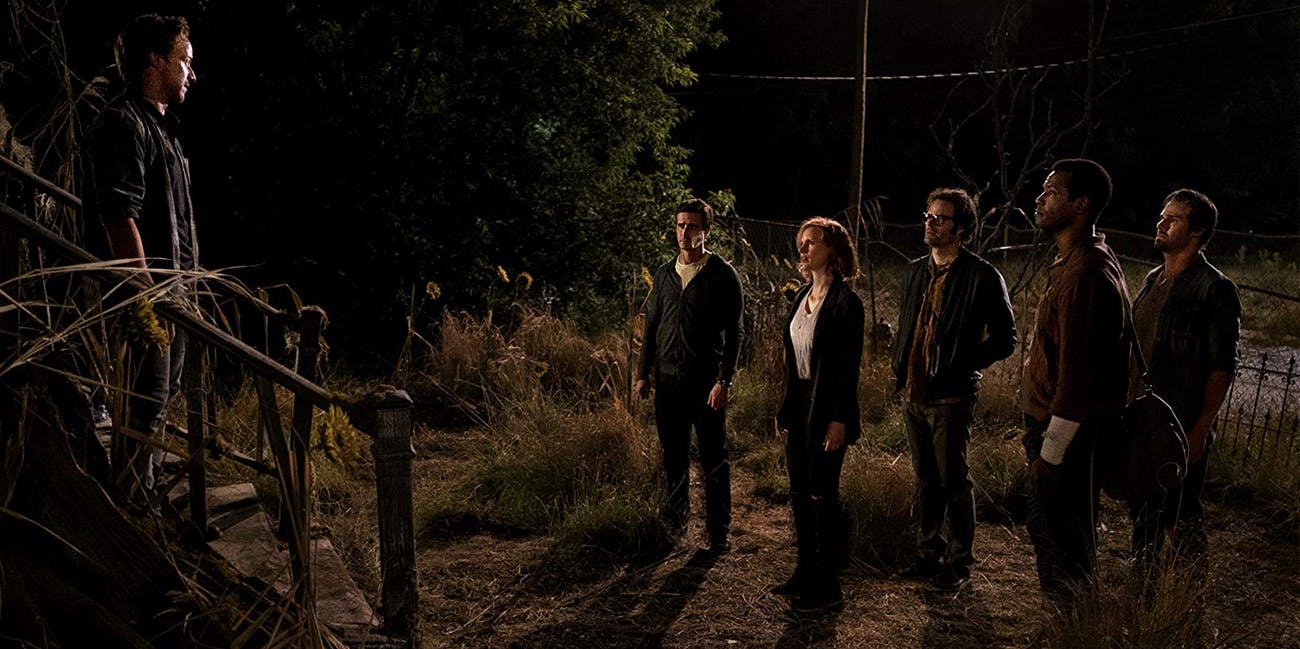
This is met with a universal reluctance by all the grown-up Losers: "Stuttering Bill" Denbrough (James McAvoy) is a horror writer (meta alert) who has a problem writing endings (real-life irony alert)—and he is told this by just about everybody including the cameoing Stephen King (HUGE real-life irony alert) and the director of his latest movie project, Peter Bogdanovich ("You said you loved the ending" "I lied."); Eddie Kaspbrack (James Ransome) has turned his hypochondriacal tendencies into a career in risk-management; irritatingly vocal Richie Tozier (Bill Hader, bless him) has become a stand-up comic; Beverly Marsh (Jessica Chastain) is a fashion designer who escaped her abusive father to marry an abusive husband—you can grow up but not grow out; and Ben Hascomb (Jay Ryan), the chubby "New Kid" with a crush on Bev has become a hunky architect ("shipper" alert). 

The one member of "The Losers" who opts out is Stanley Uris (Andy Bean) , who chooses suicide rather than confront the potentially deadly threat. Everybody else goes back to Derry at Mike's call and meet at a Chinese restaurant. Most of them have put those days out of their minds, but the memories—good and bad—come flooding back, challenging their wills to turn back and run away.
But, Pennywise starts to clown around and go on a psychological attacks against the Losers, they start to harden their resolve and decide to follow Mike's plan to employ a Native American ceremony to weaken and take out Pennywise, whose origins (in King's tortured explanation—I won't bother to relate it, as it's tough to type when you're rolling your eyes) have more to do with the stars than with themselves.
I prefer Chapter One to Chapter Two, probably because the first movie does the better job of avoiding the dumbest aspects of King's novel, which tries to provide a rational—relatively—explanation for what Pennywise is and why he does what he does. Frankly, King was just working too hard to bring some validity to his concept, when his readers are just happy to know there's a killer clown feeding on fear. We don't need an in-depth rationalization for why the car in "Christine" is haunted, when the audience already buys into the conceit of the supernatural and things that giggle in the night.
So, the movie follows each Loser as they track down the talismans from the days of the Derry disappearances 27 years ago: the paper boat from Billy's little brother Georgie, the postcard given to Bev by Ben (although she thinks it's from Bill), Ben's yearbook page that Bev signed when he was still "the New Kid" in Derry, the asthma inhaler from Eddie, a video game token from Richie—why these things are important to Pennywise's demise is a mystery, although, dramatically, they represent a Bonfire of Childhood Vanities. Certainly it's better than the rite of passage that King wrote of, first, in his book (and the filmmakers—wisely—left out, maybe because it's just too creepy and also potentially gut-busting). They may be important to the development of the kids turned adults, but what has that to do with Pennywise?
Was it really necessary to draw it out like this? The movie clocks in at 2 hours 45 minutes and feels bloated because of it. There are lots and lots of good "bits" scattered throughout it (or It: Chapter Two) and the performances by the cast—young and old—keep the movie interesting (Bill Hader is particularly effective both comedically and dramatically). But once the battle is taken underground to Pennywise, the movie starts to get frustratingly fussy and pretentiously woo-woo. It's not even very good action—I refrained from effecting a Monty Python accent and yelling at the screen: "Run away! Run away!" as I have less of a fear of clowns and red balloons than I do of flying buttered popcorn.
But, up until that time Muschietti does deliver on the shocks, usually by doing a standard "sting-in-the-tail" fake-out: as the person on-screen is confronted by a barrier to another room, ominous music begins to ramp up and climaxes just before the door is opened/the curtain is torn aside and they are confronted by...nothing. A moment of doubt. A moment of confusion. A moment of searching. A moment of relief. Then, they turn around and are confronted by something horrible that has been behind them the whole time. It happens enough that you learn to delay getting a firm grip on your soda by about 4 to 5 seconds. And that, friends, is a cardinal sin in a horror movie.
Still, for fans of the first movie and for fans of Stephen King, the second chapter won't disappoint—as so many King adaptations seem to do. The secret seems to be to take the main ideas of his books and burn them down to the core elements and concepts and leave his details out, because what works in his word-processor (and sent into our fearful little alligator brains) doesn't always work when projected to the screen. It takes a clever manipulator and story-teller to translate the story visually and provide the same thrills the written word does. (isn't that what all adaptations should do?). If not, then the time and money and effort are just wasted.
Muschietti, is less at fault if his Chapter Two doesn't live up to his Chapter One—he does a good job of creeping you out and clowning around, and one looks forward to what he does in the future in whatever genre he decides to pursue next.


* I haven't completely sworn him off, though: I did read his time travel novel "11/22/63," which, although a slog, was a worthwhile slog. But, I just returned his sequel to "The Shining," "Dr. Sleep," to the library (there's a movie coming out) after trying several time to "crack" it, (and developing some bursitis in my elbow) but finally giving up on it.