Saturday, February 22, 2020

Hell Drivers

Saturdays are "Take out the Trash" Day

Hell Drivers (Cy Endfield, 1957) British feature directed by blacklisted American director Endfield—and the first to carry his actual name and not a pseudonym*—about the rough and tumble day-to-day of short-haul truckers, battling deadlines and each other to try and meet quota and be top-driver hauling ballast (gravel) on sub-standard equipment at speeds that are break-neck, even under the best of conditions. Each driver has to make at least twelve loads a day; if they don't, they're fired. Competition is so fierce that the other drivers aren't above sabotaging each other's rigs. Work-place harassment is just part of the job and a way of life.

Into this demolition derby come Joe Yately (Stanley Baker)—call him "Tom"—who's just served a year stretch in prison and is trying to make a new honest life for himself. A position is open at Hawlett's Trucking after a driver has gone through a bad accident and although the manager, Cartley (William Hartnell) is reluctant, his secretary Lucy (Peggy Cummins of Gun Crazy) intercedes on his behalf. Tom is taken on a training run and does okay, despite near-collisions with a couple of other drivers.
The other drivers are a motley crew: there's Scottie (Gordon Jackson), Ed (Wilfrid Lawson), Dusty (Sidney James), Tinker (Alfie Bass), and Johnny (Sean Connery), all rough types who aren't above intimidating Tom—it's all in fun, after all. More receptive is Gino (Herbert Lom), an Italian (Herbert Lom?) who's in love with Lucy and wants to give the new driver a chance.
Less friendly is Red (Patrick McGoohan), the driver foreman, who always sits at the head of the table—as a rib, the drivers let Tom sit at the head and Red knocks him off his chair when he enters the room. Red is the most reckless of the drivers, does eighteen runs a day winning him a gold cigarette case, and lets it be known that no—no one—will take that case away from him, even if he has to cripple the driver to do it.
The first thing you notice, given hindsight, is the cast, early in their careers, and before they achieved their biggest success in the 1960's. Sure, there's Connery and McGoohan (who'll ride the 1960's spy-craze), but there's also Jackson from "Upstairs, Downstairs," Lom and Alfie Bass, Sidney James from the "Carry On" films, and Hartnell would become the first "Doctor Who."
But, that's not all. Playing the waitress at the driver's mess is Jill Ireland. And when Tom goes home to try to make amends, David MacCallum plays his younger brother. That's an amazing group of young actors, briefly doing washing duties in the "kitchen-sink" era of British film-making. As a result, the most subtle of the actors is star Baker, while the rest of the cast do their best to garner attention to themselves.
Lom's accent might be a little thick, but the actor who does the most egregious over-acting is a surprising one—McGoohan. He'd be known for merely quietly smoldering with a less-is-more kind of acting during his starring days, but here he's at full villainous boil, manking about like he was Richard III, hunch-shouldered and bull-headed. You hope for him to get his comeuppance early, as its a little painful to watch. When throws away a cigarette, you expect it to explode off-screen.
That aside, Endfield keeps the action going almost constantly, making it a visceral movie. Sometimes too much so. The driving scenes are viciously under-cranked, giving it an almost comic effect, rather than causing white knuckles. By the way, the cinematographer is the storied Geoffrey Unsworth, who would move on to far greater things.
Still, it's interesting to see if only for the young turks who would burn up the screen in the next decade.

* Well, it's listed as C. Raker Endfield, a slight obfuscation from how he was listed on his American films.

Friday, February 21, 2020

In The Mood For Love

In the Mood for Love (aka Faa Yeung Nin Wa, 花樣年華, Wong Kar-Wai, 2000)
"It is a restless moment. She has kept her head lowered...to give him a chance to come closer. But he could not, for lack of courage. She turns and walks away."
They are ships that pass in the night...or the hall-way. Mrs. Chow (Maggie Cheung) and Mr. Chan (Tony Leung) rent rooms next door in the same Hong Kong building (circa 1962) and move in the same day, meeting when they exchange items mis-placed by the movers. She works as an assistant for a shipping company. He works as a journalist. Sometimes, the hours are long, but not so frequently that they can't spend time with their spouses.

But, they can't. Both spouses work more erratic schedules and are frequently away "on business." We never see them, only hear their voices in other rooms or over the phone. Mr. Chan's wife is only identified by her flip hair style and Mr. Chow (in the only time we see him from the back) has the same brylcreemed hair as Mr. Chan. But, they have a lot more in common than just off-schedules and domiciles. And for being neighbors, Mrs. Chow and Mr. Chan share a lot, as well.
They spend a lot of time apart from their spouses, and given the cramped quarters of the hallways, they sometimes dance out of each others' ways. They frequently eat alone, and walk the streets at night to get food—Mrs. Chow with her noodle thermos and Mr. Chan eating at the alley-way cookery. Their land-people take note of the odd hours and their alonen-ess. They get invited to dinner, but they are appeciatively waved off. Mrs. Chow works for Mr. Ho, and must work with her boss' needs for scheduling and gifting his wife and his mistress. Sometimes, the gift is the same thing, even matching color.
Gifts are exchanged in the adjoining apartments, as well. New rice cookers, ties and hand-bags. But, familiarity breeds suspicion. After passing each other on a fairly regular basis, Mr. Chan makes the excuse of acquiring an imported hand-bag for his wife to ask Mrs. Chow out to dinner and the two compare notes—Mr. Chan is wearing the same imported tie that Mrs. Chow says her husband was gifted by (according to her husband) "his boss." And the two realize that their mutual spouses are probably having an affair. Small world, Hong Kong.
They walk back to their place, both in a bit of shock. He speculates who made the first move, and he's sure it was her husband, and he in turn wonders if they should pay them back in kind. Mrs. Chow briefly smiles, then turns dark refusing to stoop to their level. He then says it doesn't matter who made the first move—it's already happened. She turns on him: "Do you really know your wife?" And stalks off.
But, they meet again...discreetly, of course. It's Hong Kong in the 1960's and marriage is between a man and a woman, but anything else? It attracts talk. It attracts suspicion. And they've made a vow; they won't be like them. But, they have a bond, and they hurt, and so they discuss, share experiences and feelings and meals, trying to understand each other's situations. It's therapy, and they're doing nothing wrong. But still, no one must know.
They rehearse her confronting her husband about the affair, practice it, for when the time comes. She asks him what he'll do, and he thinks he'll do what he did before he had to be part of a couple—go see movies, he may even write that martial arts serial that he wants to do. She likes them, too—she's borrowed his collection; why doesn't she help him write? The idea seems absurd to her, but soon they are both writing, separately, comparing notes. But, then they have to write together and when they try at his place, she's trapped when the neighbors come home early and decide to play an all-night mahjong game.
That doesn't work. They can't work and the serial is getting attention (the kind they might want), so he rents a room away from their mutual place. But, the stigma if they're caught scares her and she resists going there. It is difficult to trust, at this point, and what if it becomes something more? But, one trepidatious visit and her fears are calmed. It's business and it's joyful and they both enjoy the writing.
They love it, in fact. And as he says, at one point, "these feelings creep up on you." They don't talk about love. They don't talk about their need. But, they feel it, and, at one point, he announces that his paper is short-staffed in Singapore—she's not going to leave her husband, anyway—why not take it?
Why not? Because it'll break their already broken hearts is why. But, they're already enured to that feeling, numb to it, even, and they can't carry on this way and it has to be curtailed. Doesn't make it any less painful, no matter how numb they are.
In the Mood for Love is tough stuff, while at the same time being one of the most beautiful movies ever made. Taking 15 months to shoot from the bare-bones outline of a script, it outlasted the availability of cinematographer Christopher Doyle, whose work here is mesmerizing (the film was completed by Lee Pin-Bing), along with the production/costume design and editing of William Chang, and the vivid eye of Wong, all done in eye-popping Technicolor in Hitchcock-psychology reds and greens. Because the story is told through image, some audiences might get lost—especially if they're depending on sub-titles to show the way—and the movie evokes a fragile, sensory-heightened time with its rich palette and it's frequent languid slowed motion effects that lull and stretch out the moments of joy or loneliness that evoke the numbed state of surviving alone-ness.
There is a visceral precision to it—like Cheung's elaborate 60's hair-do's and the taught perfection of wardrobe right down to the seams in her nylons—despite the wandering eye of Wong's camera or the disparate soundtrack of songs—that invoke deeply buried emotions that are repressed both in a society and in individuals, the need which goes unfulfilled by choice or duty, suffered in silence, but exquisite in its pain.
In the Name of Love keeps the emotions buried and only gives it full-flower in the vividness that burbles to the surface and enchants the eye. It is a platonic love story told in erotic hues, both beautiful and painful. 

It's one of "those" must-see films.

Thursday, February 20, 2020

Brief Encounter (1945)

Brief Encounter (David Lean, 1945) Two people (Trevor Howard, Celia Johnson) sit in a train depot cafe with few words passing between them, even though the need for words is agonizingly felt. This is a meeting of great import for these two people far beyond the casual and humble setting it is situated in. The time is precious and limited, and words could be balm or weapons, so they are avoided. It is agony, but neither one can avoid this meeting for both of them know it will be the last. And the clock is ticking. And words go unspoken. So much of that.

In Brief Encounter, the near-entirety of the story is told in flashback as a confession that never escapes the heroine's lips. Laura Jesson (Johnson) is considering telling her kind, stable, and decent (but dull) husband of her adultery, but the words go unspoken, flashing only in her mind, like a secret life passing through her mind before it dies. Only the audience is allowed the hearing. Only the audience will know the agony of that first scene.

But, not yet. As Laura and Dr. Alec Harvey (Howard) watch their tea cool and dread last words, they are interrupted by Dolly Messiter (Everley Gregg), a friend of Laura's and oh-so-chatty. Dolly is about to catch a train and what a lovely surprise to see Laura here and oh, how she does prattle on about the most meaningless, silly things and takes up all the oxygen—and time!—in the room, while Laura and Alec can only sit and be polite—it's not her fault, she doesn't know (although Laura will be thinking "I wish you'd stop talking. I wish you'd stop prying and trying to find things out. I wish you were dead - no I don't mean that. That was silly and unkind. But I wish you'd stop talking.") 
"Isn't it awful about people meaning to be kind?" is something she says that might also be applied in the situation. The underlying drama beneath an innocent seeming example of "two's company-three's a crowd" will not be disclosed (and only to us) the length of the picture away, but we get the gist—Dolly Messiter is intruding, but she knows not on what and is much too shallow to care. She might if she knew the possible ramifications it would lead Laura to in the near-future, but only in hind-sight, and there is something in Laura that might want to deny her the satisfaction—as satisfaction has been denied her.
Laura and Dr. Harvey part and there is only a fond hand on the shoulder to serve as a last embrace. He leaves. And as Dolly prattles on, director Lean does something amazing—he tilts the camera on Laura as her thoughts become desperate, and the image is a vertiginous tilt forward, like leaning in but off-kilter like standing on the edge of a precipice and the gravity drawing down, down, down. That tilt will remain as her resolve breaks and she runs out of the shop to the train tracks and a passing train blows her physically back and as it does so, reality —the camera returns to normal, the impulse broken. The world is "righted."
That's a bold move on Lean's part, and serves as a nice visual encompassing of the movie. The world goes off-axis during the affair, which for both parties is a secret double-life—they're both married and both quite proper. They're both racked by guilt for the indiscretion, which is as discreet as can be, as less than a handful of people suspect (and that's all they can do, besides judge), but it is enough to cause misery despite the happiness and longing they can't deny. But, it is played out in private and in the shadows, for fear of it being found out. Anyone will tell you this is common, despite how uncommon it all feels.
After all, in that very cafe, there are flirtations and affections being spouted all the time and at high volumes—particularly between station jobbers played by Sterling Holloway and Joyce Carey—and no one pays any attention to that. And on the platforms, PDA's are rampant and displayed in full, furtive view. In such an environment, guards might be down and desires encouraged. But, that's other people. Dr. Harvey and Laura Jesson are a different class and Society expects more of them, as they expect more of themselves.
Double-edged sword, that. They want more, expect more, but can't have more, and if they succumb, it tends to curl that stiff-upper-lip, even if they know forthright from wrong. Then, the inner dialogue begins, the repercussions, the guilt, the doubt, the shame. More is expected of you by denying yourself. You end up taking a lot of the joy out of it by second-guessing it and second-guessing whether you deserve it or not.
Noel Coward says all this much better than I can. By presenting that inner dialogue as a confession that will never be spoken, it offers the better parts of altruistic honesty without actually committing to it or suffering the consequences. By letting the audience in on the inner thoughts, it makes us co-conspirators and makes us put some skin in the game. And it is such a soaper that it allows the catharsis of tears without letting the figures involved on-screen so much as salt a lapel. They're allowed dignity, even if we have to blow our noses.
Clever little movie, another reason why Coward is revered as a scenarist and Lean a master craftsman. They do all the sneaking around in shadows and we do all the crying. That is a fine romance.

Wednesday, February 19, 2020

Sylvia Scarlett

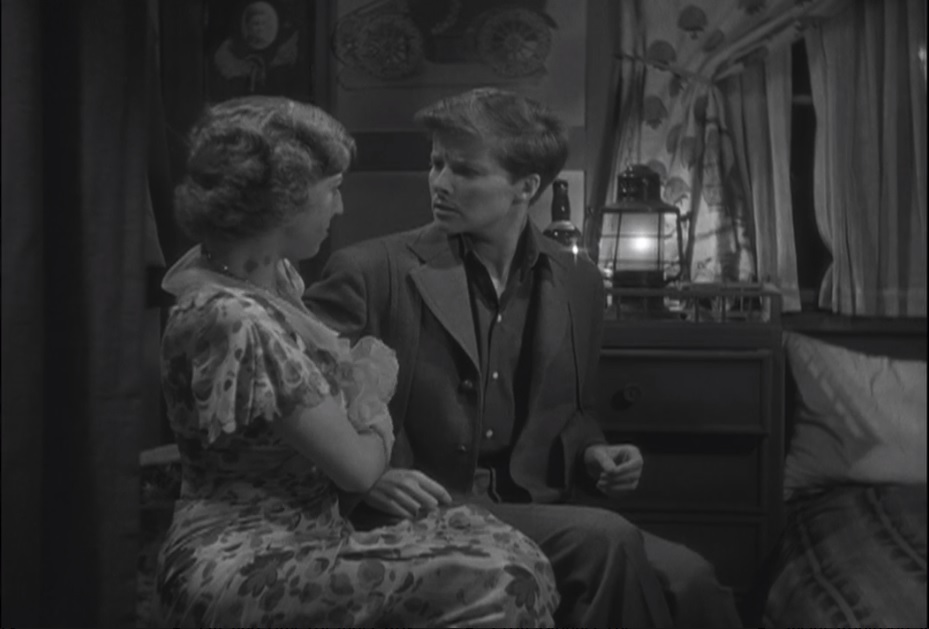
Sylvia Scarlett (George Cukor, 1935) This one can't be considered a movie of the libertine, free-and-wheelin' "Pre-Code" era of movie-making, but it takes mild chances (if only teasingly), but hardly enough to account for its reputation as one of the most financially disastrous movies on the 1930's despite a good script, solid direction by George Cukor and the pairing of Cary Grant and Katherine Hepburn (though it being their first—Hepburn had met Grant at Paramount and recommended him to Cukor—no one could anticipate their subsequent chemistry). The film's lack of success labeled Hepburn as "box-office poison" and she didn't become bankable again until she bought herself the rights to "The Philadelphia Story" and revived her career with it...also with Grant in the movie version.

But, it looks tame today, even quaint. And it wouldn't so much as cause a pursed lip among the blue-haired old ladies who went to see Victor, Victoria or Shakespeare in Love. It was just before its time, although Cukor—who was euphemistically esteemed throughout his career as "a woman's director"—enjoyed depicting the sexes in sometimes challenging ways, often as satire, often as comedy. Sylvia Scarlett is a light-hearted drama (until it turns dark) and a comedy of manners (if those manners only tease but don't commit, and Judith Martin would certainly not call that "manners"). It's a little bit of everything, but more soufleé than stew. 
In Marseilles, when the seamstress wife of Henry Scarlett (Edmund Gwenn) dies, he becomes desperate to flee the country from French officials. He's been embezzling funds from the lace factory where he was employed as a bookkeeper, and lost all the funds to gambling. With some lace that he has stolen, he decides to head back to England to start anew, but tells his daughter Sylvia (Hepburn) that he will go alone and send for her later. She will have none of that, and so cuts off her hair and tells him that if she travels with him as a boy, the police will be confounded in their search for a man and his daughter.
While ferrying across the channel, they make the acquaintance of one Jimmy Monkley (Grant), a charming Cockney con artist and grifter, who uses his acquaintance with the Scarlett's to throw suspicion off himself when they go through customs (he rats out Henry's lace so as to distract from the diamonds he's smuggling in his shoe). Despite the seeming betrayal (and the £100 Monkley gives the Scarlett's for their trouble), the three decide to hook up as con artists using Monkley's contacts in London. The living arrangements are a bit problematic, as Monkley can't seem to figure out while "Sylvester"—the name Sylvia goes by in her disguise—is nervous about sharing a room with him, and gets downright agitated about dressing down for the night. What is wrong with the boy?
The first scam attempt involves Maudie Tilt (Dennie Moore), a lady's maid whom Monkley tries to seduce to steal her lady's expensive pearl necklace. The escapade doesn't pan out but it does manage to hook Maudie up with the band, partially because she's attracted to "Sylvester" which worries Sylvia, but not as much as when her father starts to fall for Maudie. Sylvia/Sylvester, having a crisis of conscience, insists they give up the dangerous grifter life, and instead become travelling show-people, "The Pink Pierrots," a cavorting harlequin troupe caravaning from small town to small town entertaining the villagers.
In one town, they meet bohemian artist Michael Fane (Brian Aherne), who is enchanted by the group, but, curiously, most by Sylvester—who, in turn, is attracted to him—prompting Fane to gasp the most famous line to pass the censors: "I say, I know what it is that gives me a queer feeling when I look at you..."
pause for effect
"...There's something in you to be painted!" 

Of course. That must be it. Artistic inspiration. While Sylvia Scarlett (the movie) flirts and teases with the gay mystique, there is nothing beyond girl-on-girl pecking (mistaken or otherwise) that produces something akin to horror in Hepburn's character. Even Aherne's outburst is provincially couched in Sylvia's subterfuge—he's attracted to her because she's a woman, though dressed as a man. Safe enough. And when "Sylvester", smitten with Fane, borrows ladies' gear to appear all flowery and girly, he is charmed but ultimately dismissive once learning the truth of Sylvia, going back to his un-British—in fact, Russian-European—mistress.
The sexual politics is flummery—just a tease—because once things settle—and people settle—things are safely hetero, but, at least, they take one chance: the pairings are not based on Hollywood archetypes of who should be with whom (we've all seen disastrously mis-paired types in many a final fade-out), but rather in personality types; the romantics are together and the churlishly cynical are as well, being matches of the soul, rather than the romantic heart.
At least that is a bit different; the couples deserve each other, for good or ill. It's not much of a revolution, certainly not enough to inspire a reprisal at the box-office. In fact, it's merely common sense, but that's something rarely found in romantic films.

Or in romance, for all that.

Sunday, February 16, 2020

Don't Make a Scene: Scott Pilgrim vs the World

The Story: Sure, it's only a two minute scene; how long can it take?

Forever. Two minutes in an Edgar Wright film, much less     Scott Pilgrim vs. The World, has a lot of information crammed into it. The screenplay doesn't even add in the whooshes and zips, deflating balloon pops, seamless transitions and electrical failures that permeate the scene as Scott pursues the girl he sees in his dreams, Ramona Flowers.

There are so many levels to this scene, but something that might get lost in the mix is that Scott Pilgrim, he of tremulous smile, vapid conversation, and cracking voice, is something of a dog. A serial heart-breaker and too immature to be good for anybody. He basically pumps out one chord on his bass "D-D-D-D-D-D-D-D-D-D," plays video games and lives across the street from his parent's house. He's a man—a man-boy—of limited means, and as "deep" as a light dusting of Toronto (Canada) snow. The point of the movie is it's a romantic-comedy-action-adventure story (based on a comic book series by Bryan Lee O'Malley), but it can't legitimately be all of that if it wasn't also a coming-of-age story. Unless Pilgrim grows up a little and (as they say in video games) can "get a life," all that romance is going to be so thin and short-lived, it might as well be platonic.

So, in this month of February and Valentines, another scene of love at its earliest and with the best of intentions, even though it's hopelessly (and hope-fully) naive, stalker-creepy, and so, so dumb.

The Set-Up: Scott Pilgrim (Michael Cera), 22, awesome, unemployed guitarist for Sex-Bob-omb, has been okay lately since his devastating break-up a year ago with Envy Adams (Brie Larson)—who went off to become a successful pop artist—and he's dating a 17 year-old Catholic high-schooler named Knives Chau (Ellen Wong). This has some good things and some bad things about it. So, that may be why he is so smitten when he sees "the girl of his dreams" (no, literally, she is, totally, and played by Mary Elizabeth Winstead) at the High School Library, delivering an Amazon package. She's just a figment until he sees her at a party...

3-2-1...GO! (Action!)


21 INT. JULIE'S HOUSE - NIGHT 
21 A bored Scott stands next to Young Neil in a very crowded house party. Both have red plastic cups in hand. 
SCOTT ...this sucks. 
YOUNG NEIL Sucks. 
SCOTT I'm going to go pee due to boredom. 
Scott exits frame. 
YOUNG NEIL I have to pee.
 (CONTINUED) 
INTEGRATED FINAL 15A. 21 CONTINUED: 
21 Neil sips his drink. 
Scott passes by COMEAU, a bespectacled hipster geek:
 '˜COMEAU, 25, FUN FACT: KNOWS EVERYONE (INCLUDING YOU)' 
SCOTT Hey Comeau. 
COMEAU Hey Scott. Some party huh? You gettin' your drink on? (CONTINUED) INTEGRATED FINAL 16. 21 CONTINUED: (2) 21 
SCOTT This is Coke Zero. I don't drink. 
COMEAU You don't drink? I remember you getting ridiculously drunk off two G&T's one time and- 
SCOTT (QUICKLY) Comeau, you know everyone, right? 
COMEAU Pretty much. 
SCOTT Do you know this one girl with hair like this? 
Scott sketches an incomprehensible drawing of Ramona. 
COMEAU Yeah man. Ramona Flowers. Someone said she was coming tonight actually. 
SCOTT WHAT? 
COMEAU Scott?
COMEAU You got the hots for her? I hear she's hardcore... 
Scott has already left a Scott-shaped dust cloud... 
22 INT. JULIE'S HOUSE - MOMENTS LATER 22 
Scott scans the party. 
His eyes go WIDE. 
He CRUSHES his plastic cup. There she is...playing the wall...RAMONA! 

Aloof. 
Enigmatic. 
Hot. 
Scott sidles up and stands next to her. 
SCOTT Hey, what's up? 
RAMONA Nothing. 
SCOTT Hey, you know Pacman?
RAMONA I know of him. 
Scott begins to babble.
SCOTT Well you know Pac-Man was originally Puckman but not because Pac-Man looks like a hockey puck...
SCOTT and paku-paku-paku means flapping your mouth and they changed it...
SCOTT ...because if you scratch out the "P" and turn it into an "F'? You know? Like... 
RAMONA Yeah that's amazing. 
SCOTT Um...
SCOTT ...am I dreaming? 
Ramona looks at Scott blankly. He slowly skulks away. 
SCOTT (CONT'D) I'll leave you alone forever now.
RAMONA Thanks... 
"THEN HE STALKED HER FOR THE REST OF THE PARTY..." 
Series of quick shots as Scott follows Ramona.
He ducks around corners, spies from behind a much bigger dude.
Ramona leaves the party. 
Scott grabs a startled Young Neil. 
SCOTT DUDE! 
YOUNG NEIL WHA? 
SCOTT SHE'S TOTALLY REAL! 
YOUNG NEIL WHO!?
SCOTT RAMONA FLOWERS! 
YOUNG NEIL WHUH? 
JUMP CUT.
Scott RUNS towards Comeau. 
SCOTT DUDE. 
COMEAU W'oh!
SCOTT What do you know about Ramona Flowers?! 
COMEAU All I know is she's American. 
SCOTT (EXOTICALLY) American... 
COMEAU But you should talk to...
COMEAU ...Sandra and MONIQUE- 
COMEAU They know a lot more than...
"SANDRA AND MONIQUE, 24, TWO GIRLS COMEAU KNOWS" 
SCOTT LADYDUDES! 
SCOTT What do you know about Ramona Flowers? 
MONIQUE I think she has a boyfriend. 
SANDRA Some guy back in New York. 
MONIQUE Doesn't she have the most ridiculous name? 
SANDRA I know. It's so 'Ramona Quimby, Aged 8 and yet...Flowers. The girls laugh. Scott does not. 
SCOTT Yeah. Yeah, yeah. 
SCOTT What else? 
JUMP CUT through a FLURRY OF FACES as Scott asks everyone ABOUT RAMONA: 
PARTYGOER #1 I heard she kicks all kind of ass. 
PARTYGOER #2 She's on another level. 
PARTYGOER #3 She's got men dying at her feet.
PARTYGOER #4 She's got some battle scars, dude. 
PARTYGOER #5 Not to be entered into lightly 
We end on the surly JULIE (the rude clerk) who steps in front of Scott, arms crossed. Stephen Stills is with her. 
JULIE What about Ramona Flowers? 
SCOTT You know her? Tell me. Now. 
JULIE She just moved here. Got a job with Amazon. Comes into my work. 
SCOTT Does she really? 
STEPHEN STILLS Didn't you say she just broke up with someone, Jools?
SCOTT Did she reeally? 
STEPHEN STILLS That they had a huge fight or whatever? 
SCOTT Did they reeeally? 
JULIE ...yes. But I didn't want Scott to know that, Stephen.
SCOTT Yeah, I don't know...
SCOTT ...what it is about that girl, she just- 
JULIE Scott, I forbid you from hitting on Ramona. 
JULIE Even if you haven't had a real girlfriend in over a year- 
STEPHEN STILLS Hey whoa, whoa. Scott's mourning period is officially over. 
STEPHEN STILLS He's totally dating a high schooler. 
JULIE Dating... 
JULIE ...a high schooler is the mourning period. 
STEPHEN STILLS She's got a point. 
SCOTT I thought... 
SCOTT ...you guys broke up. 
JULIE I don't want... 
JULIE ...you scaring off the coolest girl at my party, Scott. 
JULIE We all know you're a total lady killer wannabe jerky jerk. 
SCOTT That's garbage! Completely untrue. 
JULIE That time...
JULIE ...with Lisa-
SCOTT That was... 
SCOTT ...a Misunderstanding. 
JULIE That time... 
JULIE ...with Hollie- 
SCOTT Not...
SCOTT ...what it looked like! 
JULIE That... 
JULIE ...time you dumped Kim for- 
SCOTT Okay... 
SCOTT ...me and Kim are all good now. Alright? 
SCOTT looks to KIM. We hear the sound of arctic winds.
JULIE Whatever, Ramona is out of your league, let's leave it at that. 
JULIE (CONT'D) And anyway, I'm not even sure she really did have a big breakup. She keeps mentioning some guy named Gideon. 
SCOTT (NOT LISTENING) Yeah, I don't know what it is about that girl,
SCOTT ...she just- 
JULIE Forget it Scott!!!
Lights go out. The crowd moans in disappointment.
Scott Pilgrim vs the World

Words by Michael Bacall and Edgar Wright

Pictures by Bill Pope and Edgar Wright

Scott Pilgrim vs. the World is available on DVD and Blu-Ray on Universal Home Video.