Showing posts with label George Cukor. Show all posts

Wednesday, January 22, 2025

The Philadelphia Story

The Philadelphia Story
(George Cukor, 1940) "The prettiest sight in this fine pretty world is the privileged class enjoying its privileges
."
 
So says Macauley "Mike" Connor (James Stewart), cynical reporter with romantic notions about nobody but himself, as he and photographer "Liz" Imbrie (Ruth Hussey) are given the enviable task of reporting on the biggest marriage event of the season—or should we say "re-marriage season"—the Lord-Kittridge affair, she of the Philadelphia Lords, Tracy Samantha Lord (Katharine Hepburn), to be precise—formerly married to one C.K. Dexter Haven (Cary Grant), an upper class yacht designer—and for her second go-'round, she is marrying George Kittridge (John Howard), a "man of the people" who raised himself from the lower classes to achieve parity (without the legacy or provenance, mind you) of the Main Line of Philadelphia. Newsies Mike and Liz are given permission to "witness" the impending nuptials for a gossip rag (under the subterfuge that they're "distant relatives"), as an arrangement that said tabloid won't be publishing lurid stories about Tracy's father (John Halliday) having an affair with a dancer (of all people). This tit-for-tat has been arranged by a former runner for the mag, that personage being one...C.K. Dexter Haven, the ex (if you'll recall) of the bride-that-was and is to-be. How gauche it all is. How lurid. How delightfully sordid.
The Lord's are trying to manage this hullabaloo without much ballyhoo, thus their agreeing to the limited press coverage. But, they're not going to make it easy for them, no sir. Tracy is determined—with the help of precocious sister Dinah (Virginia Weidler)—to put up a discouraging wall of "airs", acting all hoity-toity...which is just what reporter Connor expects them to be. Tracy sees through their subterfuge just as easily as photographer Liz sees though theirs—just as she also sees through Connor's contempt for them (he protests a bit too much). As a photog' she seems to "read" people better than Connor, which is why she's biding her time with her colleague. She's in love with him, not that he'd ever stop concentrating on himself and his deathless prose to notice.
C.K. is also inserting himself into the affair, much to the delight of the Lords and to the dismay of his ex, Tracy. Their marriage broke up a couple years previously because, as an alcoholic, he did not measure up to her high standards. Tracy is a bit judgey as a rule, and decisively so, which led to tossing Dexter out ("She's generous to a fault" he says, "except for other people's faults") as well as the ostracism of her father from the family (His opinion of her: "You have everything it takes to make a lovely woman except the one essential: an understanding heart. And without that, you might just as well be made of bronze." That one hurts).
Tracy is all too aware of the criticism ("
Oh, we're going to talk about me again, are we? Goody."), but she is absolutely sure of her paragoness—reflecting well on the parents as it may have begun, but it has rigored into an expectation that anyone in her orbit should be beholden to the same courtesy. Her stubbornness is so ram-rod straight that it has appeared to reach her spine, as evidenced by her switch-blade dives into pools or even—in the oft-replayed silent opening sequence—when she's face-palmed back into her own home after kicking out Grant's Dexter Haven. It's amazing that she can be so stiff while performing the herculean task of having one's head up their ass.
She may have grown up, but she's still her parents' child—not that that's their fault. She's just stuck in her dutiful child-role despite long having passed its maturity date. Now, even her parents are annoyed with it (by contrast, youngest daughter Dinah—played by the incomparable
Weidler—seems to have skipped her childhood to become Thelma Ritter) and wish that "the phase she's going through" was over.
But, it's unlikely, even on the eve of the second of her how-many-future-marriages. The first one didn't work out because from her lofty perch, the faults, owing to his drinking, were all on him. This second has a much-better-manufactured future husband so she glides in with confidence, secure that Kittridge is just as stalwart and inflexible as her own reflection of herself—she's found her spine-mate.
Tracy emerges from a drunken night into the light of a new day
—and reacts to it like a vampire.
But, after a night of pre-wedding jitters—no doubt brought on by her being unable to cope with the intricate machinations of "everything is going according to plan" while confronting the failures of others in her past (like Dexter Haven and her prodigal father, who both have the temerity to judge her ("I'm going crazy. I'm standing here solidly on my own two hands and going crazy!")—she ends up drunk and with the appearance of being in a compromising position and in the vulnerable position of seeing herself being judged rather than judging. 
And despite rapt descriptions of her as a "marvelous distant queen" or "the golden girl," this paragon of taste, breeding and virtue who could walk into any room and do so with style can never manage to do it with "grace"
, and when her weak night of drinking has her stumbling through what feels like a "perp walk" under scrutiny, she learns a little of what she's been dishing out...and doesn't like the taste of it. But, you can't have a hangover without some shame in the mix. And despite the bleery eyes, she starts to see things more clearly.
This was Hepburn's project—she'd been labeled "box-office poison" after films like Mary of Scotland and Bringing Up Baby and Holiday bombed (despite the last two eventually gaining reputations of being cinema classics for decades) and helped writer Philip Barry to create it and make it a hit on Broadway. Then, as she owned the rights to it, she personally took it to M-G-M and its head, Louis B. Mayer, to have it made with the director of her choosing (Cukor) and maybe with Spencer Tracy and Clark Gable as the leads. Mayer substituted Grant and Stewart who were more readily available and the deal was made. The movie was her first box-office hit in a couple years. But, there was a little bit of a price to pay for its success.
 
It was the first of Hepburn's movies where she had to have a serious  "comeuppance" moment. Oh, her Jo March in Little Women had to suffer loss and rejection before she achieved any path-way to true happiness, and in her breakout film-role in Stage Door she had to suffer another character-changing tragedy in order to make her "complete" and deserving of success, but here the knives are out for Hepburn's 
"tall poppy" to be "dead-headed" and reduced from imperious competence to crumbling vulnerability.

And that's apparently what audiences liked. Katherine Hepburn seemed to always have to be "taken down a peg" for the customers, even in her many movies with Spencer Tracy (their first pairing, Woman of the Year, had its ending changed and re-shot to end with a humiliating kitchen scene due to the negative remarks on preview cards by female audience members). She wasn't allowed to maintain her dignity, or achieve some sort of parity with her male co-star, but, to insure commercial success, she had to have her characters' weaknesses and failures made manifest and her dependence on male supremacy made apparent despite any evidence that was shown before that she could act independently from her own efforts. Katherine Hepburn, the actress, having already been shown the consequences of bad box-office reputation, conceded the point that emancipation wasn't "a thing" in the make-believe world of the movies and "played the game." Sometimes (like in Woman of the Year) it was grating and and embarrassing. In The Philadelphia Story (which, remember, she helped develop), it's a little easier to digest and becomes the crux of the movie.
It's not a bad lesson to learn, either. Everybody in the movie (unless they've been humbled in some way) is a little "judgey" and before things play out, minds are changed instead of made up and calcified into permanent prejudice. Everybody bends a little bit without the fear of snapping holding them back. Things become malleable, negotiable...why, it almost becomes the euphemism of "polite society". It's why the use of the term "yar" in the film is so apt. "Yar" (in sailboats or yachts) means "easily maneuverable" but it can also be
"agile, quick, nimble"—something C.K. Dexter Haven always aspires to. The mast must be sturdy and strong, sure, but it's the sail that gets you anywhere. You just have to bend with the wind.


Friday, May 6, 2022

Little Women (1933)

Little Women
(George Cukor, 1933) Pre-code version of Louisa May Allcott's much-beloved novel of the March family struggling with life in mid-Civil War America. "Pre-code," but we're talking Louisa May Allcott here, so don't expect anything surprising eyebrow raising, other than director Cukor's penchant for laying the iron on stuffed shirts and exposing society's pretensions and hypocrisies.
 
No, this is Little Women, so there is warm homespunnery, with an encouragement towards spunkiness of the actresses—much too old for the parts (but, jeez, Katharine Hepburn and Joan Bennett, who's going to complain?)—playing the March sisters, consigned to different fates for womanhood in the 19th century: home and hearth, marrying rich, seeking a risky independence (for awhile, anyway) or early death. The story is multi-faceted with the emphasis on self-improvement, charity towards others, positive attitudes in times of strife, and the spark of imagination.
 
Oh, and family values. Ambition is good, but when kept in small orbits...like, within horse-cart distance. Family is all.
Cukor directing Kate Hepburn directing
 
Cukor wanted to work less on the star-crossing and budding relationships and concentrate on the charity, selflessness and bonding in what would become the blueprint for all subsequent versions of Allcott's Women (there had been two previous silent versions), and although times and tastes have changed, one can't quibble too much with the acting, everything is done with such brio and conviction that, even if something questionable does come up, there will be something that punches you in the gut within a minute. Hepburn, of course, shines, but everyone else is good, too, particularly Henry Stephenson as the somewhat reticent Mr. Laurence.
And now, something a little personal: while watching the film, a flash of memory happened as one of the March sisters admonishes the others for quarreling. "Birds in their little nests agree" in a lilting sing-song. I remember as a child (3? 4?) my grandmother saying the exact same words with just the same inflection. The source of the phrase is from "Divine and Moral Songs for Children"* published in 1715 by Isaac Watts. Now, Watts was a prolific hymn-writer, but he was a Protestant (where my family was traditionally Catholic), so I'm not sure where my grandmother picked it up, but it probably was this version of Little Women. 

At the time of its release, RKO's version of Little Women was seen as wholesome entertainment (back in Hollywood's salacious "pre-code era") with an emphasis on "making do" and charity for the less fortunate. 1933 was, after all, deep into The Great Depression and that lilt and those circumstances make me certain my grandmother saw it. My mother certainly did at the age of 22. She was always an admirer of Katherine Hepburn and when the star toured Seattle in 1981 with "The West Side Waltz" (at the 5th Avenue Theater), I made sure to get tickets for her. And me, too.

It's funny how movies can reach back in time and space and link generations together over a shared memory. Small orbits...
 
* Song 17 goes like this:

1. Whatever brawls disturb the street,
There should be peace at home;
Where sisters dwell, and brothers meet,
Quarrels should never come.

2. Birds in their little nests agree;
And ’tis a shameful sight,
When children of one family
Fall out, and chide, and fight.

3. Hard names at first, and threatening
They are but noisy breath,
May grow to clubs and naked swords,
To murder and to death.

4. The devil tempts one mother’s son,
To rage against another;
So wicked Cain was hurried on
‘Till he had kill’d his brother.

5. The wise will let their anger cool,
At least before ’tis night;
But in the bosom of a fool,
It burns till morning light.

6. Pardon, O Lord, our childish rage,
Our little brawls remove;
That, as we grow of riper age,
Our hearts may all be love.


Thursday, May 20, 2021

My Fair Lady: Much Ado About Doolittle

My Fair Lady (George Cukor, 1964)

One day I'll be famous, I'll be proper and prim 
Go to Saint James so often I will call it Saint Jim 
One evening the king will say Oh Liza, old thing, 
I want all of England your praises to sing 
Next week, on the twentieth of May 
I'll proclaim Liza Doolittle day 
All the people will celebrate the glory of you 
And whatever you wish and want I gladly will do 
Thanks a lot, King says I in a manner well-bred 
But all I want is Henry Higgins 'ead
"Just You Wait, Henry Higgins"

'Tis the 20th of May, and I have come here to argue the future of Ms. Eliza Doolittle. Just the fact that I use that title no doubt betrays my feelings on the matter. 

The movie that studio mogul Jack Warner made of the Lerner and Lowe musical version of "Pygmalion" is a faithful adaptation of the famous Broadway hit (although I find it—despite the many joys of Cukor playing up the fantasy, but making the film immaculately stage-bound—rather elephantine, looking (ironically) at any nearby time-piece around the "Get Me To the Church On Time" number. And the musical is a faithful adaptation of the 1938 film version of Pygmalion, starring Wendy Hiller and Leslie Howard, the screenplay of which is credited to Bernard Shaw*, who wrote the original play. It's a bit more faithful to that movie than the play itself, given the note on which the author ended it.
You know the story: based of the Greek myth of Pygmalion—a sculptor who fell in love with a statue of his making—"Pygmalion"/My Fair Lady tells the story of an academic of grammar, who attempts to turn a cockney flower-girl into a lady of manners, able to pass the scrutiny of the upper-class. The "expert dialectician and grammarian", Prof. Henry Higgins, espouses a belief that the class system is a charade, a veil or pretense in society that is, with the proper dialect and appropriate apparel that can be exposed as a mere veneer. The secret is that Higgins is so comfortable in his own place in society that he can act like a lout and not be considered base.
Higgins is also a misogynist, which makes his taking on the transformation of flower-girl Eliza Doolittle a task that makes him susceptible to transmogrifying his role as teacher/mentor/task-master to possessiveness and coveting her, and then taking umbrage when her transformation emboldens her independent spirit. Once you're used to be the upper-hand of uneven power dynamic, any change will feel like a sacrifice. He will always see her as a creature of the gutter—and never let her forget it—even while he has fallen in love with his creation. Never mind that her soul is of her own making and not his, and she is an individual with her own thinking, her own wishes and dreams, far removed from that of her manipulator.** In Higgins' mind, a student should always be subservient.
Shaw understood that. He took umbrage with producers and directors who would change his play's ending—Eliza chooses a life of independence and walks out on Higgins—and impose a "happy ending" where Eliza comes back to the professor, to supposedly live a life of dependence. Most gallingly, Higgins reacts to this (in the 1938 presentation and the musical) with the line "Eliza, where the devil are my slippers?" It's a knife in the back of an already appalling scene.
Shaw added a post-script to his play, entitled "What Happened Afterwards" in which he argues that, despite the apparent need to sustain the relationship between the two lead characters, it runs counter to his intent of the play (and the inspiration for it). Still, when the 1938 film was made, the producers plopped a five second shot of Eliza, present in the room, returned like an obedient pet, and the musical-makers took their cue from it.

It is so wrong. The triumph of Eliza Doolittle is her own, merely proctored by the professor. Why should she come back, when the musical numbers make their mutual antipathy so clear? Eliza, at one point, imagines overseeing Higgins' demise ("Just You Wait, Henry Higgins") and towards the end calls him out on his narcissism and egotism ("Without You"—"so go back in your shell, I can do bloody well...").
In My Fair Lady, Higgins is given the final number, expressing his feelings for Eliza, both pro and con ("I've Grown Accustomed to Her Face"—really, is that the best you can do?) as he vacillates between his own fantasies of the disastrous consequences of her leaving him and his own measured longing for her. This is not a match made in heaven...even if it sells in the box office.

In recent years, there have been experiments—Bartlett Sher's revival had Eliza return, Higgins delivers his "slippers" line, and then Eliza exits the stage through the audience. Okay, if you want to remain true to the text and the spirit of the film. But, better to be true to Shaw. Instead, have Higgins crawl back to his shell of a study, play his gramophone of Eliza's voice ("I washed me face and hands before I came, I did...") and have him say the line "Eliza, where the devil are my slippers" to empty air, leaving him true to his nature, for all the bloody good it does him. 

Give him his scene, his song, his recordings and his memory and leave him with that. And his illusions.

It may be a tragedy for him. But, it's a triumph for Eliza.
* Also credited are Cecil Lewis, Ian Dalrymple, and W.P. Lipscomb, who all won that year's Oscar for Best Writing (Adapted Screenplay). Shaw added the ballroom scene with Karpathy and added montages of the training (which were directed and edited by a young David Lean).

** If you're looking for a comparable theme in the movies, Vertigo springs immediately to mind, as well as the tendency of its director, Alfred Hitchcock, to transform his actresses into his image of perfection, and then treat them—particularly "Tippi" Hedren—abominably, when they didn't acquiesce to his needs.
I'll use any excuse to show Bob Peak's poster-art

Wednesday, February 19, 2020

Sylvia Scarlett

Sylvia Scarlett (George Cukor, 1935) This one can't be considered a movie of the libertine, free-and-wheelin' "Pre-Code" era of movie-making, but it takes mild chances (if only teasingly), but hardly enough to account for its reputation as one of the most financially disastrous movies on the 1930's despite a good script, solid direction by George Cukor and the pairing of Cary Grant and Katherine Hepburn (though it being their first—Hepburn had met Grant at Paramount and recommended him to Cukor—no one could anticipate their subsequent chemistry). The film's lack of success labeled Hepburn as "box-office poison" and she didn't become bankable again until she bought herself the rights to "The Philadelphia Story" and revived her career with it...also with Grant in the movie version.

But, it looks tame today, even quaint. And it wouldn't so much as cause a pursed lip among the blue-haired old ladies who went to see Victor, Victoria or Shakespeare in Love. It was just before its time, although Cukor—who was euphemistically esteemed throughout his career as "a woman's director"—enjoyed depicting the sexes in sometimes challenging ways, often as satire, often as comedy. Sylvia Scarlett is a light-hearted drama (until it turns dark) and a comedy of manners (if those manners only tease but don't commit, and Judith Martin would certainly not call that "manners"). It's a little bit of everything, but more soufleé than stew. 
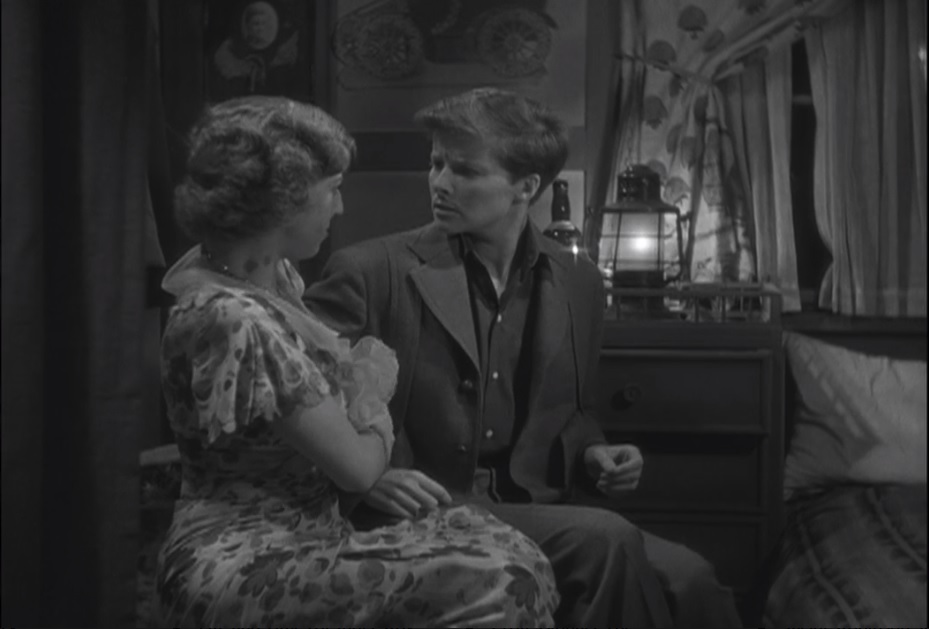
In Marseilles, when the seamstress wife of Henry Scarlett (Edmund Gwenn) dies, he becomes desperate to flee the country from French officials. He's been embezzling funds from the lace factory where he was employed as a bookkeeper, and lost all the funds to gambling. With some lace that he has stolen, he decides to head back to England to start anew, but tells his daughter Sylvia (Hepburn) that he will go alone and send for her later. She will have none of that, and so cuts off her hair and tells him that if she travels with him as a boy, the police will be confounded in their search for a man and his daughter.
While ferrying across the channel, they make the acquaintance of one Jimmy Monkley (Grant), a charming Cockney con artist and grifter, who uses his acquaintance with the Scarlett's to throw suspicion off himself when they go through customs (he rats out Henry's lace so as to distract from the diamonds he's smuggling in his shoe). Despite the seeming betrayal (and the £100 Monkley gives the Scarlett's for their trouble), the three decide to hook up as con artists using Monkley's contacts in London. The living arrangements are a bit problematic, as Monkley can't seem to figure out while "Sylvester"—the name Sylvia goes by in her disguise—is nervous about sharing a room with him, and gets downright agitated about dressing down for the night. What is wrong with the boy?
The first scam attempt involves Maudie Tilt (Dennie Moore), a lady's maid whom Monkley tries to seduce to steal her lady's expensive pearl necklace. The escapade doesn't pan out but it does manage to hook Maudie up with the band, partially because she's attracted to "Sylvester" which worries Sylvia, but not as much as when her father starts to fall for Maudie. Sylvia/Sylvester, having a crisis of conscience, insists they give up the dangerous grifter life, and instead become travelling show-people, "The Pink Pierrots," a cavorting harlequin troupe caravaning from small town to small town entertaining the villagers.
In one town, they meet bohemian artist Michael Fane (Brian Aherne), who is enchanted by the group, but, curiously, most by Sylvester—who, in turn, is attracted to him—prompting Fane to gasp the most famous line to pass the censors: "I say, I know what it is that gives me a queer feeling when I look at you..."
pause for effect
"...There's something in you to be painted!" 

Of course. That must be it. Artistic inspiration. While Sylvia Scarlett (the movie) flirts and teases with the gay mystique, there is nothing beyond girl-on-girl pecking (mistaken or otherwise) that produces something akin to horror in Hepburn's character. Even Aherne's outburst is provincially couched in Sylvia's subterfuge—he's attracted to her because she's a woman, though dressed as a man. Safe enough. And when "Sylvester", smitten with Fane, borrows ladies' gear to appear all flowery and girly, he is charmed but ultimately dismissive once learning the truth of Sylvia, going back to his un-British—in fact, Russian-European—mistress.
The sexual politics is flummery—just a tease—because once things settle—and people settle—things are safely hetero, but, at least, they take one chance: the pairings are not based on Hollywood archetypes of who should be with whom (we've all seen disastrously mis-paired types in many a final fade-out), but rather in personality types; the romantics are together and the churlishly cynical are as well, being matches of the soul, rather than the romantic heart.
At least that is a bit different; the couples deserve each other, for good or ill. It's not much of a revolution, certainly not enough to inspire a reprisal at the box-office. In fact, it's merely common sense, but that's something rarely found in romantic films.

Or in romance, for all that.