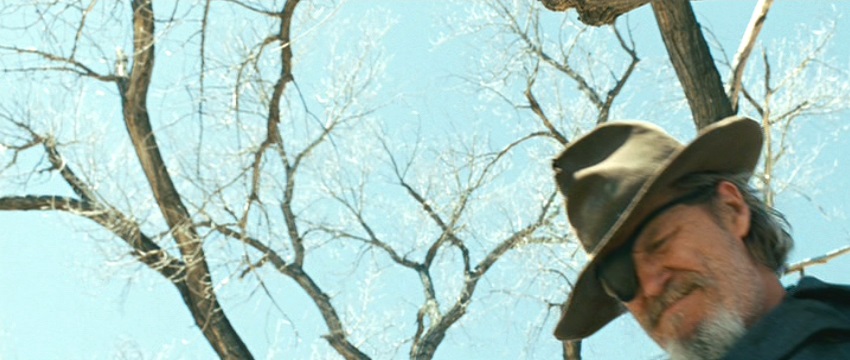
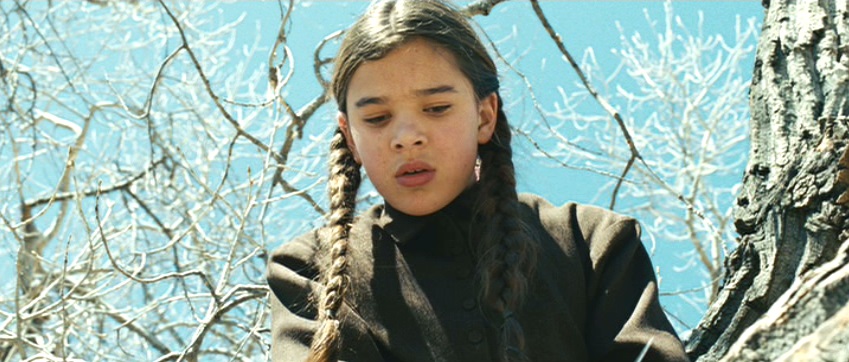
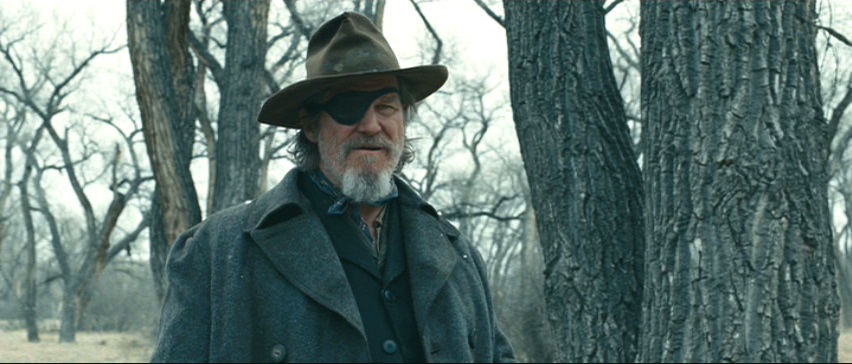
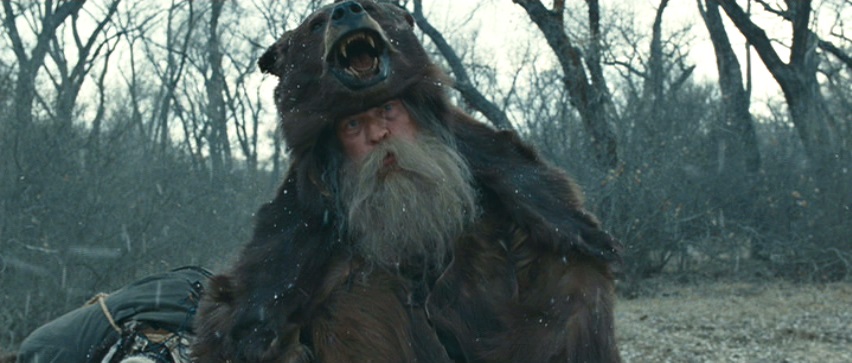
This week, we take a look at how the Coen Brothers handled it in their 2010 version, also titled True Grit. It's the same story, with much the same dialogue, but they stage it quite differently and with elements that didn't appear in Charles Portis' original novel.
Still, in tone and texture it feels closer to the Portis book than the earlier version as lauded as that film is...and should be.
That monologue has two sections: "Rooster" talking about his personal past, and then the foreshadowing of what will be the movie's big showdown at the end, with "Rooster", alone, taking on four armed bandits, jousting style. The latter discussion will be in its same place as the marshal and young Mattie Ross await the arrival of "Lucky" Ned Pepper and his gang at the cabin of "The Original" Greaser Bob later in the proceedings.
But, the Coens move the section of Cogburn's past marriages earlier than the first film, partly because, here, in this version, the character of LaBouef doesn't accompany them from the very beginning—in the 1969 film, the traveling scenes are filled with bickering between the marshal and the Texas Ranger. But, here, Cogburn is allowed to prattle on, with Ethan Coen adding in some details not included in the book.
But, you do get the story of "Nola" and you get "Horace" his clumsy child without too much prompting from Mattie.
Plus, you get an inconveniently-placed anonymous corpse and two frontier "entrepreneurs" in the bargain.
The Set-Up: Yell County, Arkansas mourns the loss of Frank Ross, killed in an altercation with his farm-hand, Tom Chaney (Josh Brolin). But, while others mourn, his teenage daughter Mattie (Hailee Steinfeld) wants to do more. She travels to Fort Smith to find a man of "grit" and finds one in the disreputable form of Rueben J. Cogburn (Jeff Bridges), "the meanest and most fearless" U.S. Marshal in those parts, to find Cheney and bring him to justice. She also learns that a Texas Ranger named LaBouef (Matt Damon) is also tracking Chaney for the murder of a Senator. She pesters Cogburn to take the job before LaBoeuf can make any advancement in his efforts and, against Cogburn's wishes, tags along to make sure her money is well-spent.
But, that doesn't mean there aren't distractions along the way...
Action.
RIDING
Rooster and Mattie ride abreast along a barely defined road.
RoosterPotter and I served with him at Elkhorn Tavern. Even
latterly our activities was by and large martial. We did
though, one time, run across a Yankee paymaster and relieve
him of four thousand dollars in gold coin. Squealed like it
was his own money. Well, since hostilities was officially
ended it was technically criminal so Potter rode down to
Arkansas and I went to Cairo Illinois with my share, started
calling myself Burroughs and opened I bought an eating place called
The Green Frog.
RoosterStarted calling myself Burroughs. I married a grass widow
Roosterbut my drinking
picked up and my wife did not like care for the company of my river
friends. She decided to go back to her first husband, a clerk
in a hardware store.
RoosterShe said, "Goodbye, Reuben, a love for
decency does not abide in you."
Rooster(That's a divorced woman for ya--talkin' about decency). I told her,
Rooster"Goodbye, Nola,
I hope that little nail-selling bastard will make you happy
this time." She took my boy with her too.
RoosterHe never did like
me anyhow. I guess I did speak awful rough to him but...
RoosterI did
not mean nothing by it. You would not want to see a
clumsier child than Horace.
RoosterI bet he broke forty cups. . .
He frowns and draws up, looking at something.
Mattie follows his look.
A man is hanging in a tree--very high, perhaps thirty feet off the ground. The body slowly
twists. The head seems unnaturally large.
Rooster
Hey!
At Rooster's shout something separates from the head: we have been looking at not just the
corpse's silhouette but that of a large carrion-eating bird as well, perched on the corpse's
shoulder and feeding at the corpse's face.
The bird flaps clumsily off.
Rooster gazes at the strung-up body.
Rooster
Is it Chaney?
Mattie
I would not recognize the soles of his feet.
Rooster gets off his horse, pulls a knife from his gear, and ambles to the tree.
Mattie
follows.
When she arrives Rooster has started sawing at the rope that ties the body off, wrapped
around a chest-high branch stump.
Mattie looks up.
She is looking mostly at soles of feet as the foreshortened body twists slowly, high above.
Rooster
Step back now.
She does.
Rooster steps back as well as the almost-cut-through rope starts to unravel by
itself, crazily twisting under the pressure and gently spinning the body above.
The rope snaps. It yanks violently upward, slapping branches.
The body drops--perhaps four feet--
and jerks to a stop, jacknifing and dancing.
Rooster
God damn it.
They both gaze up at the body.
Rooster
Snagged.
RoosterWell you are going to have to clamber on up with
this knife. I am too old and too fat.
UP IN THE TREE
Mattie is well up.
We hear Rooster's voice from below:
RoosterIt (The Green Frog) had one billiard table, ...served ladies and men both...
Roosterbut
mostly men. I tried to run it myself a while...
Roosterbut I couldn't
keep good help and...
RoosterI never did learn how to buy meat.
I was
like a man fighting bees. Finally I give up and solt it and
went out to see the country.
Mattie pauses, looking down.
We are over her. Rooster is foreshortened, a long way down, looking up, smoking a
cigarette.
He reacts to her look down:
Rooster
You are doing well.
She looks up, down again, and then proceeds.
Rooster continues as well:
. . .
RoosterThat was when I went out to the staked plains of Texas
and shot buffalo with Vernon Shaftoe and a Flathead Indian
called Olly.
Mattie stretches onto tiptoes, reaches, just gets fingers around a branch.
She secures it
enough with the one hand to dare to reach with the other.
She hauls herself up.
. . .
RoosterThe Mormons had run Shaftoe out of Great Salt Lake
City but don't ask me what it was for. Call it a misunder-standing and let it go at that. There is no use in you asking
me questions about it, for I will not answer them.
Mattie looks out, at waist-height to the corpse,
which twists maybe eight feet away over
the void.
Rooster notes her look:
. . .
RoosterIs it our man him?
The face is half-eaten and eyeless.
Mattie
I believe not.
She moves to start back down, but Rooster calls:
RoosterNo! Well. Cut him down!
Mattie
Why?
Rooster
I might know him.
She climbs one more branch to arrive at the hanging branch.
RoosterThat was when I went out to
Rooster the staked plains of
Rooster Texas
and shot buffalo with Vernon Shaftoe and a Flathead Indian
called Olly.
She shimmies out onto it and
pulls the knife from Rooster's belt now around her waist.
. . .
RoosterThe
Mormons had run Shaftoe out of Great Salt Lake
City but don't ask me what it was for.
RoosterCall it a
misunder-standing and let it go at that. There is no use in you asking
me questions about it, for I will not answer them.
RoosterYou see, Olly and me both taken a solemn oath to keep
silent.
RoosterWell sir, the big shaggies is about all gone. It is a
damned shame.
Mattie looks down, over the shoulder of the close-by foreshortened corpse to the far
foreshortened Rooster.
. . .
RoosterI would give three dollars right now for a pickled buffalo
tongue.
She shimmies out onto it and
pulls the knife from Rooster's belt now around her waist.
. . .
She calls out as she starts sawing:
Mattie
Why did they hang him so high?
Rooster
I don't know.
RoosterPossibly in the belief it would make him more
dead.
The sawing continues.
Rooster takes one step back.
The rope snaps.
At once:
The body drops.
The branch, unburdened, bucks with Mattie atop it.
She gasps, hugging at the branch, getting swung halfway around it but then righting
herself.
The body hits the ground with a smack.
Mattie looks.
The body is spread out on the ground below, many bones now broken, its posture absurd.
Rooster steps forward.
He toes the upper body to get a view of the face.
Barely audible:
Rooster
I do not know this man.
He reacts to something,
looking up the road in the direction of their heading.
Mattie looks out.
Partly obscured by intervening foliage, an oncoming rider.
His pace is
unhurried.
Down on the ground Rooster turns to face the rider--
an Indian with a long-bore rifle
balanced sideways across the pommel of his saddle. He wears a tattered Union Army
jacket, crossed bandoliers of rifle shells and a black homburg hat with a feather in its brim.
Rooster drops his hand to his gun as the rider approaches.
Mattie looks down
at the foreshortened rider pulling up under the tree.
She hears a
greeting and a mostly inaudible exchange.
After some back-and-forth the Indian dismounts.
The men stoop at either end of the
corpse.
Rooster grabs wrists, the Indian, ankles.
They lift.
Mattie frowns. She starts to move.
A MINUTE LATER
Mattie finishes climbing down.
Rooster is just returning from the road to their two horses by the tree.
The Indian, with the
corpse slung over the rump of his horse, is resuming his trip in the direction from which
Rooster and Mattie came.
MattieHe knew Why's he taking the hanged man?
Mattie Did he know him?
Rooster mounts.
Rooster
He did not.
RoosterBut it is a dead body,
Roosterpossibly probably worth something
in trade.
He looks up at the sky as snowflakes start to sift down.
RIDING
It is snowing lightly. Rooster and Mattie are clomping through a stream.
Rooster
(My second wife, she was Edna.)
RoosterShe had taken a notion she wanted me to be a lawyer.
Bought a heavy book called Daniels on Negotiable
Instruments and set me to reading it.
RoosterNever could get a grip
on it and I was happy enough to set it aside and leave Texas.
RoosterThere ain't but about six trees between there and Canada,
and nothing else grows but has stickers on it.
Rooster I went to--
A distant gunshot.
Rooster stops.
He twists to look behind.
A listening beat.
At length:
Rooster
I knew it.
Mattie
Knew what?
Rooster
We're being followed.
RoosterI asked the Indian to signal with a
shot if there was someone on our trail.
Mattie
Should we be concerned, Marshal?
Rooster
No. It's Mr...
Rooster LeBoeuf, using us as bird dogs in hopes of
cutting in once we've flushed the prey.
RoosterOur Texas friend has
got just enough sense to recognize he can't outtrack me.
Mattie thinks.
Mattie
Perhaps we could double back over our tracks, and confuse
the trail in a clever way.
Rooster
No, we will wait...
Rooster...right here and offer our friend a warm
hello, and ask him where he is going.
MINUTES LATER
Rooster waits, sitting casually astride his horse in the middle of the road. Snow continues
to fall.
A jingling noise up the road.
Movement:
an advancing rider seen through the foliage that masks a bend in the road.
Rooster straightens.
The oncoming rider rounds the bend.
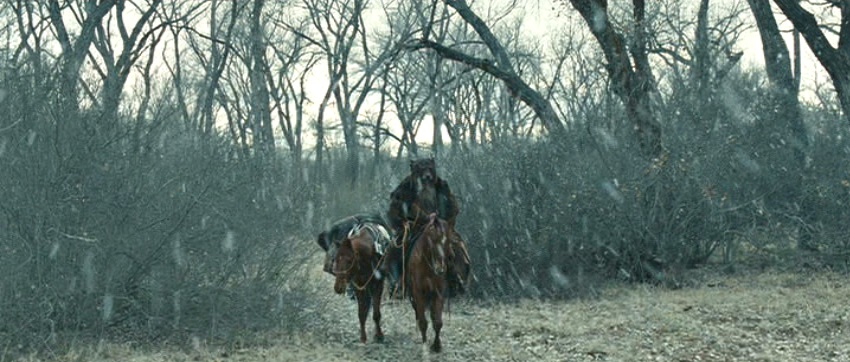
He approaches: a white man with big whiskers, his horse leading a packhorse loaded with
clinking and jangling sundries.
Draped on his own horse's rump is the hanged man's
body.
The stranger wears a fierce bear head as hat.
The rest of the bearskin trails down his body
as robe.
He advances unhurriedly towards Rooster.
At a few yards' distance he draws up,
content
to sit his horse and solemnly return Rooster's stare.
At length:
Rooster
You are not LeBoeuf.
Bear Man
My name is Forster.
Bear ManI practice dentistry
Bear Man
...in the Nation.
Bear ManAlso,
veterinary arts. And medicine,
Bear Man...on those humans that will sit
still for it.
Rooster
(indicating corpse)
You have your work cut out for you there.
Bear Man
Traded for him with an Indian, who said he came by him
honestly. I gave up two dental mirrors and a bottle of
expectorant. (beat)
Bear ManDo either of you need...
Bear Man...medical
attention?
Rooster
No.
Rooster straightens as if to rein his horse around
but stops with a thought:
. . .
RoosterIt is fixing to get cold.
RoosterDo you know of any place to take
shelter?
Bear Man
I have my bearskin.
Bear Man You might want to head to...
Bear Man ...the Original
Greaser Bob's.
Bear Man He notched a dugout...
Bear Man ...into a hollow along the
Carrillon River. If you ride the river...
Bear Man ...you won't fail to see it.
Greaser Bob...
Bear Man --Original Greaser Bob--is hunting north of the picket wire
Bear Man ...and would not begrudge its use.
Rooster Much obliged.
A pause.
The Bear Man tilts his head to indicate the corpse behind him.
Bear Man
I have taken his teeth.
Bear Man I will entertain an offer for the rest of
him.
But, getting to that point was a long, involved road. It originated with Dalton Trumbo, who, following a year-long stint in prison for contempt of Congress for not "naming names" to the House Un-American Activities Committee, was living in Mexico City. He was in financial straits, not being able to sell scripts to Hollywood—who'd provided a good income to him since 1935—owing to being "blacklisted" by the industry. He still wrote, producing 10 screenplays, and forwarded them to "fronts" who would sell the ideas to the studios for a cut of the proceeds. Trumbo's reverse-Cinderella story, Roman Holiday, was sold to Frank Capra's Liberty Films by one such front, Ian McLellan Hunter for $50,000 (all of which he paid to Trumbo), and Hunter was hired by the studio to work on the script.
The first director attached to it was Frank Capra himself, who wanted Cary Grant and Elizabeth Taylor for the parts of the deceptive reporter and princess, respectively. Taylor was unavailable and Grant, after reading the script, decided his part would be overshadowed by the part of the princess. Capra left the project when his budget demands would not be met, and he sold the script back to Paramount.
George Stevens was briefly attached, but it ended up with director William Wyler, who had some stipulations: a larger budget, Jean Simmons and Cary Grant to star, and filming to be done totally in Rome. Grant—again—wouldn't do it and Simmons was under contract to RKO and its owner Howard Hughes wouldn't loan her out except for a sizable fee. So, Wyler opted to cut his losses—he insisted on filming in Rome (and Paramount had some frozen funds that could be utilized and Rome's studio Cinecittà was back up and running). Gregory Peck—who was looking for lighter roles than he was being offered—was signed (although he, too, was worried about being overshadowed by the female lead), and Wyler decided to look for an unknown actress, which is when he heard about a new European actress, who was doing theater in small parts in movies.
Wyler left instructions to keep the camera rolling after the screen test—so the story goes—and the young actress was asked questions about her background, including her time growing up in Belgium during World War II. Everyone who saw the test was charmed by it. Hepburn got the role. But, first, she had a commitment to a Broadway role starring in "Gigi"—she had been picked by Collette herself for the role—and as Peck was held up in over-runs shooting The Snows of Kilimanjaro, the production was delayed.
In the meantime, many writers' hands worked on Roman Holiday besides Hunter, including Ben Hecht, Preston Sturges, Valentine Davies, and—when in Rome—John Dighton, who was there to punch up scenes whenever a location found by Wyler would peak his interest.Cast and crew were not afraid to make changes or make suggestions.
The film begins with a Paramount Newsreel examining Princess Ann (Hepburn) from "one of Europe's oldest ruling families" (although they never mention of what country*) on a tour to "improve trade relations" and although she projects a serene calmness publicly she's starting to crack. She's 19, royally supervised and expected to amiably meet and greet hundreds of dignitaries, all of whom seem to belie the term. And although this is a reverse-Cinderella story, she does have one thing in common with her fairy-tale predecessor—she has shoe problems. There's only so much time you can spend standing in the damn things! Plus, although she is touring Europe, she sees very little of it, cloistered in luxurious quarters with her only bed-time reading her full itinerary for the next day. And yet outside her window, life is happening, people are partying and enjoying life. And Rome, even though it's the Eternal City, can't wait forever.
She melts down. to the point where she has to be sedated to get some sleep so she can keep up the busy tour. And maybe it's the sleep-drug talking, but the princess gets it in her crowned head to escape her gilded dignitary's cage and go out into the night, un-escorted, unchaperoned, and unceremoniously. Where Cinderella wanted to see how the other 2% lived, Ann wants the 98% of possibility the world just within her regal wave can offer. She sneaks out of her embassy and finds her way into town.
And then, the sedative kicks in.
Lucky for her, Joe Bradley (Peck), a reporter for a Rome-based wire service is late coming home from an evening poker game among colleagues and happens upon her. Thinking her drunk, he tries to get her on her feet, then pours her into a cab and, with no place else to put her, takes her to his apartment ("Is this the elevator?" she bleerily asks when they get there) to sleep it off. There is some chaste teasing about sleeping arrangements that ends up with Bradley being late for his day's assignment—an interview with Princess Ann—only to discover...she's been sleeping in his bed. And suddenly he concocts a scheme to get a big story, given his special "access."
Her government has put out a cover story to explain her mysterious disappearance has had to cancel all activities due to a "sudden illness"...so Joe makes a bet with his boss that he can get an exclusive with the princess. All well and not exactly good. A lot of subterfuge has to be done to get that story. The princess wants to have her adventure but not let on that she's at any way royal. Joe conspires to get his story without letting on that he's a reporter—and he wants pictures, which he gets with the third wheel of the adventure, bohemian photographer Irving Radovich (an ebullient and funny Eddie Albert), who is constantly taking photographs with camera concealed in a lighter.
The production was, basically, a working holiday for cast and crew, and the incidents on the princess' "day off" center on aspects and sights of an elaborate tour of Rome with the Colosseum, the Trevi Fountain, the Spanish Steps, with stops for gelato, vespa-hopping, dinner and dancing and, ironically, "the Mouth of Truth" which might prove to be daunting to two people who spend the day under false identities.
Peck has rarely been allowed to be this light—and he's surprisingly subtle and slyly humorous playing a roguish Prince Charming, and Hepburn is perpetually adorable as a princess with the crown off. As Pauline Kael remarked "when she smiles, we're all goners," but leavened somewhat by eyes that always have a shade of melancholy—her wartime childhood probably had something to do with that—and it comes in handy for her scenes as a princess trying to escape the weight of her heritage while knowing that she'll never be able to get away with it...or from it.
Just as Cinderella had to return from the ball and back to the ashes, Princess Ann's fantasy has to come to an end and she must return to her origins. But, Cinderella got to have a happy ending. For Princess Ann, no ending can be completely happy. But, Roman Holiday does, at least, provide a modicum of satisfaction where the lies fall away along with the fantasies. If someone can only acknowledge the truth...however painful it might be...one can at least admit that they're being true...to themself.
And that's the lovely thing about Trumbo's story. It's not a sad ending (although not a happy one), but there is a level of satisfaction in the warm glow of memory, free of fairy tales, despite all the pomp and circumstances getting in the way. And the memory of Roman Holiday always brings an admiring smile to my face.
Dalton Trumbo was finally acknowledged to have written the story that won the 1953 Academy Award and in 1993 an Oscar was given to his widow. Trumbo died in 1976.
"...She has us all in thrall, and when she smiles we're all goners."
Pauline Kael
* The film never says, but one can assume that it isn't any of the stops on the tour which include London, Amsterdam, Paris or Rome. Although I did find an example of a script excerpt, which names the country as "Coravia" (wherever that is).
An Angel at My Table(Jane Campion, 1990) Incredible tale of the New Zealand author who was institutionalized for schizophrenia, and narrowly avoided a leucotomy procedure*by winning a prestigious book award. Talk about your narrow escapes. But escapes were what Janet Frame specialized in, from her "magic realism" writing style to her globe-trotting adventures that took her to England and Spain, while keeping herself locked inside her own creative mind.
Partly due to her diagnostic history, and partly due to her "odd duckishness" Frame had a ying-yang non-relationship with Society. The film portrays her as "odd man out" in various capacities, the one Campion seems to relish most is that while she is being socially shunned by a group of boorishly egotistical literati, she is the only one of them that has been critically acclaimed...or, for that matter, even published, already achieving what the full-of-themselves coffee klatsches only hope to accomplish. They dismiss her for her dowdy clothes and chia-pet hairstyle out of hand, not bothering to consider that they couldn't tell a book (they hadn't written) by its cover.
Made for television, the film is more conventionally framed than most Campion films, known for their stark use of isolating empty space, and sometimes fractured story-telling style, but Campion gets compelling performances from the three women playing Frame—Karen Fergusson, Alexia Keogh, and finally, settling on Kerry Fox for the second half of the film exploring the author's wandering adulthood. As an introduction to Campion's work, this is a good start, with a compelling true story with a straight-forward approach to the aspects of magic-realism that infuse her work.
My favorite shot of An Angel at My Table: Janet "does the twist" by herself in the dark by the light of her camper/writing-garret.
* A leucotomy was a specific form of lobotomy back in the dark ages when the practice was given enough medical credence to actually give a unique name to it rather than calling it what it was—hammering an ice-pick behind someone's eye-ball to sever neural connections in the brain. I'm wondering if insurance companies covered that.
A nice little movie that no one has ever heard of is John Sayles'City of Hope
made in 1991—it presents a limited space in time in the life of
Philadelphia where the decisions of every character over the disposition
of a single city block affects every other character in a way that
negates any sense that lives can escape the self-imposed limits
inflicted by others (and placed on themselves). Everyone is trapped and without any hope.
Paul Haggis, when he copied the form in Crash offered the same bleakness but leavened it with individualrays of hope. One can look at these movies and quibble about
coincidences and manipulation, but speaking as someone who's lived in
one city and worked, basically, in one field for most of his life, those
aspects of rubbing too many shoulders has never seemed like much of a
stretch. It's pretty amazing how a large city can become a "small town"
fairly quickly and without irony.
Babel, though (named after thetower in the bible-storythat created so many ESL programs), takes it one planet further. From its opening image of a Moroccan hunter trudging the desert
to its last shot of a man holding a naked woman on a Japanese balcony,
every single life is intertwined in a way that makes one wince, and
actually creates dread over the next revelation of inter-connectedness
(there's one character, whose absence sets in motion an unfortunate
series of events, that we never see—supposedly she'll be in Babel
II). It's a bit of a stretch, lessened somewhat by the global
investigation of a mistaken act of terrorism. Nothing brings the world
together like Homeland Security.
Still,
if one can overlook The Big Skein that hangs over the movie like a
shroud, the individual segments are involving, dramatically impeccable
and present worlds that are never less than intriguingly realized. One
wonders throughout where the stories will lead, even if the answer on an
occasion or two is nowhere.
To
reveal too much would be robbing the movie of any freshness it
possesses, but suffice it to say that lack of communication is a key in
all of them and that they are resolved (when they're resolved) by a
recommitment to family (except when they're not). It's a bit messy in
that regard. But, then, what world isn't?
This one's on me. Maybe, it's too technical, I don't care. Maybe you don't like learning "how sausage is made." I don't care if you're interested in watching it. I don't care if you'd just as soon watch something else.
Just be aware that if you watch something else, this nifty documentary covers something that you might not be aware of.
That what you're hearing in movies, commercials, TV shows, whatever...is faked.
People do this for a living. They try to make things better than reality...or, more crudely, they're "selling" you something that you have every intention to buy, whether you're conscience of it or not.
But, I think it's important that people know stuff like this. I sometimes read comments from people, or see things that people have posted, and it's apparent to me that an awful lot of people know very little about "the magic" than can happen in post-production to enhance what we're seeing...and now, we're of an age where one can't accept anything "on faith." Sounds (which this doc focuses on) and images can be produced or manipulated that you should probably not believe what you're seeing.
Ben Burtt recording the bear that made up the bulk
of the vocalizations of "Chewbacca" in Star Wars.
Why do I care? Because I used to do this for a living. In my past-life, I used to do "post-sound" for radio, television, film, and computer programs. It was something I was interested in when I was a kid, and somehow managed to do it when I grew up, taking "the kid" with me. And it was fun...it could be a lot of fun and had an inherent joy in making things "work." But, it could also be painstakingly tedious (which was readily apparent whenever I showed somebody "my work"—the attraction to the process would always "thin" for observers).
But, the thrill of the finished project always made it worth it. I especially loved when I made something out of elements so completely different from what the visuals were and people "bought it" anyway. It was a little conspiracy I played with an audience that took advantage of their natural proclivities to see an image, hear a sound with it and put two and two together in their heads. Manipulative, sure. But, nobody cared because they were "in on the act."
And I was lucky to get in on this when everything was changing, when sound wasn't part of a corporate department to be done using stock sound effects that had been in the vaults for 30 years, but became something new and creative—I remember sitting in the Crossroads theater to see THX-1138 (sound-designed by Walter Murch) and being stunned by the sounds and created environments I was hearing and wanting to do stuff like that. Then, American Graffiti. Star Wars. I was blown away attending a very early screening of Apocalypse Now (also designed by Murch, but more importantly he'd also personally set up the speaker arrays in the theater!) and having my mind blown when the helicopters in that first sequence flew right through my head. Murch and Ben Burtt and the others in their foot-steps would become as much a reason to see the film as the actors or who directed it.
And Making Waves shows all of that—the technical advancements and the advancements in creativity—of what was possible, without compromise. Of how the old ways of doing things were left by the way-side because the new ways became better and took over, so that now the sound isn't just a paint-by-numbers formality, but is, in itself, its own art.
Now, all of that is behind me. I watch things and don't even notice the sound-design anymore. Oh, I do if something's "off" or if I recognize an old library sound that I used a couple decades ago (it happens more frequently than I'd like!). These days I appreciate when a film doesn't throw a sonic kitchen-sink at everything. I appreciate the silences...the judicious choices...the spareness...and the realization of what's important.