Showing posts with label William Wyler. Show all posts

Friday, May 10, 2024

How to Steal a Million

How to Steal a Million (William Wyler, 1966) Writer Harry Kurnitz (who the story for Hatari!, the novel for A Shot in the Dark, and the screenwriter for Witness for the Prosecution and a couple entries of the "Thin Man" series) could be counted on to deliver a solid story that never really amounted to what it promised...that is, other than to entertain and entertain mightily. Especially if all the elements were in place—good photography, cracker-jack actors, an ornate location or two. He didn't write important pictures. He wrote fluff. Good fluff. That would satisfy audiences, and make critics suspicious that they were being conned.

The story goes that director William Wyler, after directing Audrey Hepburn to an Oscar for Roman Holiday, wanted to re-team her with co-star Gregory Peck for another rompish movie, this time set in Paris. In the forseeable future, however, Hepburn and Wyler worked on The Children's Hour together, Wyler had directed a little film called Ben-Hur, and Peck had won his Oscar for To Kill a Mockingbird. Somehow, the elements wouldn't gel until Wyler put together Hepburn and Peter O'Toole—who was toiling in an endless stream of drama parts, and was probably attracted to the idea of something lighter for a change.
What the fuss is all about...
The story concerns one Charles Bonnet (Hugh Griffith), whose French estate contains some of the world's most renowned art treasures, and who, also, maybe coincidentally, is also one of the world's most unknown art forgers. His daughter Nicole (Hepburn, all Givenchy'd up and no place to go—O'Toole's character makes a crack about it later in the movie) is constantly worried that Dad is going to go too far some day and the Paris gendarmes will come knocking at their door and the family's wealth and reputation will be as worthless as one of Daddy's forgeries.
Wyler, exploiting the film's wide-screen presentation,
must really love that staircase.
So, imagine her dismay when guards, police and armored cars come to the drive-way. Charles assures her that he is merely lending one of his collection, "The Cellini Venus", to the Kléber-Lafayette Museum* for display and the heavy armory is for safe passage. Except for one tiny detail—that "Cellini Venus" is a forgery, too, sculpted by Charles' father and the model for it being his mother. What's more, it is probably more susceptible to being realized as a forgery than one of the family's many paintings. Her father is not worried, and the small Venus is whisked away for display. Nicole is not so reassured.
It doesn't help that while father Charles attends a celebratory soiree at the museum, Nicole** must confront a burglar, one Simon Dermott (O'Toole), caught in the act of examining one of the Bonnet Van Gogh's. In a tuxedo, he's exceptionally well-dressed for burgling, a move no doubt inspired by Charles' absence for the night. But, he's charming enough to be able to disarm the situation, although she does manage to ruin the line of sight by accidentally shooting him in the arm. "Oh, it's just a flesh wound" Nicole scolds. "But it's MY flesh!" he retorts.
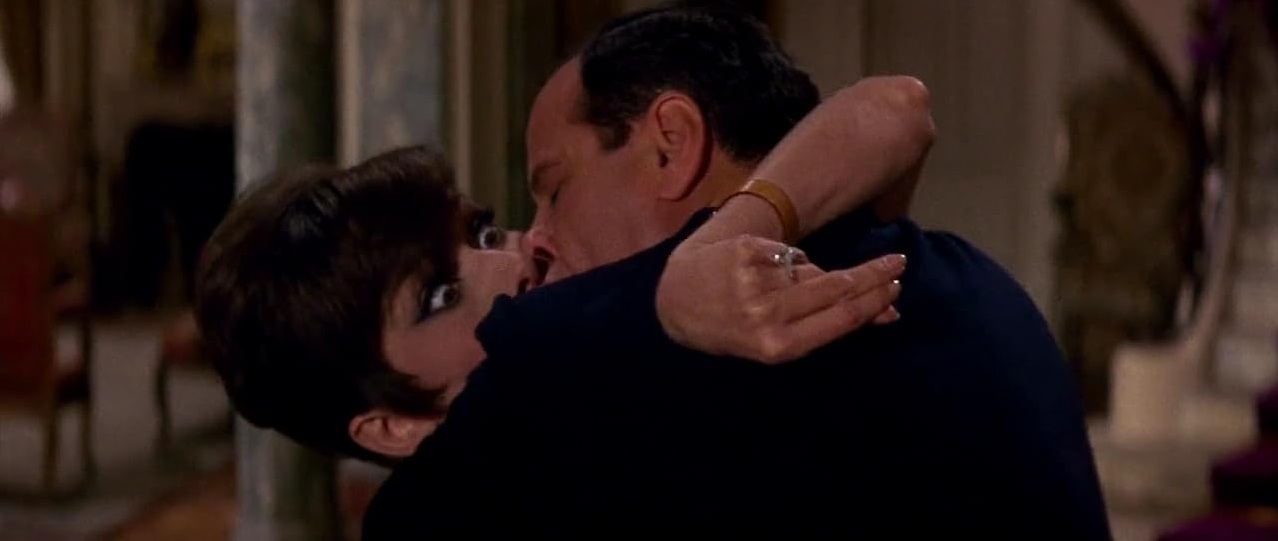
Nicole should be worried. Dermott is something of a fraud himself. Plus, the Bonnet household is being circled by art dealer DeSolnay (Charles Boyer), who has decided to look into the Bonnet provenance and have it investigated. And a rather eccentrically driven American wheeler-dealer (Eli Wallach) wants to obtain the "Venus" by any means necessary—including marrying Nicole. 
And then, there's the major complication: insurance. Charles Bonnet is not worried about the Venus being determined a forgery, as he is merely loaning it out and it need not be examined for authenticity. He thought. But, as the museum has to insure the statue from theft, it must go through the formality of a "technical examination, which will expose the fakery. Bonnet has already signed the papers, inadvertently giving the Museum permission to its study, so surely that will expose the family.
Nicole then decides—mad-cap that she is—to hire Demott (the only burglar she knows) to steal the statue before it can be found out. It takes about an hour of cute dialogue, spry encounters, several costume changes and that nearly lethal incident of "meet-cute" before we get there. The rest of the movie documents the long, drawn-out robbery which relies on false alarms—and we see all of them.
There is magnetism involved among the principal actors—Hepburn pirouettes in her own spotlight, and O'Toole observes, amused. Wyler, on the other hand, is content to make sure we see how expansive the sets are, like he was still filming Ben-Hur. Those sets, however, never seem more than nattily-dressed cavernous sound-stages (his next film would be the equally ornate Funny Girl). How to Steal a Million is a trifle, with all the consistency of just-applied meringue, and with as much confectioner's sugar.
One interesting thing to ponder is what might have been. For the role Wallach eventually played, Walter Mathau (who was in Hepburn's Charade and starred on Broadway in Kurnitz's "A Shot in the Dark" was approached but wanted too much money. Cast instead was George C. Scott, who, unfortunately, turned up late for his first day of shooting...like, after lunch. Wyler, who was already worried that O'Toole and Griffith, two notorious drinkers, were in danger of derailing the project, would not abide such behavior in a third, and promptly fired Scott, which, apparently, greatly upset Hepburn.
 
One can only imagine...
Face it. Whatever the plot, this is what audiences wanted to see.
 
* It's fictional, but then so is The Cellini Venus...

** Interestingly, she is again caught in her bed reading a book involving Alfred Hitchcock (as was also the case in Roman Holiday). I don't know if this was a nod to his fellow director by Wyler, or if Hepburn was attempting to court Hitch to appear in one of his films (although the film Charade is considered the next best thing), but the two never collaborated. Maybe because Hepburn would not have let Hitchcock decide what she wore.

Friday, March 8, 2024

Roman Holiday

Roman Holiday
(
William Wyler, 1953) The legend has it that when Gregory Peck returned from filming Roman Holiday with Audrey Hepburn on location in Rome, he advised someone at Paramount that they might have to change the billing and put her name above the title—"that girl's going to win an Academy Award!"
But, getting to that point was a long, involved road. It originated with Dalton Trumbo, who, following a year-long stint in prison for contempt of Congress for not "naming names" to the House Un-American Activities Committee, was living in Mexico City. He was in financial straits, not being able to sell scripts to Hollywood—who'd provided a good income to him since 1935—owing to being "blacklisted" by the industry. He still wrote, producing 10 screenplays, and forwarded them to "fronts" who would sell the ideas to the studios for a cut of the proceeds. Trumbo's reverse-Cinderella story, Roman Holiday, was sold to Frank Capra's Liberty Films by one such front, Ian McLellan Hunter for $50,000 (all of which he paid to Trumbo), and Hunter was hired by the studio to work on the script.
 
The first director attached to it was Frank Capra himself, who wanted Cary Grant and Elizabeth Taylor for the parts of the deceptive reporter and princess, respectively. Taylor was unavailable and Grant, after reading the script, decided his part would be overshadowed by the part of the princess. Capra left the project when his budget demands would not be met, and he sold the script back to Paramount.
George Stevens was briefly attached, but it ended up with director William Wyler, who had some stipulations: a larger budget, Jean Simmons and Cary Grant to star, and filming to be done totally in Rome. Grant—again—wouldn't do it and Simmons was under contract to RKO and its owner Howard Hughes wouldn't loan her out except for a sizable fee. So, Wyler opted to cut his losses—he insisted on filming in Rome (and Paramount had some frozen funds that could be utilized and Rome's studio Cinecittà was back up and running). Gregory Peck—who was looking for lighter roles than he was being offered—was signed (although he, too, was worried about being overshadowed by the female lead), and Wyler decided to look for an unknown actress, which is when he heard about a new European actress, who was doing theater in small parts in movies.

 
Wyler left instructions to keep the camera rolling after the screen test—so the story goes—and the young actress was asked questions about her background, including her time growing up in Belgium during World War II. Everyone who saw the test was charmed by it. Hepburn got the role. But, first, she had a commitment to a Broadway role starring in "Gigi"—she had been picked by Collette herself for the role—and as Peck was held up in over-runs shooting The Snows of Kilimanjaro, the production was delayed.

In the meantime, many writers' hands worked on Roman Holiday besides Hunter, including Ben Hecht, Preston Sturges, Valentine Davies, and—when in Rome—John Dighton, who was there to punch up scenes whenever a location found by Wyler would peak his interest. Cast and crew were not afraid to make changes or make suggestions.
The film begins with a Paramount Newsreel examining Princess Ann (Hepburn) from "one of Europe's oldest ruling families" (although they never mention of what country
*) on a tour to "improve trade relations" and although she projects a serene calmness publicly she's starting to crack. She's 19, royally supervised and expected to amiably meet and greet hundreds of dignitaries, all of whom seem to belie the term. And although this is a reverse-Cinderella story, she does have one thing in common with her fairy-tale predecessor—she has shoe problems. There's only so much time you can spend standing in the damn things! Plus, although she is touring Europe, she sees very little of it, cloistered in luxurious quarters with her only bed-time reading her full itinerary for the next day. And yet outside her window, life is happening, people are partying and enjoying life. And Rome, even though it's the Eternal City, can't wait forever.
 
She melts down. to the point where she has to be sedated to get some sleep so she can keep up the busy tour. And maybe it's the sleep-drug talking, but the princess gets it in her crowned head to escape her gilded dignitary's cage and go out into the night, un-escorted, unchaperoned, and unceremoniously. Where Cinderella wanted to see how the other 2% lived, Ann wants the 98% of possibility the world just within her regal wave can offer. She sneaks out of her embassy and finds her way into town.
And then, the sedative kicks in. 
 
Lucky for her, Joe Bradley (Peck), a reporter for a Rome-based wire service is late coming home from an evening poker game among colleagues and happens upon her. Thinking her drunk, he tries to get her on her feet, then pours her into a cab and, with no place else to put her, takes her to his apartment ("Is this the elevator?" she bleerily asks when they get there) to sleep it off. There is some chaste teasing about sleeping arrangements that ends up with Bradley being late for his day's assignment—an interview with Princess Ann—only to discover...she's been sleeping in his bed. And suddenly he concocts a scheme to get a big story, given his special "access."
Her government has put out a cover story to explain her mysterious disappearance has had to cancel all activities due to a "sudden illness"...so Joe makes a bet with his boss that he can get an exclusive with the princess. All well and not exactly good. A lot of subterfuge has to be done to get that story. The princess wants to have her adventure but not let on that she's at any way royal. Joe conspires to get his story without letting on that he's a reporter—and he wants pictures, which he gets with the third wheel of the adventure, bohemian photographer Irving Radovich (an ebullient and funny 
Eddie Albert), who is constantly taking photographs with camera concealed in a lighter.
The production was, basically, a working holiday for cast and crew, and the incidents on the princess' "day off" center on aspects and sights of an elaborate tour of Rome with the Colosseum, the Trevi Fountain, the Spanish Steps, with stops for gelato, vespa-hopping, dinner and dancing and, ironically, "the Mouth of Truth" which might prove to be daunting to two people who spend the day under false identities.
Peck has rarely been allowed to be this light—and he's surprisingly subtle and slyly humorous playing a roguish Prince Charming, and Hepburn is perpetually adorable as a princess with the crown off. As Pauline Kael remarked "when she smiles, we're all goners," but leavened somewhat by eyes that always have a shade of melancholy—her wartime childhood probably had something to do with that—and it comes in handy for her scenes as a princess trying to escape the weight of her heritage while knowing that she'll never be able to get away with it...or from it.
Just as Cinderella had to return from the ball and back to the ashes, Princess Ann's fantasy has to come to an end and she must return to her origins. But, Cinderella got to have a happy ending. For Princess Ann, no ending can be completely happy. But, Roman Holiday does, at least, provide a modicum of satisfaction where the lies fall away along with the fantasies. If someone can only acknowledge the truth...however painful it might be...one can at least admit that they're being true...to themself.
 
And that's the lovely thing about Trumbo's story. It's not a sad ending (although not a happy one), but there is a level of satisfaction in the warm glow of memory, free of fairy tales, despite all the pomp and circumstances getting in the way. And the memory of Roman Holiday always brings an admiring smile to my face.
Dalton Trumbo was finally acknowledged to have written the story that won the 1953 Academy Award and in 1993 an Oscar was given to his widow. Trumbo died in 1976. 
"...She has us all in thrall, and when she smiles we're all goners."
Pauline Kael

* The film never says, but one can assume that it isn't any of the stops on the tour which include London, Amsterdam, Paris or Rome. Although I did find an example of a script excerpt, which names the country as "Coravia" (wherever that is).


Tuesday, April 4, 2023

Come and Get It!

Come and Get It
!
(Howard Hawks
, William Wyler, Richard Rosson* 1936) Edna Ferber's novel was purchased by Samuel L. Goldwyn to turn into a Hollywood blockbuster and Howard Hawks hired to direct. But Hawks was a maverick, and when Goldwyn came back from a long illness to see how things had progressed, he was shocked, shocked (I tell you), to see that Hawks had drifted afield of the Ferber source novel. For one reason or another, Hawks was fired (or quit, depending who was asked) and replaced by Goldwyn favorite William Wyler (who was just finishing up Dodsworth for Goldwyn).
 
The result is a revelation on very many levels: that Hawks' signature style was so evident it couldn't be mistaken for any other director; that the difference between Wyler's and Hawks' scenes are night and day; that Edward Arnold, known to modern audiences as a supporting player in Capra films could carry a movie so handily; Walter Brennan could be a versatile and nimble actor; and that Frances Farmer was an incredibly gifted actor of enormous facility and subtlety.
The story of a logging "pirate," Bernard Glasgow (Arnold) falls in love with a saloon girl (Farmer), but gives her up to marry the boss's daughter, win himself a partnership and become one of the richest men in Missouri. Hawks' part is a fast-moving, rollicking story of rapacious men grabbing as much as they could to line their pockets. Shot in mostly waist-level fast set-ups, with a rarely moving camera, the emphasis is what's in the frame and not how it's framed, so most of the scenes are crowded with people, the actors stepping over each other's lines and character bits of business that are not called attention to (including the requisite cigarette lighting without being asked). Highlights are a saloon fight with serving trays used as dangerous flying discs, a couple of fights in which Arnold solidly smacks his opponents, a game of chance turned on its ear, and an Oscar-winning turn (the first to be given to a supporting actor) by Walter Brennan, rangy, ebullient and sporting a high Swedish accent.
But Farmer steals this section (she dominates the whole movie, actually) with her performance as the ultimate "Hawks dame:" her Lotta Morgan is gum-chewing, moose-jawed, with big movements and a dusky drawled voice, with more than a hint of Marlene Dietrich's insolence (courtesy of frequent Hawks collaborator Jules Furthman, who'd written a couple Dietrich films). That Farmer then plays her daughter (also named Lotta) later in the film in a high-toned, fluttery manner—she even sings differently—with a more subdued jaw-line and a smile not so crooked as her mother's is one of those nuanced things of such complexity that you remember how clever these "old" movies can be.
Farmer is able to keep up the performance when Wyler takes over, and it's pretty obvious when that is—when the Bostrom clan and Glasgow (now smitten with the daughter of the woman he left behind) take a fancy trip to Chicago. The pace slows. The actor's get out of the way of each other's lines.** The Gregg Toland photography is a bit more finicky and lush, not having to rush to make Hawks' schedule but accommodating to Wyler's. Scenes are staged more angularly and more obviously, telegraphing future camera moves and upcoming "business." And attention is paid to more obvious scene-fussiness, even to including cut-away's—a boy-girl flirtation is built around a taffy pull, and a later scene between Glasgow and his daughter doesn't communicate their "reflection of each other" relationship as Hawks did, but is, instead, based around a child's balancing toy. Wyler has enormous taste and style, but as much as he tries to emulate Hawks' off-the-cuff way of doing things, the more it feels staged and unnecessary, even making more of a Joel McCrea ad-libbed-over gaffe in Hawks's section than is necessary.

Hawks is more adept at making his points, too. Where he has a quick discussion of the duplicity of homesteading to acquire more timber land from the government for nothing ("Well...it's not illegal" says the company CEO), and shows Glasgow's utter disregard for re-planting ("Ah, nothin'll grow back there!"), whereas
Joel McCrea's son has the "planting for the future" line in Wyler's section—a conversation that puts the older Bostrow's to sleep.
It's an interesting study in contrasts in directing style—Hawks's attention to material and Wyler's attention to presentation—that may be lost on those caught up in Ferber's soapish story ("the famous novel by Edna Ferber" is how it's described in the credits. There's plenty of reason to go hunting for this film. And a hunt it will be; this film is notoriously snake-bit.
*** Maybe because of the melodrama behind the scenes, or Goldwyn's lack of enthusiasm for the result—the film went way over budget, capping at more than a million 1935 dollars—and was not a box-office success. Then there's the troubled career of Frances Farmer, which no studio wanted to gamble on promoting. For whatever reason, Come and Get It!, holds up very well and seems downright prescient for its asides on ecological issues and corporate ethics. And it is the film that Farmer was proudest of, despite its many issues in front of and behind the camera. She would never be as satisfied with her work and the conditions to achieve it again in her life.

Come and Get it! premiered in Seattle, Washington at The Liberty Theatre, where Frances Farmer had once been an usherette.

"Our Lady of Perpetual Rebellion:" Frances Farmer
Publicity Glamour photo by George Hurrell

* With all the attention made to Hawks' and Wyler's separate efforts there was a third director for Come and Get It!—Hawks's talented assistant director Richard Rosson who traveled to Idaho to photograph the incredible logging footage contained in the early part of the film.

** Is it preposterous for me to think that Wyler was taking a jab at Hawks' dialogue direction by having Brennan and Mady Christians—playing his niece—stop a conversation dead by saying the same thing over each other a couple times and then give up trying to inject into the conversation?

*** As an indication of this on a personal note, it took far more effort than normal to find a vintage poster of Come and Get It!. Until the last minute, the best I could uncover was a newspaper ad.

Friday, November 19, 2021

The Big Country

The Big Country (William Wyler, Robert Swink, 1958) One of those films you hear so much about—when one is talking about "epics"—that, once you see it, you wonder what all the fuss is about. Oh, the technical specs are there: stunning cinematography by Franz Planer in Technicolor and Technirama (although early videos before remastered DVD's tended to look a bit washed out and squeezed); a top-notch cast where Charlton Heston is only fourth-billed; and a rousing score by Jerome Moross that busily pumped up the excitement when nothing much was happening (director Wyler evidently hated the score, but it rarely flags—much the same way Elmer Bernstein's score for The Magnificent Seven goosed that film a couple years later). And William Wyler's framing has just enough "edge" to it that when he went off to prep Ben-Hur in Rome (leaving second unit director Robert Swink to finish it) the difference is extremely noticeable. Swink managed to solve some story-issues, but the "snap" of Wyler's visual flair just isn't there, especially in its use of the Technirama frame.
East-coaster James Mackay (Gregory Peck), a sailor by trade, has traveled out West to San Rafael to marry his beloved, Patricia Terrill (Carroll Baker), daughter to "The Major" (Charles Bickford), wealthy land-baron and owner of the Ladder ranch. He's met by ranch foreman Steve Leech (Heston), who takes one look at McKay's city-slicker duds and pegs him for a "rube," especially galling as he's a little sweet on his boss' daughter, as well.
What McKay doesn't know is he's stepped right into a situation not too far afield of Dashiell Hammett's "Red Harvest" where two warring factions are competing for supremacy—the Terrill's and the Hannassey's (led by the blustery Rufus Hannassey played by Burl Ives in an Oscar-winning turn). San Rafael may be "Big Country" (as McKay is continually told by locals), but it doesn't seem to be big enough for two ranches and their respective herds of cattle. The burr under everybody's saddles is the Maragon spread, which has an accommodating body of water for watering the parched cows out on the chaparral. The late owner of the area kept the peace by allowing access to everyone, but things seem to have gotten out of control, now that it's run by Maragon's daughter, school-teacher Julie (Jean Simmons). Seems the strategy for dealing with her is to either make her sell or marry her and she's not having any of it.
And McKay is metaphorically a fish out of water. He doesn't fit in out West. He does things differently than they're used to in the passive-aggressive West. When a bunch of Hannassey's men (led by son Chuck Connors) have a little fun drunkenly hog-tying McKay, the Terrill's want to string them up—and even shoot up the Hannassey ranch over it—but McKay dismisses the attack and doesn't want anybody escalating the tensions on his behalf. That's not how they do things out West! And McKay is taken to be a coward, something driven home when Leech offers the use of the horse "Old Thunder"—withholding the information that "Thunder" is a notorious ill-tempered bronco—which McKay refuses, not wanting to be made sport of.
While the Terrill's are off on their little pissing match, McKay secretly works with the horse, constantly being bucked off*, until it finally is worn down and acquiesces to being ridden. McKay chooses to keep that knowledge secret—he doesn't give a rip what the others think of him, nor does he check with anyone when he takes a solo sortie out to the Maragon place to inquire about purchase. The Terrill's go into a panic at his disappearance, not realizing that McKay knows how to navigate...and evidently never having seen a compass.
McKay's "otherness" is played up in a lot of the film for drama and comedy—McKay's never acquiring the hang of greeting with "Howdy" or "Good Morning" garners an exquisite Peck triple-take—and his stoicism may be the biggest point of the film. Wyler had some dealings with water-rights in his private life, but he saw The Big Country as a Cold War allegory of oneupmanship and territorial transgressions using the philosophy of "Might Makes Right." His protagonist is no antagonist. Peck's McKay doesn't like violence, and though he does carry guns in the film—they're a gift to the Major in a fancy case—he only fires one once...and quite deliberately. In a wild west with so many characters shooting promiscuously (as they say in The Wind and the Lion), McKay's naval Captain makes a third act resolution a little problematic—the film was constantly being rewritten while in production (much to the consternation of the actors). It's what happens when you concentrate on "The Message" rather than "The Story."
It's an odd Western where so much of the footage is of someone thinking rather than acting (or "reacting"). It throws the pacing off—Moross' score helps speed through the gaps—and there are a couple of dodgy "within-the-take" edits indicating that someone was aware of the pokiness. The overall effect is to make one think that the West is some kind of "Crazy Town"—maybe there's something in that water!—where everyone is just a little too quick to make assumptions and stubbornly adhere to them no matter what anyone says. Except for the one stranger who sticks to his lack of guns and is comfortable in his own skin, no matter what anybody else thinks. One may initially think that the heads of the Terrill and Hannassey clans are the stubborn ones, but there's enough mule-headedness in everyone to go around.
The West is thus a place of contradictions—you have to be strong and stand up for yourself, but in a way that the community approves of, and if you change to accommodate them isn't that going against that principle? Maybe that's what Peck is thinking about throughout the movie (the Westerners certainly don't appear to be thinking!)—stay methodical and tenacious and consistent and maybe you can wear people down in the same way as "Old Thunder." And...if you do that enough over time...maybe, just maybe...you can bring life to the desert and bring civilization to the wild.


* Peck, of course, doesn't do the stunts himself for obvious safety reasons, but in addition  the horse's owner insisted on doing the stunts himself. That owner was Slim Pickens.

Wednesday, December 19, 2018

Five Came Back


Five Came Back (Laurent Bouzereau, 2017) If you've ever cared to delve into the "Special Extra's" of some of your favorite DVD's, you might have seen the name of Laurent Bouzereau, a French director who has done a lot of producing/helming chores on many "Making of" features as well as a few soundtrack reconstructions. One word comes to mind when considering Bouzereau's work and that is "definitive"—once he's done a documentary on a film by Spielberg, or Hitchcock, or Scorsese, or DePalma, or Lucas, or Lean, or Bertolucci, you can pretty much say "Okay, that's been done, I don't need to see anything more about it" because Bouzereau's research is fastidious, his story-telling skills make the most esoteric points obvious to the untrained, and his attitude incessantly celebratory.

He has expanded his reach and, under Spielberg's "Amblin" shingle directed a 3 hour distillation of Mark Harris' extraordinarily well-researched book "Five Came Back," detailing the war-time careers of five Hollywood filmmakers who volunteered into the Army Signal Corps for the purposes of documenting the war, creating propaganda films for the public and educational films for the troops, with all the professionalism and artistry that they had to bear. The purpose was to "sell" the war and counter the propaganda efforts of the Axis powers, who were creating a new form with the use of film.

Guillermo del Toro takes on Frank Capra
It's a complex story of the life- and career-transforming effects on five very different directors—Frank Capra, John Ford, William Wyler, George Stevens, and John Huston. The backgrounds and career-stages of the five couldn't be more diverse. Capra and Ford started their careers in the silent era, while Huston had just started directing films after a tenure as a screen-writer. William Wyler was an immigrant from the very theater where the war in Europe was taking place. George Stevens was known for making stylish comedies.
Francis Ford Coppola talks about John Huston
Bouzereau tells their stories, with archive footage—some of which has never been seen due to its graphic nature—the work of the film-makers, archived interviews with the five, and a chorus of contemporary film-makers who bridge the gaps in the narration (done by Meryl Streep) with anecdotes and analysis. The "new kids" take on a director apiece: Guillermo del Toro focuses on Capra, Steven Spielberg on Wyler, Lawrence Kasdan on Stevens, Francis Ford Coppola on Huston, and Paul Greengrass on Ford. 
Paul Greengrass' subject is John Ford.
The footage taken by Ford and Stevens is gruesome and unnerving, so much so that Ford walked to a French chateau for officers and went on a drinking binge that put him in a stupor for three days, ending his military service. Stevens continued on through The Battle of the Bulge and the opening of the Nazi concentration camps where he realized his job had changed from documenting to gathering evidence—he also had the temerity to re-stage the surrender of Germany outside when the setting proved to be too dark to photograph. Wyler spent so much time filming the crew of the "Memphis Belle" that he lost most of his hearing, and remained close to the crew for the rest of his life. Huston became adept at "faking" footage of war-time action, and his last film on "Battle Fatigue" was banned from being seen until the 1980's. Capra's film of "Know Your Enemy: Japan" was found to be so racist that even Gen. Douglas MacArthur refused to allow it to be seen by troops. 
Lawrence Kasdan goes over the service of George Stevens.
What the film really sells is the way the war changed the directors, as was apparent immediately after they came back from the war. Ford's first film was the decidedly downbeat They were Expendable, Capra made the despairing It's a Wonderful Life, Wyler directed The Best Years of Our Lives, about the struggles of returning veterans, while Huston made his long-planned exploration of the worst parts of human nature with The Treasure of the Sierra Madre. Stevens stopped making films for years, unable to shake what he'd experienced and made dramas instead starting with A Place in the Sun and, ultimately, The Diary of Anne Frank.

They emerged changed down to their souls and their outlook on life and their art.
Spielberg says he watches Wyler's The Best Years of Our Lives every year.