Saturday, August 4, 2018

Hell and High Water (1954)

Hell and High Water (Samuel Fuller, 1954) Sam Fuller was a tabloid journalist before he became a film-maker, and when he switched careers—after stints writing pulp novels and screenplays—he had his first big hit with a topical Korean War picture, The Steel Helmet. From then on, Fuller kept his eyes on the headlines for his subject matter in order to attract audiences in such of something new. It kept his already edgy film-making style on the bleeding edge of topical audience-grabbers.

So, you can hardly blame him when he starts his atomic-age spy adventure, Hell and High Water, with a literal bang—an atomic bomb explosion, created with a high-octane initial explosion inter-cut with government approved nuclear footage (carefully color-corrected, evidently, as the actual colors  might reveal atomic secrets via the boiling colors inside the conflagration.

That bomb blast is preceded by opening titles: 
In the summer of 1953, it was announced that an atomic bomb of foreign origin had been exploded somewhere outside of the United States. Shortly thereafter it was indicated that this atomic reaction, according to scientific reports, originated in a remote area in North Pacific waters, somewhere between the northern tip of the Japanese Islands and the Arctic Circle. This is the story of that explosion.

A French atomic scientist, Prof. Montel (Victor Francen) on his way to a conference goes missing at Orly Airport; the headlines around the world assume that he has defected behind the Iron Curtain. But one man is about to find out differently. 

Retired submarine commander Adam Jones (Richard Widmark) is traveling anonymously in Tokyo.  A former sub-mate recognizes him, but he brushes him off. $5,000 will do that. He's been wired the money as down payment for a job in Japan; what it entails he has no idea, but he's traveled there to find out. Instructions take him to a hidden base, where an eclectic group of officials and atomic scientists—including the missing Frenchman—have summoned Jones for a particular mission.
They've taken possession of a scuttled Japanese submarine to do some investigating of a remote island in the Bering sea above the Arctic Circle, where a Chinese freighter has been making frequent deliveries, and where a recent surveillance plane has been shot down. The pilot was a friend of Jones' so he's already hooked to take on the mission, plus, he'll get an additional $45 grand  if he pulls it off, but he has two demands—he wants his pick of his old crew to get the submarine into shape...and he wants it armed.

The first one he gets, but the committee, in a hurry to get going because that targeted freighter has once again sailed, doesn't give Jones the time to test the torpedo tubes...or, for that matter, give the sub an extended dive test. Well, it wouldn't be a secret mission without some form of handicap. But, it doesn't stop the handicaps from increasing by taking on Marcel as an observer, and he brings along his assistant, Professor Denise Gerard (Bella Darvi*), whose presence is perpetually disruptive—initially because the crew-members of Jones' old command see her as a sign of bad luck for an all-male crew, but eventually, because she inspires a lot of unwanted attention, causing fist-fights and a general lack of focus.
The problem is solved by the Captain, by cracking down on his crew and placing her off-limits—to everyone, but himself, of course. Rank evidently has its privileges.
Fuller did his research aboard an active submarine, and he was able to use the relatively new Cinemascope widescreen process to advantage aboard the cramped quarters of the submarine sets, showing that it could be used for more than religious epics. One of the benefits of that research is in the using of red interior lights in a submarine—which were used to keep light from being emitted from a raised periscope and to allow crewmen's eyes on watch to adjust to the dark. It creates an eerie glow that Fuller uses to great advantage during one of the improbable love scenes between Jones and Gerard.

Fuller stages some nifty little underwater sequences as the sub plays cat-and-mouse games with a Chinese submarine and the freighter only to find that the island that it's going to is a feint for a second island, where there is a marked difference in detectable radioactivity and a secret that reveals a plot that would be re-run in the Cold War James Bond films of the '60's. 
This wasn't one of Fuller's favorite assignments or results, which he dismissed as "a sea picture where we never went to sea" (although Fuller is a clever magician with stock footage that you never know that, despite the set-bound nature of many of the set-pieces)—but it is fondly remembered—recycled footage was used in the "Voyage to the Bottom of the Sea" TV series and Steven Spielberg used it as research for 1941, and proudly showed Fuller a print of it in the trunk of his car when Fuller filmed a cameo for that film (as Fuller chortled in his autobiography).
Still, it is a diverting adventure yarn, with some surprises and shocks along the way, even if it's muted Fuller (perhaps because the original writer, Jesse Lasky, Jr. was allowed a re-write of Fuller's re-write of his script).  It is rare that you could call a film by Sam Fuller "a programmer" but Hell and High Water is as close as the man would come in his career.


* Fuller took on the assignment out of loyalty to producer Darryl F. Zanuck, who stood by the director after FBI Director J. Edgar Hoover had strong, and censorious, objections to Fuller's Pickup on South Street. But, along with taking on the job, Fuller had to put up with some of Zanuck's casting suggestions—Bella Darvi being one of them. Darvi was discovered by Zanuck's wife Virginia—her stage name is a combination of the first syllable of the Mr. and Mrs. Zanuck's first names—who insisted she move into the Zanuck home after her divorce from her husband. Soon after, she became Darryl Zanuck's mistress. Widmark protested Davi's casting, but was overruled. Fuller did have a problem with Darvi's heavily accented English, so he used Zanuck's tric of calling in a favor, employing his frequent co-star Gene Evans to function as her dialogue coach.

Friday, August 3, 2018

Mission: Impossible—Fallout

The Perpetual "Mission" Machine
or
"We'll Burn That Bridge When We Come To It"

The sixth of the Tom Cruise "Mission: Impossible" films has slammed into theaters going 90, and it's getting rapturous reviews. Yeah, it's okay, but it's not the best of the series; the original and Ghost Protocol are the best, and the last one (which was also written and directed by Christopher McQuarrie)—of which this is a direct sequel—was quite good, too. McQuarrie must be scratching his head: "you mean I can have the barest bones of plot, but just make it wall-to-wall stunts, and people will love it more than if I make something really intricate? Who knew?"

Who, indeed? This one subtitled Fallout is cobbled together from elements of the other "Mission: Impossible" movies* as well as recent entries in the James Bond franchise (the first time in a long time that other movies are borrowing from them instead of the other way around), but the main thing it's borrowed from that series is a short-hand story-telling in service as lattice-work connecting the stunt sequences.

It's pretty basic stuff. 

Ethan Hunt is having those horrible foreshadowing nightmares you only get in the movies. They usually involve a Mission gone wrong, killing himself and those he loves in the process. Something goes BOOM! in the distance and they go boom in the shock-wave. Wake up! Time for a special delivery (special because it requires code-phrases). It's a Mission: the capture of Solomon Lane (Sean Harris)—from Rogue Nation—has not ended his menace. He has inspired a cult of terrorists called "The Apostles" who conduct attacks around the world. Led by a mysterious figure named "John Lark," they are attempting to acquire three stolen plutonium cores to be used to build nuclear bombs, designed by an extremist nuclear scientist Nil Debruuk (Kristoffer Joner). Hunt's mission—should he decide to accept it—is to intercept the sale and out-bid for it. As Lane says at one point: "I wonder, did you ever choose not to?"
Now might've been the right time; at the hand-off in Berlin, things don't go as carefully planned—Hunt and fellow IMF-er Benji Dunn (Simon Pegg) meet up with the sellers while Luther Stickell (Ving Rhames) does reconnaissance in a van some distance away. They're compromised and Hunt chooses to save his team-mates, and in the ensuing firefight, they lose the plutonium. Who has it? 
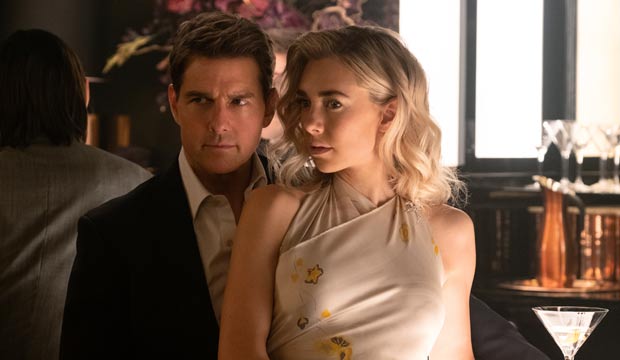
Turns out it's not The Apostles but some other bad people, led by a "broker" named "The White Widow" (Vanessa Kirby), who is to have a meeting with that "John Lark" in Paris in that most secure of locations, a disco. Given how well he did in the first-go 'round, IMF division head Alan Hunley (Alec Baldwin) assigns Hunt to track Lark and intercept the meeting, but Hunley is overruled by his boss at the CIA, Erica Sloan (Angela Bassett), who distrusts Hunt to get the job done and assigns him their best "minder," Agent August Walker (Henry Cavill) to keep him in his sights and in line.
Paris being a tough town to get into these days, Walker and Hunt stage a HALO jump (High Altitude-Low Opening) to land on the roof of the disco and infiltrate searching the crowd for Lark. The idea is to find Lark, incapacitate him, make a 3-D mask of his face and let Hunt impersonate him for the meeting with The Widow, but the guy they've tracked as Lark is a little tougher for them to take on—both Walker and Hunt are used as mops in a bathroom brawl, where the three pummel pusses and porcelain, and it is only the intervention of Ilsa Faust (Rebecca Ferguson, also from Rogue Nation) that keeps him from killing one or both of them. Unfortunately, though, amid her fortunate entrance into a men's room, she's killed the guy. "Could we still make the mask?" she asks. "You need a FACE to make a mask!" Hunt replies. 
So, they do what the IMF always does, they spit-ball—or, in the phrase Hunt uses throughout this one, "I'm working on it"—since no one knows what Lark looks like, Hunt elects to pose as him for the meeting with The White Widow—unfortunately, there are all sorts of assassins looking to take Lark out on sight and since his appearance with The Widow is a dead give-away, he and Walker and The Widow only make it out of the rendezvous by killing a few assailants among the bystanders. Some secret mission.
At the meeting, The Widow gives Hunt and Walker one of the cores and presents the price they must pay for the other two: spring Solomon Lane from captivity, which she has already carefully arranged for them, by creating a viable distraction, while Lane is being transported in Paris. As her thugs are a bunch of murderous sociopaths, Hunt conspires to do them one better with the help of Benji and Luther. They manage to capture Lane with as little collateral damage as possible except for the brick-and-mortar kind. 
But, it makes Walker suspicious: he tells his boss that it is his contention that Hunt is actually Lark, and that it's not just a pose. He thinks he's gone rogue, really, this time: "How many times has Hunt's government betrayed him, disavowed him, cast him aside? How long before a man like that has had enough?" All true, of course. Cruise's Hunt is the most trusted and LEAST trusted spy in the movies. And, not that he didn't understand it before, Walker is told to keep watching him, and if he can prove his suspicions, take Hunt out.
Cue music (Lorne Balfe does a fine job adapting Lalo Schifrin's iconic music, by the way), wind Cruise up and let him go. The remainder of the movie is, basically, chases—motorcycle, cross-country (or city, in this instance, which is London), and culminating in a helicopter chase in the mountainous terrain of India, with the purpose of getting the key widget of a doohickey that will allow his IMF team to stop the two nuclear bombs that are deployed nearby in a remote section of the country—why set them off in India as opposed to more populous cities is anyone's guess.
Cruise doesn't do all of the stunts—some of the motorcycle work is not him—but so much of the dangerous stuff IS him that you can't fail to be impressed...and come to the conclusion that the man is, basically, nuts, and must have one hell of an insurance policy.
He's obviously been watching the Craig Bond's and the "Bourne" films and saying "I could do that"—after spidering around Dubai skyscrapers and clinging to the outside of planes, jungle-gymming under helicopters might have seemed like a bit of a rest—"AND I can keep my face in the camera the whole time." Cruise's self-promotion is legendary, although it didn't help him when he was pin-balling through The Mummy and American Made.
Okey-dokey. Not sure that doing that actually improves the movie, or gets him in good with any stunt-person's union, but sure, big hand for Tom. Way to go, kid. You manage to keep the focus on yourself and make sure the audience is watching you no matter what is going on around you.
They needed to do something because the central mystery of the film—"who is John Lark?"—is easily suspected somewhat early on and confirmed half-way through the film. Not that it matters: as Bassett's Sloan says at one point, "The IMF is Hallowe'en"—it's part of the fabric of the Mission: Impossible series that no one is who they seem to be, by nature or latex disguise, and the gambit has been exhausted in the M:I series. One is hardly surprised by the reveal, because at that point, the film is on auto-pilot.
At this point in the film and the series, Mission: Impossible—Fallout has given up on interesting set-pieces—like the opera sequence in Rogue Nation or the Dubai hotel team-gambit in Ghost Protocol—and deception as its inspiration and just goes for the jugular with the hyper-activity of what has been termed "chaos cinema," that breed of action film begat by The Dark Knight, where you didn't need logic in your story-telling so much as momentum and spectacle. You could also go so far as ignore internal logic in a shot if it produced the desired "buzz" in the audience. Momentum keeps audiences from asking too many questions because the next shock dispels the memory of that question—it's quite effective in presidential politics, too! So, to borrow a phrase from the film, if the other films were scalpels, then this one is a hammer. A blunt instrument to beat out objections. Not too far afield from John Woo's strategy in Mission: Impossible II (and, as I remember, that one stunk).
Look, kids, despite everything that we've been shown the last few years in theaters, "kinetic" does not equal "great." It's one thing to move the camera, it's another thing to move the heart and the mind. And unfortunately, that's one mission that government-run spy agencies always seem to get wrong.
This is from the trailer but does not appear in the film....

* Well, Vanessa Kirby plays a character called "The White Widow" who is actually the daughter of "Max," Vanessa Redgrave's character from the first film, Ethan Hunt has to match wits with another agent as in M-I II, Michelle Monaghan is back as Hunt's...wife... from 3, who was supposedly killed between 3 and 4, but that was just a deception (aw, fergettit) and Rebecca Ferguson's Ilsa is back from 5, and Alec Baldwin's back again from 5...and on and on.

Thursday, August 2, 2018

Triple Dillinger

Written at the time of the film's release...


"Pretty Boys and Baby Faces: The Romancing of John Dillinger"


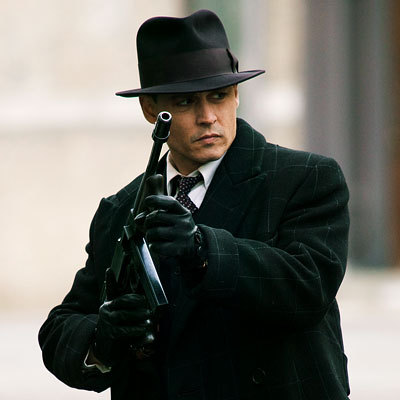
John Dillinger had enough publicity during his short* reign on the Most Wanted List, a lot of it generated by the man himself and his way of painting himself a folk-hero (he even saved his press clippings), so it seems like gold-plating a tommy-gun to make another movie lionizing him (see below). But Michael Mann—the director who created "Miami Vice" and has made a good movie or two (Manhunter, The Last of the Mohicans, The Insider, and Collateral) felt the need to make a new telling of the Dillinger legend—this one gussied up with Mann's usual stylish flair (although on more than one occasion the stylish suits and the familiar Chicago locations made me mindful of Brian De Palma's The Untouchables). Let us put aside for awhile the argument that the movie is morally wrong-headed to paint Dillinger as more sympathetic than his "Public Enemy" in the FBI, Melvin Purvis. Let's just examine where the movie Public Enemies goes wrong.

The opening break-out from the Indiana State Pen portrayed in the film has some relation to truth—guns were smuggled into the shirt-making shop in shipments of thread—but Dillinger wasn't there. He'd been paroled early due his step-mother's imminent death and was sitting in a jail-cell at the time from a small series of robberies that had been planned with his earlier cell-mates at Indiana. He was picked up at his girl-friend's house, which was being staked out by police. That hardly fits the legend of John Dillinger that
Public Enemies insists on pushing forward.

But then, the movie is less an accurate crime drama than a period romance. The film makes "
Billie" Freschette (Marion Cotillard) the love of Dillinger's life—the case could be made for Dillinger's wife who divorced him while he was serving his initial stretch in prison, breaking his heart and subsequently making him distrustful of long relationships with women. The absurdity is taken to an extreme case with a coda that is completely unbelievable, considering that Dillinger was famously gunned down in the company of a new prostitute girlfriend Polly Hamilton (Leelee Sobieski) and madam Anna Sage (Branka Katic)—the legendary "lady in red."** Still, one of the interesting stories about Dillinger is that the FBI staked out his boyhood home, hoping to arrest him the day he brought Freschette home to meet his folks. When the party broke up, three cars left the farm-house. The Feds followed the wrong one. It is true, as the movie shows, that Dillinger watched as Freschette was arrested and "cried like a baby" when he left the scene. He wasn't so broken up that he wouldn't take up with somebody else, though. And last words? Horseradish. Barbara Cartland could have written such sentimental sop.

The problems began from the beginning, when Leonardo DeCaprio was set to star as Dillinger, then when the project stalled, Johnny Depp signed on. Neither of these boy-men make a credible Public Enemy #1. Depp's performance is fine, but wrong-headed, his Dillinger looking more dyspeptic than criminal. It's a romantic's fantasy of John Dillinger, as is the concept of Dillinger being a one-woman man.
Still, Mann does some good things. Shot on video (by Dante Spinotti) the film is crystal-sharp, and looks great, even during its numerous hand-held sequences. The shoot-out at the Little Bohemia Lodge is completely inaccurate—the movie would have you believe that "Baby Face" Nelson died in the action as well as the two FBI agents who were killed—but the sequence is rip-roaring at times with Christian Bale's Melvin Purvis riding the running board firing a tommy-gun at the fleeing bandits.*** There are interesting cameo's—Billy Crudup does a fine impression of a young John Edgar Hoover, pugnacious, brittle and paranoid, and Lili Taylor shows up as Sheriff Lillian Holley. A made-up scene of Purvis and Dillinger taunting each other while the robber's in prison allows the two stars to have a scene together, but sacrifices the fact that Dillinger looked right at Purvis while walking out of the Biograph Theater his last night and did not recognize him.
But the film is as much fiction as fact, getting a lot of period facts wrong (there was no FDIC at the time of Dillinger's robbing career, yet a sign announcing the fact is displayed prominently, probably for comic effect, during a heist sequence) and the story a Disney version of actual events. It's a disappointment, considering a lot of the Dillinger story is stranger than fiction.


There have been other versions of the story****


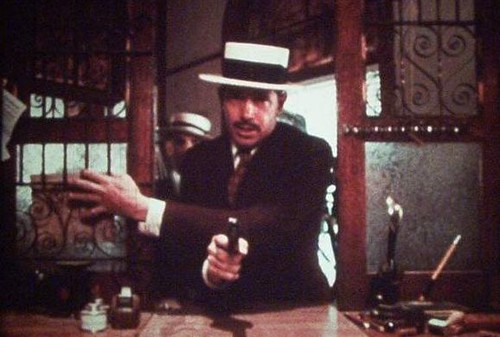
Dillinger (John Milius, 1973) Produced at a time when American International Pictures was actually putting some money into their films, it gave USC maverick director Milius a chance to direct. There's a lot of Bonnie and Clyde in this Dillinger, and Milius indulges in some Peckinpavian slow-mo blood-spurting, but on the whole it's an interesting account of the Dillinger years. Milius also uses two members of the Peckinpah stock-company: Ben Johnson is too old to play Melvin Purvis, but the man lends considerable weight and history to the role and the movie which made a folk-hero out of Purvis on a par with Dillinger.***** In the title role, there could be no one better than Warren Oates, who not only looked like the real thing, but was a more pragmatic, less idealized version of the gangster. Along with Oates' better performance, Milius' film is a grittier, sparer version of things, not as glossy and feeling much more ambivalent toward both cops and robbers.

And look at that cast! Richard Dreyfuss (over the top as "Baby Face" Nelson), Michelle Phillips (late of "The Mamas and the Papas") as Billy Frischette (though she's present at Dillinger's death), Cloris Leachman as Anna Sage, and a wealth of character actorsHarry Dean Stanton, Geoffrey Lewis, Steve Kanaly, Frank McRae, and Roy Jenson.
This is the one to see, despite (and maybe because of) the protestations of J. Edgar Hoover at the credits' end.


Dillinger (Max Nosseck, 1945) Low-budget exploitation film that took the Dillinger notoriety and regurgitated the legends, fictionalizing the story and changing names (winning an Academy Award nomination for screenwriting in the process!). The film starred Lawrence Tierney, Hollywood bad boy, who had a long career as a hood-type up to and including Reservoir Dogs. But there are some good actors on hand like Marc Lawrence, Elisha Cook Jr., and Edmund Lowe. But the film is strictly of the "Calling All Cars" school, laughably simple-minded, with none of the style of the gangster movies of the previous decade, and Dillinger portrayed as a romantic figure—the female lead (Anne Jeffreys) refuses to pick Dillinger out of a line-up because she's got "the hots" for him. Not much to recommend it.


Just to let you know this lionization still exists (as if Public Enemies wasn't enough), July 22nd is traditionally "John Dillinger Day" and members of the "John Dillinger Died For You" Society do their traditional walk from the Biograph Theater, commemorating his death July 22, 1934.


* Dillinger's crime career (following his prison sentence for unsuccessfully cold-cocking a local grocer) lasted all of 14 months.

** Even that story's not true—Sage told Purvis she would wear a white blouse and orange skirt—which appeared red in the Biograph's marquee lights. The trio went to the movies to escape a hot apartment and the Biograph was air-conditioned; the movie—Manhattan Melodrama, a gangster film with Clark Gable, William Powell and Myrna Loy (she's given quite a tribute in Public Enemies, and Marion Cotillard does resemble her).


*** Bale does a good job as Purvis, but he's a bit too dapper to portray the Special Agent. He is, however, one of the few actors who can fire a large caliber weapon without blinking. Purvis' story is an interesting one: charged by J. Edgar Hoover to "get Dillinger," when the press lionized the Agent, Hoover became jealous of the attention paid to him, making life miserable until Purvis left the Bureau a year later. Unable to find further work in law enforcement (due to alleged interference from Hoover), Purvis became a private businessman, married and fathered three sons. He died in 1960 of a gun-shot wound to the head from the revolver given to him by his FBI colleagues upon his retirement from the Bureau. Hoover's FBI ruled it a suicide (and Purvis was suffering from cancer at the time), but others have speculated he was killed accidentally trying to pry a tracer bullet out of the gun. When the legend becomes fact...

**** Not including Young Dillinger starring Nick Adams, sort of an "I was a Teen-Age Dillinger."


***** Milius padded Purvis' resume a great deal, having him in charge of the captures of "Pretty Boy" Floyd and Dillinger, but also "Baby Face" Nelson (as does Public Enemies), and "Machine Gun" Kelly, "Handsome Jack" Klutis, and Walter Underhill.


Wednesday, August 1, 2018

The Hobbit: The Desolation of Smaug

Written at the time of the film's release...

Maintaining Good Working Hobbits
or
A Dense Overlay of Smaug

The second of Peter Jackson's three "Hobbit" films, The Hobbit: The Desolation of Smaug is, predictably, more of the same. It's a three hour ramble, a complication and a darkening of the tone of the first film—as usually happens with the second of a trilogy, so that we, the audience, can climb out of our emotional valley in time for the resolution of conflicts in the third. Standard Operating Procedure. We are given a quick recap of the first film—going back in time to when Gandalf the Gray (Ian McKellan) first put the idea into the head of Thorin Oakenshield (Richard Armitage) and getting the dwarf crusade rolling. Once the summary is done (in brief: Gold, Mountain, Dragon, Dead King, Arkenstone, New King, No Elves Allowed), they skip over An Unexpected Journey and head back to the Gandalf, Bilbo and the dwarves on the path to Lonely Mountain (Sindarin Erebor), orcs still snapping at their behinds and making their way to the entrance of Mirkwood.

A quick visit to the skin-changer Beorn (Mikael Persbrandt), who usually appears in the form of a bear—not much is made of him, even though he got his own poster with Gandalf last time—and they get to Mirkwood (by pony), at which point Gandalf goes "walkabout"—he does this every movie and they probably split the story to accommodate a "Gandalf disappearance"—so the wee folk must enter the spooky forest alone, with a promise from the wizard that he'll meet them at "the Lookout."
"The Lookout"—he said he'd meet us; he should be easy to find...
Anyone familiar with the book knows that you don't find out where G.the G. goes until the last chapter, and that was after Tolkien had written "The Lord of the Rings" and got continuity-conscious. But, here, we do get to see where (hint: he went there LAST movie), and Jackson's The Lord of the Rings gets set up all good and proper (except Benedict Cumberbatch is voicing the character now—wonder if Jackson will Lucasize everything to make it all match up). The dwarves and hobbit are concerned with icky things and splendors that one would associate with a place called Mirkwood, and the ring that Bilbo snatched from Gollum is starting to exert its unholy influence turning the peaceful little guy into a berserker bad-ass. Travel packages with unruly companions and nasty accommodations with large pests and diffident natives will do that to anyone. But, Bilbo proves his worth on more than one occasion and eventually they do make it to the Halls of Lonely Mountain, a few shy of a full dwarve-deck and make their way to a meeting with the titular character that's been hoarding all the gold and keeping it for himself—the ultimate one percenter of Middle Earth.
Bilbo above the canopy of Mirkwood
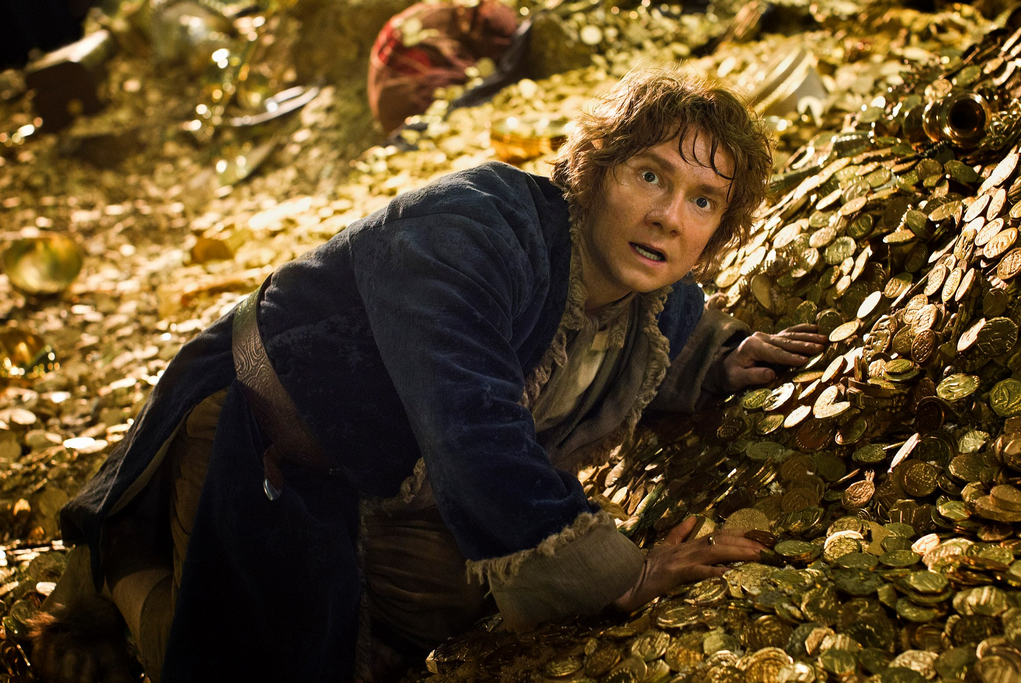
Smaug is the dragon, living in the massive storage caves of the Mountain, and he spends his time, far from desolate, sleeping among the gold and treasures of the dwarves like a big scaled, fire-breathing Scrooge McDuck. When Bilbo's attempts to find the Arkenstone awaken him, there is quite an extensive cat-and-mouse game as the small hobbit scurries around the cumbersome dragon. Or I should say Cumberbatch, as the ubiquitous actor provides a nicely arch resonant voice to Smaug, which is accompanied by a lip-curling animation to enhance it. This is where the film shines, as the territory is new, the imagineering of the dragon is fresh, and the surprises are many. After the previous two hours, that's a bit refreshing.
For if there's a problem with Peter Jackson's version of The Hobbit, it's that, by now, we are so familiar with the way he does things that nothing much really resonates anymore. The heavily belabored ripostes by the actors seem a bit too predictable—when Bilbo changes his story to Gandalf that he found his courage in the goblin caves last movie (rather than The Ring), there's a close-up of Gandalf as he says what half the audience is expecting: "You'll need it." Really, that one and "You should be" are certain candidates for Screenwriting 101 "easy irony" along with "You just don't get it, do you?" and "They're standing behind me, aren't they?"  
And the action sequences, this time assistant-directed by actor Andy Serkis. go on and on, in ever-increasing silliness. If last movie set a more rollicking, silly tone than The Lord of the Rings (in part by the influence of Guillermo del Toro), now the joke's wearing a little thin. Extended fights between orcs and elves are no longer thrilling, they're a demonstration of every possible way you can kill something with an arrow.  An extended rush down a rapids in barrels is accompanied by additional orc-elf fighting, where the barrels are used for any other purpose besides transport, as every tree-limb and branch over-hanging is used as a foot-hold. Some of this criticism isn't fair, because if this had been the first film in a trilogy of Tolkien adaptations, the marvels of the film would send people off a CGI cliff in amazement. It mustt take at least forty-five minutes to tumble down it, though.
One should, however, point out that the "we've been down this glade before" problem didn't occur with Jackson's earlier Tolkien trilogy, where there was enough material to keep things seeming fresh each film, and Jackson and his screenwriters did enough juggling of the narrative to keep things seeming new from film to film. Their attempts here amount to trying to add a romantic element between the elf warrior Tauriel (Evangeline Lily) and the dwarf Kili (Aidan Turner), much to the consternation of Legolas (Orlando Bloom, back in action). And while it provides a reprieve from tumbling and shooting and other too-frantic sequences, it does take away from the basic focus on the titular Bilbo Baggins (Martin Freeman) whose story this is. Freeman's performance is, again, terrific, bringing all sorts of fretting elements to play, and making the transformation of his hobbit into a killer more than a little disturbing.
The vistas are staggeringly rendered, but some short-changing has been done with the characters in action sequences—Orlando Bloom seems to be the chief character robbed of some pixels, here and there, and the attempt to de-age him to a younger self doesn't really work (I've never seen it done convincingly, so far). The only real surprises come in snatches of casting with Lee Pace, disappearing into the role of the elf Thronduil, Lily's elven warrior, and Stephen Fry's Master of Laketown. Be on the lookout for some Laketown spies and you might even find Stephen Colbert for a brief second. Oh, and Jackson gets his own "Hitchcock moment" out of the way very quickly.
Oh. And SPOILER ALERT there's another movie coming, so this one ends at a rather inopportune time. You only have to wait another year.
"Conversation with Smaug" drawn by J.R.R. Tolkien
"Conversation with Smaug" drawn by WETA