Showing posts with label Michelle Monaghan. Show all posts

Wednesday, August 23, 2023

Eagle Eye

Written at the time of the film's release...

"Where's LaBeouf?"

Jerry Shaw (Shia LaBeouf) has just had $71,500 dropped into his bank account. Giddily, he snatches up the money, runs home, and pays two months rent in advance. The landlady mentions something about all the boxes. Jerry spins inside, turns on the light, and finds he's walked into a nightmare--crates of sensitive materials and bomb-making equipment, pistols, rifles, night-vison goggles, F-16 training manuals...oh, and several tons of ammonium nitrate—enough to level another Oklahoma municipal building.

The moment is so well-staged that it evokes an audience-wide "Woh!"

His cell phone rings. A female voice says, "The FBI will be at your apartment in thirty seconds. Get out now!" He hasn't learned to move fast enough yet.

Dedicated mom Rachel Holloman (Michelle Monaghan) has just shipped her son on a band-trip to Washington D.C. and is relaxing for some girl-talk and a boiler-maker when she gets a phone call. A female voice tells her to go outside and look at the window of the McDonald's across the street. On the promo monitor, she sees a "live" shot of her son en route, and the voice tells her to go to a specific parked car—right now—or her son will be killed. She goes.
Remember the story about the pizza-delivery guy who robbed a bank, got caught, and told the police that he was forced to do it or a necklace he was wearing would explode
?
* And while waiting for the bomb squad, the device went off, killing him? Evidently, so did the screen-writers for much of Eagle Eye recalls that bizarre scenario of an innocent forced to commit acts against their will. But that organization attached to that phone-voice must be near-messianic in scope because it can monitor your progress by hacking into security-cams, and eases their near-escapes with constant directions and remote access to reader-boards, cell-networks, automated machinery, traffic lights, military equipment, cranes, high-tension towers, anything electronic or capable of broadcasting, right down to the X-ray machines at the airport check-points. Needless to say, there's a scene at Circuit City where this anonymous group goes to town.
It's a movie that, more than any theater announcement, compels you to turn off your cell-phone in the theater.
Who or what organization is doing this and why? Throughout the movie, I was harboring the suspicion that whatever the reasoning behind the elaborate, sometimes crazy, plot, it would not live up to the preposterous hook of the film. But it almost does, using as its center a security risk that this nation has practically inscribed in its Constitution—a blunder as big as lining up all your planes at Pearl Harbor. It's a scenario that's been used before in spy/suspense fiction, and Eagle Eye owes a lot to those writers, as well as the scribes for such diverse films as
I, Robot, The Manchurian Candidate, Colossus: The Forbin Project, The Man Who Knew Too Much, 2001: a Space Odyssey, North By Northwest, Telefon, The Lady from Shanghai, and The Conversation. That's quite a diverse roster of films, paranoia being their common thread.
Director
D.J. Caruso helmed a previous Shia LaBeouf box-office winner, Disturbia, and manages to make wide-open landscapes as restrictive as the limited point-of-view of that earlier film. Sometimes too restrictive. Two highway smash-ups are shot so close that one gets no sense of the relationship of mayhem to mayhem--they could be happening in separate states for all we see. However, the strategy benefits a sequence utilizing an airport's baggage conveyor system—making it as dizzying as a turn through a carnival fun-house.
LaBeouf has a bit more energy than he displayed in the "Indiana Jones" film, and Michelle Monaghan (of Gone Baby Gone) shows she's just as capable doing action work as well. Billy Bob Thornton is wonderfully dry as an FBI agent, Rosario Dawson gets to be taken seriously as an Air Force investigator, and Michael Chiklis makes a fine Secretary of Defense.
It isn't art, but it's a good ride--a pop-corn movie with just as much shelf-life and nutrition-value, while being a nice little tumble through the history of techno-thrillers of the past thirty years.
 
* 2023 Aside: Matt Reeves used the same bit in The Batman.

Friday, August 31, 2018

Source Code

Written at the time of the film's release...

"This Train is Bound for Glory, This Train"
or
"Getting to Heaven By Way of Hell"

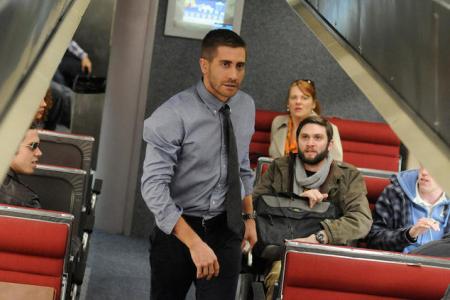
Captain Colter Stevens (Jake Gyllenhaal) wakes up, disoriented on a train. He was on a mission in Afghanistan just a moment ago...now he's on a train heading for Chicago, and the pretty girl (Michelle Monaghan) sitting across from him is calling him "Sean."

What the..?

The world is rushing by, full of commuter-sounds and commuter-problems, but all he knows is that he's not where he should be, and that the face staring back at him from a bathroom mirror isn't his.
"Don't worry," says the pretty girl, Christina. "Everything is going to be alright."

And then, the train explodes.
Famous last words.

Duncan Jones' (a clever enough director after two films that we can stop saying he's David Bowie's kid) last film was the under-performing Moon, featuring a tour de force performance by Sam Rockwell, and a sensibility that borrowed its uneasy creepiness from other sci-fi pics like 2001: A Space Odyssey. What was nice about Moon was that it was science fiction for adults, touching on themes and concepts that point out what role exactly man will play in Space, whether its comfortable or not. In Source Code, Jones and his clever scriptwriter Ben Ripley explore the same issues in the guise of a science-fiction time-travel movie that has, at its core—its own source code, if you will—the guarantee that the train is going to blow up every few minutes...like a movie serial gone very, very wrong. And it is Stevens' mission, as he is military, to keep catching that train for the critical eight minutes before the explosion to try and find the bomb, stop it (low priority), but, more importantly, find out who did it—for that terrorist attack is merely a distraction for emergency crews to turn their attention away from a much bigger threat. Stevens must survey the passengers on the train to determine how the bomb was detonated...and who did it.
Each eight minutes gives him more clues, narrowing his focus and his mission, but at the same time, he's starting to have feelings for the girl sitting across from him. He wants to save her, and maybe the other strangers on the train.
But, like any broken-hearted suitor, he's living in the past. They're already dead. And time is running out for Chicago. His mission specialists (Vera Farmiga—doing a lot of subtle work with so little—and Jeffrey Wright—doing too much, as he is wont to do when searching for a character) are tasked to keep him on point: "Out here, the clocks only move in one direction."

"Out here?" Where is he?
"Star Trek: The Next Generation" had an ingenious episode "Cause and Effect" (written by Brannon Braga and directed by Jonathan Frakes), where the U.S.S. Enterprise-D was caught in a time-loop, but its crew didn't know it. We'd watch them go through a series of events, there'd be an emergency and the ship blew up. Cut to commercial.  Back to the story, everything would reset, we'd watch the crew go through the same scenario, but with an increasing sense of deja-vu. The ship would blow up. Back to commercial. We'd run through the same incidents over and over, until Picard and co. realize that..."oh, we're caught in a time-loop, and we're doing the same things over and over, how do we stop?" It takes a few Enterprises blowing to smithereens before they figure out how to keep it from happening again. It was 60 minutes of Boom, Rinse and Repeat.
As I said, clever.* Like Groundhog Day with one hell of a punch-line. But here, the stakes are higher. Stevens doesn't know anyone on that train, but in his plunging again and again into that future-Hell, he gets to know them, as they go from suspects to victims, while managing to piss off each and every one of them along the way. The deeper he goes, the more he empathizes with their plight and wants to change a History already set in smoke and flame. Even if in a small way.
Source Code manages to be many genres in its perpetual loop of pieces of time: Science-fiction, disaster, action, detective, love story, and finally, inspirational, in showing how we, mere meat and electricity, can escape any trap that science, however well-intentioned, springs on us.
The best of science-fiction, despite the abilities of its clockwork mechanisms and theories to explain How Things Work, take those trappings of the soon-to-be, and tests the mettle of the beings caught in the gears. The most inspiring of science fiction always throws in the element of humanity that rises above by taking a leap of faith in nothing that approximates theory. Inspiration makes science. Wishing makes it so. Humanity makes both. And there's no formula, no theorem, no artificial intelligence to replace that one organic spark, the living breathing pilot light in the testing furnace of technology.


And the belief that everything is going to be alright.
The official poster for Source Code just sucks (and even the one I used above doesn't do the job).
But Olly Moss designed one (for the SXSW double bill with Jones' Moon) and it's quite timely.


* Jones is all too aware of the source code for this movie.  One of my favorite bits in the film is who plays Stevens' father in voice-over.  Of course, it has to be him.  And it's a terrific performance, even if we never see him.

Friday, August 3, 2018

Mission: Impossible—Fallout

The Perpetual "Mission" Machine
or
"We'll Burn That Bridge When We Come To It"

The sixth of the Tom Cruise "Mission: Impossible" films has slammed into theaters going 90, and it's getting rapturous reviews. Yeah, it's okay, but it's not the best of the series; the original and Ghost Protocol are the best, and the last one (which was also written and directed by Christopher McQuarrie)—of which this is a direct sequel—was quite good, too. McQuarrie must be scratching his head: "you mean I can have the barest bones of plot, but just make it wall-to-wall stunts, and people will love it more than if I make something really intricate? Who knew?"

Who, indeed? This one subtitled Fallout is cobbled together from elements of the other "Mission: Impossible" movies* as well as recent entries in the James Bond franchise (the first time in a long time that other movies are borrowing from them instead of the other way around), but the main thing it's borrowed from that series is a short-hand story-telling in service as lattice-work connecting the stunt sequences.

It's pretty basic stuff. 

Ethan Hunt is having those horrible foreshadowing nightmares you only get in the movies. They usually involve a Mission gone wrong, killing himself and those he loves in the process. Something goes BOOM! in the distance and they go boom in the shock-wave. Wake up! Time for a special delivery (special because it requires code-phrases). It's a Mission: the capture of Solomon Lane (Sean Harris)—from Rogue Nation—has not ended his menace. He has inspired a cult of terrorists called "The Apostles" who conduct attacks around the world. Led by a mysterious figure named "John Lark," they are attempting to acquire three stolen plutonium cores to be used to build nuclear bombs, designed by an extremist nuclear scientist Nil Debruuk (Kristoffer Joner). Hunt's mission—should he decide to accept it—is to intercept the sale and out-bid for it. As Lane says at one point: "I wonder, did you ever choose not to?"
Now might've been the right time; at the hand-off in Berlin, things don't go as carefully planned—Hunt and fellow IMF-er Benji Dunn (Simon Pegg) meet up with the sellers while Luther Stickell (Ving Rhames) does reconnaissance in a van some distance away. They're compromised and Hunt chooses to save his team-mates, and in the ensuing firefight, they lose the plutonium. Who has it? 
Turns out it's not The Apostles but some other bad people, led by a "broker" named "The White Widow" (Vanessa Kirby), who is to have a meeting with that "John Lark" in Paris in that most secure of locations, a disco. Given how well he did in the first-go 'round, IMF division head Alan Hunley (Alec Baldwin) assigns Hunt to track Lark and intercept the meeting, but Hunley is overruled by his boss at the CIA, Erica Sloan (Angela Bassett), who distrusts Hunt to get the job done and assigns him their best "minder," Agent August Walker (Henry Cavill) to keep him in his sights and in line.
Paris being a tough town to get into these days, Walker and Hunt stage a HALO jump (High Altitude-Low Opening) to land on the roof of the disco and infiltrate searching the crowd for Lark. The idea is to find Lark, incapacitate him, make a 3-D mask of his face and let Hunt impersonate him for the meeting with The Widow, but the guy they've tracked as Lark is a little tougher for them to take on—both Walker and Hunt are used as mops in a bathroom brawl, where the three pummel pusses and porcelain, and it is only the intervention of Ilsa Faust (Rebecca Ferguson, also from Rogue Nation) that keeps him from killing one or both of them. Unfortunately, though, amid her fortunate entrance into a men's room, she's killed the guy. "Could we still make the mask?" she asks. "You need a FACE to make a mask!" Hunt replies. 
So, they do what the IMF always does, they spit-ball—or, in the phrase Hunt uses throughout this one, "I'm working on it"—since no one knows what Lark looks like, Hunt elects to pose as him for the meeting with The White Widow—unfortunately, there are all sorts of assassins looking to take Lark out on sight and since his appearance with The Widow is a dead give-away, he and Walker and The Widow only make it out of the rendezvous by killing a few assailants among the bystanders. Some secret mission.
At the meeting, The Widow gives Hunt and Walker one of the cores and presents the price they must pay for the other two: spring Solomon Lane from captivity, which she has already carefully arranged for them, by creating a viable distraction, while Lane is being transported in Paris. As her thugs are a bunch of murderous sociopaths, Hunt conspires to do them one better with the help of Benji and Luther. They manage to capture Lane with as little collateral damage as possible except for the brick-and-mortar kind. 
But, it makes Walker suspicious: he tells his boss that it is his contention that Hunt is actually Lark, and that it's not just a pose. He thinks he's gone rogue, really, this time: "How many times has Hunt's government betrayed him, disavowed him, cast him aside? How long before a man like that has had enough?" All true, of course. Cruise's Hunt is the most trusted and LEAST trusted spy in the movies. And, not that he didn't understand it before, Walker is told to keep watching him, and if he can prove his suspicions, take Hunt out.
Cue music (Lorne Balfe does a fine job adapting Lalo Schifrin's iconic music, by the way), wind Cruise up and let him go. The remainder of the movie is, basically, chases—motorcycle, cross-country (or city, in this instance, which is London), and culminating in a helicopter chase in the mountainous terrain of India, with the purpose of getting the key widget of a doohickey that will allow his IMF team to stop the two nuclear bombs that are deployed nearby in a remote section of the country—why set them off in India as opposed to more populous cities is anyone's guess.
Cruise doesn't do all of the stunts—some of the motorcycle work is not him—but so much of the dangerous stuff IS him that you can't fail to be impressed...and come to the conclusion that the man is, basically, nuts, and must have one hell of an insurance policy.
He's obviously been watching the Craig Bond's and the "Bourne" films and saying "I could do that"—after spidering around Dubai skyscrapers and clinging to the outside of planes, jungle-gymming under helicopters might have seemed like a bit of a rest—"AND I can keep my face in the camera the whole time." Cruise's self-promotion is legendary, although it didn't help him when he was pin-balling through The Mummy and American Made.
Okey-dokey. Not sure that doing that actually improves the movie, or gets him in good with any stunt-person's union, but sure, big hand for Tom. Way to go, kid. You manage to keep the focus on yourself and make sure the audience is watching you no matter what is going on around you.
They needed to do something because the central mystery of the film—"who is John Lark?"—is easily suspected somewhat early on and confirmed half-way through the film. Not that it matters: as Bassett's Sloan says at one point, "The IMF is Hallowe'en"—it's part of the fabric of the Mission: Impossible series that no one is who they seem to be, by nature or latex disguise, and the gambit has been exhausted in the M:I series. One is hardly surprised by the reveal, because at that point, the film is on auto-pilot.
At this point in the film and the series, Mission: Impossible—Fallout has given up on interesting set-pieces—like the opera sequence in Rogue Nation or the Dubai hotel team-gambit in Ghost Protocol—and deception as its inspiration and just goes for the jugular with the hyper-activity of what has been termed "chaos cinema," that breed of action film begat by The Dark Knight, where you didn't need logic in your story-telling so much as momentum and spectacle. You could also go so far as ignore internal logic in a shot if it produced the desired "buzz" in the audience. Momentum keeps audiences from asking too many questions because the next shock dispels the memory of that question—it's quite effective in presidential politics, too! So, to borrow a phrase from the film, if the other films were scalpels, then this one is a hammer. A blunt instrument to beat out objections. Not too far afield from John Woo's strategy in Mission: Impossible II (and, as I remember, that one stunk).
Look, kids, despite everything that we've been shown the last few years in theaters, "kinetic" does not equal "great." It's one thing to move the camera, it's another thing to move the heart and the mind. And unfortunately, that's one mission that government-run spy agencies always seem to get wrong.
This is from the trailer but does not appear in the film....

* Well, Vanessa Kirby plays a character called "The White Widow" who is actually the daughter of "Max," Vanessa Redgrave's character from the first film, Ethan Hunt has to match wits with another agent as in M-I II, Michelle Monaghan is back as Hunt's...wife... from 3, who was supposedly killed between 3 and 4, but that was just a deception (aw, fergettit) and Rebecca Ferguson's Ilsa is back from 5, and Alec Baldwin's back again from 5...and on and on.

Saturday, August 1, 2015

Mission Impossible: Ghost Protocol

Written at the time of the film's release.

"Mission: Incredibles"
or
"I'm Spit-Balling—It's Not All Going to be Gold"

The first Mission: Impossible film (based on Bruce Geller's TV series) was darned good—script tinkered by Robert Towne, nice set-pieces by Brian De Palma—while the second, not so much, a Woo-fest where star-egos and director-eccentricities clashed—and the third, directed by J.J. Abrams, a slight improvement, more gritty and down-to-Earth if nothing to really write home about.

The fourth, numerically neutral and titled Mission Impossible: Ghost Protocol, is actually the best of the bunch, much more in keeping with the original series' intent: a team of operatives plan out an unlikely spy-mission, fading into the wood-work, disguised and deceptive, insert themselves into scenarios that inevitably go wrong at some point, and they have to punt in order to get out alive and successful. The big problem with the movie series (and its chief departure from its small-screen inspiration) is that Tom Cruise is the star and everybody takes second-seat to him, the other members of the team being merely escort planes to the Big Cruise Missile. His character, Ethan Hunt, is supposed to be something of a cypher—all the IMF agents are—but more attention is paid to his character, while not really defining who he is, and as a result, you don't really care what happens to him. There are no character peccadilloes or habits that one can relate to or identify as such, and what there is—no vodka martinis, but he always favors a celebratory beer at the end—is rather pedestrian. So the movies are this weird yin-yang of Big Star/Small Character that crowds everybody else out.  The stunts are the stars.
Cruise, Patton, Pegg and Renner make a good M:Ix
That changes here. Even though it is a "Tom Cruise Production" (executive-produced by J.J. Abrams), MI:GP is very much a team effort, with nice strong characters in the group (Cruise, Paula Patton, Simon Pegg and Jeremy Renner) who are thrown together from a previous mission that goes "somewhat" awry and leads the President to invoke "the ghost protocol:" The IMF is entirely "disavowed" and The Secretary (there's been one each movie—Henry Czerny, Anthony Hopkins, Laurence Fishburne, and this time Tom Wilkinson, the job must be the least secure in Washington D.C.) arranges for the closest team—Hunt's—to carry out a risky mission as they're already privy to inside information, and they're already deeply implicated in what has happened—which could see the resurgence in Cold War rivalries that will accelerate to nuclear-hot mighty fast.
So, it's just the four agents against the world, on a tight timeline and even tighter high-wire act to prevent terrorists from striking the match to the series' signature fuse. And the nice thing is, it's not Cruise's show alone, it can't be, and Renner, Patton and Pegg are strong enough personalities, that Cruise doesn't even have to generously step out of the limelight for them.  It is a team effort, finally, the way the series was initially envisioned.  And the writers and director have set up some nifty clockwork scenarios that nicely merge into each other to create a steady stream of nifty sequences that make you stop and say..."Huh...Haven't seen that one before."

A lot of the credit should go to director Brad Bird, former animator and Pixar grad (he made The Iron Giant, The Incredibles, and did the "save" on Ratatouille), who keeps things elegantly focused, tightly synced, and throws in more than a dash of surprising absurdism throughout the film.  Yeah, a lot of it's over-the-top—that's kind of the way it is with the MI films—but there is no stoic acceptance of the risks this time. In fact, there's a bit of slap-dashery to the whole thing—everything that can go wrong does—the timelines, the tech and the teamwork, and the four are left scrambling trying to pick up the pieces.
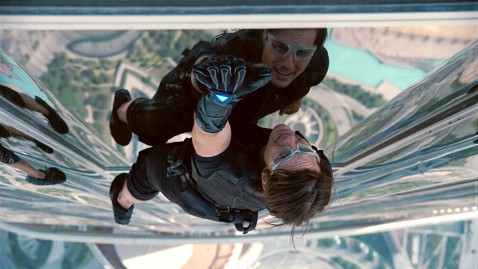
Along the way there are nice little touches, like the comic bend given to the usual "this message will self-destruct in five seconds" bit, or an extended sequence of guard-fooling that wouldn't seem out of place in a "Roadrunner" cartoon. Even the big set-piece—Hunt in Dubai having to spider-man up the glass face of the world's tallest building ("eleven stories up and seven over") is played for grins, albeit with the teeth chattering. There is no Cruise brio in evidence for the stunt, his character doesn't want to do it, but he's the only one who can and...the clock's ticking. That Bird milks it for all the tension it's worth and manages to make it pay off spectacularly and...with humor...shows he owes more to Buster Keaton than to typical action-directors who take this stuff so deadly seriously (credibility issues).
Credibility is the least of the concerns for the director of The Incredibles. Instead, he and the MI team have provided a spy-romp that aims to be a thrill-ride that leaves one chuckling. In that case, mission accomplished.