Sunday, April 9, 2017

Don't Make a Scene: Notorious

The Set-Up: Sex and Food: the two are essential to any Hitchcock movie recipe (along with a tea-spoon of mother-love, a dash of a chase, a side of entrapment that may or may not be kosher, an overflowing cup of Catholic-guilt, one peppered MacGuffin and a measured cameo). This marvelous scene from Notorious has a main course of both—the rest will come later.

Crossroads figure in a lot of Hitchcock, too, and here Alicia Huberman, society-girl with a past, trying to clear the family name working for Uncle Sam, and government op Devlin (that's it, just Devlin) are at the turning point in their relationship, torn between love and duty, dedication and betrayal. The stakes are high—mushroom-cloud high—with America at war with the Nazis. All's fair in love and war, they say. But what if it's both. Then sacrifices must be made...even those of the heart.

Devlin had been assigned Miss Huberman—the daughter of an American traitor—finding her a bit tipsy-turvy after Dad's conviction. He recruited her for her Dad's connections...and wouldn't you know it...they fall in love. Now, they're in romantic Rio, awaiting an assignment, and Devlin has just picked up a bottle of champagne for a consummate dinner that Alicia is preparing for them. Then Devlin finds out what the assignment is: Alicia must seduce an old snuffed flame (Claude Rains) to track down what a coven of Nazi conspirators are doing there. 'Tis a pity the government thinks she's a whore.

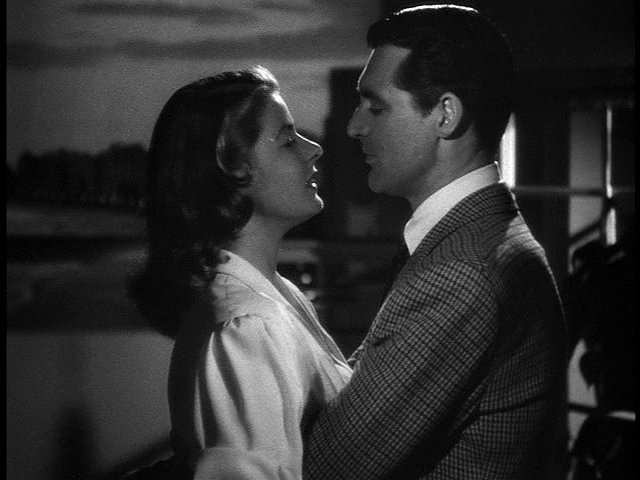
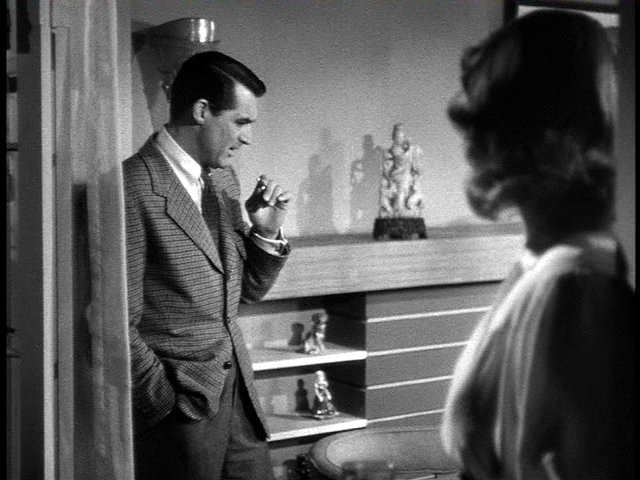
Duty calls. Love has no answer. This painful scene, where Devlin breaks the news to her (and not gently, as he is simultaneously ending their affair and testing the extent of her love for him), is a fascinating study of situation, acting and staging. The dialogue, by Ben Hecht (with an overlay of nastiness from Clifford Odets—who knew something about dishing out betrayal) is arch and pointed. 

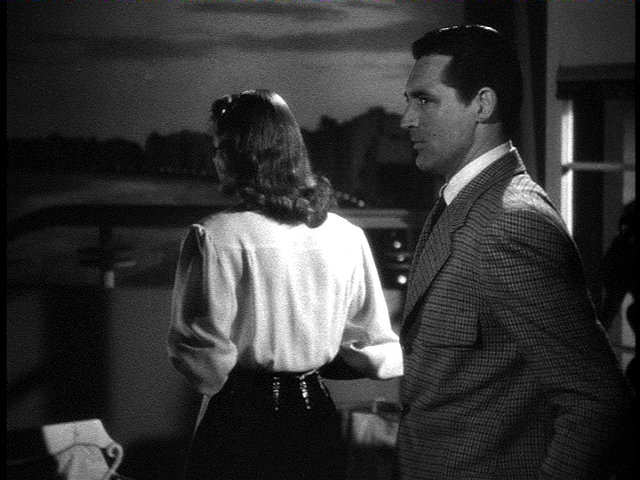
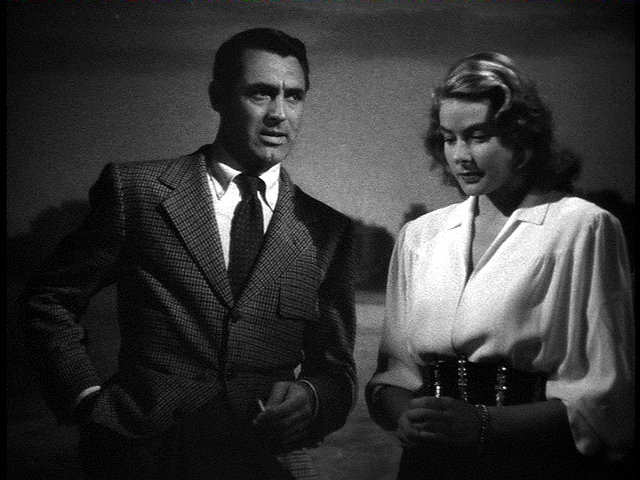
But what's between the lines is equally important. A visual artist, Hitchcock, as he so often does in his films, bends time a bit to draw things out. Here, his cutting allows for reaction shots before the next line of dialogue, allowing us to see the effects of the plunge of the dagger, or the measured pause before a response. For these two were a couple, once locked in embrace, and now they are separate, not even facing each other.

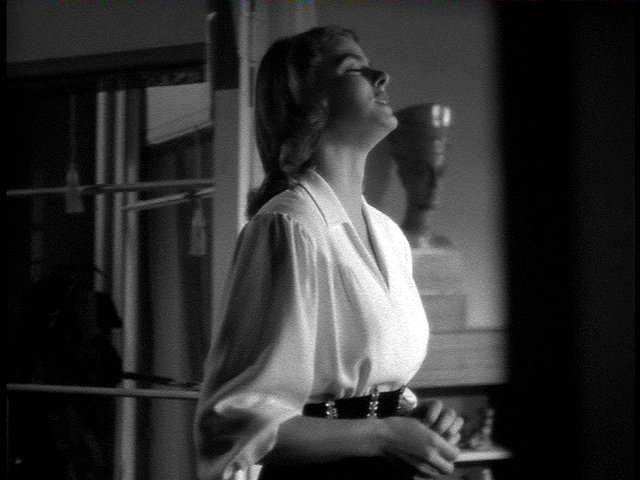
Ingrid Bergman's Alicia wears her heart on her sleeve, then retreats behind an ironic arched eyebrow, then moves away from the scene of the crime of the heart to retreat to "the old" Alicia, taking solace in drink, which Hitchcock discreetly veils.

Cary Grant's Devlin plays his cards close to his vest. He's a spy. He doesn't betray much of himself, just others, and Grant brings out the monster in his own persona: Devlin does not smile, his eyes are cold, he speaks evenly with little emotion. He deflects with a cigarette, a downward glance, a harsh sentence spoken like an uncaring "how are you," a face like a slammed door. And like any good spy he enters a room looking for the escape route. But this time, he's cornered. In his amoral world he is being judged by the one person whose opinion he cares about: he's a cad, he's a heel, he's betrayed the woman he loves, and himself, as well. 

Duty calls. Love has no answer.

Oh, and that missing bottle of champagne? He left it at the mission briefing—along with his hopes, his morality and large portion of his humanity.

Action!
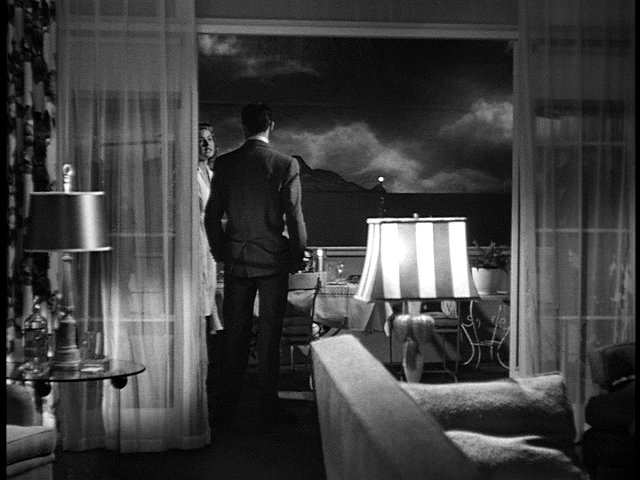
ALICIA HUBERMAN: What's the matter? I wonder if it's too cold out here? Maybe we should eat inside.
ALICIA: Hasn't something like this happened before?
ALICIA: What's the matter? Don't look so tense. Troubles?
ALICIA: Well, handsome, I think you better tell Mama what's going on, or all this secrecy is going to ruin my little dinner.
ALICIA: Come on, Mr. D., what is darkening your brow?
DEVLIN: After dinner.
ALICIA: No, now. Look, I'll make it easy for you. The time has come when you must tell me that you have a wife and two adorable children, and this madness between us can't go on any longer.
DEVLIN: I'll bet you've heard that line often enough.
ALICIA: Right below the belt every time.
ALICIA: Oh, that isn't fair, Dev'.
DEVLIN: Skip it. We have other things to talk about. We've got a job.
ALICIA: Oh, so there is a job.
DEVLIN: You, uh, you remember a man named Sebastian?
ALICIA: Alex Sebastian?
DEVLIN: Yes.
ALICIA: One of my father's friends, yes.
DEVLIN: He had quite a crush on you.
ALICIA: I wasn't very responsive.
DEVLIN:  Well, he's here. The head of a large German business concern.
ALICIA: His family always had money.
DEVLIN: He's part of the combine that built up the German war machine and hopes to keep on going.
ALICIA: Something big?
DEVLIN: It has all the earmarks of being something big. We have to contact him.
ALICIA: Go on. Let's have it all.
DEVLIN: We're meeting him tomorrow. The rest is up to you. You've got to work on him and land him.
ALICIA: Mata Hari. She makes love for the papers.
DEVLIN: There are no papers. 
DEVLIN: You land him. Find out what's going on inside his house, what the group around him is up to, and report to us.
ALICIA: I suppose you knew about this nasty little job of mine all the time.
DEVLIN: No, I only just found out about it.
ALICIA: Did you say anything? I mean, that maybe I wasn't the girl for such shenanigans?
DEVLIN: I figured that was up to you—if you'd care to back out.
ALICIA: I suppose you told them "Alicia Huberman will have this Sebastian eating out of her hand in a couple weeks. She's good at it. Always was."
DEVLIN: I didn't say anything.
ALICIA: Not a word for that little lovesick lady you left an hour ago?
DEVLIN: I told you, that's the assignment.
ALICIA: Now don't get sore, Dev'. 
ALICIA: I'm only fishing for a little bird-call from my dream man. 
ALICIA: One little remark, such as "How dare you gentlemen suggest that Alicia Huberman...
ALICIA: ...the new Miss Huberman be submitted to so ugly a fate."
DEVLIN: That's not funny.
ALICIA: Do you want me to take the job?
DEVLIN: You're answering for yourself.
ALICIA: I am asking you.
DEVLIN: It's up to you.
ALICIA: Not a peep, hm? 
ALICIA: Oh, darling, what you didn't tell them, tell me—that you believe I'm nice, that I love you, and I'll never change back.
DEVLIN: I'm waiting for your answer.
 ALICIA: Hm.
ALICIA: What a little pal you are.
ALICIA: Never believing me, hmm? Not a word of faith. Just, down the drain with Alicia. That's where she belongs. 
ALICIA: Oh, Dev', Dev'.
 
ALICIA: When do I go to work for Uncle Sam?
DEVLIN: Tomorrow morning.
ALICIA: Oh, we shouldn't have had this out here. 
ALICIA: It's all cold now.
ALICIA: What are you looking for?
Devlin: I had a bottle of champagne. I must have left it somewhere.
Fade to Black


Notorious

Words by Ben Hecht, Clifford Odets and Alfred Hitchcock

Pictures by Ted Tetzlaff and Alfred Hitchcock

Notorious is available on DVD from MGM Home Video (and out of print from The Criterion Collection).


This week's scene starts at 6:48 on the first video and continues on the second...

Friday, April 7, 2017

The Loved One

The Loved One (Tony Richardson, 1965)  Director Tony Richardson "does" Hollywood, and it ain't pretty.  There are lots of Tinsel Town screeds out there, mostly about personal mania (Sunset Boulevard, What Makes Sammy Run?), but few—like Day of the Locust—where the craziness seems endemic to the region and its excesses. The Loved One has an air of pretense with sanctimonious chortling while it shoots its fish in a barrel, casting the film with "types"—Liberace as a coffin salesman, Milton Berle as a crass businessman—that might be a little too leaden in its intent.

Flush from his success with the multi-Oscar-winning Tom Jones, after toiling away over in the British "kitchen-sink" industry, Richardson returned to black and white cinematography (by Haskell Wexler) in an adaptation of Evelyn Waugh's novel adapted by Terry Southern and Christopher Isherwood. Waugh's book was inspired by a disappointing trip to Hollywood on the pretense of making a film of "Brideshead Revisited," and his twining of the film industry with the funeral business has a natural feel to it, as both have a lot to do with presentation, and the construction of artifice, all in the name of comfort (while robbing money blind).  

But that was in the 40's.  The film was made in the early 60's on the cusp of "mod" and in the nuclear shadow of Dr. Strangelove. Both films have that Southern exposure in common, but where Kubrick made his film with a gargoylishly straight face, Richardson can't help gilding the mourning lily.
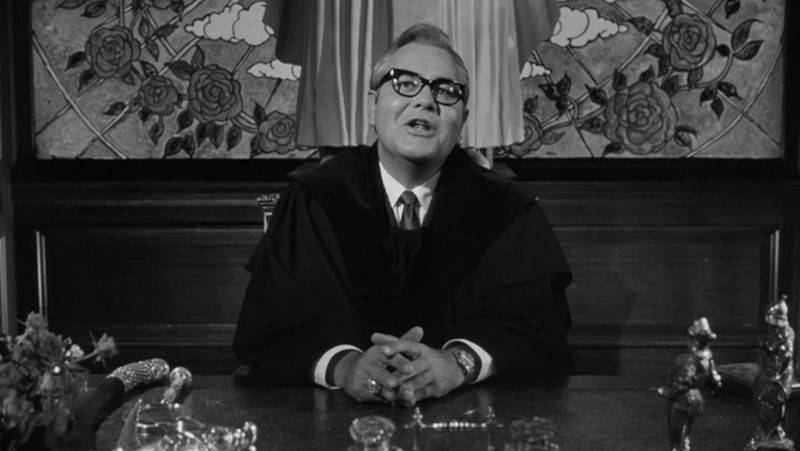
Poet Dennis Barlow (Robert Morse, post-dubbed with a wavering British accent) wins a literary competition, the first prize being a trip to Hollywood, where he stays with his uncle, Sir Francis Hinsley (John Gielgud) who works at a film studio. Hinsley is soon fired by the studio's boss DJ, jr. (Roddy McDowell) and commits suicide. The British community (led by Robert Morley) insists that Hinsley's funeral be as grand as possible, bankrupting the old man's estate, and forcing Barlow to stay in Hollywood and taking a job at a pet cemetery run by Henry Glenworthy (Jonathan Winters), whose brother, the Reverend Wilbur Glenworthy (also Jonathan Winters) runs the Whispering Glades cemetery and mortuary, the establishment handling Hinsley's solemnities. There, Barlow meets Aimee Thanatogenous (Anjanette Comer), a corpse beautician and Mr. Joyboy (Rod Steiger), the Whispering Glades embalmer, who competes with Barlow for her affections.  
There is a lot of brilliant stuff here: a sequence at another chapel has a wedding (ministered by Ed—the original "You're in good hands with Allstate" announcer—Reimers) that is run like a television production, so that everyone can be ushered out, and the next scheduled funeral ushered in; the "keeping up appearances" haranguing of the British enclave in Hollywood; Jonathan Winters, not really given free rein to his inner demons in the roles, but showing how he might have been our Peter Sellers; and (okay) Liberace as a coffin salesman, there's something utterly apropos about that; a visit to Ms. Thanatagenous' under-construction cliff-house that is constantly rumbling with the threat of sliding to the highway below (a nice visual representation of her fragile doe-eyed innocence); Lionel Stander as newspaper advice columnist Guru Brahmin—a study in contrasts; the creepily loving reverence of the Whispering Glades workers for "the loved ones," as opposed to how the stiff pets at the pet cemetery are tossed into a freezer.
It's all very ghoulish and naughty (even flirting with pornography towards the end, discretely edited by Hal Ashby) but something of a misfire in its presentation. Morse is energetic and fun (and he has the teeth to play British), but in the same way The Wrong Box has the timing wrong to evoke humor, The Loved One never quite convinces you that you're supposed to be laughing, even guiltily. Instead, it has the air of stuffy indignation even as it's trying to regale. One can sympathize with the sentiments, but one wishes it was done better, less fire and more mockery. What's the quote? "There's nothing I like less than bad arguments for a view I hold dear."

Thursday, April 6, 2017

Ice Station Zebra

Ice Station Zebra (John Sturges, 1968) The movie that was (supposedly) the favorite movie of billionaire-aviation pioneer Howard Hughes—one that he would watch obsessively.

One can only wonder why. It is not exactly inspired entertainment, although somewhat competently directed by John Sturges (who was at his best with genuine location work, rather than with effects-heavy set-bound shows, such as this and Marooned).


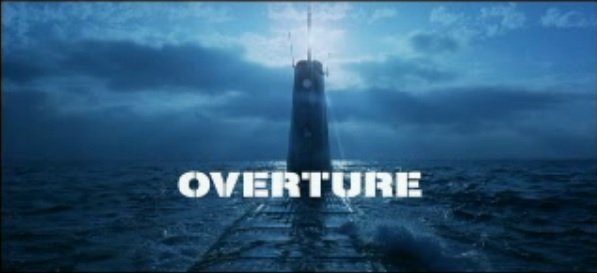
It was also one of the last of the prestigious "roadshow" presentations, shot in "Super-Panavison-70" and featuring "Overture" music and an Intermission at the theater. After this one, the "roadshow" concept was abandoned, in order to squeeze in extra showings per night, sounding the death-knell-by-chopping-block for such ambitious projects as Billy Wilder's The Private Life of Sherlock Holmes and Richard Lester's originally conceived three-hour version of The Three Musketeers. But, beyond that, the film may be one of the dullest thrillers ever filmed. 
Ice Station Zebra has the same stolid air of other adaptations of Alistair MacLean adventure yarns (The Guns of Navarone, Where Eagles Dare). It's just not as adventurous, and the locations—studio-created—are claustrophobic and closed-in, as opposed to having any dramatic vistas or the intriguing foreign locales of other MacLean stories. Here, it's meeting rooms, a submarine and a burned out polar station on a floating ice flow. People don't get out much, and the whole film feels close and boxed-in (quite a trick in "Super-Panavision-70). 
Oh, there are intrigues—it wouldn't be a MacLean story if there wasn't one or two double-crosses thrown in—but they're fairly typical. The sub' has to have a debilitating leak, and as befitting a Cold War drama (the coldest!), there are dueling loyalties and the to-be-expected double-agent (but who?). It never rises from the slightly edgy to the exciting and is mostly cliché-ridden, especially when it comes to the "whodunnit" aspects.
It's a fairly good cast with not much to do except glower at each other, and top-liner Rock Hudson isn't at his best at that, and is ham-strung by the script (by MacLean, Douglas Hayes—he wrote Kitten with a Whip, after all—Harry Julian Fink, and W.R. Burnett, no slouches, any of them) from doing anything interesting, like humor. Patrick McGoohan has one interesting scene where he loses it, but mostly he's clipped and acerbic in hyper-"Danger-Man" mode.  Jim Brown matches him frown for frown—twin performances by actors playing characters hating each other—and Ernest Borgnine does a risible Russian accent. A lot of testosterone, mostly going to waste, in material which is stretched to the ice-breaking point.
Patrick McGoohan recreates my expression watching this movie.
Supposedly there's going to be a remake, so there's a lot of room for improvement.
Given that it's a submarine movie, shouldn't it be called an "Underture?"

Wednesday, April 5, 2017

Pacific Rim

Have a review of Kong: Skull Island coming up...which was originally suggested to be directed by Guillermo del Toro. This was written at this film's release.

"Jaeger-Meisters of the Universe"
or
Gigantor versus Godzilla

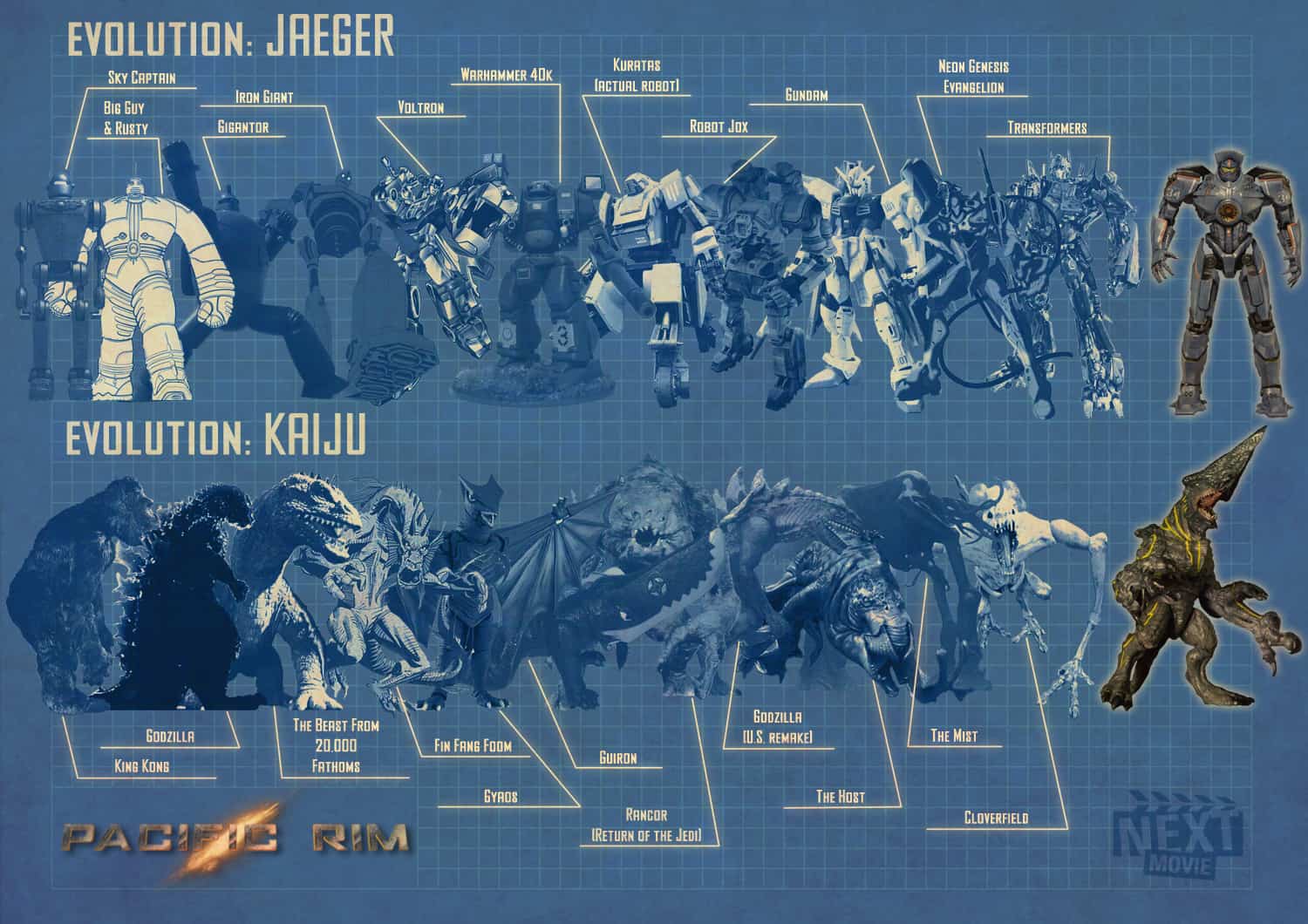
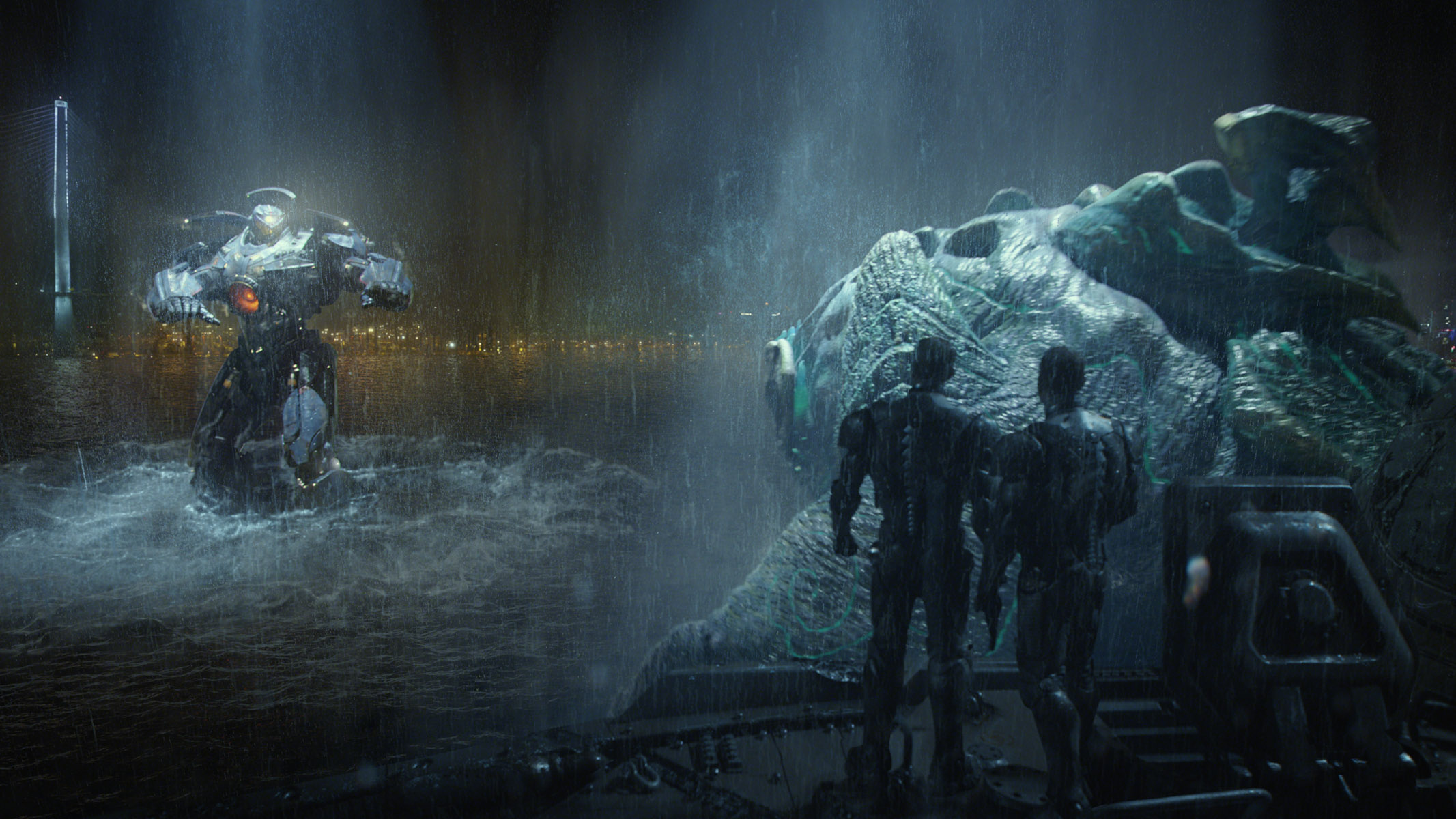
Oh, man. Guillermo del Toro's Pacific Rim may be the smartest dumb movie ever made, a direct descendant of the Japanese monster movies that became increasingly inane and family-friendly...but were not without their charms...and cultish admirers. Del Toro is obviously one of the latter, expanding from the menagerie of Big Creature Movies of the 1950's and '60's to posit "if we're getting so many of these things in our midst," what would the World do to combat them?

Build really big, hurkin' robots to beat 'em up, of course!  


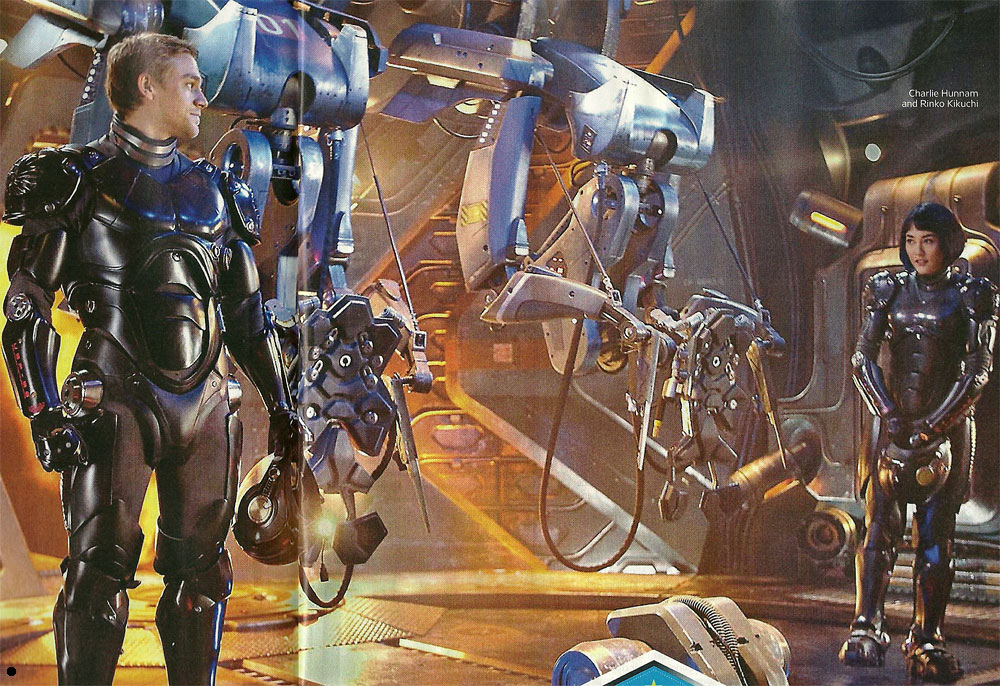
In a short explanation at the beginning, pilot Raleigh Beckett (Charlie Hunnam) says, "Whenever I felt lonely I looked at the stars. I was looking in the wrong direction." It turns out that we're not alone; there's a rift in the Marianas Trench in the Pacific Ocean that serves as an inter-dimensional portal for creatures that attack coastal cities, starting in 2013. The devastation wreaked by the increasing monster attacks compels the Pacific Rim nations—U.S., Russia, China, Australia, New Zealand, Japan, Indonesia—to form their own anti-giant lizard NATO against the "Kaiju," as they're dubbed, by using skyscraper-tall "Jaegers," huge piloted robot warriors to take on the huge lumbering monsters.

For awhile, the system works, the pilots becoming heroes, but the Kaiju get bigger and more resistant to Jaeger attacks and more sophisticated in their assaults, and Jaeger up-keep gets expensive. World leaders start leaning towards defensive measures—thick walls to keep the invaders out—which, given the increasing abilities of the Kaiju, will eventually be a losing proposition.
Parallels to current issues abound, and the film is a bit more subtle tackling other questions than one might expect in a robo-critter slug-a-thon: what are the Kaiju? Where do they come from? How does one fight an increasingly sophisticated enemy with the weapons you have?
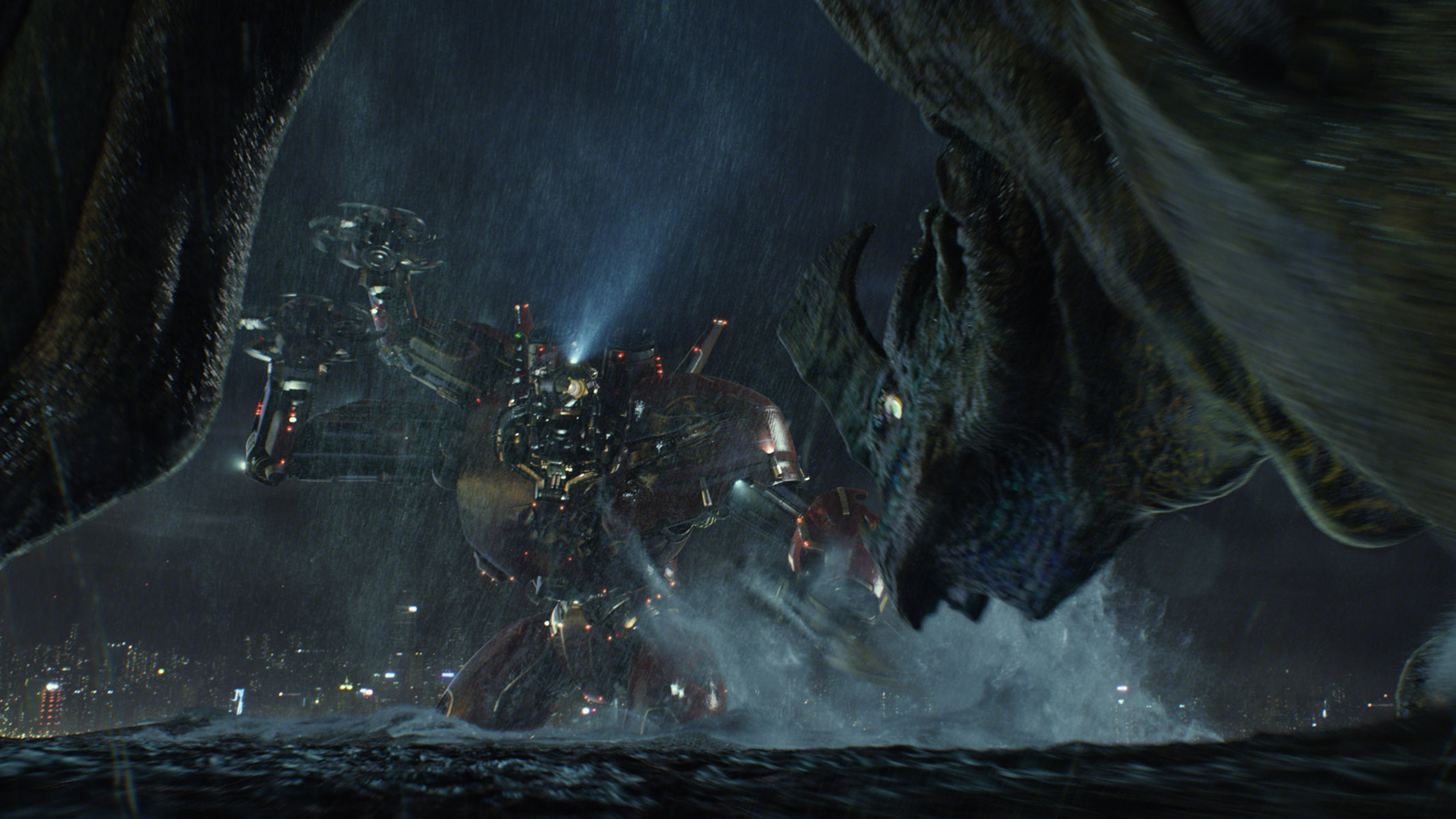
Those are answered in the peripheries of the smack-downs that are the Jaeger-Kaiju battles, which have a giddy "Alley Oop!" quality to them. There's an inherent goofy quality to seeing these lumbering mecha's—each with their own distinctive movement and swagger—planting hay-makers on assorted carapaces, using WWF moves on the monsters when it comes to close combat. 
There's also something innately funny that these robots are so huge, as if they were walking Chrysler Buildings seeking revenge for past attacks. It takes awhile for the Kaiju to figure out that they should go for the head (where the pilots are), but the Jaeger are so absurdly top-heavy one wonders why they don't just go for the knees in the first place. Or double-team them by one sneaking up behind one (they have enormous blind-spots, being humanoid-inspired), and kneeling down, so that a front-attacking Kaiju can just push them over backwards—the fighting is that level of sophistication. But overlook that, and the basic concept of two people working in tandem for the movements—explained away by a hokum concept called "The Drift" that allows minds to merge—so that the minuscule puppet-masters can operate the stories tall rod-puppets.
That's in the foreground, but the basic concepts are deep and detailed, with the various Rim stations and individual fighter designs being incredibly complex. There's also an optimistic "we're all in this together" spirit, despite all the expected competition and squabbling between the teams for most effective skills.

It's weird, inherently silly, but rather thrilling in conceptualization and realization. And even though the Kaiju are not distinctive enough to be able to quickly ascertain who's who and what's what on first viewing, del Toro manages to keep all things clear—a bit like pulling off his own Jaeger juggling act.  
It's Kaiju-clobberin' time
Now, one would think that after a Summer of mounting indiscriminate screen carnage that has become increasingly boring to watch and numbing to the senses, that any more apocalypse would continue the trend of providing less bang for your buck. But del Toro has managed to create a movie that has some impact, includes some awe-inspiring moments, and considerable humor to balance the package out, and one has to applaud the "togetherness" factor of individuals and nations forming a Corps of the Clobbering to take on the global threat (did I mention this movie is a complete fantasy?), in a way that doesn't feel militaristic, but is inclusive in spirit. 

Hell, yeah, it's goofy, but it is also entertaining and points to how a particular vision can rise above pedestrian material to make something so enjoyable.