Showing posts with label 1946. Show all posts

Saturday, January 18, 2025

Deadline at Dawn

Deadline At Dawn
(Harold Clurman, William Cameron Menzies , 1946) One of those movies that, I'm sure, grows on you over time, once all the shocks have worn off.
 
But, if you're peeping at it in for the first time...well, all I can say, pally, is it's a lot to take in. Oh, it's got a lot of familiar tropes of the noir-type: everything takes place at night, shadows seem to be the popular decor, there's good people and bad people, good people get accused of doing bad things, there are a couple of desperate chases between desperate people, and it's entirely black-and-white, the only color being the complications along the way which are, more times than not, red herrings. And if you can't follow it too well, that's understandable because it starts getting confusing with in the first ten minutes. Watching it drunk or sober won't help you with the film's terrain—you're going to be bumping into walls either way. Oh, and don't get attached to characters because most of them will disappear before the sun comes up. It's not that they die or anything, it's just that they have their fifteen seconds in what passes for a spotlight in a film-noir and then they just go away, never to be seen again. That's life in the big city.
Enough with the opening narration (there isn't any, that would be too helpful). A sailor-boy (Bill Williams) is gonna be shipped off to his next hell-hole and he spends the eve of it getting black-out drunk. He wakes up at a newsie's where he's been sleeping it off with no idea where he's been or what he's been doing. All he knows is that he's got $1400 bucks he didn't know he had. "Found money" is always a nice surprise, but not when there's four hours to kill and you're a possiible target. What better thing to do than hide in the arms of a frail (you could always use her for cover!), so he goes to a dance club and ends up with a handful of a hostess named June Goffe (Susan Hayward) who's dead-on-her-feet and doesn't get interested until sailor-boy shows her his $1400 wad. Naturally, she invites him over to her place for a sobering sandwich and the story of how he got it...if he can remember.
Pretty soon, things start going "Hayward". The sailor isn't as much of a shoe-cruncher as she thought he was but insists on thinking of him as "a baby." But, he had managed to crawl to a drinks-provided poker game (not sure if that's a euphemism or not) at the apartment of Edna Bartelli (Lola Lane), who, with her brother (Joseph Calleia) regularly ran a scam of luring rubes off the street and then robbing them of their wits and their bankroll. Somehow, he'd gotten the better end of the deal with more money than he could spend in four hours. But, he's "a baby" and he wants to return the money because it's the right thing to do (even to people who'd rolled you) and he doesn't want to spend his last four hours of furlough looking over his duffel bag to see if the cops are looking to pick him up for theft. He is in uniform, after all.

Yeah, well, no good deed goes unpunished and sometimes you get exactly what you're trying to avoid, especially in noir movies. June and Alex ('the baby") go over to the address and instead of finding the woman dead-drunk (like he left her), they find her just plain old dead. Like he left her? Well, that's the question. Either June's running around with a killer or there's a killer somewhere else running around after them. That's the question. And they only have a shrinking four hours before Alex gets deployed.
"I hear a whistle blowing" says June, metaphorically
...or is that "Odetically"?
It has the simple par-boiled "jeopardy" plot one comes to associate with its original author Cornell Woolrich (he wrote the original stories for Rear Window, The Bride Wore Black, The Window, Mississippi Mermaid and Phantom Lady) where "trust" (or lack of it) is the one thing drum-soloing through the characters' minds as they try to unravel the plot. But, Deadline at Dawn doesn't so much provoke a sense of associative paranoia as "what in the black-and-blue-blazes are you talking about?" It's scripted by Clifford Odets, who wrote it as a favor to his old Group Theater pal, director Harold Clurman, and it is Odets at his Fink-iest, feeding lines to the cast that are all starch and pepper. Odets took theater out of the drawing-room and into the tenements—and a lot of Deadline at Dawn takes place on the streets and back-alleys of early-hours New York.
Oh, it begins interestingly enough, as we watch a blind ex-husband (Marvin Miller) of future murder-victim Edna Bartelli hammer on her door to collect the $1400 she promised she had for him (the very money the sailor-boy had made off with)—and our introduction to her is properly sordid for the "Code" days where she's so stinking drunk that a fly is pirouetting around on her face. The ex is blind-mad: "You'll never change, Edna. You're bad. I loved you very much. But you're bad." 
But, once we leave the place for the murder to happen, "
Golly, the misery that walks around in this pretty, quiet night." Everybody's kvetching, philosophizing, giving you their dime's worth when all you wanted was a nickel. And complaining about the heat even though nobody's sweating much. Everybody's an overripe wise-guy even the cabbie (Paul Lukas) who hears June's "misery" comment replies with "the logic you are looking for... the logic is that there is no logic. The horror and terror you feel, my dear, comes from being alive. Die, and there is no trouble. Live, and you struggle." I don't know that she was searching for any "logic" there, just making idle conversation. But, everybody's over-explaining in Odets-burg, like when another cabbie bleats "Listen, I don't wanna get in no trouble. I work. I'm just a parasite on parasites." TMI, buddy! Especially with a paying customer in your hack.
Deadline at Dawn is filled with such distractions and so many blind-alleys that you can get lost very easily, but despite the density of the population on display, the solution returns you to the same bubble-world that feels a little too neat for all the obfuscation of the community-building going on. Maybe that was to enrich the plot, but it does nothing to ramp up the tension or unease one usually finds from Woolrich. One shouldn't substitute "overwritten" for "overwrought."

Sunday, January 12, 2025

Don't Make a Scene: My Darling Clementine

The Story: One of the wonders of director John Ford's work is how he could combine comedy and drama and do it very quickly. This has brought some critical sniffing from academics complaining of his "tonal shifts"—as if drama couldn't have some ironic levity to it—and that one would undermine the other. Such a thing (goes the thinking) is indicative of "low-brow" entertainment.

I rather think the opposite.
 
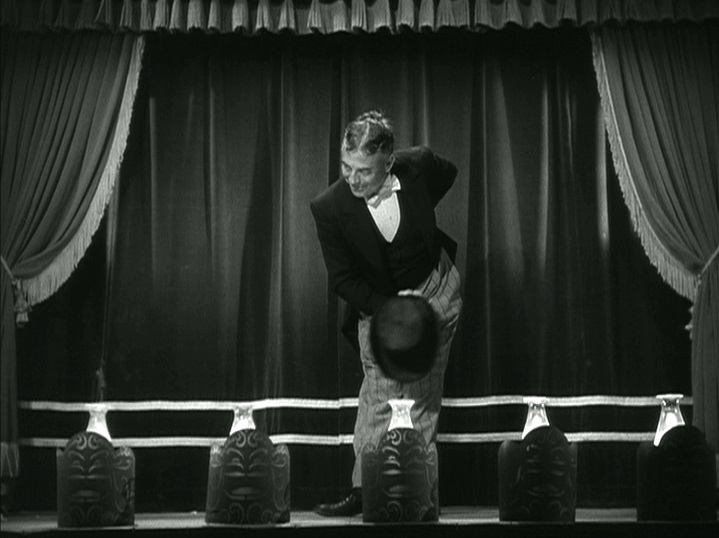
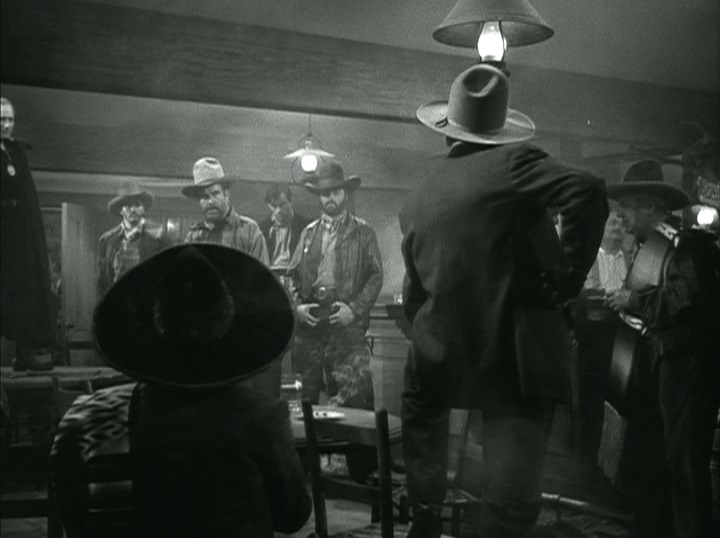
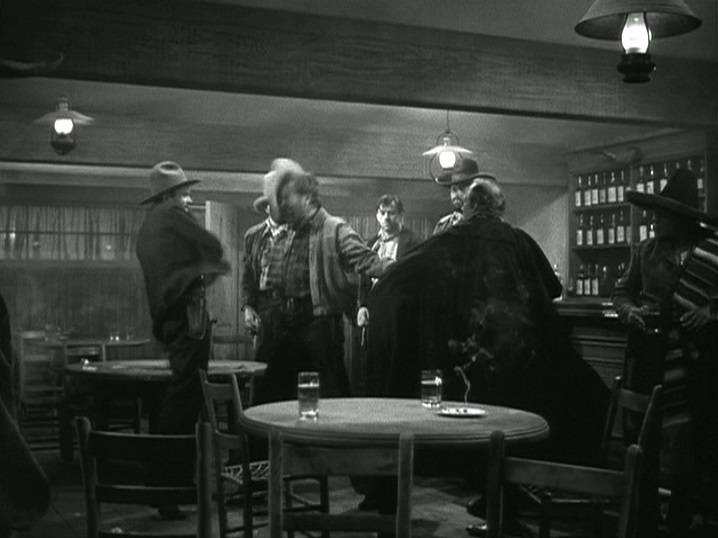
Take this scene from My Darling Clementine (what some have argued is Ford's greatest western—I don't agree but it's right "up there"): moments after a rollicking, boisterously chaotic scene where Tombstone's citizenry is about to lynch the town's opera-house owner for not producing the Shakespearean actor that was promised ("Bird imitators! Bird imitators! That's all we get!" "Marshal, be reasonable! All we want to do is to ride him around town a couple of times on the rail!")to a haunting scene where the film's personification of doom—Doc Holliday—completes Hamlet's soliloquy when that previously mentioned Shakespearean thesp' has trouble stage-treading "the undiscoverd' country" portion. Talk about "tonal shift"—from the senselessly raucous rubism of frontier justice to the contemplation of death and its place in the lives of its characters and its near occasion within a hand's reach.
 
Of course, Doc Holliday does the recitation. And does it...by heart. He's medically-trained, college-educated. He knows his "Hamlet". But, he also knows of that section and has probably contemplated it, seeing has he's got one foot in the grave already—he's come to the dry-air of Tombstone because of the TB that's eating away at his lungs. And the same fatalism that makes him quick on the draw (in cards or confrontation) shadows his very existence. Ford treats him like Death itself, dressing him darkly, keeping him in shadow, and, here, reciting Shakespeare's contemplation of action versus inaction versus consequences, reciting the darker part of the speech, choking on the "conscience doth make cowards of us all." Doc has a conscience of death more than any of them. No wonder he chokes on the words. It's a harbinger of things to come.
 
But, given how the scene plays out ("Exeunt 'Doc'"), it is pretty sure that neither Wyatt or Old Man Clanton have ever read "Hamlet". They don't have time for indecision...or use for it.
 
And death? That'll happen to other people. 
 
The Set-up: Wyatt Earp (Henry Fonda), with his brothers, have settled in the town of Tombstone, Arizona, after their youngest brother James has been killed by rustlers, suspected to be the gang run by Old Man Clanton (Walter Brennan). Now Wyatt is Marshall of the frontier town, trying to keep the peace, even with such notorious residents as the gambler and gun-fighter "Doc" Holliday (Victor Mature). Earp and Holliday become allies, and one night—after "Doc" has had a particularly hazardous shave—go out on the town. But, Wyatt's "job" is never too far away.
 
Action!
 
[Fanfare] 
OPERA HOUSE OWNER:
[Clears Throat] Ladies! 
[Women Cheering] 
OPERA HOUSE OWNER:
- And gentlemen! - 
[Men Cheering] 
OPERA HOUSE OWNER:
Owing to circumstances that I had nothing to do with! 
OPERA HOUSE OWNER:
The show, The Convict's Oath, will not appear tonight! 
[Crowd Jeering] 
OPERA HOUSE OWNER:
But...
OPERA HOUSE OWNER:
as if I didn't already have enough trouble! That eminent actor, that sterling tragedian! 
OPERA HOUSE OWNER:
Mr Granville... 
CROWD:
Thorndyke! 
OPERA HOUSE OWNER:
Has completely disappeared! 
[Yelling, Jeering] 
WYATT EARP:
Wait a minute! What are you acting so mad about? 
PATRON 1:
Why, this is the fourth time this year this has happened, Marshal! 
TOWNSMAN 1:
Bird imitators! Bird imitators, that's all we get! - 
OPERA HOUSE OWNER:
Gentlemen, I can explain! - 
WYATT:
What are you fixin' to do about it? 
TOWNSMAN 2:
Marshal, be reasonable! All we want to do is to ride him around town a couple of times on the rail! - 
[Crowd Agreeing] 
WYATT:
Well, that sounds reasonable enough to me! 
OPERA HOUSE OWNER:
Oh, no, not that! Oh, no! 
WYATT:
Wait a minute, boys! Wait a minute! 
WYATT:
I got a better idea! Just give me fifteen minutes! And I think I can find this Mr ... - 
CROWD:
Thorndyke! - 
WYATT:
I'll bring him back here! Now sit down! Take your seats again! Have another beer! 
[Crowd Chattering] 
IKE CLANTON:
Look, Yorick! Can't you give us nothing but them poems? 
THORNDYKE:
I have a very large repertoire, sir! 
IKE: Great! All right, Yorick! Go ahead! Shoot!
Thorndyke uncorks a bottle with his teeth,
spits out the cork,
and takes a long draw.
Thorndyke lays down the bottle
A barfly draws his pistol
and shoots his bottle
[All Laughing] 
THORNDYKE:
Minstrel, pray help me! 
[Piano] 
DOC HOLLIDAY:
Wait! I wanna hear this! 
THORNDYKE:
Thank you! 
THORNDYKE:
To be, or not to be: 
THORNDYKE:
That is the question! Whether 'tis nobler in the mind! To suffer the slings and arrows of outrageous fortune! Or to take arms against a sea of troubles! And by opposing end them? 
THORNDYKE:
To die, to sleep, 
THORNDYKE:
no more. 
THORNDYKE:
And by a sleep, to say we end the heartaches... and the 
THORNDYKE:
thousand natural shocks that flesh is heir to! 'Tis a consummation devoutly to be wish'd! To die, 
THORNDYKE:
to sleep! To sleep, perchance to dream. 
THORNDYKE:
Ay, there's the rub! For in that sleep of death, what dreams may come! When we have shuffled off this mortal coil... 
IKE: That's enough! 
IKE: That's enough! 
[Shot Glass Shatters] 
IKE: You don't know nothin' but them poems! 
IKE:
You can't sing! 
IKE: Maybe you can dance! 
DOC:
Leave him alone. 
DOC:
Please go on, Mr Thorndyke! - 
THORNDYKE:
Thank you, gentleman! - 
[Piano Continues] 
THORNDYKE: Must give us pause! 
THORNDYKE:
There's the respect! 
THORNDYKE:
That makes calamity of so long life! 
THORNDYKE:
For who would bear the whips and scorns of time! 
THORNDYKE:
The law's delay, the insolence of office! 
THORNDYKE:
And the spurns that patient merit of the unworthy take!
THORNDYKE:
When he himself might his quietus make! With a bare bodkin? 
THORNDYKE:
Who would fardels bear, to grunt and sweat! Under a weary life... 
THORNDYKE:
...
life! 
THORNDYKE:
Please, help me, sir! 
DOC:
But that the dread of something after death! 
THORNDYKE:
Would you carry on? I'm afraid! 
THORNDYKE:
It's been so long! 
DOC:
The undiscover'd country! From whose bourne no traveler returns!
DOC:
Puzzles the will and makes us rather bear those ills we have...
DOC:
than fly to others that we know not of! Thus, conscience does make cowards of us all! 
[Coughs] 
[Gagging] 
WYATT:
They're waiting for you at the theater, Mr Thorndyke! 
THORNDYKE:
Thank you, sir! 
THORNDYKE:
Shakespeare was not meant for taverns!  
THORNDYKE:
Nor for tavern louts! 
IKE:
Yorick stays here!
Wyatt unholsters his gun.
and clobbers IKE.
Phin draws on Wyatt...
...who fires back.
Old Man Clanton, hearing the gunshots, bursts out of the card room.
WOMAN:
¿Qué pasa? ¿Qué pasa? 
WOMAN:
¡Parece que hay bandidos! 
OLD MAN CLANTON:
My apologies, Marshal! 
OLD MAN CLANTON:
Ike and Phin have had a little whiskey! 
WYATT:
Sure! I figured they was just having themselves some fun! 
WYATT:
Come on, Mr Thorndyke! I'll take you to the theater! 
BILLY CLANTON:
Stop! - 
BILLY:
Stop, Pa! 
BILLY:
Stop! Stop! 
OLD MAN CLANTON:
When you pull a gun, 
OLD MAN CLANTON:
kill a man!
BILLY:
Yes, Pa...


Pictures by Joseph MacDonald and John Ford
 
My Darling Clementine is available on DVD from Twentieth Century Fox Home Entertainment and on Blu-Ray from The Criterion Collection.