Saturday, June 7, 2014

God's Little Acre

God's Little Acre (Anthony Mann, 1958) Back to Erskine Caldwell territory although, as opposed to "Tobacco Road," this one never made the transition to the stage before being adapted to film (unless you want to count its pornography trials as theater). 

Anthony Mann's a good choice to direct this, especially at this time, having coming off a series of "adult" psychological westerns with James Stewart, that stretched both the genre and the actor. His approach to the "white trash" pretensions of Caldwell border on the comic, but don't belly-flop into the slapstick just this side of Al Capp's "Lil Abner," as did John Ford's direction of Tobacco Road. And Mann's history with black-and-white cinematography (dp'd here by Ernest Haller) during his noir phase, gives God's Little Acre a shady high-contrast look whether the scene is day or night. 


God's Little Acre is primarily the story of Ty Ty Walden (Robert Ryan, lightening up), who, at the film's opening, is mid-way through his project of digging up every square hectare of land, looking for the fortune in gold supposedly left by an ancestor on the farm. A man of Faith (as far as that goes), Ty has tithed an acre of his land to God...but keeps moving the location of that acre while he digs to avoid any gold from being rendered to the Almighty and out of his own hands.  His craven hypocrisy posing as piousness is as slippery a slope as any of the edges of the pits he and his sons (Jack Lord, Vic Morrow) have dug for themselves.

Nice visual metaphor, this. The Walden farm is a wasteland, like a WWI no-man's land, as opposed to a well-worked straight-tilled farmland teeming with life and growth. Such are the wages of sloth, and the Waldens are putting an awful lot of effort into it.

In his pursuits, Ty's morality changes as much as the landscape—going so far as to kidnap a local albino (played by a young Michael Landon, in an oddly comic performance that brightens the picture somewhat) rumored to have divining powers that might aid in locating the alleged treasure.

But, he's not alone. The town's local factory has shut down, putting the local populace, including son-in-law Will Thompson (Aldo Ray), out of work. Married to Ty's oldest daughter, Thompson has eyes on desperate acts: storming the closed factory and turning on the dormant equipment; and on the beautiful Griselda (Tina Louise) the wife of Ty's son Buck (Lord). All that restless, unsatisfied energy can only come to no good. Nor does it, resulting in empty dreams and broken lives.
Director Mann, who returns to black and white after making some gorgeous color westerns with James Stewart, shows that he's still a master of shadows and the dark, filling the frame with corners of blackness whether on the farm or on a deserted work-floor, and one appreciates his command of landscape that ripples with heat, even in the darkest of times. The film benefits from an early score by Elmer Bernstein, but it's the notoriety of the book that got the film made, not the superiority of the material it contained.

Currently, God's Little Acre (in the black and white version) is in Public Domain. The colorized version...I don't think I'd bother with.

Thursday, June 5, 2014

Brave

We All Have Our Bear to Cross
or
"A Princess Strives for Perfection"

They used to have a lot of trouble with hair in the early days of digital crafting. For instance, you remember the monkeys from Jumanji—the hair was short and matted and plasticene looking ("Not good enough, Sonny Jim").

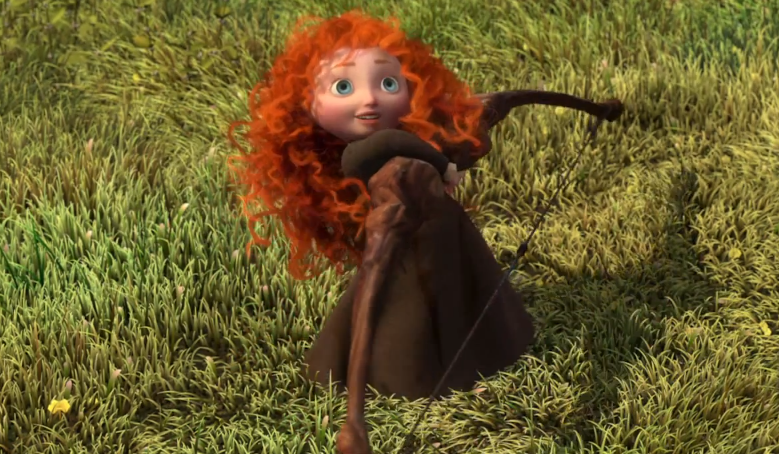
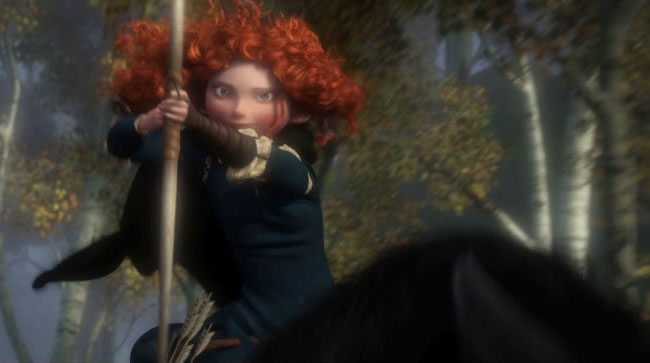
Things have come a long way; Princess Merida (voiced by Kelly Macdonald) in Brave has an unruly hedge of red hair, of all different textures and tensile strength, thatched together, the odd curlicue strands floating, like the representatives of an unruly spirit. The one girl in the royal Scottish family of Lord Fergus (Billy Connelly) and Lady Elinor (Emma Thompson), she is being groomed, quite radically by Elinor, to be the perfect little princess, a prim and proper consort to one of the sons of the other clans (led by voice actors Robbie Coltrane, Craig Ferguson, and Kevin McKidd)—losers all. Trouble is, Merida is very much a product of her parents. The first born, she takes off a lot from her Lord-father, who when we first encounter the family, gives his daughter a bow for her birthday. A wild shot sends an arrow deep into the forest where Merida has her first encounter with will'o-the-wisps, which her Mother tells her can lead her to her Fate. As if Merida wants to be led anywhere. As she grows, she'd much rather take off with her steed Angus, firing arrows at a full gallop on an archery course of her own devising, going on adventures that her potential suitors might blanch at.
But, when forced to play the role imposed on her, Merida becomes defiant, setting in motion a series of events that will prove disastrous to her clam, politically and personally.

To reveal any more would be spoiling the surprises along the way, which are heart-felt, potentially extremely tragic, and ironic all at the same time. It's a grim fairy tale, conceived by original director Brenda Chapman (Pixar's first female director, although she was let go in the middle of production over "creative differences.")

There are a lot of "first's" here: it's Pixar's first "period" film; their first with a female protagonist, believe it or not (and this has a strong one to start off with, with feminist leanings, and mother-daughter issues); their first "princess" film and their first "fairy tale" of sorts, although it's not based on any story I'm aware of, treading new ground, although the touchstones along the way have all the familiarity of ages-old myth.
And Pixar has re-written their software codes to make a truly complex-looking film. It's not just the hair, but also the verdant forests, rough-hewn roads, castles, and water effects all have a photo-realism quality, while the cartoon-proportioned people have a fastidiously eclectic design and a malleability of expression far beyond what Pixar's animators have been able to accomplish before. There are no short-cuts here, but only the pushing of the artistic envelope (and that includes the 3-D effects which looks seamless and flawless with no speed-artifacting) that has been the standard for every production out of this studio.

At the showing I attended there was a technical glitch with the projectors that delayed the film somewhat (pfft...so I missed a couple of previews), and one of the patrons remarked out-loud how much the theater might compensate for the delay. It left me wondering what sort of compensation is needed besides a great film, flawlessly done.
Brave is preceded by a magical short, La Luna. And stay 'til the end as there's a nice little coda.

Wednesday, June 4, 2014

Anytime Movies (Transplanted): Once Upon a Time in the West

While I have a few reviews "in the works," It's as good a time as any to re-boot (actually transplant from the old movie blog) a feature I started years ago, when it was suggested I do a "Top Ten" List. 

I don't like those: they're rather arbitrary; they pit films against each other, and there's always one or two that should be on the list that aren't because something better shoved it down the trash-bin. 

So, I came up with this: "Anytime" Movies. 

Anytime Movies are the movies I can watch anytime, anywhere. If I see a second of it, I can identify it. If it shows up on television, my attention is focused on it until the conclusion. Sometimes it’s the direction, sometimes it’s the writing, sometimes it’s the acting, sometimes it’s just the idea behind it, but these are the movies I can watch again and again (and again!) and never tire of them. There are ten (kinda). They're not in any particular order, but the #1 movie IS the #1 movie.


Landscapes.

That’s what’s featured in
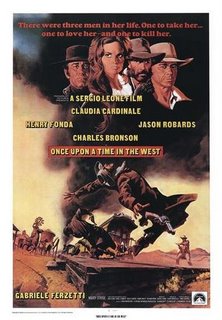
Sergio Leone’s Once Upon a Time in the West. Whether it’s the vast, aboriginal spaces of Monument Valley—an affectionate genuflection to the films of John Ford—or the intricately chiseled planes of the faces of Charles Bronson and Henry Fonda—you spend a lot of time looking at both in Once….—as well as deep close-ups of the faces of Jason Robards and Claudia Cardinale. There is one shot where Bronson ever so slowly relaxes a smile out of existence. Bronson does it so subtly you don’t know what’s happening until it’s happened. It’s one of the things I look forward to in the Dance of Death of Once Upon a Time in the West. Here are some others:


1. “Looks Like We’re Shy One Horse…” The first twelve minutes. A dilapidated train station in the middle of nowhere. Three long-coated bad-men wait for a train. They while away the time, each in their own unique fashion. Driven mostly by sound and filmed in extreme close-ups, the sequence, accompanied by the homely squeak of a windmill—one of the out-sized sound effects typical of Leone’s westerns—and the jokey placement of the credits, rolls on and on until a confrontation ends explosively. It’s an opening of great economy and intricate film-making. Few words are spoken throughout. I’ve shown students this sequence to show just how much presence and atmosphere simple sound effects can bring to a scene. It’s just the opening gambit in a plot by two men who are playing against each other. It will take the entire movie to explain why.


2. “You Don’t Know How To Play” The gist of Once Upon a Time in the West is a chess game with lives and futures as the playing pieces. As scripted by Sergio Leone and his co-scenarists--the soon to be master of Italian horror films Dario Argento and the young Bernardo Bertolucci--the movie is a series of moves and counter-moves by the antagonists, each one trying to tame the frontier in their own way, and taking their own sweet time about it. Each has to make the pieces fall their way. For the first-time viewer it can be maddening following the strategems of the four participants in the story, but by the end the motivations and loyalties—or lack of them—become clear.
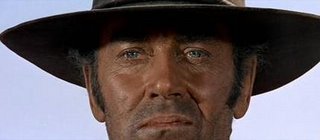
3. “People Scare Easier When They’re Dyin’” The villain of the piece is the meanest, rottenest most conniving scumbag to ever walk a dusty street and spit on it. “Frank” is a sadist who smiles when he kills and for the first time in his life he has a patron with a vision—one big enough for Frank to start to see how there might be such a thing as a future, and that one man can own it. He just can’t understand why people are getting in his way.
4. “Instead of Talking, He Plays. And When He Better Play, He Talks.” The composer and the director did it backwards. Ennio Morricone wrote the music for the film first and Leone built his sequences around the music, playing it on-set to establish mood. There are two spectacular pay-offs--one in the previously mentioned Monument Valley sequence. But the other is at a train station where Claudia Cardinale, has just arrived from New Orleans to find no one to meet her. After a long wait (which is actually mercifully short for a Leone western) she decides to hire passage. Sounds disappear as she is seen through a station window talking to an official, and then the camera HEAVES up and over the roof, and in a burst of music reveals a burgeoning western town full of life and activity. It’s as if all of America is presented in that one astounding crane shot. My wife audibly gasped when she saw the shot in some movie clip program on TV, so stunning is the effect. And more than a little of the power of that shot is due to Morricone’s music and the angelic voice of Edda Dell’Orso, wordlessly cooing an ode to the country and to the protagonist around whom the movie and the future hinges.
5. “Ma’am, It Seems To Me You Ain’t Caught The Idea” For the first time in a Leone western, a woman is the hero, but like her predecessor—"The Man with No Name"—she is flawed and has some learning to do, and it’s up to Leone’s trio of men – another man with no name (going under the aliases of dead men), a wolf-like vagabond-thief, and the villain, Frank—to push, prod, blackmail, challenge and coerce her into a new role. It’s a role each man knows they’ll have no part of, and that, for a time, she is reluctant to fulfill. In the last shot of the film, she is seen bringing water to the railroad work-crew who will be bringing people and prosperity to what will be her town. It may seem a servile role, but as we pull away and follow the disappearing tracks to the frontier, leaving her to her future, she begins to bark orders, to direct and take charge. Her station will become a cornerstone of the push west. “This movie drips with testosterone,” a colleague once told me after a screening. Yes, but Leone includes a healthy shot of estrogen as, for the first time, he is dealing with a story that not only leaves the past behind, but also looks forward to the future.
After his spectacular success with the "Dollars" trilogy starring Clint Eastwood, Leone was given a lot of money, quite a bit of it from Paramount Pictures, to not make his next planned film (based on the novel, "The Hoods" which would eventually become his last film Once Upon a Time in America) but make his next production a western. When he delivered this slow-moving epic on a small scale writ large, the full length film (2 hours, 46 minutes) became a hit in Europe, but Paramount cut what it considered "extraneous" material—a full 25 minutes of it—for its American release.* The film was a bomb in the States.  It was released, after all, in 1968, the year of Bullitt, Rosemary's Baby, and 2001: a Space Odyssey. Cinema, and its audience, was changing. The next year Easy Rider would be a huge hit. Once Upon a Time in the West might have seemed a little archaic to the youth audience. Eastwood, a popular star outside of the Leone films by then, wasn't in it. Bronson—popular in Europe, but a supporting actor in America—was. Fonda, Cardinale, and Robards, perfectly cast though they are, did not bring in droves of film-goers.
But, despite its reputation from the box-office performance upon its release in America, the film has developed a cult following here—more than that, it is acknowledged as a masterpiece of film-making, one of the great films of the 20th Century, maybe a little behind-the-times for the box-office, but certainly ahead of its time for the influence it has had on subsequent film-makers.

For me, it is simply beautiful, dusty and hard-scrabble though it is. Some of the images, some of the sequences, run through my head daily, and Morricone's music "ear-worms" into my head once a week. It is still, despite the acolyte-directors who "one-off" the style and sometimes the film, wholly original, while acknowledging its debt to films of the past, presenting them in its own unique way. You'll never see a wide-screen film filled so interestingly as Once Upon a Time in the West. Filled and brimming. Rustic and operatic, Once Upon a Time in the West is a fairy-tale of Myth and History—film history—while making its own.
Claudia Cardinale: The West wrapped around her little finger.

-Only Angels Have Wings
The Searchers
Mr. Smith Goes to Washington
Chinatown
American Graffiti
To Kill a Mockingbird
Goldfinger

Bonus: Edge of Darkness


* There had been a precedent: United Artists cut 16 minutes from the nearly 3 hour The Good, The Bad, and the Ugly. And Paramount made a worse decision when it eventually released Leone's Once Upon a Time in America: restructuring the director's intricate flashback structure into a chronological narrative, which robbed the movie of its melancholy tone, and removed any mystery the film contained. Curiously, the longer film is fascinating throughout, but Paramount's re-edit seemed interminable. It just shows the differences between a genuine film-maker and studio hacks.

Tuesday, June 3, 2014

Maleficent

Her Wicked, Wicked (Though Très Jolie) Ways
or
The Method Act of Evil ("So, What's My Motivation?")

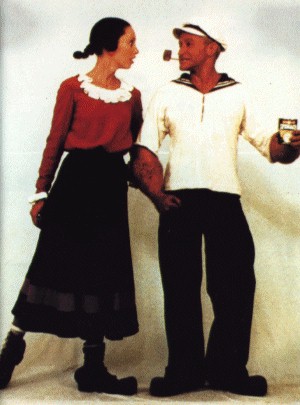
I'm of two minds on Maleficent: pro and con.   This Angelina Jolie star-vehicle (she also executive produced) is one of those slam-dunks of casting real-life counterparts for animated characters—like Shelley Duvall for Olive Oyl, or John Goodman for Fred Flintstone. Make-up artist Rick Baker merely had to chisel a little more cheekbone to make her match the stylized profile from Disney's late-50's animation of Sleeping Beauty to perfect the look. Rookie Robert Stromberg is the director here (although his production design work on Avatar, Alice in Wonderland, and Oz the Great and Powerful, shows he knows his way around a complicated set). Linda Woolverton (who worked on Beauty and the Beast, The Lion King, and Alice in Wonderland) wrote the screenplay with some whispered assistance from the shadows by Paul Dini. That's some talent behind and in front of the camera, that no one can deny.

But, this one left me torn. Jolie is terrific, in a performance of such stillness and economy that a raised eyebrow can raise the hairs on the back of your neck. And when she opens up and howls in a moment of violation, it haunts. She and the production design are the whole movie, really. Sharlto Copley plays the antagonist, and he seems to be rather straight-jacketed in the role, and Elle Fanning plays the "sleeping beauty" Princess Aurora, in a performance that consists of grinning like an idiot.
Maleficent is the latest of the "Wicked" school of re-written history fairy-tales,* where the traditional villains' side of things are presented, their reasons for being bad more than just because they're "drawn that way"—there are psychological reasons for their actions, like Richard II's "I got a hump, okay?" and Oedipus' "Look, it was all a big mistake!" Maleficent takes one of Disney's more fancifully-designed villains and "explains" her away, negating what made Maleficent the character so intriguing (and inspired Jolie to take the role in the first place). So, I'm torn.
Having seen the Disney version of Sleeping Beauty (on which this is inspired), I'm con.  


But having seen the Disney version of Sleeping Beauty, I'm pro.

Perhaps I should explain. 
Submitted—Argument for the prosecution: 

Not to get too "law and order" here, but villains are villains because they are bad. Vain, selfish, of no community except of their own making, they are the cautionary "other" that fairy-tales warn us about and provide the heroic alternative to inspire us. Villains are supposed to frighten us, and be examples only in the negative. Unfortunately, the thrill of the villain can also make them attractive. Marlon Brando was famously aghast when his anti-establishment motorcycle punk in The Wild One became so popular. Darth Vader was fascinating in Star Wars and because of it, his caché increased in size and scope in the second film of the first trilogy—I suspect that part of the animosity towards the prequels is how they diminished the mystery of the character (We like to tear down our heroes, but we HATE it when we tear down our villains). 

I don't mind when a villain gets his just desserts, but I don't want to "feel for" them when they receive it. I want no sympathy for villainy, no matter the lawyering of its arguments. The fact is I don't care why the Grinch stole Christmas, why the Wicked Witches terrorize Oz, or why Booth shot Lincoln or Oswald shot Kennedy. I don't care why the creep killed those people at USC. Some things cannot be explained away, or understood for their motivations. God help me when I do understand the terrible actions in this world. They are acts of evil, un-pure and simple.


It is a tragedy that we even have the opportunity to ponder them at all. 

Making Maleficent sympathetic diminishes us...and diminishes her.

Submitted—Argument for the defense:
However, there is something good going on here that started with Disney's Beauty and the Beast and is just starting to bloom in full flower with films like Pixar's Brave and Disney Frozen—female heroes and female bonding is making a comeback in movies, and Disney, who foisted so many pliant princesses on our culture, seems to be leading the charge. However improbable it may be for Princess Aurora to see Maleficent as a fairy godmother (as she does in this), there is a bracing antidote to the traditional "true love's kiss" (as there was in Frozen) that belies the fairy-tale of the solution to problems being a handsome prince. Because if it's one thing that "Sleeping Beauty" teaches us, it's that a woman's life can really get messed up due to an unfortunate prick.

It's a lesson more important for our women-folk than sustaining the conventional jealous battles over territory for the efficacy of Evil Queens.

Still torn, though. One thing I did find perfect in this film, however, is the exit song—a new rendition of the 1959 film's song, a melancholy, minor-key version, lachrymosely husked by Lana Del Ray.


* Nah.  It's not "Wicked" that started it.  It's John Gardner's "Grendel" which told the story of "Beowulf" from the monster's perspective.

Sunday, June 1, 2014

Don't Make a Scene: - Only Angels Have Wings

The Story:  Howard Hawks swore that he saw this scene from - Only Angels Have Wings played out in real life (but Hawks was a renowned story-teller)—a young pilot, dying, asking to die alone. 

"A good death," said Hawks. An unsentimental death, certainly, on the surface, but Hawks never did anything very simply. The conversation between Geoff and the Kid (who is, typically for Hawks, older than him) is played out conversationally with emotions held in check. 

But Nature has a way of betraying us, and the rain that falls from Carter's hat stands as a substitute for the tears he won't shed in front of his friend. 

And the trademark Hawks cigarette bit-of-business is there, too—his usual symbol for charity, for need, for friendship, for bonds, serves a dual purpose: the smoke escaping from the Kid's last puff might be a representation of a soul (other directors have used it, like Sergio Leone in The Good, The Bad and The Ugly); and, that last cigarette goes from the Kid's lips to Carter's bestowing a once-removed kiss, (Hawks never shied away from a gay sub-text), or you can see it as Geoff continuing something the Kid can't finish. Simple actions in Hawks' films often have deep or multiple interpretations.  

But, that's business.  The important part is that Geoff Carter and the Kid "go solo" their separate ways, Geoff finishing the Kid's last cigarette and walking out into a down-pour. 

A good death, indeed.  

And a great film.

The Set-Up: Tragedy has struck the flight-service run by Geoff Carter (Cary Grant)out of the banana-port of Baranca. On this rainy, wind-swept night, a flight over the Andes has been thrown into jeopardy when condors, spooked by the sound of the its engines, crashed into the plane and through the wind-screen, disabling the navigator Kid Dabb (Thomas Mitchell), and causing a fire in one of the engines that severely burns the pilot, Bat MacPherson (Richard Barthlemess). MacPherson, years earlier, had disgraced himself, jumping from a damaged plane that crashed, killing his mechanic. As Fate would have it, that mechanic was Dabb's younger brother, and "The Kid" has never been able to forget, or forgive MacPherson. Now, MacPherson, fighting fire and severe weather has brought the plane in for a crash-landing--both men injured, but Kid Dabb, critically. A doctor tries to make him comfortable on this rainy night, the entire crew of the service hovering near their older colleague. 

Action!

Kid Dabb: [Wounded and laid out on a table after the crash, he gets annoyed at the doctor attending to him] Okay, doc, that's fine, that's fine. Cut it out.  Come on, Geoff, tell this guy to quit fussing with me, willya? I'm all right.
Geoff Carter: Let him alone. doc. [The doctor backs away and stands with the other pilots, who are watching behind Carter]
Dabb: Cigarette, papa?
Carter: Sure [He holds the cigarette to the Kid's mouth] Here.
Dabb: How's the other guy?
Carter: Hands burned and one side of his face.
Dabb: He's all right, Geoff. He could have jumped, but he didn't. He just sat there and took it like it was an ice cream soda. Buy him a drink for me, will ya?
Carter: Sure I will.
Dabb: Hadn't been for those birds, we'd have made it.
Carter: Sure you would.
Dabb: I'd make a windshield at an angle. Then they'd bounce off.
Carter: Not a bad idea.
Dabb: I'll make a present of it, papa. When I get on my feet, we'll work it out....Or will we?
Carter: Your neck's broken, Kid.
Dabb: Funny. Wondered why I couldn't feel anything.
Dabb: Well I guess this is it, then.
Dabb: Bad sport. Gee. [He suddenly tenses up]
Carter: What is it, fella?
Dabb: Get that bunch outta here, quick.
Carter: [To the others in the room] Get out of here. Hurry up. You, too, doc. Use both feet. [They leave. Carter turns back to the Kid]
Carter: What is it, fella? Come on, you can tell me.
Dabb: I didn't want them to see me.
Carter: Sure, sure.
Dabb: I'm not scared, Geoff.
Carter: Of course you're not.

Dabb: It's just that--it's like doing something new. Like when I made my first solo--I didn't want anybody watching then either.
Carter: Yeah.
Dabb: I don't know how good I'm gonna be at this.

Carter: Do you want me to go too?
Dabb: I'd hate to pull a boner in front of you, Geoff.
Carter: Sure, sure, I know.
Carter: Here y'are, boy. [He gives him a last puff on his cigarette] So long, Kid.
Dabb: So long, Geoff. [Carter, with the cigarette in his mouth, walks out into the night rain]
 

Words by Howard Hawks and
Jules Furthman

Pictures by
Joseph Walker and Howard Hawks

- Only Angels Have Wings is available on DVD from Sony Home Video