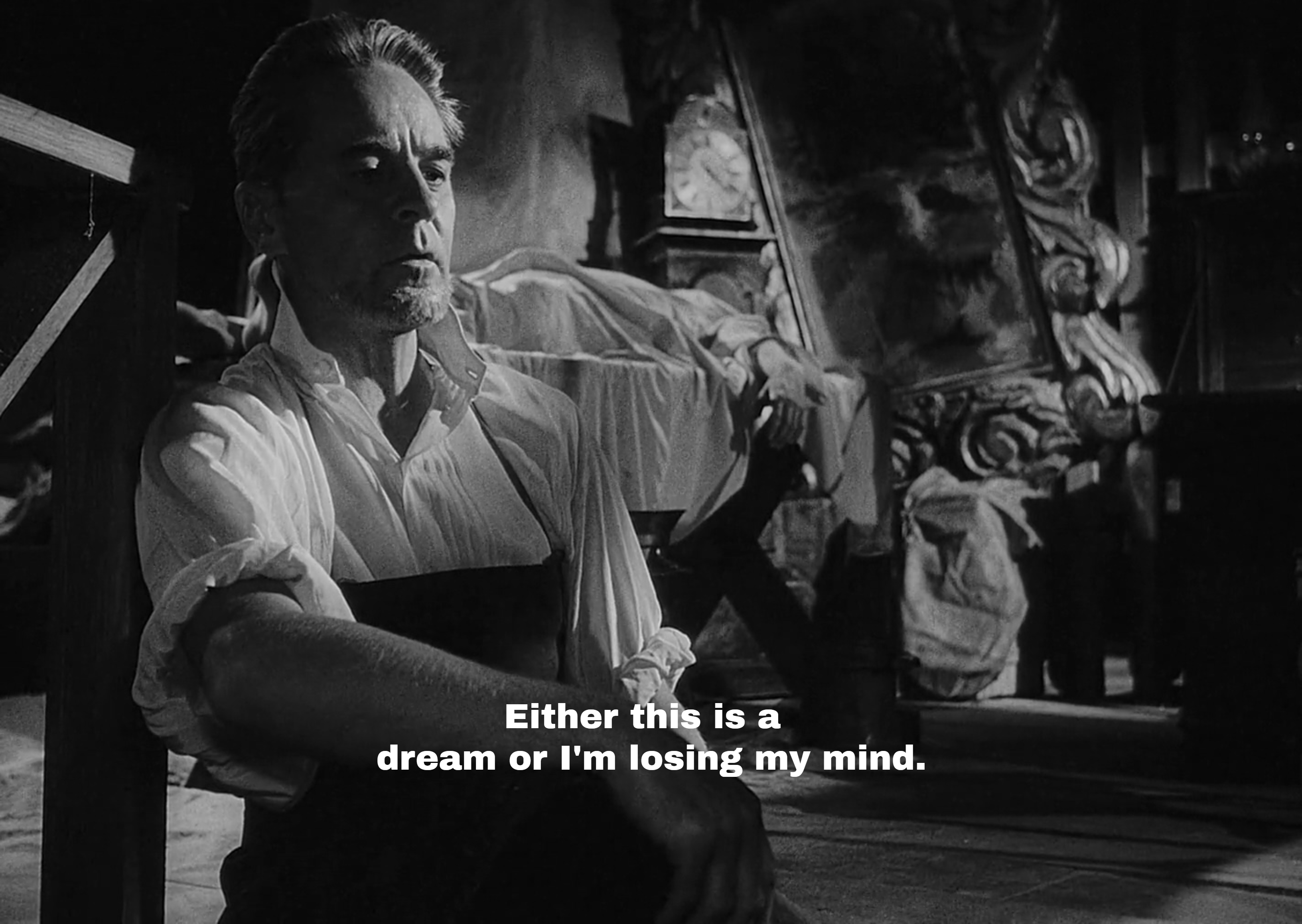
The Magician(aka Ansiktet or "The Face",Ingmar Bergman, 1958) It is a rough day of travel for Vogler's Magnetic Health Theater, a gypsy band of performers just out of Copenhagen and carriaging to Sweden. Their reputation precedes them, having been accused of fraud and blasphemy at various stages of Europe, and some time incarcerated, but still they have a following and luckily it doesn't involve torches and pitch-forks. The troupe moves purposely on demonstrating the awesome powers of animal magnetism and selling potions for the sick and the wantonly healthy. "Sensational marvels never seen before. Magical acts derived from the philosophies of the Orient. Health-giving magnets, and spine-tingling thrills for the senses." That's what the flyers say, anyway. Whether it is true or not, the head of the troupe, Albert Vogler (Max von Sydow) will neither confirm or deny; Mr. Vogler, you see, is mute. Better to neither confirm or deny, the less said the better, and nothing is best of all.
In their travel, they come across a sickly actor, Johan Spegel (Bengt Ekerot), who asks for some brandy as he's sure today will be the last day of his life. He is offered that and a ride, and he joins the troupe consisting of Vogler, the severes"Mr. Aman" (portrayed by Vogler's wife, Manda—portrayed by Ingrid Thulin), their assistant and spokes-person Tubal (Åke Fridell), the carriage driver Simson (Lars Ekborg) and "Granny" Vogler (Naima Wifstrand), who "may" be a witch but is skilled at potions.
The actor having a mute audience as benefactor, talks and talks, his health gradually declining, his life ebbing away with every word, knowing that Vogler will be fascinated to hear his account with death, but...just as he's about to reveal what death is like...he dies.
Against that backdrop, the troupe continues on to the first village on their way, and are invited by Counsel Egerman (Erland Josephson) and his wife (Gertrud Fridh), both of whom are believers in the supernatural and are fascinated by the claims of the visitors, to join a party held in their behalf. Also attending—with a bit more "official" interest in the theater troupe—are Police Superintendent Starbeck (Toivo Pawlo) and the Minister of Health, Dr. Vergerus (Gunnar Björnstrand). The officials decide to have an informal bet on whether Vogler's group and abilities are frauds.
Are they frauds? There's room for interpretation: Egerson and his wife—especially the wife—lean towards belief, but Vergerus is a man of science and is disinclined to buy into any sort of mumbo-jumbo, and Starbeck's fall-back is to believe the band—given their reputation—are fraudsters, looking to separate the populace from their Krona. And given the artifice displayed by the players of the theater—Albert and his wife are both heavily made up and not what they appear to be—there's more than enough reason to think that it's all an act, mere illusion and trickery than any sort of mystic power.
One is inclined to say that there's a battle of wits between the troupe and their hosts, but it's no battle, really, merely the troupe being true to their nature as imaginative outsiders and the officials being stuck in their ways of thinking. Even if members of the troupe protest that everything is smoke and mirrors, there will always be that little suspicion with evidence to the contrary that they might not be. The evidence will be equal parts what they see with their eyes and what they feel with their hearts, and even the most pessimistic of the lot can be made to doubt, especially if their beliefs are merely a way to prop up a reputation of confidence.
One line haunts, and feels more true these days than at the time of the film's creation: At one point, the ailing actor makes a point:
Ouch. That hits you right in your superstitions. Or is it maybe the one who tells the truth needs to be put down by all the deceivers, lest they be exposed as such. But, in a world of deceivers what difference would being exposed make, especially if it's status quo?
Bergman offers no answers, just possibilities. The troupe could be fraudsters, but that fallen actor at the beginning comes back to haunt Vogler, something that only he is privy to. That must be evidence, no? But, evidence of what? Who would it convince but only another believer?
The Magician leaves the stage making you want more. And its questions haunt long after that point.
This was part of a series of reviews of the ASUW Film series back in the '70's. Except for some punctuation, I haven't changed anything from the way it was presented, giving the kid I was back in the '70's a bit of a break. Any stray thoughts and updates I've included with the inevitable asterisked post-scripts.
Phantom of the Paradise(Brian De Palma, 1974) Too few people know about Brian De Palma's Phantom of the Paradise. Too few people know about Brian DePalma. He is one of the best of the young, young crop of film-makers—the under-30 branch*—and he is quite taken with great directors of the past and their great movies. And so, very often, he will borrow a scene from these directors.
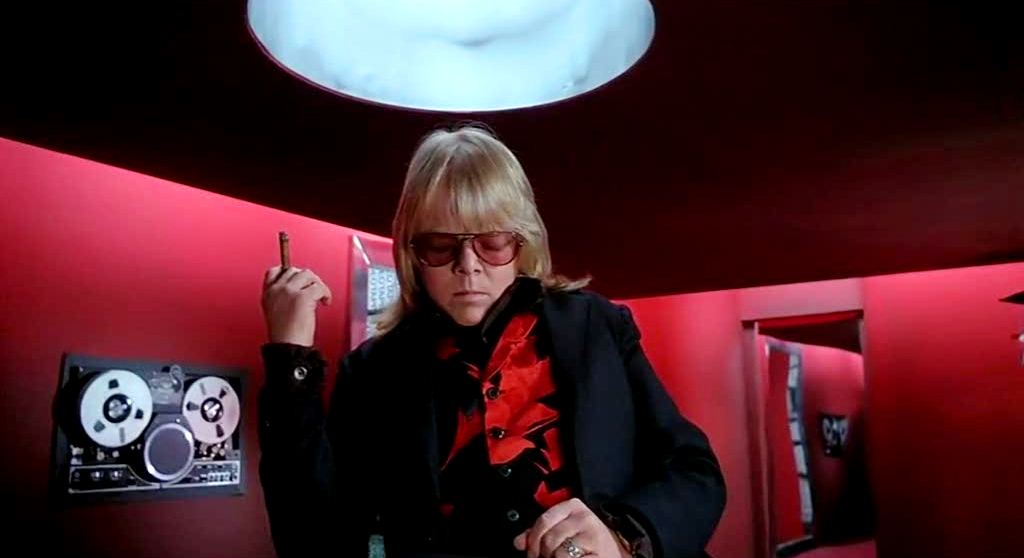
Foremost among the borrowees is Alfred Hitchcock. In fact, De Palma has made two films almost totally Hitchcockian: 1973's Sisters,**and this year's Obsession.***Phantom of the Paradisecame between them, and although it lacks the total Hitchcock commitment, and the many beauties that commitment brought about in Obsession, The Phantom is an altogether enjoyable musical-comedy/horror-satire about the rock industry (kinda whets your interest, doesn't it?) It takes the old "Phantom of the Opera" story into the 20th Century glitter-rock scene, as a young man (William Finley) disappointed in love and betrayed by a rock entrepreneur named Swan (Paul Williams)****, finds himself deformed and deranged, haunting Swan's Paradise Rock Emporium.
Swan is played by Paul Williams, and before you make some expectorating noises, I should say he is properly sinister and comic in the role. He also wrote the songs for the film's exemplary score, which covers a variety of rock-styles, none of which sinks to his regular lonely-introspection fare.
William Finley, who played a mad doctor in Sisters plays the deranged "Phantom," and Jessica Harper,*****who with Diane Keaton participated in the send-up of Bergman's Persona in Woody Allen's Love and Death (see how all these films tie together?), portrays a young and naive innocent who wants to be a "star(!!)" As Obsession borrowed from almost all its ideas from different Hitchcock films, Phantom borrows a lot of plots from success-stories of the past, and incidental scenes from The Godfather, White Heat, and Psycho. But De Palma manages to make this pastiche of film totally his own and in a perverse way, totally enjoyable. Go see it. You may just become a Brian De Palma fan.******
Broadcast on KCMU-FM on November 5th and 6th, 1975
Man, I was a big Brian De Palma fan back in those day. Fortunately, he rarely disappointed with his movies. Oh, there are the duds in his CV--The Fury, Home Movies (which he did with a class he was teaching), Wise Guys, The Bonfire of the Vanities (compromised by studio and De Palman cold-feet), and he would grow out of his "Hitchcock" obsession of the 1970's, and just sneak some of the Master's craft into his pictures (like Dressed to Kill, Blow Out, Body Double, Mission: Impossible,Femme Fatale, and Snake Eyes). He is still a fine film-maker, who pushes the envelope as far as subject matter and technique. His most recent film--Redacted--was a raging film against the Iraq War that scared its distributor into quietly burying it in theaters (it opened locally at The Crest, usually the last stop before video). As of this writing, his next film is a long-in-the-works prequel to his very popular version of The Untouchables--written by playwright David Rabe this time, instead of playwright David Mamet.
But enough about De Palma! What about Phantom of the Paradise? I have fond memories of it, and was impressed with the soundtrack—Williams did some wicked parodies of song-styles that scored satiric points as well as the film. It was inevitable that someone would take the era of Glam Rock and mix it with Gothic Horror.
Across the pond, Richard Sherman's Rocky Horror Show opened on stage in June 1973, and it's not inconceivable that De Palma might have heard of it. But Phantom is rooted in "Faust" and "The Phantom of the Opera," while "Rocky Horror" takes its cue from the RKO horror films and Frankenstein, and, more importantly, The Bride of Frankenstein. The fact that both came out on the tails of the "Glam" era were the big influences, with Rocky being its step-child, and Phantom using it for texture—and Phantom is more concerned with the phony excesses of the music biz, while Rocky embraces them.
One could make the case that Phantom was influenced by Rocky Horror, but the timing's way off—Rocky Horror wasn't that huge a hit at the time of Phantom's creation (right after De Palma directed Carrie) and wouldn't be filmed until a year later. So, though they have the same roots, any resemblance is a very specious one.
****No, really, he's good. Very good. So are the songs he composed for the film.
*****For awhile, Jessica Harper seemed to be in every good movie that came out, and a few bad ones, too. She's still acting, but she's doing more singing and writing for kids. Her last movie role to date was in Spielberg's Minority Report.
******* Those would be The Thin Man, Chinatown, and The Conformist. The Vertmüller film was Love and Anarchy, which I'll re-post once we get October Hallowe'en out of our systems.
The View from 2023: No more asterisks (I really over-did it on this one), but let's update a few things that were in the original and in the re-review. DePalma is now 83. He has two movies currently in development, but not that Untouchables Prequel—which was titled Capone Rising, it is in development Hell. Jessica Harper (bless her heart) is still acting.
Grann's book is a fine read—it spent 49 weeks on the New York Times non-fiction best-seller list—breaking down the story into three narratives: of Mollie Burkhart (played in the film by Lily Gladstone) of the Osage Tribe, who saw three of her sisters and her mother die (under suspicious or downright murderous circumstances) in a short space of a few years; of Tom White (played in the film by Jesse Plemons), a former Texas Ranger, recruited by the Bureau to investigate the murders—his unique way of assembling a team and having them blend in with the community was a bit unpracticed, but did lead to convictions; and a modern post-investigation appraisal. When Martin Scorsese announced it for his next movie with Robert De Niro and Leonardo DiCaprio
starring it was originally just going to focus on the FBI investigation with DiCaprio as White.But DiCaprio had other ideas—he wanted to play "a villain" and so the film was re-tooled by Scorsese and Eric Roth to feature more of the role of Ernest Burkhart, husband of Mollie and his role in the web of deceit and murders...all to obtain the headrights (the land mineral rights owned by full-blooded Osage tribe-members) to their oil-rich pocket of Oklahoma, that made the Osage "the wealthiest people per capita" in the nation. The Osage became prosperous with their oil stipend, creating a power dynamic where they ostensibly ran things in Fairfax, Oklahoma, but they were also targets for any scam and flim-flam the other residents could concoct in order to benefit from their prosperity.
And that included marrying into the money, the oldest way for profligate men to get a sustainable nest-egg and not waste it all in a short period of time. If there's children, then there's always inheritance, or better yet, the idealistically labeled "trust-fund," that can be exploited as long as no one is following the trail of money. In Fairfax, Oklahoma, the trail was not only monetary, but one merely had to trace family ties and the obituary column to see that something was surfacing besides oil.
Clocking in at a back-breaking 3 hours 20 minutes, Killers of the Flower Moon begins where most Scorsese movies do, following the bad guys. Ernest Burkhart (DiCaprio) exits the train to Fairfax after serving in the First World War and receives a warm welcome from his uncle, cattleman William Hale (De Niro), who is perfectly agreeable to taking Ernest under his wing, despite his lack of experience. Under an avuncular pretense, Hale gives his nephew the lay of the land, giving him a book on the Osage people ("Do you read?") and asking pointed questions about his taste in women. Hale speaks the Osage language and extends his avuncular charm to express support for the Native land-owners, especially dealing with the white city officials, the police and Sheriff, the local doctors, even the undertaker (that'll come in handy!). He also is quite familiar with the local underworld (even handier!), and his network makes him less than a town father, and more of a puppet-master.
Burkhart is his primary puppet, lending support to a romance between Ernest and Mollie Kyle (Underwood, who in her mandarin understated way, steals the show as well as hearts), who is already seeing signs of poor health in her family, who have a tendency towards diabetes. And when a "specialist" is needed for some special work to be done, Hale uses his nephew as a go-between, the better to keep his immaculate hands clean.
But, the center cannot hold. In the community, the deaths become less and less isolated and more overt, culminating in a house-bombing that kills Mollie's sister and her husband, who has been asking questions and connecting dots, while resisting any overtures to share information with Ernest. That signs his death warrant and the egregiousness of the crime—the sheer audacity of it—mandates outside help. Private detectives had been hired before...but had disappeared never to be heard from again. A meeting between tribes leaders and President Calvin Coolidge allows Mollie to make an entreaty...and for once, the Great White Father keeps his word.
This is where Plemons' Tom White from the Bureau of Investigation comes into town from Washington, and it only takes a couple of inquiries to determine that he's being stone-walled...by everybody. Evidence goes missing, records disappear, stories are vague and sometimes conflicting. But White brings in some other agents with varying backgrounds to infiltrate the town and integrate themselves into both the White and Native communities. Then, they share information and find the links...and discrepancies. And they attack from within.
If the film has a fault in conception, it is in the sheer repetitiveness of the crimes (although, to be clear, the crimes DID happen as depicted and over that long period of time, which shows how frustratingly slow any shred of justice could be brought to so insular and complicit a community). But, the numbing volume of the crimes strains credulity and patience for an audience, even one used to the slow process of justice and the bull-headedness that passes for politics but stinks like conspiracy. Not to minimize the scope of the crimes, but to see every one of them played out through the machinations of Hale through the prevarifications of DiCaprio's Burkhart makes it a long stretch of the same thing repeated over and over.
Gladstone is the acting highlight of the film, and De Niro—although a bit too long in the tooth to be playing Hale—does a good turn as evil posing as the friendly neighbor.
DiCaprio, though, is an issue. Sure, he's good box-office (and he's an Executive Producer on the film), but it may be time for the long string of Scorsese collaborations to end. At times, one can see him using Brando tricks and an occasional Jack Nicholson strategy in his acting, but mostly he seems to have based his performance on a frowny-face emoji (😠). His face freezes into the same petulant scowl, no matter the circumstances, whether he's unhappy, concerned, frustrated, murderous or cornered. And, the deeper you get into the movie, the lower the corners of his mouth drop until you wonder if his jaw will just drop off once they carve far enough. It's a disappointing performance, considering how integral DiCaprio made himself to the film.
It may be time to kick him off the raft, Marty.
As his character is in the film, DiCaprio is the film's weakest link.
Still, Killers of the Flower Moon resonates, as one more early example of a nation's systemic racism hiding in the shadows and swept under the rug, something that, although denied in all corners of the continuing national reckoning, continues to raise its ugly head.
Ernest Burkhart, Mollie Kyle Burkhart (on the right), and William Hale,
The Story: I'm not a big fan of horror movies. But, they are useful.
Because they're so manipulative, and conducive to "showing off," first-time directors like to make them. Also, for a subject that is "unreal" it's a challenge for first-time directors to create the realness, the verisimilitude. It's a good "first lesson" when starting out. Can you make the audience suspend belief that it's a movie, and then can you make them suspend belief to be "into" it.
Plus, horror films are good "concept" films. Because people have "fight or flight" reflexes that are basic equipment in our alligator brains, there's a lot of material that can freak us out, and a good director will find a way to do that. It's just that we're hip to their tricks. We've seen it all before. There's nothing new under the projector light.
Until somebody comes along and does something different...like the makers of The Blair Witch Project.
It was just the sketch of an idea, really. Hire three actors. Say that they're playing "themselves" as amateur filmmakers making a documentary about a scary urban legend. Give 'em cameras. And leave 'em in the woods. Then, surprise them every day with some new plot-point they didn't know about.
Then, in your viral marketing campaign for the film, say that the film is "found footage" from the three...who have, themselves, never been found.
It worked like gang-busters, earning what is the largest recorded profit from expenditure for a movie to date.
"Blair Witch" has the best thing going for it: the camera work sucks. And, as has been well-demonstrated before, the stuff you don't see is far scarier than the stuff you do see. And "Blair Witch" suggests the hell out of everything without being tangible about anything. All we know is that the filmmakers are scared and don't know what's going on, as we cut from different cameras' points of view, while scrambling in the dark.
It's amazing that it works so well. And it's amazing that no one had done it before.
It's been done since to lesser effect. We live. We learn.
Oh, and it shouldn't surprise you that some people believe it's real.
Now, that's really scary!
The Set-Up: "In October of 1994, three student filmmakers (Heather Donahue, Joshua Leonard, Michael C. Williams) disappeared in the woods near Burkittsville, Maryland while shooting a documentary.
A year later their footage was found."
It was supposed to be a 3-day shoot. This is the night of Day 8.
Action.
Heather: I just want to apologize to Mike’s mom and Josh’s mom and my mom
and I’m sorry to everyone. I was very naive.
(Looks away from camera
scared)
Heather:I was very naive and very stupid and I shouldn’t have put other
people in danger for something that was all about me and my selfish motives.
Heather:I’m so sorry for everything that has happened because in spite of what Mike
says now it is my fault. Because it was my project and I insisted...I insisted on
everything.
Heather:I insisted we weren’t lost. I insisted we keep going.
Heather:I
insisted we walk south.
Heather:Everything had to be my way and this is where we’ve
ended up. And it’s all because of me we're here now...
Heather:...hungry and cold and
hunted.
Heather:I love you mom and dad. I am so sorry. It was never my intention
to hurt any one and I hope that’s clear.
(Begins to hyperventilate as mucus
streams from her nostrils)
Heather:(whispers) What is that? (sobs)
Heather:I am so scared. What was that? I’m scared to
close my eyes and I’m scared to open them.
Heather:I’m going to die out here.
Every night we just wait for them to come. (Breaks down and sobs)


.jpg)


 Ouch. That hits you right in your superstitions. Or is it maybe the one who tells the truth needs to be put down by all the deceivers, lest they be exposed as such. But, in a world of deceivers what difference would being exposed make, especially if it's status quo?



.jpg)

.gif)


.jpg)


