Showing posts with label Bibi Andersson. Show all posts

Thursday, October 26, 2023

The Magician (1958)

The Magician
(aka Ansiktet or "The Face", 
Ingmar Bergman, 1958) It is a rough day of travel for Vogler's Magnetic Health Theater, a gypsy band of performers just out of Copenhagen and carriaging to Sweden. Their reputation precedes them, having been accused of fraud and blasphemy at various stages of Europe, and some time incarcerated, but still they have a following and luckily it doesn't involve torches and pitch-forks. The troupe moves purposely on demonstrating the awesome powers of animal magnetism and selling potions for the sick and the wantonly healthy. "Sensational marvels never seen before. Magical acts derived from the philosophies of the Orient. Health-giving magnets, and spine-tingling thrills for the senses." That's what the flyers say, anyway. Whether it is true or not, the head of the troupe, Albert Vogler (Max von Sydow) will neither confirm or deny; Mr. Vogler, you see, is mute. Better to neither confirm or deny, the less said the better, and nothing is best of all.
In their travel, they come across a sickly actor, Johan Spegel (
Bengt Ekerot), who asks for some brandy as he's sure today will be the last day of his life. He is offered that and a ride, and he joins the troupe consisting of Vogler, the severes"Mr. Aman" (portrayed by Vogler's wife, Manda—portrayed by Ingrid Thulin), their assistant and spokes-person Tubal (Åke Fridell), the carriage driver Simson (Lars Ekborg) and "Granny" Vogler (Naima Wifstrand), who "may" be a witch but is skilled at potions.
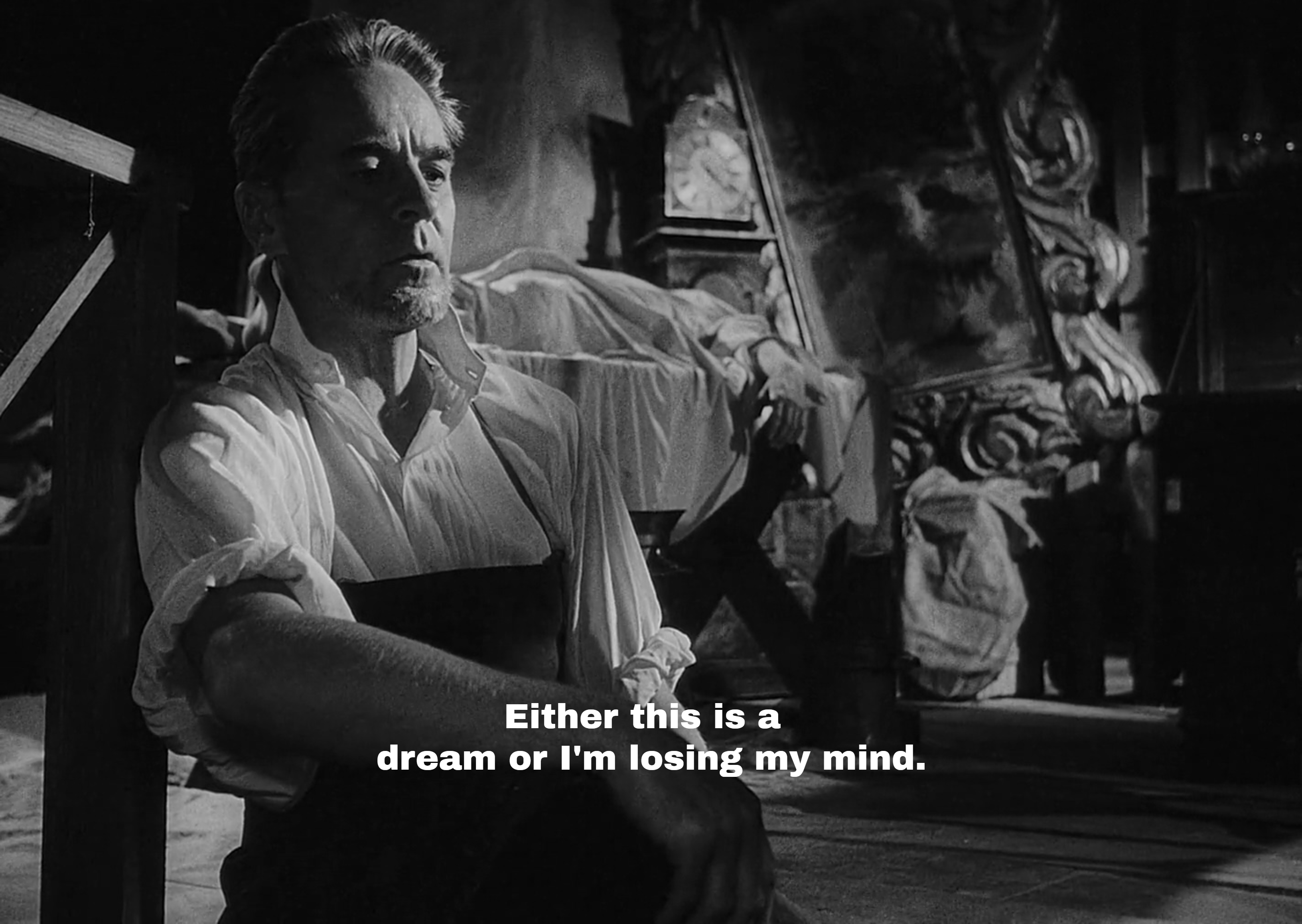
The actor having a mute audience as benefactor, talks and talks, his health gradually declining, his life ebbing away with every word, knowing that Vogler will be fascinated to hear his account with death, but...just as he's about to reveal what death is like...he dies.
Against that backdrop, the troupe continues on to the first village on their way, and are invited by Counsel Egerman (
Erland Josephson) and his wife (Gertrud Fridh), both of whom are believers in the supernatural and are fascinated by the claims of the visitors, to join a party held in their behalf. Also attending—with a bit more "official" interest in the theater troupe—are Police Superintendent Starbeck (Toivo Pawlo) and the Minister of Health, Dr. Vergerus (Gunnar Björnstrand). The officials decide to have an informal bet on whether Vogler's group and abilities are frauds.
Are they frauds? There's room for interpretation: Egerson and his wife—especially the wife—lean towards belief, but Vergerus is a man of science and is disinclined to buy into any sort of mumbo-jumbo, and Starbeck's fall-back is to believe the band—given their reputation—are fraudsters, looking to separate the populace from their Krona. And given the artifice displayed by the players of the theater—Albert and his wife are both heavily made up and not what they appear to be—there's more than enough reason to think that it's all an act, mere illusion and trickery than any sort of mystic power.
One is inclined to say that there's a battle of wits between the troupe and their hosts, but it's no battle, really, merely the troupe being true to their nature as imaginative outsiders and the officials being stuck in their ways of thinking. Even if members of the troupe protest that everything is smoke and mirrors, there will always be that little suspicion with evidence to the contrary that they might not be. The evidence will be equal parts what they see with their eyes and what they feel with their hearts, and even the most pessimistic of the lot can be made to doubt, especially if their beliefs are merely a way to prop up a reputation of confidence.
One line haunts, and feels more true these days than at the time of the film's creation: At one point, the ailing actor makes a point:
Ouch. That hits you right in your superstitions. Or is it maybe the one who tells the truth needs to be put down by all the deceivers, lest they be exposed as such. But, in a world of deceivers what difference would being exposed make, especially if it's status quo?
Bergman offers no answers, just possibilities. The troupe could be fraudsters, but that fallen actor at the beginning comes back to haunt Vogler, something that only he is privy to. That must be evidence, no? But, evidence of what? Who would it convince but only another believer?
 
The Magician leaves the stage making you want more. And its questions haunt long after that point.

Thursday, October 19, 2023

Olde Review: Persona

This was part of a series of reviews of the ASUW Film series back in the '70's. Except for some punctuation, I haven't changed anything from the way it was presented, giving the kid I was back in the '70's a bit of a break. Any stray thoughts and updates I've included with the inevitable asterisked post-scripts.

This is a companion piece to The Fire Within
 
Persona (Ingmar Bergman, 1967) As opposed to the approach Malle takes with The Fire Within, Bergman takes a totally different tack--he lets you know right from the start that Persona is only a movie, not reality at all (and as an ex-projectionist, my sympathy to the fellow who has to show it Saturday night!*). It is another Bergman film dealing with the supernatural. But for Bergman the supernatural does not come from beyond, it exists within us, within our personalities.

An actress
(Liv Ullmann) is admitted to a hospital when she falls silent, unwilling to speak. A nurse (Bibi Anderssonn) is put in charge of the actress' care. For therapy, the two women live at a house on the seaside, and it is at this point that the supernatural forces of the soul take over.
The two women--the nurse, talkative and light; the actress, silent and brooding--begin to resemble each other, to merge psychically, take on each other's characteristics...and I find that I really can't go on with a synopsis of the story. For at this point, what one sees in the film is almost totally subjective. You have to explain what goes on to yourself. I can't do it for you, even if I were to try.**
Bergman can be a light and breezy film-maker as is evident in The Magic Flute and his '50's comedies. But at other times, his films can be claustrophobic and suffocating almost beyond endurance (and I think Bergman realized this in Persona, for at one point he lets up, forgets the story just for a moment, and explodes the creen with fast, fleeting, and irrelevant images***--a filmic explosion to relieve this build-up in tension).
William Bayer in his book "The Great Movies"
**** says this about Persona and its creator, Ingmar Bergman.
"It is not his obscurity that is so frightening about Bergman. It is his intensity. there is such tension in "Persona" that it comes at times to be an almost unbearable experience. One senses a man revealing his anguish at the furthest extremes of cold fire, compelling attention by the blazing sting of total chill. In "Persona," the faces of Liv Ullmann and Bibi Anderssonn are incandescent with this intensity. Their interchange is so intimate that at times we want to avert our eyes." "The Great Movies" (p. 190)

It is all very heavy stuff. And I'm not sure the majority of UW students will be able to understand,be able to deal, with "The Fire Within" and "Persona."

But they are there...as a challenge.
Broadcast on KCMU-FM October 29, 1975 
A little condescending there at the end, I think. Perhaps I should have said I HOPE the majority of UW students would be able to understand or deal with the movies. They're disturbing films, and they resonate more, the older one gets and the closer one gets to the Edge of the Abyss. Perhaps I should have said that. Who knew?
As for what happens in the film: is it an empathy,
a Jungian merging of souls, a familial bond, a lesbian love, possession, a psychic experience? Is it like pet-owners resembling their dogs? Is it the two women influencing each other so much that it becomes impossible to tell where one begins and the other ends?

There's a line from the wonderful Tucker: The Man and his Dream. I've always loved the dialog where Abe Karatz (Martin Landau), Tucker's financier semi-explains why he stays with the visionary auto-maker despite the financial risks: his mother, in her poor English, tried to communicate that you shouldn't get too close to people "or you'll catch their dreams. She meant germs. But she said 'you'll catch their dreams.'"

Maybe it's as simple as that.
 

The view from 2023: Well, good for "the kid." You can tell I'm dancing around it, dispensing possibilities—all that could be legitimate if you're going for metaphors—but, as someone who has "care-taken" since the writing of this, it's seems that Persona's talking about how one can lose oneself in one's charge. Empathy begats symptoms. There are support groups for those taking care of Alzheimer's patients who can succumb to depression. It happens. And then there's always "Student's disease" where you can read about symptoms and go "That sounds familiar..." and begin to think you have the same malady. 

We take on burdens and...and...there's nothing further to say...we "take them on." The concerns of the person we care for or about become our concerns...and we change accordingly. We sacrifice a bit of ourselves for what we care for.

Or...it could be possession. Your viewing is as good as mine.

* That joke's a little "inside"
** It sounds like a cop-out (in the language of that day), but it really isn't--Persona is such a personal film, that one's life-experiences, even one's fleeting subconscious thoughts, will influence what one sees in Persona: is it an empathy, a merging of souls, a familial bond, a lesbian love, a psychic experience? Quite literally, your guess is as good as mine. Bergman could have come out and said something preposterous like "this is based on the Norwegian folk-tale of the two sea-nymphs who become one with nature--of warring clans who find that they have more in common with what separates them, and when you attempt to care for a tyger, you become the tyger!," but what fun would that be? We all bring something unique to the table. Isn't that what a smorgasbord is all about?

*** Irrelevent? I actually doubt that, now. Film is edited together for a reason.

**** Sadly out of print, and not to be confused with Roger Ebert's series of collected essays. I can't even find it mentioned at Amazon.com
.

Tuesday, August 16, 2016

An Enemy of the People

An Enemy of the People (George Shaefer, 1978) An oddity in the career of Terence Steven "Steve" McQueen. For years the "King of Cool" and a favorite action star, at some point he felt that he wasn't being taken seriously as an actor. McQueen, in his slow-burning way, dominated the screen, even when appearing with an attention-magnet like Dustin Hoffman (Papillon). But, there are times when scripts coming across the desk begin to take on a familiarity and staleness that can make any actor dissatisfied. 

At the time, McQueen had finished a lucrative starring role in Irwin Allen's The Towering Inferno, and he began to set his sights a little higher. Perhaps it was his marriage to Ali MacGraw, or perhaps his age that might have made action parts a bit more risky and feel less authentic, but whatever it was, McQueen used his star clout to have produced this adaptation (by Arthur Miller, no less, based on his 1950's version written during the McCarthy era) of Henrik Ibsen's play, short on action but featuring McQueen in very much the "rebel" role. But unlike any he had played before.

Dr. Thomas Stockmann (McQueen) and his wife Katherine (Bibi Andersson) host a dinner party for the Mayor of the town, who happens to be his brother Peter (Charles Durning) and Hovstad (Michael Cristofer), editor of the town paper, The People's Messenger. Although it's a social occasion, everyone has an agenda. Mayor Peter wants Thomas to not support the rumor going around town about the town baths being contaminated even though he is the Kirsten Springs Municipal Baths chief medical officer. Thomas is having the water tested as he feels the health of the town is his responsibility, whatever impact it may have on the town's economy, which is dependent on the popular attraction remaining in operation. During dinner, Stockmann receives a post showing that the suspicions are correct—the baths are a health risk and should be shut down, pending an investigation. The editor is excited to print the news in his latest edition. The Mayor, Stockmann's brother, is not pleased.
The next day, it is all excitement. Stockmann is visited by the editor and publisher of the Messenger, who pledge their paper's support with extensive coverage and even more investigation as to how the location for the Baths allowed it to be taking in polluted water from a local tannery. They want to expose the corruption of the government system. And, as if on cue, the Mayor pays a visit on his brother. He tells Stockmann that if he pursues his investigations, he will bring about the ruin of the town for the sake of his own self-righteousness, and that he will do everything in his power to stop him, even if it involves his family. He is, after all, the one who got him the position on the board in the first place.
Stockmann is adamant, however, and will do the right thing for the sake of the community. How much good will it do the people to be poisoned by the health baths—what will that do to the economy? But, he is surprised that, when he pays a visit to the offices of the Messenger, that the editor and publisher (Richard Dysart) are now suddenly reluctant to report the doctor's findings, and in fact, will be running an article by the Mayor trumpeting the safety of the Baths and emphasizing their importance to the economy of the town. Undeterred, Stockmann decides to hold a public meeting at which he'll personally give his report and inform the citizenry that for their own good, the Baths must be shut down.

Public meetings always go so well.

But then this was fifty years before the phrase was coined "no good deed goes unpunished." 
Ibsen's play is extraordinarily contemporary, with its theme of the whistle-blower going up against "the system," that "system" being implacable and turning on them before you can say "As you know, Amity means friendship," and the steadfastness of allies when they're only tangentially involved without self-interest. The fidelity of the press to the truth is far too often based on its profit margins and who's in charge of that newspaper. The people's right to know is outweighed by their right to stay in business. Or be allowed "access." We can argue all day about the efficacy of that term "rights," but the individual interpretation of them extends to how far one's own rights are interfered with. No matter who thinks that doesn't apply to them.
Ibsen was ahead of his time in his cynicism. Not only in his doubts about institutions like government, business, and the press, as here, but also in people, singularly and collectively. All of the individuals in "An Enemy of the People" act in their own self-interest, even Stockmann, whose idealism masks an arrogant and naive hubris. He thinks he can turn things around by merely being right about his suspicions and is equally guilty of "stonewalling" as his brother and the publisher.
But Ibsen's harshest criticism is for "the wisdom of the tribe," or (to put it less kindly) "mob rule." As Winston Churchill put it "democracy is the worst form of government...except for all the others." As Lincoln put it "you can fool some of the people all of the time and all of the people some of the time" and that foolishness comes in waves of rumor and gossip and superstition and greedy self-interest (and "fad" diets, don't forget "fad" diets). If, every election cycle, democracy shows America at its best, it also shows it at its most cretinous—even "loon" candidates get support...for whatever unfathomable reason. "The mob" just can't be trusted to make the right decision at the right time, especially when the information it's being fed is biased and self-interested, the very definition of any candidate.
Ibsen had been stung by the reaction of his previous play, "Ghosts" and his answer to that criticism (and his reflection on his position in the controversy), "An Enemy of the People" was a stepping-stone to his condemnation of idealism in his next play "The Wild Duck." As he wrote to his publisher, he didn't know if "An Enemy of the People" was a comedy or a drama. In its time, it was at least better received than "Ghosts."
The same cannot be said in the time of McQueen. Even though two competing films were made of Ibsen's "The Doll House" in 1973 (one starring Jane Fonda and the other Claire Bloom), "mob rule" played its own hand in the distribution of this film. It was filmed in August of 1976, but was not released until late 1978 and even then in only two key cities for awards-consideration. Despite an ad campaign from Warner Brothers emphasizing McQueen and his role in it, the movie went virtually unreleased throughout the rest of the country. It was not released to home video until 2009, twenty-nine years after the actor's death.

Friday, April 1, 2016

The Lost Bergman

There have been many "lost" films, never completed or abandoned mid-filming: Josef von Sternberg's version of I, Claudius or Terry Gilliam's The Man Who Killed Don Quixote. Every so often, there's news of a Stanley Kubrick script that's surfaced—haven't heard about the "Napoleon" mini-series based on his post-2001 research, or the Jim Thompson-scripted "Lunatic At Large" for awhile.

But, the oddest of the "lost" films of famed directors was the comedy begun by director Ingmar Bergman. Feeling he needed to lighten up after an intense period of experimentation, Bergman responded to a fan letter from his country's greatest star, Greta Garbo, who told him that she might consider coming out of her self-imposed exile from the screen to work with him. Bergman was enthusiastic, and was initially hoping that Garbo might consider a psychological drama of a grandmother more in touch with her grandchildren than her daughter and the fracturing of the traditional family prevalent in Sweden.

Garbo, for whatever reason—whether playing a grandmother (she was 63 at the time) or not relishing the thought of Bergman's intense scrutinizing after so long away from the screen—suggested a comedy, not unlike the breaking of perceptions she enjoyed from making something lighter, like Ninotchka.


Bergman was charmed by the idea and began work on a comedy centered around a retreat for teenagers (on the island of Gotland Lans in a quiet resort by the city of Visby) and their rebellious natures, especially in regards to the couple running the area (played by Bibi Andersson and Nils Poppe), who vainly try to keep things under control, even while their marriage is coming apart at the seams.  A rivalry between a rival summer camp (run by Liv Ullmann and Max von Sydow) camps in an end of Summer sports-and-skills competition forms the nexus of the plot. As the couples are having affairs with their distaff camp rivals, the inter-camp competition gets wrapped up in the personal lives of their over-seers in chaotic and vindictive ways.


Poppe's counselor is particularly put upon, because he has a bad relationship with the camp's athletic director (Garbo), who regularly takes advantage of his frequent naps to kidnap him and place him in precarious positions—waking up in the middle of a lake with a paddle-less canoe, or behind the archery targets, or on the roof above the kitchen, face next to the fan-funnel. Garbo's relationship with the kids is like the dark side of Maria with the vonTrapp's in Sound of Music (something Bergman is well aware of—at one point, Maria grabs a guitar during a sing-along and breaks it across a log and throws a ukulele in a camp-fire). And Poppe's frequent disappearances—which aid Andersson's indiscretions—are regularly carried out by the kid-campers under Garbo's directions.


Garbo's athletic director is a dark figure, perpetually dressed in black despite the summer weather. Whether this was a choice by the star or the director is a matter of some controversy (it does make an interesting contrast with the immaculately-dressed children) but Bergman, who already was using call-backs poking at Smiles of a Summer Night, decided to go one better. The Garbo character has visions and hallucinations, and in one—filmed in rather pointless color—plays badminton with Death (Bengt Ekerot, who played the role in The Seventh Seal). Bergman does more cross-cutting in this sequence than three of his other films combined, but ultimately Garbo's character hits the "birdie" out of bounds. The face of Death fills the frame: "Jag har alltid vinner," he intones. ("I always win").


Garbo cracks him over the head with a badminton racket.


The film culminates in the inter-camp competition where despite Garbo's encouragement (at one point her pep talk has the entire camp chanting "Det bara spelar ingen roll!"), they fall way behind until the värmlandskorv-eating contest, which puts them over the top to the somewhat-joyless commendations of the adults, still preoccupied with their own issues, wondering how it will affect their personal relationships at the other camp.

Satisfied with the results, Bergman pushed through with the post-production, and prepared for a robust reception to his first real comedy at select screenings.


There was only one problem.

It wasn't funny.

Preview audiences in Stockholm sat stony-faced, with not even the hint of an encouraging chuckle. Kind witnesses offered that the patrons might have thought this was a serious Bergman film and so refused to laugh and, instead, regarded it studiously. But, when asked if they found it amusing, preview cards said "No." "I don't know what this is," said one remark "Is there a book I can read?" A confused indifference settled over the film. Yes, it was a work-print with no soundtrack (nor would there ever be) and Bergman worked for weeks thinking some editing tweaks might improve the comic timing (and there were rumors Jerry Lewis was hired as a consultant*). It didn't, and instead, merely shortened the film more and more.  The director began to bitterly refer to the still-untitled film as "Persona Non Greta." 

Bergman finally abandoned it, not sure what to do with it, letting the film languish and ultimately burning it during a particularly stringent winter. Not a frame of the film survives. 
Garbo, who had returned to New York after filming, resumed her retirement from films, vowing "never to do THAT again."

But, as will often happen, the unrealized project did not completely disappear, as a rough translation, with essentially the same plot, still made the rounds of the studio script mills without much interest until the Canadian Film Development Corporation acquired it for a vehicle for up-and-coming SNL performer Bill Murray. The resulting non-Swedish film was released in the US by Paramount in 1979.


* In his desperation for a solution, Bergman wired Garbo to ask for suggestions on how to make it more funny. "Put in some clowns," she wrote back."There ought to be clowns." Plans for a re-shoot were scuttled with a cease-and desist order from Federico Fellini. 

Saturday, September 5, 2015

Olde Review: The Seventh Seal

This was part of a series of reviews of the ASUW Film series back in the '70's. Except for some punctuation, I haven't changed anything from the way it was presented, giving the snarky, clueless kid I was back in the '70's a break. Any stray thoughts and updates I've included with the inevitable asterisked post-scripts.

The Seventh Seal aka "Det Sjunde inseglet" (Ingmar Bergman, 1957)

An odd combination of films await those in
130 Kane this Saturday night: Ingmar Bergman's The Seventh Seal and Ken Russell's The Devils.

For those of you whose only experience with
Ingmar Bergman is his wildly splintered and heavy film Persona from last quarter's ASUW series, The Seventh Seal will seem to be made by another man. At this time, Bergman wasn't so experimental, so strange. He was, as he is now, alive and vibrant with the charm of film-making and his '50's films (The Magician, Wild Strawberries, Through a Glass Darkly) although dealing with "heavy" subjects of God and Death and self still possessed a lightness in the telling, a lightness that carried over from his beginnings in films and was lost in the dark broodings of his late '50's and '60's films. There was a time for comedy, and time for deep-think in the space of the best Ingmar Bergman films.

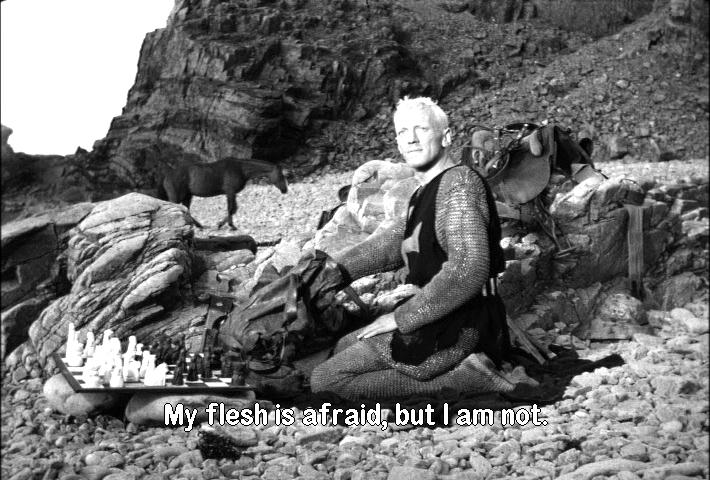
There are many characters in The Seventh Seal, but at the film's hub are two. The most important is The Knight, who is played Max von Sydow, the supreme brooding actor. The Knight is home from the religious wars where the quest for God has been fruitless—where the point of the quest, after the year's ox-killing has been lost. But the quest for God continues. It has to. God can't be in the war, but can he be found outside amidst plague, witch-burnings and ignorance?
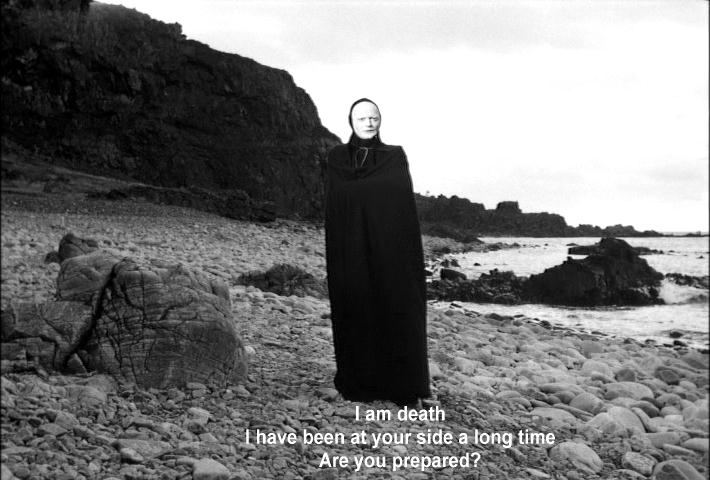
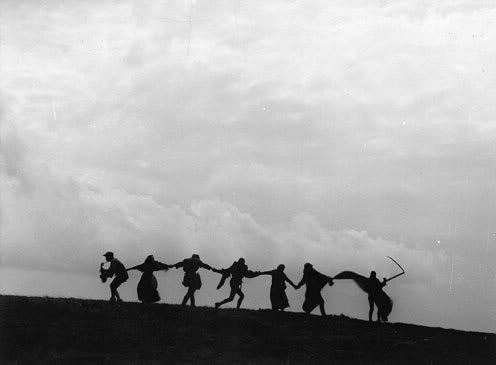
The answers are hard to come by, and even harder to come by while being pursued by another hold-over from the wars, the second most important character being Death. Death pursues the Knight and they engage in continuing battles of wits and of chess. The two opponents are only the hub of the story. There are others: the Knight's man-servant whose musings are concerned more with life that what is beyond; a troupe of actors; a wood-cutter and his adulterous wife. Bergman combines them all in a film that wheels between light and heavy in tone, but always excellent in quality.

Broadcast on KCMU-FM on January 8th, 1976 

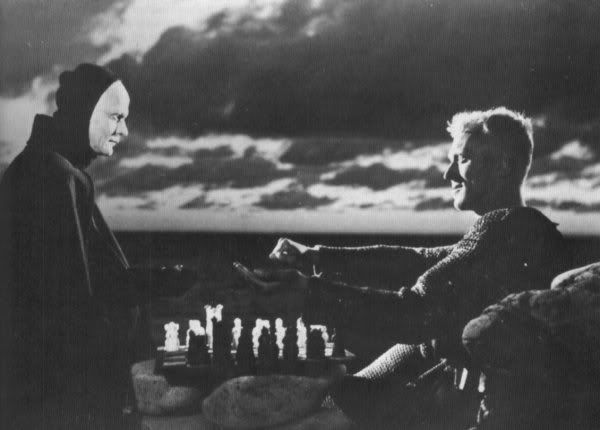
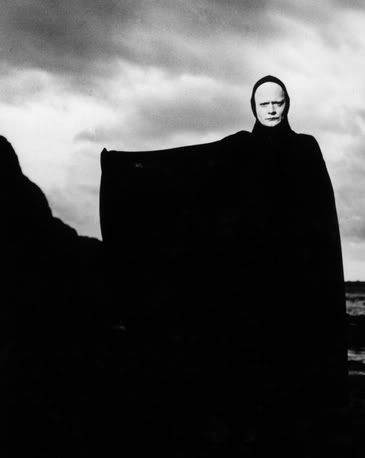
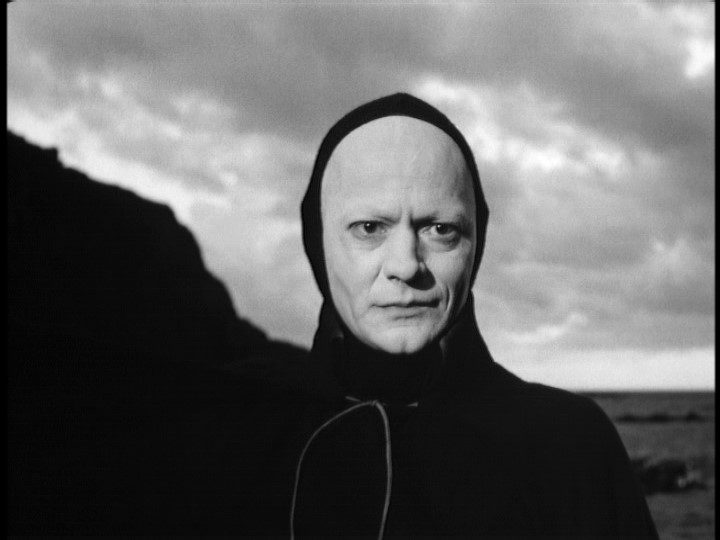
Sounds like I ran out of time there at the end--I usually only had two or three minutes per film to talk. So, I didn't even mention the stark black-and-white photography that has become so iconic, along with Bergman's simple personification of Death--an actor dressed entirely in a black cassock, with just his face appearing...in sharp contrast. And the image of The Knight playing chess with Death has been copied, parodied, purloined and done...well, to death. In Bill and Ted's Bogus Journey, they played "Battleship."

It sounds bleak, and it is—it is the Plague-Years, after all. But the film ends with a touch of hope and sacrifice, that even after all the Knight has seen—and not seen, as in the form of God—he can still cling to ideals. 
One last thought inspired by the film after a recent viewing (again): Is religion a balm for the weak and superstitious as so many think, or is faith an act of bravery in a world of tangible horror? If God has an answer, he's not telling. Wise.