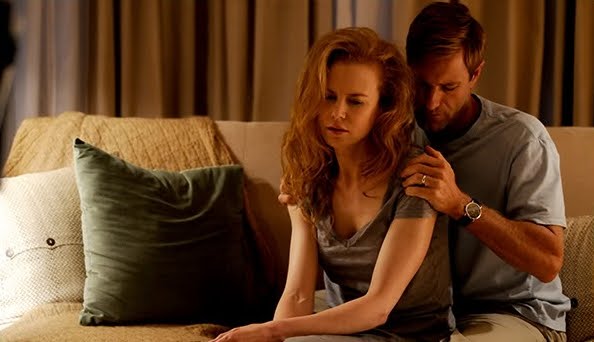
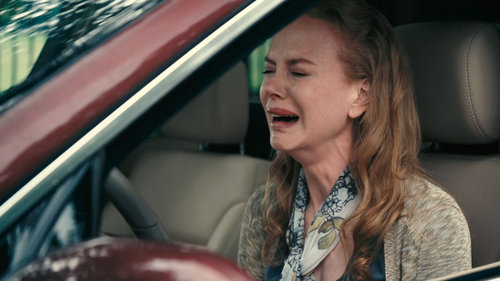
'Becca (Nicole Kidman) is going through the motions. She's doing everything expected of her and dutifully. The planting of new flowers in the garden, the making of stringent recipes of comfort food, the grief support group. All those motherly instincts and nothing to mother, and everything—absolutely everything—reminds her of the void in her life. Her child is dead, a victim of a car-pedestrian accident. Her sister (Tammy Blanchard) is pregnant, her mother (Dianne Wiest) keeps bringing up her own dead child—Becca's brother, friends with kids avoid her as if death were communicable, the flowers get crushed, the pans go empty. Life goes on, horribly.
Husband Howie (Aaron Eckhart, all clenched jaw and knotted body language) can't let go, sitting up every night endlessly watching a phone-video of little DannyThis frustrates 'Becca. So do the "professional wallowers" of the support group. She's avoiding grief, while Howie and the others are embracing it, and both sides are going too farShe starts to find ways of relieving herself of Danny's things, each one precious to Howie. They start to splinter, the pressures of the void hammering them from both sides.
Audiences have been avoidingRabbit hole like those parents avoid Becca, the subject matter presuming to be a downer. More's the pity as there is enough humor in the cracks of the angst to make it worth seeing and nod appreciatively at the simulations of life and death and the grief that comes between. Director John Cameron Mitchellstays out of the way, mostly, merely observing the struggles from sympathetic angles, while not making a big thing of the POV—making him a far subtler director than, say,Tom HooperofThe King's Speech. The performances are pitch-perfect along the scale of emotional expression, from buried thought to screaming match, with Kidman sublimating technique for organic feeling to Wiest's haunted portrait of mother love. You pull for these people as they learn to live with death, even if they only get a "C" average.
It would be unfair to say too much of the plot other than the set-up, but it touches briefly on comics and concepts of parallel universes and alternate realities—an alternate form of Heaven and the possibility that somehow, somewhere, things are different and that the cosmic dice might roll a different way. Possibilities erode the concept of the concrete reality, and sometimes the best way out of a trap is to imagine the way out, rather than accept that there isn't.
A downer? Maybe. But I found something heartening in a film that suggests that the only way to fill the void of death is with larger doses of life. And that the holes those voids leave can only be healed—not so much in reality—but, in another dimension, the warrens of our soul.
The Good Earth(Sidney Franklin, Victor Fleming, George W. Hill, Sam Wood and Gustav Machatý, 1936) This is a film (as Leonard Maltin would say) "very much of its time"—Hollywood critical code for saying that if it was made this way today it would be picketed and protested and denounced on the Senate floor (well, maybe not the last one). So, let's just get it out of the way. There's a lot of racism in The Good Earth, from the casting of Paul Muni*and Luise Rainer (and many of the principals, including Walter Connolly and...Charley Grapewin?!), all Caucasians, as Asians,**which is unfortunate, the music is Hong-Kong china-gong cliche-ridden, the pigeon-English of the screenplay insulting. Absolutely true.
Give them points for trying in bloody 1936, though. The original plan for the film, as envisioned by author Pearl Buck and M-G-M honcho Irving Thalberg was to create an all-Chinese film, but studio pressure for "better profits with bigger stars" from M-G-M head Louis B. Mayer (who didn't want to make the film, whether it was profitable or not) compromised the plan—Paul Muni was cast as farmer Wang Lung. And, because of anti-miscegenation language built into the Hays Code, as Wang was being played by a white guy, a Chinese actress could therefore not be cast as Mrs. Wang. So the part went to Luise Rainer, who had won the Oscar for Best Actress for "The Great Ziegfeld."***
Original director George W. Hill traveled to China to film location footage that was supplemented by California locations and sets. Hill died before principal photography could take place and Sidney Franklin was hired as director—but as, with other big M-G-M productions, other directors stepped in for some sequences, including the ubiquitous Victor Fleming (of Gone with the Wind and The Wizard of Oz fame), and Sam Wood, who directed the genuinely frightening scenes of the looting at The Great House. This one tears the "auteur" theory to shreds as it was, very much, a Producer's picture. Thalberg (fictionalized in "The Last Tycoon" by F. Scott Fitzgerald), oversaw the whole thing, picking directors from his stable of them to maximize the thrill of specific sequences to enhance the spectacle of his "prestige" picture, and despite the clashing styles, the thing seems to work rather seamlessly.
Beyond the piece-meal approach and industrial racism, though, The Good Earth is frequently thrilling with production value and subtle in its politics. In it, we see a lower-caste family go through the travails of living off the soil. When The Good Earth turns against them and a drought threatens the family, they're forced to movie "to the city" to look for work. Glossy this production may be, but it doesn't turn a blind eye to tragedy, with surprisingly dire consequences for the family. Their fortunes turn—through theft—and they prosper, but that good fortune corrupts, distancing the family from the community. Only when the future is threatened with a devastating invasion (and it literally looks like it) of locusts—through a combination of M-G-M effects wizardry and micro-photography—does the village, now a small city, band together and defeat a Nature they can beat back with sticks and fire.
As I stated, the film is worrisome for its attempts at political correctness and political duplicity at the expense of caricature and wrong-headed casting, but it does deliver an unblinking look at the havoc that can be wrought on people caught between the gales of Nature and their own natures. Rainer is fairly luminous throughout, and it is particularly heart-warming to see Keye Luke, whom I'd only known as an old man, young and strapping as the best educated (and thus least respected) of the farmer's sons.
The Good Earth should be seen in the spirit of "The Big Epic" (with all the frothing, high dudgeon and drama inherent in such enterprises). It is best, flaws known and forgiven...if not ignored.
* I'm as Chinese as Herbert Hoover" was Muni's retort to his suggested casting.
** And, look, as sure as Anthony Quinn was Arabian, you can bet that box-office potential wins out over authenticity every day. Only a couple of years ago, there was a furor that Chinese actress Zang Ziyi was cast in the lead ofMemoirs of a Geisha. Of course, authenticity and cultural sensitivity should be the basis of casting (along with such minor considerations as talent and ability to pull off the role...), but...Zhang Ziyi? If you could land her for a movie...wouldn't you?
*** Rainer at this writing is alive and well and celebrated her 100th birthday January 10th, 2010. She won back-to-back Oscars in 1935 and 1936, which she stated was "the worst possible thing" for her career. She has mostly stayed out of the lime-light, but occasionally does acting jobs that have struck her fancy--like a dual-role on "The Love Boat," in 1983.
The Sea of Grass(Elia Kazan, 1943) It's Kazan's third feature as a director, playing in Louis B. Mayer's sandbox (literally—the film is shot in-studio at M-G-M, making use of stock-footage of rolling fields already in the can, with some location back-projection), and the founding member of The Actor's Studio has a cast of anybody but—Spencer Tracy and Katherine Hepburn (in their third film together), Melvyn Douglas, Harry Carey Sr. and Edgar Buchanan, all pro movie actors who'd already figured out the best way to project on film, without having to rely on sense-memory for it.
Kazan hated this film and discouraged anybody who'd listen from seeing it. But, despite its soap-ish tendencies as a romance, it has an underlying ecological message. Colonel Jim Brewton (Tracy) is a very well-landed cattle baron and resists any efforts by the "guv'mint" towards granting homesteading rights or development on the open range. For him, its a matter of keeping it unspoiled. "God's work," as he calls it. That's his purpose, but he's a might surly, mulish and uncommunicative. Along comes city-girl Lutie (Hepburn) into his life, and he bends slightly, like the trees she insists be planted at the entrance to their estate, as they sway in the harsh prairie winds. He'll bend with a "wait-and-see" attitude, as in "Wait—you'll see." He yields to Lutie on her friends's homesteading near his property. But, a clash is inevitable. "Fences are a curse word in these parts, he informs her.
There are other complications. She's a city girl on the prairie and distances between people are daunting. Then, there's the town lawyer, Chamberlain (Douglas) who has two strikes against him in Brewton's suspicious eyes—he wants the land open to homesteading, and he has his own eyes for Lutie, waiting to pounce whenever there's a crack in the Brewton marriage, which is inevitable. What his motivations are in both areas are suspect—Brewton Chamberlain are bitter enemies, politically and socially. Chamberlain just might be making the fight personal and can't help himself. With both the open fields and Lutie, he can't leave well enough alone.
The rise in Chamberlain's political career (becoming a judge in the district) dooms Brewton's ecological dreams, and soon the prairie becomes home to sod-busters, dependent on weather for their success, and when the rains stop, the crops fail and the farmers leave, the countryside becoming a barren dust-bowl. It's a hollow, dry victory for Brewton—he's proven right (which no one will admit) and the land goes to waste. And, in the meantime, Lutie has left, leaving Brewton and cook Jeff (Buchanan) to raise the kids: loyal but neglected Sara Beth (Phyllis Thaxter), and black sheep son Brock (Robert Walker), who it is more than suggested may be Chambelain's child.
One can see why Kazan, Tracy and Hepburn were attracted to the material. The ecology theme (even if espoused by a bull-headed "protect-what's-mine" cattle rancher) should have been close to the sod of anybody who'd come out of the depression, and the "unbranded scarlet letter" theme must have been attractive to Hepburn who enjoyed tilting at societal windmills. At this point, Tracy and Hepburn knew each other's tricks on-set. And it's interesting to see that their personal back-and-forth's in this film are much the same as they are in Guess Who's Coming to Dinner decades later. She's adoringly passive with a steel spine, and he's remote until his face collapses with emotion. Kazan would come out of this film feeling compromised—and, indeed, this film about the vastness of open land and the prairie feels like it was filmed inside a glass ball—and would explore other ways to make movies, as opposed to being stuck on the sound-stage. He'd start insisting on location work and even filming with a documentarian's eye. His search for authenticity in artifice could not be held behind stage-doors and artificial light.
I'd thought I'd re-posted all my "Don't Make a Scene" features from the olde site, but apparently I forgot one—and there was a good reason why: it was a special Valentine's Day edition. And it's still February! You have to take lucky breaks where you get them.
The Story: In the movies, in romantic comedies or romantic dramas, it's called "The Meet Cute." The two potential paramours collide...sometimes literally...into each other's orbits, and circle around each other, as if they were heavenly bodies caught in each other's gravity fields. They wobble, they parry, they dance...frequently against their will, and most often to one of their's frustration. But, they can't get free of each other; a screenwriter's contrivances are stronger than anything Einstein could come up with.
Here is one of the best, the "Meet Cute" of paleontologist David Huxley (Cary Grant) with Susan Vance (Katharine Hepburn) in Bringing Up Baby. He's buttoned down, conservative, neat, tidy (and probably brave, clean and reverent), concerned with dead things for a living and in need of growing up. Fly-by-night Susan Vance is his exact opposite: where he's studied, she's instinctual; he's deferential, she's aggressive; he's methodical, she's scatter-shot; he's a "details" guy, she's a generalist. Well, to get back to science, opposites attract...even if it's only trouble.
They complement each other, but their attraction seems to disrupt the Universe. Disaster follows in their wake, which David cannot stand, much less fathom. It makes him crazy, frustrating him, and driving him to distraction. Constraints are broken down by Susan's anarchy and pretty soon he can't help but be in love. It's only logical—what in the hell would he been doing spending all this time with this girl if he wasn't.
Good thing, too. The order of his life—his work, his career, his impending wedding—is pretty neat and tidy, and in desperate need of being shaken up; Susan is his tornado. The two of them together resembles something of the real world, messy and chaotic but copable. More than that, Life is what happens when you're busy making other plans—Susan is the anarchic Life-force that disrupts David's lock-step march with Order and Death.
But, of course, this is all sub-text in the details. The story is an old one. Boy Meets Girl. Boy Loses Mind.
And Heart.
♥Happy Valentine's Day♥
(Okay...6 days late!)
The Set-Up: On the day before his wedding to his colleague Miss Swallow, David Huxley (Cary Grant) is attempting to secure a million dollar donation for his dinosaur museum, playing golf with his potential benefactor's lawyer, a Mr. Peabody. Right off the tee, David has hooked his ball. And Susan Vance (Katharine Hepburn) has taken it and is about to play with it...so to speak.
Action!
DAVID HUXLEY: Oh, look. Loo..k..
DAVID: Hey that's my ball! Just a minute!
DAVID: Uh, say... SUSAN VANCE: Well, here's hoping... DAVID: I say! Just a minute, I beg your pardon...eh... SUSAN swings and hits.
DAVID: Oh dear...
SUSAN: You shouldn't do that, y'know...
DAVID: But tha...What shouldn't I do?
SUSAN: Talk while someone's shooting. DAVID: Yes, but that was my ball y... SUSAN: Well, anyway, I forgive you, 'cuz I got a good shot. DAVID: But, you don't understand... SUSAN walks off, DAVID following.
SUSAN: See? There it is, right next to the pin.
DAVID: But...that has nothing to do with it...
SUSAN: Oh, are you playing through?
DAVID: No, I've just driven off the first tee...
SUSAN: (laughs) I see you're a stranger here. You should be over there. This is the 18th fairway and I'm right on the green.
DAVID: Yes, but...
SUSAN: If I sink this putt, I'm going to beat my record.
DAVID: (To Peabody, waiting on the first fairway) I'll be with you in a minute!!
DAVID: What kind of ball are you playing? SUSAN: PGA. DAVID: Well, I'm playing a Crowflight. SUSAN: Hmm. I like the PGA better.
DAVID: I'm just trying to explain to you that you're playing my ball. You see, A PGA has two black dots and a Crowflight has a circle... SUSAN: Mm-hmm. DAVID: Y..y.. SUSAN: I'm not superstitious about things like that... DAVID: Oh, but that doesn't have anything to do with i... SUSAN: Stop talking for a minute, would you please...
SUSAN: Would you take out the pin? DAVID: But...
DAVID: Oh my, this is so silly, I never saw such... SUSAN: Ha!
DAVID: There, you see? It's a circle. SUSAN: Well, now, of course it is. Do you think it would roll if it was square? DAVID: No, I have reference to a mark on the ball. SUSAN: Oh no, I was merely being silly... DAVID: That proves it's a Crowflight. SUSAN: What does it matter? It's only a game, anyway.
DAVID: Well, my dear young lady, you don't seem to realize that you've placed me in a m...very embarrassing position. SUSAN: Oh really? I'm sorry... DAVID: The most important corporation lawyer in New York is waiting for me over on the first fairway. SUSAN: Then it's silly of you to be fooling around on the eighteenth green. DAVID: Uh..y..y..you don't mind if I take this with me? SUSAN: No! Not at all! Tell the caddy-master to put it in my bag when you're finished.
PEABODY: Huxley!
PEABODY: Huxley! Come on!
DAVID: Oh, yes! I'll be with you in a minute, Mr. Peabody!
SUSAN is blocked in the parking lot and attempts to get out by slamming into the car in front.
CADDY: Hey, Mister. I think that's your car!
DAVID: Hey! Hey! Oh...
DAVID: I'll be with you in a minute, Mr. Peabody!
DAVID: Hey!
DAVID: Hey! Hey! What do you think you're doing? SUSAN: I'm trying to unpark my car!
SUSAN: Oh! Hello! DAVID: This is MY car! SUSAN: Oh, good, would you mind moving it out of the way? DAVID: No! No! This is MY CAR! SUSAN: Yes, I understand that! If you'd move it back about four feet, well, maybe I'll be able to get out! DAVID: Well, I'm afraid you made a mistake. THIS is your... SUSAN revs the engine. DAVID: Wait! What did you say?
SUSAN: I said if you move it back about four feet, I'll be able to get out. I'm in a terrible hurry and I can't budge. DAVID: Oh, you want me to move YOUR car... SUSAN: Would you mind terribly? DAVID: Well, yes I will, but I... SUSAN: Oh, that would be awfully kind of you. DAVID: Well, take it easy with that car.. SUSAN: Yes, I'll go slowly. SUSAN accelerates in reverse and crumples a bumper on the tree.
DAVID: No..what...
DAVID: What are you doing?
SUSAN: Well, I..I have to get into position.
DAVID: Well, please be CAREFUL! SUSAN: I will. DAVID starts her car.
SUSAN: Now, you say "when." DAVID: Alright. SUSAN: Am I clear? DAVID: Yes, you're clear now. SUSAN: Clear? DAVID: Yes...
SUSAN accelerates into the car in front of her. DAVID: Oh!
DAVID: Now look what you've done!
SUSAN: Oh, that's alright, I'm insured.
DAVID: Well, I don't care whether YOU'RE insured or not!
DAVID: Look! Let me drive this car. SUSAN: Oh, it's alright, it's an old wreck, anyway. Doesn't matter... DAVID: Well, you..you don't understand! This is MY CAR! SUSAN: You mean THIS is YOUR CAR? DAVID: Of course! SUSAN: YOUR golf ball. YOUR car. Is there anything in the world that doesn't belong to you?
DAVID: Yes, thank heaven...YOU!!
SUSAN: Now, don't lose your temper. DAVID: Well, uh...
DAVID: My dear young lady, I am not losing my temper. I am merely trying to play some golf! SUSAN: Well, you choose the funniest places. This is a parking lot!
DAVID: Will you get out of my car? SUSAN: Will you get off my running board? DAVID: This is MY running board!
SUSAN: Alright, honey, stay there, then! SUSAN starts to pull out, with DAVID being carried away, clinging to the car, protesting the entire way.
DAVID: Oh! Oh! Oh!
SUSAN: Oh, you think everything belongs to you, this is my car....
SUSAN: If you want to come with me, you're more than...






_04.jpg)