Saturday, January 30, 2021

The Big Sleep (1978)

Saturday is usually "Take Out the Trash" Day...

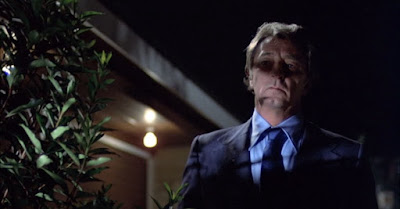
The Big Sleep (Michael Winner, 1978) You already know that it's going to be a bit problematic with the very first shot of this adaptation. This later version of Raymond Chandler's first detective novel—cobbled together from elements of his short stories and published in 1939—starts right where the novel starts—with detective Philip Marlowe (played, as in 1975's Farewell, My Lovely, by Robert Mitchum) driving up to the Sternwood Estate for an interview to taking a job. 

The thing is he's driving on the wrong side of the road. That's a clue. When you've been over-stewed in Chandler pot-boilers about L.A.'s most geographically-associated gumshoe that sort of thing stands out like the proverbial tarantula on angel food. He's not in Los Angeles, where they drive on the right (that is "non-left") side of the road, he's in London, held over from The War, it seems, and he's driving a Mercedes. Already you feel that something is very wrong, even before he does his interview. It's not your Grandfather's Philip Marlowe.
The interview with Sternwood (James Stewart) goes well, as far as it goes. The General is being blackmailed—it's not the first time—and his son-in-law Rusty Regan usually handled such things one way or another. But, Rusty has disappeared. There are rumors, but just that. Marlowe has been recommended by Scotland Yard and he accepts the assignment, but not before he's been told about the Sternwood girls, Charlotte (Sarah Miles, Mitchum's co-star in Ryan's Daughter) and Camilla (Candy Clark), who Marlowe has already met ("She tried to sit on my lap...while I was standing up," a line used in the book and both movies. For this version, the names have been changed—from "Vivian" and "Carmen"—to protect the not-so-innocent.
After taking his leave of the General, who has complained of fatigue, he is commanded to the bedroom of Charlotte, who demands to know what Marlowe has been hired for—possibly to find her missing husband? Marlowe says it's the general's business and none of hers, and she leaves unsatisfied and unimpressed.
Marlowe's first stop is to the bookstore of H. R. Geiger, whose name is on the notes. By subterfuge, he concludes that the shop is not a book store, per se, but rather a front for a pornography distributor. He has a bit of disagreement with the shop's receptionist, Agnes (Joan Collins), who develops an instant dislike to Marlowe's pestering.
Marlowe stakes out Geiger's flat and sees lights flashing inside. The last flash, though, is from a gun-shot and Marlowe breaks in to find much amiss: Camilla, drugged and naked in front of a camera, the film missing, drug paraphernalia  strewn about, and Geiger dead on the floor with a gunshot wound in the forehead. He checks the backway to look for the killer, but has missed him. Camilla is certainly in no shape to have done it, she's high out of her mind, the bar of which is set pretty low to begin with. The best thing to do is throw something on Camilla and get her home, pronto. He'll come back to the house later.
That's after he gets some well-deserved shut-eye; the bags under Mitchum's eyes are starting to look like suitcases. But, he gets called by The Yard (in the person of John Mills) to watch a car being dragged from the water. In it is the Sternwood's chauffeur, dead. A little too close to home, even if your home is a mansion, ain't it? Heading back to his office, Marlowe finds older sister Charlotte waiting for him, still wanting to know what the General has hired him for—no dice, lady—and to tell him they're being blackmailed by somebody else, this time with naked pictures of Camilla...from the previous evening's recreations. Marlowe tells her to pay up and she says she can borrow the money from gambling boss Eddie Mars (Oliver Reed in full hissing snake mode). Hmmm. Isn't there a rumor that Rusty ran off with Mars' wife? Bears investigating.
Well, one can get into the weeds very quickly here, and the movie's only 30 minutes in. There is a famous story about the Howard Hawks-Humphrey Bogart-Lauren Bacall version done in the 40's where there was a body but nobody had any idea who killed him. The writers didn't know. Hawks didn't know. Chandler didn't care—"that's your job" he told the movie-makers. By that time, Hawks didn't care, either. There's a line in both movies "so many guns. So few brains." Well, there are so many corpses that keeping track of them all without a toe-tag is an exercise in fatality. The 1978 version wants everything nice and tidy and explained, whether we care or not. Where, the 1946 version kept that information vague and unresolved, Winner doubles down to explain it with voice-over and a flash-back sequence introduced with a picture-spinning rotation (the edge of the frame threatening to slap us awake). He needn't have bothered.
What this version of The Big Sleep does well is to fill the film with so many good British actors that one gets dizzy remembering them all: Miles, Mills, Reed, Harry Andrews, Collins, Edward Fox (he's good!), Colin Blakely, Richard Todd, James Donald, who are clearly enjoying their versions of American 1940's types. It's just that it's set in the 1970's and the transition makes some of the scenes a little bit campy, like the actors are having too good a time "slumming." But, this one doesn't feel like one of those old B-movie shadow-fests. It's film-noir with the lights on, and one fairly squints from that and volunteering too much information. 
There's no style, just a lot of substance. And although it's a slightly more faithful version of the Chandler novel in the tawdry specifics, thanks to deep-sixing the Hays Code, nothing much is gained—other than the feeling that this would have been really racy in the 1940's, but in the era of buying nudie mags at the 7-11, it's merely people going to too much trouble for little return.
One of my favorite lines from the earlier version is in the scene when Vivian comes to Marlowe's office and gives him the envelope with Carmen's nudes. He takes a look at them and cracks "She takes a good picture..." It's funny and sick and rude and if you didn't know what he was talking about, you'd never know, so far does it fly beneath the censor's radar.

And it's clever, something that Winner's "bleed-by-the-numbers version" never really achieves. Should have known when I first saw the Mercedes driving up the left lane. This movie was going the wrong way.

Friday, January 29, 2021

Haunted Honeymoon (1940)

Haunted Honeymoon
 (aka Busman's Honeymoon) (Arthur B. Woods, Richard Thorpe, 1940) 
During the COVID shutdown I retreated to books rather than online films. This was made problematic when libraries were shut down for the initial blast of lockdown/containment. An e-book reader (which I never really cottoned to) had access/account issues that I was never able to resolve. My brother, however, took pity on me and sent me a CARE package of lots and lots of books, mostly in the "Mystery" genre—lots of Hammett's (I'd never read any of the "Continental Op" stories and now I've read them all), some McDonald's (Ross) and some more contemporary ones that I found intriguing.

Most of them, however, were from the Golden Age of Mystery—the line from "Sleuth" says "when every cabinet minister had a thriller on their nightstand and all detectives were titled." The ones I received were by Dorothy Sayers, a name that was on the back-burner of my mind from browsing at book-stores, but I never entertained reading.

Sayers' most remembered creation is Lord Peter Wimsey—upper-crust, refined, WWI veteran and survivor, a book-collector and frequent "quoter," considered flippant and frivolous, but managed to "fit in" with gentry and commoner alike. He and his loyal butler, Mervyn Bunter, would take on the mantle of amateur sleuths when requested of "The Yard" or when a curious death merely crossed their paths. 

During one of those investigations ("Strong Poison" published 1930), Lord Peter falls in love with the object of his investigation, novelist Harriet Vane, who is accused of murdering her lover with arsenic—during their first meeting in the London dock he asks her to marry him, which she refuses, aghast). Over the course of three novels, Wimsey pursues Harriet, until they are finally marry in "Busman's Honeymoon" published 1937.
But, before that, that last was a stage play of the same title, first performed in December 1936. It is for that reason—the adaptation to another medium along with Sayers' aversion for screen adaptations of her work—that it is the only Wimsey story ever filmed (although television serials have been done subsequently). 

Raymond Chandler (in his essay "The Simple Art of Murder") griped about the story “a murderer who needs that much help from Providence must be in the wrong business.” One sees his point. The elaborate way in which the murder is committed—and recreated—beggars the logical, but one CAN see where it might make for an entertaining experience for a stage audience.
M-G-M acquired the rights to film the play and three screenwriters are credited with it. There is an extensive re-write as fall as dialogue but everything basically follows the original structure...with some shifting of the weight of exposition. The set-up is this: Lord Peter and Harriet get married and having won his intended, Wimsey, in a sentimental gesture, has purchased the estate of "Tallboy's"—"Elizabethan, very pretty," "a huddle of black gables with two piled chimney stacks"—in the village of Paggleham, not far from where Harriet was raised as a child, and the site of many fondly-remembered visits to the Bateson's who lived there at the time. Harriet had once vowed that should she be able to afford it, that she would purchase it one day. That day has come, purchased from a blunt man called Noakes, who says he will arrange that the place will be set up for the honeymooners. After the wedding and reception the now-newly designated Lord and Lady Wimsey set off for their honeymoon...with butler in tow, gingerly minding their crate of port.
Once there, though, they find the place altogether not ready. Vacated, yes. But, there is still a meal on the table (dash it all!) and no keys made available for easy entrance. What has happened to the man Noakes and why are things in such disarray?
That's the novel's perspective, anyway. Haunted Honeymoon gives us a little more back-story. In the book, we never meet Tallboys' present owner, Noakes. But, the movie has an extended scene where we see a great deal of him, and the various squabbles he has with employees, neighbors, and locals acted out (which we receive in the novel from gossipy hear-say in various interrogations, which, in a movie, might have become tiresome and pedantic). The movie cleans up any extended dialog and things bustle and bounce along with charming village quaintness displayed, giving the impression of Wimsey and Harriet understanding the situation with just the merest mention.

In fact, the reveal and denouement occur so quickly that one may suspect that the two have some sort of precognitive power, rather than any method of deduction. It's no wonder Sayers was horrified, thoroughly dis-owned it, and stated that she would never watch it. The idea!
And let's just be chauvinistic about it: Robert Montgomery just isn't suave, sophisticated, or silly enough to be Peter Wimsey. There's no monocle, he's thoroughly Americanized wisenheimer with an attempt at "jolly-good" positivity thrown in, but it's never consistent like the accent (he's like the "thinnest" of "Thin Men")—Constance Cummings fares better with her formal M-G-M elocution-speech-patterns resembling high talk. Seymour Hicks is much, much too old an actor to be playing Bunter—one could hardly believe that he served with Wimsey during The War, and wouldn't just be patted on the back at the recruiting office and told he'd be better doing "civilian service" 'round 'ome.

Still, it's something. Not unlike the Basil Rathbone Sherlock Holmes series that seems like they should be faithful renditions of the source, but simply aren't, merely neutered imitations to satisfy the folks who've never read them and wouldn't know the difference. The thing is, Sayers is just too complicated and methodical a writer to shoe-horn her stuff into a two-hour movie. Better that they were adapted as a mini-series, and a rather leisurely mini-series at that.


Thursday, January 28, 2021

The Midnight Sky

It's Lonely Out in Space...
or 
Our Future...Didn't Quite Turn Out That Way

Barbeau Observatory, located near the Arctic Circle, has been evacuated after a global nuclear catastrophe—everyone wanted to go home for the end. Except for Dr. Augustine Lofthouse (George Clooney). Someone has to stay at the observatory watching the night skies and maybe contacting the space missions still out there. And he's dying anyway. As one of the departing techs observes, given the situation, he'll probably outlive them all.

There is one ship out there that hasn't been evacuated and is still occupied and functioning—the ship Æther, which went out to the orbit of Jupiter to explore K-23, a moon of the gas-planet that seems to be—as they say on "Trek"—"Class M". It can sustain human life. They're supposedly on their way back, but nobody knows that because they've been out of contact for a long time. Augustine has a personal stake in the mission as it was his theoretical work that inspired it, and he's completing his life's work trying to reach them to tell them that it's no longer a reconnaissance trip and to go back. There's nothing to come home to. 
Onboard ship, the crew—"Captain" David Oyelowo, Felicity Jones, Kyle Chandler, Tiffany Boone, and Demian Bichir—have successfully scouted the Jovian moon in question and it hits the "Goldilocks" sweet-spot of conditions: not too cold, not too hot, but "just right." Water is plentiful and vegetation abundant. The orange sky will take some getting used to, but the close proximity to Jupiter has its compensations and abundant landscape photo-ops.
The crew has been out of touch with Earth and that's caused some issues. Astronaut Sully (Jones) thinks there might be a glitch in their system somewhere, but the ship is complicated enough with artificially-generated gravity, supplies, greenhouses, and the like that trying to pin-point a fault would be harder than finding a hospitable planet in the Solar System. Now, on the leg home, they're spending a lot of time being nostalgic for Mother Earth and their families on it. A lot of time being spent in therapeutic holo-suites with family-memories. They don't know that anything is wrong on Earth or that there is nobody on Earth trying to contact them.
Except for Augustine, of course.

Now, the only one at the observatory, Augustine settles into a routine of taking pills, daily hemodialysis, the perfunctory meals (usually taken with scotch). Isolated and alone, he has a lot of time for there to be flash-backs, nightmares and mind-wanderings. So, he can be forgiven if, at breakfast, he finds a half-finished bowl of cereal sitting at the table. Maybe it's the aloneness, maybe it's the drinking, but obviously, the routine has slipped.
But, it's more than he's thinking. Wandering around the station, he finds a little girl (Caoilinn Springall)—curled up, sleeping, hiding. There had been some confusion during the evacuation...and then, this child. Another responsibility, which he is not ready to cope with. At first, he tells the deliberately mute child (whom he finds out is named "Iris") that she's on her own, that he can't handle the work AND take care of her. But, there's nowhere to send her. They are now stuck with each other, and she is now a constant presence ("Don't touch anything!" he frets while he's working "You know, there's no rule that says you have to TOUCH everything."). Eventually, she will be a comfort.
There are complications aboard the Æther: their trajectory from Jupiter is slightly off and they have to weigh whether to do course-correction burn or take a chance going through a route in space that hasn't been properly "mapped-out." Personally, I'd go for the course-correction because any deviancy from "true" will only increase the farther they go, but they vote to do nothing and risk it. How like "Earthlings". Oh, and Sully is pregnant with Captain Adwole's child. Everyone has a suggestion what to name it. Except for that off-kilter trajectory, everything is nominal.
Back on Earth, the atmosphere around Barbeau is becoming increasingly toxic and time is running out, so Augustine decides to travel to a weather station at Lake Hazen with a more powerful antenna in the off-chance that it'll be just enough to reach the Æther. He packs up his supplies, dialysis gear, and does the proper parent-thing of bundling up the girl for a snow-day, and they set off on a snowmobile to reach their destination. 
At the Ã†ther, there is another problem: a hitherto unknown cluster of ice-fragments is hurtling around the solar system in the asteroid belt and the ship runs smack-dab into it, causing a lot of damage to a couple of the ship's systems—radar and communications, mostly. They're going to need the communications, so they decide to "take a stroll around the block" and make repairs. Sully, Adwole, and Maya (Boone) suit up and crawl around the outside of the craft with their spare parts to DIY the broken systems.  
At this point, you begin to realize time is running out on both sides of the solar system, despite there being very few people to do anything and a lot of space to do it in. In all that expanse—of space and snow-scape—the chances of connection, despite wonders of radio communication, are remote given the solitary beings 329 km apart. With all that geography, time becomes a precious commodity while also being a brutal deterrent. Nature, or the destruction of it, will make its course in its own time. It makes an interesting conundrum to ponder while everyone is trying to hurry things up...but can't.
The Midnight Sky is directed by Clooney and, given his access to so much material because of his demand, it's always interesting to ponder why he does the projects that he does. Perhaps his ever-increasing age (he's a "twinkly" 59 years) is making him consider that time is short and its one commodity that his earnings can't buy more of. But, this film—which looks great, and it's a pity that a film of this budget and scope isn't playing theaters (except in a limited Oscar-qualifying engagement), but is stuck in the limited dimensions of Netflix—has an interesting ability to stick in the head and make one consider the shortness of life amid the imponderable extent of cosmic time. 
And, as a director on this one, Clooney is focusing on spectacle rather than letting the performances carry it. The landscapes are artfully presented. The framings are formal, often symmetrical, only to break the rule to go full-tilt Alfonso Cuarón during the space-walk (and even then he has a nice feel for perspective—you're rarely disoriented). There are long stretches without dialog, but the movie doesn't drag and there's a nice sense that there isn't a lot of unnecessary "explaining" that needs to be done for the audience's benefit.
It also takes the time to have little "grace-notes," little touches of a shot or two which speak volumes about the characters without having to talk about it. The performances are uniformly good, but, for me, Demian Bichir and Kyle Chandler get the kudo's for most elegant acting here, with Tiffany Boone providing the most comic touches and the most tragic. A bonus is another of those lovely scores by Alexander Desplat.
It's a good watch, but it's not "whizz-bang." The Midnight Sky is one of those proverbial "good" science fiction films whose brain-shelf-life goes beyond the ephemeral "what happened there?" of its "Twilight Zone" machinations and makes one consider the possibilities mythic, parental, and biological all in one melancholy little package*—a 21st Century version of On the Beach** for the Space Age.


* Melancholy in the same way that George Carlin broke down the hopefulness behind Earth Day: "EARTH day! The EARTH will be FINE. WE'RE the ones who're fucked!"

** At one point in the film, Kyle Chandler's family man on the Ã†ther is watching that Stanley Kramer picture in his room.

Wednesday, January 27, 2021

Mank

The Tale of the Organ-Grinder's Monkey
or
"I built him a water-tight narrative and a suggested destination. Where he takes it, that's his job."

The film Citizen Kane has held such a reputation over the years of being an iron-clad masterpiece and possibly "the greatest film ever made" that, of course, people are going to fight over it. One can't dispute its brio and artistry, especially in comparing it to what had come before. So, the alternative is to fight about something else. Tone problems, maybe? (in a film that centers on child abandonment, it's remarkably free of sentiment and thus—it is argued—"cold").

But, no. The big argument is usually "credit." Who did what (and to whom?). And the history of Citizen Kane has been continually squabbled over in a snow-storm of exhumed scripts, continuity pages, notes, and interviews (usually accompanied by a background whine of axes grinding). It's all such flotsam in a snow-globe, shaken up with little purpose or permanence. Time would have been better spent watching the movie because, like the poster tag-line said, "It's terrific!" 

People are just trying to determine "why" that is.
Fincher not using depth-of-field; the looming shadow is that of Orson Welles

Now comes Mank, directed by David Fincher from a script by his late father (and tinkered-with by Eric Roth, who gets a producer credit in lieu of a writing one, ironically enough) and it's a deliciously inventive stirring of the pot, going maybe a bit too "inside" of Hollywood and the games people play to get work and the compromises they make to keep getting it. It is less about the making of Citizen Kane than the writing of it* and it takes the structure of Kane to tell it, weaving back and forth between screenwriter Herman J. Mankiewicz (Gary Oldman), bed-ridden from an auto accident, holed up in working convalescence in Victorville, California, and his memories—some fueled by alcohol—of his years in Hollywood, when he wrote with the best of them and circled among the powerful, like William Randolph Hearst (Charles Dance) and his mistress, Marion Davies (Amanda Seyfried).
Reaction in the various corners has been predictable. The Welles loyalists  think it's a smear job and "Paulettes" (writers mentored by—or apologists for—Pauline Kael), and the Mankiewicz relations are reserved in their praise. Nobody in the Mank scenario gets out unscathed...or alive (or they couldn't have made the picture). So, if anybody "wins" it would be merely on points, no knock-out. The character assassinations are done in a circular firing squad, but no one's legacy is left un-besmirched. Credit where credit is due.
But, credit is like Truth in Hollywood. If you got it in writing, the odds are in your favor, but Hollywood is filled with myth-makers; how are you going to know if it's true...or just makes a good story. Mank takes the position that Mankiewicz, having proved his worth in Hollywood, started to take his position for granted—he was an alcoholic and a gambler, so someone for whom consequences come later. His work and his attitudes toward his bosses and his worth changed and he saw himself tolerated rather than cherished and so began to pay less fealty to his overlords. He didn't play politics with California power; politics was too important to waste on film studio's.
Burke as Orson Welles

All of this he recounts to himself, both in his proudest moments and in his weakest, as he dictates the promised screenplay "American" for the New Kid on the Block, the Wunderkind with the Iron-Clad Contract, Orson Welles (Tom Burke). Mankiewicz is writing "American" as work-for-hire, so he's getting paid but that's it. He's being overseen by Welles major domo John Houseman (Sam Troughton)—who drops by, fusses and leaves—but the work is done by Mank dictating, which gets typed up by assistant Rita (Lily Collins), whose husband is lost in the opening fires of WWII, while a nurse Freda (Monika Gossmann) handles medical attention.
Oldman's Mankiewicz with Sam Troughton as John Houseman

We talked about truth, earlier. Among other things, Mank is a movie about conspiracy. Everything about it is under the table and understood between friends. No one knows that Mankiewicz is working on a screenplay, Welles—absent while working at RKO on a planned "Heart of Darkness" movie—is kept vague about work accomplished, Houseman doesn't know that Mankiewicz has smuggled in liquor ("exercise equipment" Mankiewicz calls it), although both Freda and Rita know it and aren't disclosing—the work flows with the liquor and progress is being made.
Writers' meeting

Mankiewicz is not shown to be above this sort of "nudge-nuge, wink-wink" flummery in the past as, in flashback, he and an all-star group of studio scribes—like Ben Hecht, S. J. Perlman, George S. Kaufman, Charles McArthur and Ben Hecht go into a script meeting with David O. Selznick and "Joe" Von Sternberg and hash out the progress of an entirely fictional script that they're ad-libbing on the spot; they have been playing cards and other non-writerly things on the studio's dime. It's an intellectual game played on the "rubes" running the studio, a little arrogant "up you" from the smart guys to the dumb, unsuspecting bosses. This mutual loathing/self-loathing society will be Mankiewicz's play-book negotiating around Hollywood.
At San Simeon with Mayer (Howard) and Thalberg (Kingsley)

At parties he's invited to (thank you very much, old sport), he'll always drink too much and talk too loud and be too indiscreet around the likes of the Louis B. Mayer's (Arliss Howard) and Irving Thalberg's (Ferdinand Kingsley) because everyone knows he's clever and he's amusing and a bit of a cheeky sort good for a laugh to fill up uncomfortable party-pauses. It's what brings him to the grounds of San Simeon and the world of William Randolph Hearst, a king-maker as well, but with far more reach than over just stars and starlets. The studio heads are all about fantasy; Hearst makes it real.
Which is fine as long as the liquor is flowing and everybody laughs at—or at least tolerates—your jokes. But, when Hearst and Mayer and Thalberg collude on their own little machinations to influence the vote on the up-coming governor's race (using the M-G-M dream machine to concoct footage to promote fear of a wave of socialism taking people's jobs) that's when Mankiewicz sobers up and loses his sense of humor—and nobody likes that at a Hollywood party. Republican or Democrat.
It spells Mankiewicz's down-fall as a "trustee" and "good ol' boy" and the jobs dry up—without filmed trainloads of migrants having to take them. That and a few other ramifications of the Governor's race gives Mankiewicz the need for the Welles job, the justification for taking it, and the opportunity—and ammunition—to pay back some debts by doing what a writer does best—writing what he knows. Despite having the semblance of a happy ending (wherein Mankiewicz raises another clever middle digit), Mank is a movie that doesn't make him look good. In fact, with the exception of the character of his wife and nurses (and sympathy for the character of Marion Davies), nobody "looks good" in the film. 

But, then, nobody did in Citizen Kane, either.
Mankiewicz's triangulation by Houseman and Welles

The movie certainly looks good, though, even resplendent. Shot in high-res black-and-white that fairly vibrates on the screen, Mank is, in all ways, a labor of love for Fincher. Beyond the parental connection, he revels in the deep-focus compositions and the chiaroscuro lighting pallets in monochrome duly recorded by DP Erik Messerschmidt. Fincher has always been a stickler for composition, but combining the "old movie" format with wide-screen—and the inspiration inherent in the subject, he's like Welles' proverbial "kid in a candy store" even going so far as to include "cigarette burns"—those corner spots indicating reel changes?** (Well, maybe if you're young enough, you don't)—totally unnecessary in a streaming presentation—but here, popping up every 14 minutes or so.*** The projectionist in me was always waiting for the second one and was not disappointed. (No "jump" on the next scene, though).
Although I wasn't exactly the choir Mank was preaching to, I did watch it with a perpetual, appreciative smile on my face. It's great to see this sort of artfulness being festooned over something that merely recreates the past, rather than create a whole new reality. More risk to this, especially for those who'll twitch if they see a flaw in period or manner. 
"...she was carrying a white parasol."

The only caveat I had was one lasting thought on my brain's back-burner almost the entire picture: If Mankiewicz is so much the driving force of the finished work, why then does Fincher follow the visual language and the look of Kane...which was the work of the director?  

Because Kane wouldn't be Kane without it?
"A far too-long screenplay for the ages...John Houseman"


* There are two other films if you want to see vague watered-down versions of that, 1996's "The Battle Over Citizen Kane," an episode of PBS's documentary series "The American Experience"(which seemed to come to the conclusion that Welles and Hearst had a lot in common, which is bosh—other than ego) and RKO 281, a fictionalized account based on that documentary produced by ScottFree Productions and directed by Benjamin Ross for HBO, which is even worse. 

The best place to start is reading Pauline Kael's "Raising Kane"--which appeared in The New Yorker and accompanied Mankiewicz's (and Welles') published shooting script in "The Citizen Kane Book" (Bantam Books, October 1971). Using another scholar's work, Kael built her article on the thesis that whatever is great about Citizen Kane is presaged in the screenplay rather than Welles' interpretation of it. 

Kael was a hell of a writer but a lousy researcher—once she had what she wanted to say on her mind nothing could refute it—nor would she seek out information refuting it. On top of that, she had a running feud with fellow-critic Andrew Sarris who took up the mantle of the French "auteur theory"—that the director is the true author of a film—of which Orson Welles was considered a prime example. The article raised all sorts of holy hell, dented her reputation a tad, but she remained unapologetic. Like most of her writing, it came from her heart, not necessarily any research.

** Fincher used the joke earlier in his career with Fight Club:

*** Reels were traditionally 10 minutes in length.

"Forgive us our trespasses"