The inability to write about the films of Akira Kurosawa to my satisfaction led me to to take a different path: start at the beginning, take each film in sequence, one after the other, and watch the progression of the man from film-maker to Master. I'm hoping I can write more intelligently and more knowledgeably about his work by, step by step, Walking Kurosawa's Road.
The Quiet Duel(aka 静かなる決闘, Shizukanaru Kettō) (Akira Kurosawa, 1949) Watching The Quiet Duel (only released in the U.S. in 1979, made outside Toho Studios, and his only collaboration with Gojira! composer Akira Ifukube), was an interesting lesson in Kurosawa and his direction. The film's not available in usual circles (probably due to its production outside of Toho Studios), but after several attempts to find a copy, I relied on YouTube (never the best source for anything) for viewing. I was a bit distressed to see that there was no translation burned into the print used, but went on viewing, figuring that I'd get a sense of the visual and figure out the story later. I found that I didn't need translation. Kurosawa was telling the story visually and I got a sense of character, relation, action and drama without being told what I was watching. I may not have the words precisely as intended, but the story and emotion were conveyed. And that, ladies and gentlemen, is what cinema should be. It was almost disappointing to hit the "cc" button and get the translation. It just told me what I already knew. And Kurosawa was telling the story so efficiently, I was surprised about how much information was being conveyed in so short a time.
The Quiet Duel is a particularly timely story—in these pandemic times—of how personal responsibility can affect the lives of others, and the acknowledgment that such personal responsibility is painful, but necessary. That it involves a medical professional affected by a patient is especially poignant now, but the story serves as a universal parable of personal duty versus the anarchy of selfishness. Or is it the selfishness of anarchy? I tend to get those confused.
During the second World War, Army surgeon Dr. Kyoji Fujisaki (Toshirô Mifune) is working a particularly tough night in the OR. Despite the heat, it's raining buckets, enough that the tent roof is leaking into the surgical area. And the make-shift unit is more chaotic than usual: the lights are going out and the wounded keep coming in an endless stream. One of them is Susuma Nakada (Kenjirô Uemura), just another blasted body that needs to be repaired and on the razor's edge of life and death. Time is of the essence. So, the careful Dr. Kyoji can be forgiven when, in trying to tie off a suture, he takes off one of his surgical gloves to complete the task in order to move on to the next. But, when he reaches for his scalpel, he cuts his finger, bloodied from the soldiers wounds. Iodine is applied, but the damage is done. His blood is mixed with the soldier's. The two are inevitably tied. Blood brothers.
The operation is a success, on the surface. The soldier survives and will go on to a long life. But, the doctor overhears that Nakada has syphilis and sternly tells him (""Get treatment when you get back home. Don't spread your disease. If you do, you'll ruin people's lives.") that he should have it treated, not only for his own health, but the health of others. Nakada scoffs—he's fine, and he's not going to worry about it. But, the doctor has a blood-test done on himself. When the results are brought to him with silence, he already knows the result—he has contracted the disease. He is not fine. He will have to live with the ramifications for the rest of his life.
It is 1946, post-war. Dr. Kyoji returns to civilian life, working in the clinic— "Surgery, Obstetrician and Gynecologist"—of his father Dr. Konsoke Fujisaki (Takashi Shimura), and things have changed a bit. Kyoji is a diligent surgeon, but stoic and a bit of a ram-rod. His father chalks it up to his war experience, but he cannot explain why Kyoji has broken off his six year engagement to Misao Matsumoto (Miki Sanjô). She continues to come by the clinic to cook and to help, but also in a vain attempt to try to learn why the love of her life has decided to postpone their marriage, let alone cancel it completely. She can't get any answers from Kyoji, who is cold and advises that she move on. Neither can his father explain it, who keeps the pictures of the two when they were happy. He loves his son, but it's like he's a stranger now.
Kyoji is not mentioning his syphilis. There's a stigma attached to having a venereal disease, but as long as no blood is exchanged between himself and his patients, he can continue doing his job. But, his reasons for cutting Misao loose are obvious—he loves her still, but does not want to give her the disease and any children they may conceive will suffer horrendous medical consequences. So, he remains silent, but secretly uses the clinic's supply of salvarsan to give himself a weekly injection, so that, maybe, after years of treatment, he might be cured.
But, the depleting supplies of salvarsan have not gone unnoticed. The clinic's new apprentice nurse Rui Minegishi (Noriko Sengoku)—single, pregnant, and working at the clinic somewhat under protest at the suggestion of a local police corporal—is of a cynical disposition and catches the doctor taking the injection—so, it's not vitamins—and it only shows her how duplicitous even a high-and-mighty doctor like Kyoji can be. After all, didn't he dump his fiance with no explanation (as had been done to her)?
When nurse Rui discovers Kyoji's injecting salvarsan, the two form a cautious bond of the disgraced. But, with her knowing the truth, he won't be able to keep the secret contained; he tells his father, who, at last, understands the heavy burden he's been carrying and, now knowing the truth, takes the sad step of telling the Matsumoto family that their daughter has been released from the agreed engagement. Nurse Rui overhears the two doctors come to their understanding and comes away with more respect for Kyoji and an understanding of his burden. She begins to take her nursing duties more seriously, given Kyoji's example.
To the viewer, Kyoji's self-sacrificing altruism would appear to be a little hollow without some display of consequence beyond his own imposed martyrdom. One of the clinic's patients happens to be the wife of Nakada, the soldier Kyoji saved during that fateful operation. Kyoji seeks out the man to implore him to begin treatment for his syphilis and warns him of the ramifications on his child, but Nakada merely dismisses him, tells Kyoji he has no signs of syphilis, and warns him not to interfere with his family. Kyoji can only watch as the wife is not informed and Nature must take its course.
The Quiet Duel was not released in the U.S. until 1979, maybe because of its origins from a different studio with a different distribution deal—Toho's films made their way to Janus—but maybe due to its subject matter, which might have slowed its showing. It could have been worse—Kurosawa's original plan was to end the film with Mifune's doctor going mad from the disease, but that script could not get past the censors of American Occupied Forces, who balked that the idea would discourage anyone with the disease to get treatment. It shows a bleaker view of life, and of doing the right thing, something that will show up later in Kurosawa's film.One interesting line from Kyoji's father has an interesting depth: "If he'd been happier, he might have been a snob."
The Quiet Duel is not regarded as a great Kurosawa film—it's set-bound, melodramatic, and rather sedate...and is not one of his later films! Those reactions are from folks who know that his best films are ahead, certainly the ones he's most known for. But, just my incident with the sub-titles tells me a lot. All I need to know, really. Whatever language—or lack of it—that separates the communication of ideas and emotions and content from viewers, is something that Kurosawa has mastered by how he makes a film and the choices he makes. His film could be silent and everything still comes across. Communication is key in film-making with its special blend of telling stories through pictures. No matter the language, no matter the details, Kurosawa still manages to connect with audiences willing to watch and feel. That is what makes a master film-maker. We'll see you further down the road.
The Great Northfield, Minnesota Raid(Philip Kaufman, 1972) Genre-busting western (following two years after the similarly revisionist Little Big Man) by Philip Kaufman back in his wild indie days about the splintering of the Younger-James Gang, due to their most notorious crime, the theft of Northfield's First National Bank, "the biggest bank west of the Mississippi." Starring Cliff Robertson and produced by Robertson's production company, the film was obviously massaged as a vehicle for Robertson, if not for the fact that Robert Duvall makes the most of the weirder, more psychotic role of Jesse James, cutting through his scenes like a murderously sharp scythe through prairie wheat. By comparison, Robertson has the more central, but goonier role of Cole Younger—distractedly visionary outlaw cursed with an eye toward "wonderments" and other bright objects that tended to throw him off-task.
The world is on the cusp of change—one of those "wonderments" is a steam-powered organ that proves to be both a blessing and a curse to the Younger-James Gang's ability to fight authority, rob banks, and line their pockets in the process. Jesse can't be bothered with "wonderments;" they get in the way of his "visions" for their exploits, which come upon him in nearly incomprehensible rants. Cole, however, always wonders how the outskirts of the Industrial Revolution can make their burgling business a little easier (he sports a brine-soaked leather vest to protect him from bullets).* Pretty soon, they'll move from banks to trains and the stakes will get that much higher. But for the moment, their targets are stationary, and their tactics not unknown to today's white-collar criminals.**
That it was also the beginning of the end for the gang, with Northfield's populace turning on the bandits during the course of the prolonged robbery, ending their "Robin Hood" reputations, and leaving a couple of the gang dead in the street, shot by civilians. The romance with the criminals would go on (so long as they were dead and not stealing town-folks' money anymore) in fictional pulps (and Cole Younger would survive and go on the lecture circuit...yes, really), but the West changed around them as so many of these "sunset" Westerns of the 70's were showing, making them legends...and you have to past your prime (or dead) to be that. Kaufman's take on it is intermittently fun, long on ideas, but short on entertainment.
* Jesse could be seen as the evangelical, and Cole the scientific , world-views. No wonder they broke up. Jesse died 2 1/2 weeks before Charles Darwin died. ** Before the raid, they prime the pump by encouraging stories of the bank's safety, driving up deposits to ensure they make away with a huge haul. They could work for Enron!
The Stalking Moon(Robert Mulligan, 1968) Only a few years after teaming up on their multi-award-winning adaptation of the Pulitzer Prize winning novel of To Kill a Mockingbird, its producer Alan J Pakula (only a year before making his own directorial debut), its director Robert Mulligan and its star Gregory Peck came together once again to work on this western about revenge, the clash of cultures, and its inherent affect on those caught between them in the post Civil War era in The Stalking Moon. Given the scenario, one could think of the film as yet another variation of John Ford's The Searchers—with different souls, certainly, and different outlooks, but a similar set of circumstances that are a continuation of that story if it was set a few years after the timeline of its captor, and runs closer to the story on which The Searchers was based—the true story of the capture of Cynthia Ann Parker, taken by Comanche warriors in 1836 at the age of 10, during a raid on her family's settlement. She was mother to the last Commanche chief, the formidable Quanah Parker.
But, that's history. The Stalking Moon is merely fiction. Sarah Carver (Eva Marie Saint) is found in a Cavalry raid and returned to "the White Man's World" after 10 years of living in the Apache's. With her is her son (Noland Clay), his father being the Apache warrior Salvaje (Nathaniel Narcisco), whose name means "Ghost" or "He Who Is Not Here."
Carver is at the Army camp awaiting a military escort to take her and her son to the town of Hennessy to board a stage for her original home of Columbus, but that will be in five days and Carver will not wait, wanting to get out of military custody...now. She implores a retiring Army scout Sam Varner (Peck) to take her to Hennessy. He's on his way to his home in New Mexico, so it's just one more stop along the way, so it's just a matter of leaving her and the boy at the stage station and moving on.
But, it's not that easy, and should give Varner reason to wonder what the hurry is all about. There'll be a wait for the stage, and the Boy (he's never named) runs off—Varner is once again persuaded by Carver to go an another errand, one complicated by a sandstorm that will make the search difficult. The child is found hiding in a cave and the three ride out the storm during the night.
The one they can see, anyway. There was another storm that they were lucky enough to miss, one that was man-made—when the three return to meet the next stage, the town of Hennesy is wiped out of any life. Salvaje, apparently, is tracking them, but what his ultimate plans are, like his tactics, unknowable, and Varner decides to waste no more time waiting for stages or locomotives. The timetable, now, is Salvaje's, and the near-mythic Apache warrior is calling all shots.
Which makes Varner's plan to take Carver and son back to his ranch in New Mexico somewhat perplexing. Perhaps, it's the mountainous terrain surrounding his ranch, maybe "the-country-you-know" will give some advantage in the fight, but it seems like giving the Apache plenty of room to hide runs counter to a safe strategy, and one thinks that knowing the territory might allow for some better preparedness, maybe even a snare or two. Without it, the desert gives very little cover and might be a better idea.
But, it's back to New Mexico they go, and The Stalking Moon becomes more of a thriller with the protagonists having to make a stand against a highly-estimated antagonist that is far too trained to go bump in the night and give away his position. And even allies like Varner's wizened ranch-hand (Russell Thorsen) and his ranger-trainee (Robert Forster in a wonderful early performance) become merely red-shirts to increase the suspense without impinging on any domestic situation that may ensue. Director Mulligan thought the project (handed down after director George Stevens bowed out) as a Western/Hitchcock hybrid, but one doubts The Master of Suspense would play it so safe and not toy with the audience's expectations of an ultimately happy ending.
But, give Mulligan credit for giving it a try. His eye for composition is comparable to Hitchcock's in making emotional use of the frame, although his way of communicating the point-of-view of his players is far more organic and less stylized than his British counterpart (who, at the time, was struggling to make Topaz a signature film). The film is spare on dialog—contrarily, Peck's Varner is the most loquacious in the film and even gripes about it during a quiet dinner—so there's a lot of communicating through looks and glances (which is handy when you have a legendarily crafty Apache warrior targeting your house.
Finally, this is where the film ultimately fails—false advertising. After building up a "boogey-man" persona for Salvaje's character, he is not as good as he's said to be. The man has massacred whole towns and still pursues his prey in the course of the movie, but how what he does in the final set-piece is not what one would expect of such an antagonist. Perhaps those unfortunate way-stations (two of them) merely got that way because he's just very thorough—an OCD Apache warrior. He certainly is persistent. Either that, or he had to be given a bit less skill in order to be believably (or otherwise) defeated by Peck's Varner. In either case, somebody compromised in order to have a standard outcome—they way TV writers do when they know that a character has to return next week. It's drama by contract, and except for having to sit with the lawyers, there's no suspense (or terror there) there. But, think what a better movie it might have been if they hadn't.
Mulligan is on record of why he wasn't satisfied with the film: “It just didn’t work, and a lot of that may have to do with the basic silence of the movie.” On the contrary, the silence works in the film's favor...and has in westerns whenever the dogs start barking (then stop) or the insects get quiet. The quiet of the outdoors is one of the things that draws us to sparser settings...while also keeping us awake the first couple of nights.
No, the silence that hurt the picture is the one didn't object to weakening the script.
It's a truly fascinating experience to revisit Delmer Daves' strange little 1957 "oater" 3:10 to Yuma, and look at what James Mangold (Walk The Line) has done with it 50 years later. The original was a tight little psychological western based on an Elmore Leonard ("Get Shorty," "Out of Sight," "Hombre," "The Friends of Eddie Coyle") short story, but, as with his latter urban capers, character informs action. And it provided Van Heflin and Glenn Ford two of the finest roles of their careers. Ford, never the most inspired of actors, does wonders with the role of rogue-bandit Ben Wade, who's just as handy with his words as a gun, and is just as dangerous hand-cuffed and guarded as he is on the loose. No one is safe in his sphere and he rules a band of outlaws on sheer force of personality.
Ford ekes out every subtlety, every nuance of his clever dialog and makes it look easy as taking a nap. His is a villain that never admits he's not in control of the situation. He's evenly matched by Van Heflin, looking haggard and down-trodden as a desert-farmer, who takes on a prisoner-transfer to save his farm, and maybe a touch of glory. Such a man is constantly in threat of temptation from the devil, and it's only his cussed stubbornness that makes him see through a job when other men give up. Heflin has the less fun role, but gives it his all, and is rewarded by a Divine Intervention that is announced by a choir of angels (who are backing Frankie Laine singing the inevitable Title Song).
So, 50 years on, what can Mangold bring to the material? Well, not much really. It's puffed up with some more action and the dialogue is retained (at least in spirit) a surprising amount of the time (original screenplay writer Hallstead Welles gets the lead screenplay credit). What new things are added are informed by earlier instances in the original and made explicit, some times thuddingly, and everything is tamped down in a nihilistic amoral rasp as is expected of a western post-Leone/Eastwood (but with none of the wit or stylism).
More explosions (Two, instead of the none in the first), one in an unnecessary story-detour through a railroad camp. The one opportunity the modern makers had--that of fleshing out the denouement in terms of character, they manage to make even more false, by pumping up the action and circumstances, straining credibility to the snapping point. Russell Crowe's Ben Wade has the same dialogue, but none of the swagger, and enough skills that one wonders just what he's doing staying around the whole movie. Christian Bale's Dan Evans has the same motivations as the original, but his circumstances are worse, and to make his family connection explicit and situations more dire, his son sneaks along on the expedition. Still, its pretty obvious how much Mangold loves the original, seeing how much is retained, but the expansion of the story works against it, and we are left with what's good in the new one...being the old one.
But there are things missing, too. Besides the more colorful straight-ahead performances of Ford and Heflin, there is a marvelous one by the fine character-actor Richard Jaeckel, who makes Wade's lieutenant, Charlie Prince, a craftily-goofy rooster of a character. Ben Foster's performance has some of the characteristics, but is a stone-cold psycho (no doubt written that way) and pales by comparison.
And then there's that Frankie Laine song... It's the 1957 version. The 2007 version goes to Boot Hill.
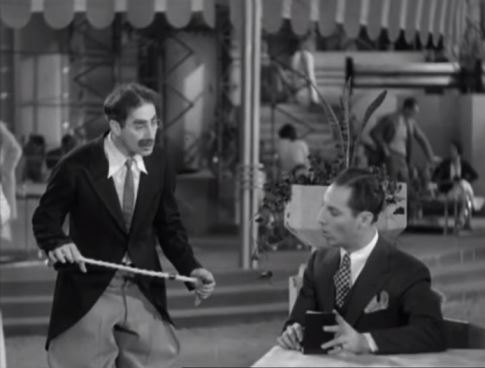
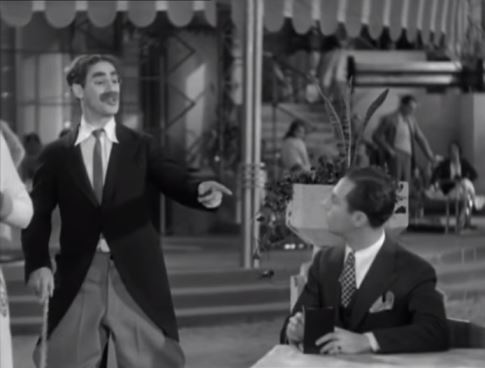
The Story: More Marx Brothers, because, why not? Again, the best representation is the clip at the bottom of the page, rather than my pathetic attempts to capture the humor of it. Timing and the inability to capture Groucho's constant winging and hoofing at a frame at a time. Impossible! Madness! Appropriate, as it is the Marx Brothers, after all. They were, in Andrew Sarris' view an anarchic presence, mad men in a sane world, but sane with pomposity, hypocrisy and duplicity, all bubbles that the Marxes circled with knives. Plots would be foiled, romances would bloom, the world would turn right because of their presence, even if you didn't quite know how. Here, Groucho, with the aid of brother Zeppo (playing Capt. Spaulding's secretary Horatio Jamison), skewer both lawyerly formality, obfuscating pro forma, and the rules of punctuation, as he dictates a letter to his lawyer—that never gets written, and never gets sent. It's just as well because the letter doesn't "say" anything, so bogged down in introduction that it never comes to the conclusion...unless it's to say that Captain Spaulding exists (at least as of June 9th). It's a lot of sound and fury signifying nothing. Which is what a good deal of the judiciary is, anyway. I wonder what the Marx Brothers would do with the Internet and Social Media. Probably toss it out the window. Using Windows.™ If I want to turn it off, I have to go the "Start" menu? Maybe they designed it! The Set-Up: The garden party in honor of Captain Jeffrey Spaulding—the African Explorer—(Groucho Marx) has turned into a disaster! The unveiling of the prized painting "After the Hunt" has been spoiled by the masterpiece being stolen! And the distraught hostess Mrs. Rittenhouse (Margaret Dumont) has sent for the police, the idea of which causes the guest of honor some proper embarrassment (and some improper embarrassment, which is the best kind). To wit:
BUTLER The police are here, madam.
- MRS. RITTENHOSE Oh, the police. Have them come in.
CAPT. SPAULDING Oh, so that's your game, is it? Well, you can't shut me up! MRS. RITTENHOUSE Captain...
CAPT. SPAULDING Nooo, you can talk to my attorney.
CAPT. SPAULDING Jamison, take a letter to my lawyers.
I'll show you a thing or two.
Or three.
CAPT. SPAULDING I'll show you a thing or three. MRS. RITTENHOUSE Oh, Captain...
CAPT.SPAULDING Sending for the police!
Take a letter to my lawyers.
Sending for the police, eh? I said, take a letter to my lawyers.
- JAMISON I am taking it.
CAPT. SPAULDING Well, read me what you have so far.
Honorable Charles H. Hungadunga,
c/ o Hungadunga, Hungadunga,
Hungadunga, Hungadunga & McCormack.
CAPT. SPAULDING Semicolon. JAMISON How do you spell "semicolon"?
-
CAPT. SPAULDING Alright, make it a comma.
Honorable Charles H. Hungadunga, care of Hungadunga, Hungerr, Hungerr, McCormack.
CAPT. SPAULDING Gentlemen, question mark. Er-r-r! JAMISON Do you want that "er-r-r" in the letter?
- CAPT. SPAULDING No, put that in an envelope. Now then...
CAPT. SPAULDING In re yours of the 5th inst,
yours to hand and beg to rep...brackets...that uh, we have gone over the ground
carefully and we seem to believe,
i.e., to wit, e.g., in lieu,
that uh, despite all our precautionary
measures which have been involved, uhhhh, we seem to believe that it is hardly
necessary for us to proceed
unless we uh, receive an ipso facto
that is not negligible at this moment.
Quotes, unquotes and quotes.
CAPT. SPAULDING Uh. Hoping this finds you, I beg to...
- JAMISON Hoping this finds him where? CAPT. SPAULDING Let him worry about that.
Don't be so inquisitive, Jamison.
CAPT. SPAULDING Sneak!
CAPT. SPAULDING I said, hoping this finds you,
I beg to remain as of June 9th, Cordially yours, regards...That's all, Jamison.
CAPT. SPAULDING I'll show you where I get off.
Sending for the police. (scoffs)
CAPT. SPAULDING Now, read me the letter, Jamison. JAMISON "Honorable Charles H. Hungadunga."
CAPT. SPAULDING You've left out a Hungadunga.
You left out the main one, too.
CAPT. SPAULDING Thought you could slip one
over on me, didn't you, ehhh?
Alright, leave it out and put in a windshield wiper instead.
CAPT. SPAULDING I'll tell you what you do, Jamison. I tell you what. Uh, make it three
windshield wipers and one Hungadunga.
They won't all be there
when the letter arrives anyhow.
JAMISON "Gentlemen, question mark." CAPT. SPAULDING "Gentleman, question mark?"Put it on the penultimate
and not on the dipthonic.
You want to brush up on your Greek, Jamison. Well, get a Greek and brush up on him. JAMISON "In re yours of the 5th inst."
- CAPT. SPAULDING I see.
JAMISON Now, uh, you said a lot of things here that weren't
important, so I just omitted them.
MRS. RITTENHOUSE Really!
MRS. RITTENHOUSE Oh Captain!
MRS. RITTENHOUSE Good gracious. Oh my!
CAPT. SPAULDING So, you just omitted them, eh? You just omitted
the body of the letter, that's all.
CAPT. SPAULDING You just left out the body of the letter, that's all.
Yours is not to reason why, Jamison!
CAPT. SPAULDING You've left out the body.
Alright, send it that way
and tell him the body will follow. JAMISON You want the body in brackets?
CAPT. SPAULDING No, it'll never get there in brackets.
Put it in a box.
Put it in a box
and mark it uh, 'fragilly'. JAMISON Mark it what?
-
CAPT. SPAULDING Mark it 'Fragilly!' F-R-A-G...
Look it up, Jamison, it's in the dictionary! Look under 'fragile'.
CAPT. SPAULDING Look under the table
if you don't find it there. JAMISON "Quotes, unquotes and quotes."
- CAPT. SPAULDING That's 3 quotes? - JAMISON Yes, sir.
CAPT. SPAULDING Add another and make it a gallon. How much is it a gallon, Jamison? JAMISON Regards.
-
CAPT. SPAULDING "Regards" That's a fine letter, Jamison.
That's an epic. That's dandy.
CAPT. SPAULDING Now, I want you to make two carbon copies of that letter and throw the original away. And when you get through with that, throw the carbon copies away.
Just send a stamp. Air mail. That's all. You may go, Jamison.