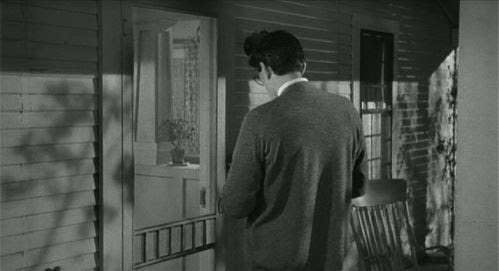
Nothing from that first day I saw her and no one that has happened to me
since, has ever been as frightening and as confusing. For no person
I've ever known has ever done more to make me feel more sure, more
insecure, more important and less significant.
Herman Raucher's remembrance of growing up an adolescent (the word "teenager" wasn't in common usage yet) in the early days of America's involvement in WWII and being lost between the worlds of youngsters and adulthood was a huge hit when it was released to theaters (despite little promotional fanfare). But, strong word of mouth made it popular*, and as the Warner Brothers had no confidence in it at all—director Robert Mulligan (who also provided the narration) barely eked a million dollar budget out of them—it made an inordinate amount of profit.
Audiences were in a romantic mood. Love Story had been a huge hit six months previously, and when Summer of '42 was released in April of '71, American audiences were still in a bit of a lovesick delirium. And Summer of '42, despite its emphasis on the horny bantering teens that make up the majority of the film, it is best remembered for its love story, aided and abetted by Robert Surtees' dreamlike cinematography and Michel Legrand's tentatively yearning (if extremely spare score).
The story is all about "Hermie" (Gary Grimes) "Oscy" (Jerry Houser) and "Benjie" (Oliver Conant), vacationing with their families on Nantucket Island in the first Summer of U.S. involvement in the war. The boys are 14 years old and they spend their days on the beach playing war-games, and ogling the local girls. They're already planning how to join the Army and/or "get laid," the latter being the (in their minds) most easily attained. "Oscy," the most impatient for both occurrences is the most persistent, hoping to score with the local girls—any of them, really—and is hardly aware that "Hermie" only has eyes for "Dorothy" (Jennifer O'Neill), married to a service-man, about to be shipped off to the European theater.
While the boys are conspiring andhaving deep discussions about acquiring "rubbers" and timing "feels" and poring over medical books for details, Hermie's
interest in the sex education is to appear more mature and less a boy in
the eyes of Dorothy, and given his propensity to "hover" nearby, the two
start crossing orbits—it's a small island and, as I said, he's usually in her vicinity—and he begins being helpful, helping her with "man" stuff, like carrying her groceries...or anything...just to be near her.
29 years passed between Raucher's summer of '42 and the appearance of Summer of '42 in theaters (although Raucher wrote it in the 1950's and, in his words, "couldn't give it away" then). Almost double that amount of years have passed since its release, and things and morés have changed. At the time of the film's release, the film was seen as a coming-of-age story with a bittersweet ending about love gained and loves lost, with a lot of goofy adolescence hi-jinks for humor.
But now, at this point and time, movie-Hermie seems more like a stalker...and Dorothy's actions? They're something she might be prosecuted for, however one sentimentalizes it.** "Circumstances" may be argued and motivations considered, but, the way the movie presents it, it's a good thing that Dorothy gets out of town before the insulated island begins to suspect anything. Sure, I'm a jerk for mentioning it, and it's certainly not in the romantic spirit in which the movie wants me to wallow, but there are "circumstances" and then there are "consequences"...in the real world, if not in the rarefied movie-world that Raucher and Mulligan present. The studio even had some initial cold-feet: the film was raunchy enough to be rated "R" (restricted from those under
17—so the kids portrayed in the movie wouldn't have been able to see
it!), although after its initial release, it was changed to a "PG"
rating for suburban theater runs without a single frame of film being
cut.
Mulligan's work as director comes through extraordinarily clearly—he was able to coax lived-in performances out of his players that they rarely ever again achieved, whether it was Natalie Wood, Sandy Dennis, or the parade of kids he directed from To Kill a Mockingbird all the way up to Reese Witherspoon in The Man in the Moon. Here, both Gary Grimes and Jennifer O'Neill make career-launching performances that they couldn't equal, subsequently, and he pushed Jerry Houser into a manic-comedy highlight that the actor subsequently leavened in later appearances. And Mulligan's live-television history inspired his "go-for-broke" perfect camera placement without ever making a show of it. Mulligan's movies have the "lived-in" quality of place that make you feel that you've been there before, even if it's your first time. His movies "feel" real. But, usually, without the earnestness of sentimentality.
The sentimentality if where Raucher comes in, but he does get one thing very right—he, after all, represented it best by his 29 year obsession with it—that such encounters of the significantly heart-felt kind can last a long time, and mark the sea-change between lust and love—is there any difference to a 14 year old boy?—until things get serious and one starts thinking about someone else rather than themselves. If we're going to get all soppy about "manhood" that's where growing up is achieved. Not in the sack, but in the soul.
I was never to see her again. Nor was I ever to learn what became of
her. We were different then. Kids were different. It took us longer to
understand the things we felt. Life is made up of small comings and
goings. And for everything we take with us, there is something that we
leave behind. In the summer of '42, we raided the Coast Guard station
four times, we saw five movies, and had nine days of rain. Benji broke
his watch, Oscy gave up the harmonica, and in a very special way, I lost
Hermie forever.
* There's a lot of irony here—much to author Raucher's favor. The film's small budget didn't allow much pay for the writing of the screenplay, and the author was enticed to take a back-end deal, where he'd be paid 10% from the profits of the film's theatrical release. It was an easy deal for Warner Bros. studio to make—they didn't think the movie would make any money. But, during the film's post-production, Raucher was encouraged to write a novel based on his screenplay to maybe help the box-office. Raucher's novel—a thick, much-expanded version of the script—concentrating on the boys' more than the Hermie-Dorothy story-line (which had always been Raucher's intention: he wanted to pay tribute to his friend Oscar, who, in reality, was killed in the Korean War—on Raucher's birthday, in fact, which he hasn't celebrated since). Raucher wrote it in a month's time, and when it was released, became a "runaway" best-seller—whether by actual public interest or studio "priming" is unsure—spending a good block of 1971 on the New York Times Best-Seller list, both before and after the movie's run in theaters. And it's still available, under the Barnes & Noble imprint. With the success of the book and the unexpected success of the movie, Raucher made an awful lot of money.
** People who love the movie will be offended that I bring this up. "How dare you?" Because it's the reality of the situation, when looked at, free of the gauze of romantic gooeyness. Summer of '42 is like a male-weepy version of An Affair To Remember in that regard. It takes a hard heart and a sense of realism to look at it with clear—un-teary—eyes. Credit Mulligan's artistry for that. But, then the film is more blatant: it implies that something sexual happened between Hermy and Dorothy. Raucher's book and his memory of the incident was one of shared grief and intimacy, but no sexual congress. But, the movie? It wants you to "go there."
The Story: First off, Happy Father's Day. And apologies for a very long post—it may actually take awhile to download—but it's an important one.
When I think of fathers, I think of Atticus Finch from To Kill a Mockingbird. The character was voted the #1 movie hero in an AFI poll in 2003. Harper Lee thought of Spencer Tracy for the role. Universal thought Rock Hudson, their biggest star, would be ideal. The role (supposedly) was offered to James Stewart, who rejected it for its racial themes.
But producer Alan J. Pakula thought of Gregory Peck. When offered the part, Peck called back immediately and always considered the role "a great gift." It won him the Academy Award for Best Actor. Peck is usually associated with dramatic roles, ones where he is stolid and sure (although he could also be good in light comedy like Roman Holiday and Designing Woman). But, his Atticus Finch is more contemplative and—certainly in this scene—unsure. His earlier films where he was conflicted—particularly in Hitchcock's Spellbound and The Paradine Case—his portrayals seemed awkward and less than convincing. But, not his Atticus. For all the talk of "#1 movie hero" it's a portrayal torn between duty and consequences in all aspects of life and Peck's portrayal is vulnerable and no less strong for appearing weak.
"Thank you for my children." It's at that line that I usually start bawling my eyes out.
But, it's not just Peck as Atticus that I love in this scene. Homage must be paid to two of my favorite actors of all time.
Frank Overton, who plays Sheriff Tate, was a fixture of television playing stern authority types, and became known to the producers after appearing in a TV version of Horton Foote's "A Trip to Bountiful." His Sheriff Tate is another authority type, but watching Overton in this scene, one senses the sub-text that he feels a bit responsible for putting the Finch family in jeopardy for Atticus' role as appointed public defender. Watching his expression change throughout the scene, considering what has happened is a master-class of subtlety, even when he is not the center of attention. Overton died after completing one of his last roles, that of Elias Sandoval in the first season "Star Trek" episode "This Side of Paradise." Another favorite appearance is as the Father in the Twilight Zone TV-series season one episode "Walking Distance." And I always remember him as another conflicted Sheriff who must decide whether he will turn over Dr. Richard Kimble to Lt. Gerard after Kimble has saved a busload of kids in "Nightmare at Northoak."
For Robert Duvall, To Kill a Mockingbird would be his feature film debut—he'd been doing a lot of television since 1960 and was recommended by Horton Foote's wife for his performance in the stage play "The Midnight Caller." When he got the part, author Harper Lee wired a simple note—"Hey, Boo." Duvall stayed out of the sun for six weeks before filming and died his hair blond for the role—and his performance is another shining example of subtlety—his changes of expression are almost too small to notice. And his one line—a whispered "Will you take me home?"—was cut in the re-arrangement of scenes.
Regarding that, Mulligan's direction took the basics of the script, but pared it down, almost eliminating the participation of Estella Evans' Calpurnia, slicing the doctor's role to almost nothing—and that done with voice-over done in post-production—and taking out some repeated dialog and just leaving the scene to Atticus, Scout, Sheriff Tate, and Boo Radley. It also allows for some dramatic pacing, not over-crowded with dialog. A lot happens in this scene, but so much of it that is memorable are expressions on faces.
I did some juggling here on the transcript: where I could, I used Horton Foote's screenplay and directions when they match the final film. Where there were changes, I merely used the dialogue.
The Set-Up: In 1932, Lawyer Atticus Finch (Gregory Peck) has been asked to serve as defense attorney to laborer Tom Robinson (Brock Peters) in a rape trial in the southern town of Macomb, Georgia. The consequences being a guilty verdict, the death while making an escape attempt by Tom, and an attack on Finch's children Jem (Phillip Alford) and Scout (Mary Badham) by Bob Ewell (James Anderson) for Finch's efforts. An altercation has occurred injuring Jem, who is carried home by a mysterious stranger. Scout, who is uninjured, runs home after them.
Action.
INT. THE HALL OF THE FINCH HOUSE
ATTICUS Scout?!
ATTICUSScout!
ATTICUS What happened?
SCOUT I don't know!
SCOUT I don't know!
ATTICUS Cal, get Dr. Reynolds down here.
CALPURNIA Yes, sir.
ATTICUS Are you alright?
SCOUT Yes, sir.
ATTICUS Are you sure?
SCOUT Yes, sir.
ATTICUS IS AT THE PHONE.
ATTICUSSheriff Tate, please...
SCOUT
Atticus, is Jem dead?
ATTICUS
No. He's unconscious. We won't know how bad he's hurt until the doctor gets here.
ATTICUS Heck? Atticus Finch. Someone’s
been after my children.
DR. REYNOLDS He’s got a bad
break, so far as I can tell, like
somebody tried to wring his arm
off.
289 CLOSE SHOT- SCOUT
She is all alone. She glances in terror towards Jem’s
room. She slowly puts on her overalls Calpurnia has
given her.
DR. REYNOLDSI'll be right back, Atticus.
After she has dressed, she starts slowly down
the hall towards Jem’s room.
TATE How's the boy, doc.
DR. REYNOLDS He'll be alright.
ANGLE WIDENS as Heck Tate COMES down the hall.
291 INT. JEM’S ROOM
The room is dim. Jem’s reading light is shaded with a
towel.
Jem lies on his back. There is an ugly mark on
the side of his face.
His left arm is out from the side
of his body. The man who brought Jem stands in a corner,
leaning against the wall.
Atticus is by Jem’s bed.
Calpurnia is standing to one side. Scout and Heck Tate
COME IN.
ATTICUS
What is it, Heck?
HECK
(rubbing his neck) Bob Ewell’s lyin’ on the ground
under that tree down yonder with a
kitchen knife...
HECK
...stuck up under his
ribs.
HECKHe’s dead, Mr. Finch.
Atticus rises.
ATTICUS
(bleakly) Are you sure?
HECK
Yes, sir.
HECKHe won’t bother these
children again.
HECKMiss Scout, you think you can tell us what
happened? 140.
SCOUT
I don't know.
SCOUTAll of a sudden, somebody grabbed
me and knocked me down on the ground...
SCOUTJem found me then...
SCOUT...and then Mr. Ewell, I
reckon,
SCOUT...grabbed him again and Jem
hollered...
SCOUT...an’ then somebody grabbed
me, Mr. Ewell, I guess,
SCOUT...somebody grabbed him...
SCOUT...and then I
heard someone pantin’ and
coughin’...
SCOUTThen I saw someone carrying Jem.
HECKWell, who was it?
SCOUTWell, there he is, Mr. Tate.
SCOUTHe can tell ya his name.
She points to the MAN in the corner who brought Jem home.
He leans against the wall.
He has a pale face and his
hair is thin and dead white, and as she points to him, a
strange spasm shakes him.
At this moment it comes to
Scout who he is, and she gazes at him in wonder, as a
timid smile comes to his face.
SCOUT Hey, Boo!
ATTICUSJean Louise,
this is Mr. Arthur Radley.
ATTICUSI
believe he already knows you.
ATTICUS
(glancing at Boo)
Er -- Heck, let’s go out on the
front porch.
Atticus and Heck Tate GO ON OUT.
Scout goes to Arthur.
SCOUT Would you like to say good night to
Jem, Mr. Arthur?
Scout leads him to Jem’s bed.
Arthur looks at him from
head to foot as though he had never seen a boy before.
His hand comes up, but he lets it drop to his side.
SCOUT
You can pet him, Mr. Arthur. He’s
asleep.
SCOUT You couldn’t if he was
awake, though, he wouldn’t let
you.
SCOUT Go ahead.
144.
His hand comes lightly on Jem’s hair.
Then he tugs at
Scout’s arm and she understands he wants to leave.
They
GO OUT.
292 EXT. SWING FRONT PORCH - NIGHT
Atticus and Heck Tate are there. Scout brings Arthur
out.
SCOUT
Won’t you have a seat, Mr. Arthur?
She leads him to the chair farthest from Atticus and
Heck. It is in deep shadow. Atticus is seated in the
swing, Heck on a chair next to him.
Scout sits next to
Arthur. 293 TWO SHOT - ATTICUS AND HECK
ATTICUS
Well, Heck, I guess the thing to
do --
294 ANGLE FAVORING ATTICUS
ATTICUS
Good Lord, I guess I’m losing my
memory.
Atticus pushes up his glasses and presses his fingers to
his eyes.
ATTICUS
I can’t remember if Jem is twelve or thirteen.
ATTICUS
Anyway, it will come
before the County court.
ATTICUS Of
course, it was a clear cut case of
self-defense, but I’ll have to go
to the office and hunt up -- 295 ANGLE FAVORING TATE
TATE
Mr. Finch,
TATE do you think Jem killed
Bob Ewell? Is that what you think?
TATEYour
boy never stabbed him.
142.
TATE
(quietly, firmly) Bob Ewell fell on his
knife. He killed himself.
Atticus walks to the corner of the porch and looks at the
wisteria vine.
TATE
(exploding) There’s a black man dead for no
reason,
TATE and now the man
responsible for it is dead.
TATELet
the dead bury the dead this time,
Mr. Finch.
TATEI never heard tell
that it’s against the law for a
citizen to do his utmost to
prevent a crime from being
committed, which is exactly what
he did,
TATEbut maybe you’ll say it’s
my duty to tell the town all about
it and not hush it up.
TATEWell, you know what’d
happen then?
TATEAll the ladies in
Maycomb, includin’ my wife, ‘d be
knockin’ on his door...
TATE...bringin’
angel food cakes.
TATETo my way of
thinkin’,
TATE...takin’ the
one man who’s done you and this
town a great service,
TATE...and draggin’
him with his shy ways into the
limelight...
TATETo me, that’s a sin.
TATEIt’s a sin...
TATE ...and I’m not about to
have it on my head. He is trying to dig a hole in the floor with the toe of
his boot. Atticus looks over at Boo. Heck’s meaning
dawns on him.
TATE
I may not be much, Mr. Finch, but
I’m still Sheriff of Maycomb
County,
TATE...and Bob Ewell fell on his
knife.
TATEGood night, sir.
He LEAVES.
O.S. SOUND: CAR DRIVING OFF
Atticus looks out into the yard and then over at Scout.
296 TWO SHOT - SCOUT AND ATTICUS
SCOUT
Mr. Tate
was right.
ATTICUS
What do you mean?
SCOUT
Well, it would be sort of like
shooting a mockingbird, wouldn’t
it?
Atticus puts his face in her hair and rubs it.
ANGLE
WIDENS as Atticus gets up and starts for the house.
Before he goes inside, he stops in front of Arthur
Radley.
To Kill a Mockingbird is available on DVD and Blu-Ray from Universal Home Video.
Horton Foote's original screenplay differs slightly in order from how the film continuity occurs.
288 INT. THE HALL OF THE FINCH HOUSE
Cal and Scout COME IN. ATTICUS IS AT THE PHONE.
ATTICUS
Heck? Atticus Finch. Someone’s
been after my children. Jem’s
hurt. Between here and the
schoolhouse. I can’t leave my
boy. Run out here, please, and
see if he’s still around. Thanks,
Heck.
He hangs up. He goes to Scout.
SCOUT
Atticus, is Jem dead?
ATTICUS
No, Scout. Look after her, Cal. He runs down the hall towards Jem’s room. Cal begins to
undress Scout and get her out of the costume.
CALPURNIA
Are you sure you’re all right?
SCOUT
Sure.
She is free of the costume now and begins to rub her
little body. SCOUT
Cal, is Jem dead? 137. CUNNINGHAM
No, he’s unconscious. We don’t
know how badly he’s hurt until Dr.
Reynolds gets here. Honey, what
happened? SCOUT
I swear, I don’t know. Calpurnia rushes OUT of the hall and into Scout’s room
and then APPEARS again with clothes for Scout. CALPURNIA
Put these on, honey. She hands the clothes to her and rushes down the hall
towards Jem’s room. DR. REYNOLDS, in his fifties,
carrying his doctor’s bag COMES IN the front door. He
takes a look at Scout and pats her on the head. DR. REYNOLDS
JEAN LOUISE
Well, you’re still standing. He goes past her down the hall to Jem’s room. 289 CLOSE SHOT- SCOUT
She is all alone. She glances in terror towards Jem’s
room. She slowly puts on her overalls Calpurnia has
given her. After she has dressed, she starts slowly down
the hall towards Jem’s room. ANGLE WIDENS as the door
opens and Dr. Reynolds COMES OUT. He sees Scout and goes
to her. SCOUT
Is Jem dead? DR. REYNOLDS
Far from it. He squats down beside her.
290 TWO SHOT - SCOUT AND DR. REYNOLDS
He pats her head.
DR. REYNOLDS
He has a bump on his head like you
and a broken arm. He’s got a bad
break, so far as I can tell, like
somebody tried to wring his arm
off. We can’t do much tonight except
try to make him as comfortable as
possible. We’ll have to X-ray his
arm. Looks like he’ll be wearing
his arm way out by his side for
awhile. Don’t worry though.
He’ll be as good as new. Boys his
age bounce.
While he has been talking to her, DR. REYNOLDS has been
fingering her bump and looking keenly at her.
DR. REYNOLDS
You don’t feel broke anywhere, do
you? SCOUT
No, sir. DR. REYNOLDS
Then go in and look at your brother. ANGLE WIDENS as Heck Tate COMES down the hall. HECK
You all right, Scout? SCOUT
Yes, sir. I’m goin’ now to see
Jem. Atticus is in there. HECK
I’ll go with you. 291 INT. JEM’S ROOM The room is dim. Jem’s reading light is shaded with a
towel. Jem lies on his back. There is an ugly mark on
the side of his face. His left arm is out from the side
of his body. The man who brought Jem stands in a corner,
leaning against the wall. Atticus is by Jem’s bed.
Calpurnia is standing to one side. Scout and Heck Tate
COME IN. ATTICUS
Come in, Heck. Did you find
anything? Heck glances sharply at the man in the corner, nods to
him, then looks around the room -- at Jem, Calpurnia and
Atticus. 139.
DR. REYNOLDS (CONT'D) HECK
Mr. Finch, I’ll tell you what I
found. I found a little girl’s
dress. It’s out there in my car.
That your dress, Scout? SCOUT
Yes, sir. If it’s pink. HECK
An’ I found some funning-lookin’
pieces of muddy colored cloth. SCOUT
That was m’ costume. Heck runs his hands down his thighs. He rubs his left
arm along the wall of Jem’s room. ATTICUS
What is it, Heck? HECK
(rubbing his neck) Bob Ewell’s lyin’ on the ground
under that tree down yonder with a
kitchen knife stuck up under his
ribs. He’s dead, Mr. Finch. Atticus rises. ATTICUS
(bleakly) Are you sure? HECK
Yes, sir. He won’t bother these
children again. ATTICUS
Maybe we’d better go into the
living room, Heck. HECK
No, if you don’t mind, I’d rather
stay here if it won’t hurt Jem
any, and I can have a look at his
injuries while Scout tells me what
happened. Scout goes to Atticus. He puts his arms around her.
Heck goes to Jem and looks at him. HECK
You think you can tell us what
happened, Miss Scout? 140. SCOUT
All of a sudden, somethin’ grabbed
me and mashed my costume an’ I
ducked and then Mr. Ewell, I
reckon, grabbed him again and Jem
hollered an’ then somebody grabbed
me, Mr. Ewell, I guess, and
somebody grabbed him and then I
heard somebody pantin’ and
coughin’... HECK
Who was it? SCOUT
Why, there he is, Mr. Tate. He
can tell you his name... She points to the MAN in the corner who brought Jem home.
He leans against the wall. He has a pale face and his
hair is thin and dead white, and as she points to him, a
strange spasm shakes him. At this moment it comes to
Scout who he is, and she gazes at him in wonder, as a
timid smile comes to his face. SCOUT
Hey, Boo... ATTICUS
(gently correcting
her) Mr. Arthur, honey. Jean Louise,
this is Mr. Arthur Radley. I
believe he already know you. Scout is embarrassed and trying to hide her
embarrassment. She goes to cover Jem up. Dr. Reynolds
COMES back IN. DR. REYNOLDS
Everybody out.
(glances at Boo) Evenin’, Arthur. Didn’t notice
you the first time I was here. ATTICUS
(glancing at Boo)
Er -- Heck, let’s go out on the
front porch. There are plenty of
chairs out there and it’s still
warm enough. Atticus and Heck Tate GO ON OUT. Scout goes to Arthur. 141.
SCOUT
Come along, Mr. Arthur. You don’t
know the house real well. I’ll
take you to the porch, sir. He looks down at Scout and nods. She leads him out of
the door. 292 EXT. FING FRONT PORCH - NIGHT Atticus and Heck Tate are there. Scout brings Arthur
out. SCOUT
Won’t you have a seat, Mr. Arthur?
This rocking chair’s nice and
comfortable. She leads him to the chair farthest from Atticus and
Heck. It is in deep shadow. Atticus is seated in the
swing, Heck on a chair next to him. Scout sits next to
Arthur. 293 TWO SHOT - ATTICUS AND HECK ATTICUS
Well, Heck, I guess the thing to
do -- Good Lord, I’m losing my
memory. 294 ANGLE FAVORING ATTICUS Atticus pushes up his glasses and presses his fingers to
his eyes. ATTICUS
I can’t remember if Jem is ten or
eleven. Anyway, it will come
before the County court. Of
course, it was a clear cut case of
self-defense, but I’ll have to go
to the office and hunt up -- 295 ANGLE FAVORING TATE TATE
Mr. Finch, do you think Jem killed
Bob Ewell? Do you think that? ATTICUS
You heard what Scout said. 142. TATE
(quietly, firmly) Mr. Finch, Bob Ewell fell on his
knife. He killed himself. Your
boy never stabbed him. Atticus walks to the corner of the porch and looks at the
wisteria vine. TATE
(exploding) There’s a black man dead for no
reason, and now the man
responsible for it is dead. Let
the dead bury the dead this time,
Mr. Finch. I never heard tell
that it’s against the law for a
citizen to do his utmost to
prevent a crime from being
committed, which is exactly what
he did, but maybe you’ll say it’s
my duty to tell the town all about
it and not hush it up. Know what’d
happen then? All the ladies in
Maycomb, includin’ my wife, ‘d be
knockin’ on his door bringin’
angel food cakes. To my way of
thinkin’, Mr. Finch, takin’ the
one man who’s done you and this
town a great service, and draggin’
him with his shy ways into the
limelight... To me, that’s a sin.
It’s a sin and I’m not about to
have it on my head. He is trying to dig a hole in the floor with the toe of
his boot. Atticus looks over at Boo. Heck’s meaning
dawns on him. TATE
I may not be much, Mr. Finch, but
I’m still Sheriff of Maycomb
County, and Bob Ewell fell on his
knife. Good night, sir. He LEAVES. O.S. SOUND: CAR DRIVING OFF
Atticus looks out into the yard and then over at Scout. ATTICUS
Scout, Mr. Ewell fell on his
knife. Do you think you can
possibly understand? 143. 296 TWO SHOT - SCOUT AND ATTICUS SCOUT
Yes, sir. I understand. Mr. Tate
was right. ATTICUS
What do you mean? SCOUT
Well, it would be sort of like
shooting a mockingbird, wouldn’t
it? Atticus puts his face in her hair and rubs it. ANGLE
WIDENS as Atticus gets up and starts for the house.
Before he goes inside, he stops in front of Arthur
Radley. ATTICUS
Thank you for my children, Arthur. He goes on inside. Arthur gets up and nods toward the
front door. SCOUT
You’d like to say good night to
Jem, wouldn’t you, Mr. Arthur?
Come right in. They go in the door. 297 INT. HALLWAY
Scout and Arthur COME IN. They go to the door of Jem’s
room. 298 INT. JEM’S ROOM
Scout and Arthur ENTER. SCOUT
Dr. Reynolds gave him a heavy
sedative, Cal says, so he’d sleep. Scout leads him to Jem’s bed. Arthur looks at him from
head to foot as though he had never seen a boy before.
His hand comes up, but he lets it drop to his side. SCOUT
You can pet him, Mr. Arthur. He’s
asleep. You couldn’t if he was
awake, though, he wouldn’t let
you. Go ahead. 144.
His hand comes lightly on Jem’s hair. Then he tugs at
Scout’s arm and she understands he wants to leave. They
GO OUT. 299 INT. HALLWAY
Scout and Arthur ENTER from Jem’s room. She leads him to
the font door. They stand there. He holds her hand. ARTHUR
(whispering) Will you take me home? SCOUT
Mr. Arthur, bend your arm down
here like that. That’s right,
sir. She slips her hand into the crook of his arm. They walk
out the front door.


 While the boys are conspiring and having deep discussions about acquiring "rubbers" and timing "feels" and poring over medical books for details, Hermie's
interest in the sex education is to appear more mature and less a boy in
the eyes of Dorothy, and given his propensity to "hover" nearby, the two
start crossing orbits—it's a small island and, as I said, he's usually in her vicinity—and he begins being helpful, helping her with "man" stuff, like carrying her groceries...or anything...just to be near her.
While the boys are conspiring and having deep discussions about acquiring "rubbers" and timing "feels" and poring over medical books for details, Hermie's
interest in the sex education is to appear more mature and less a boy in
the eyes of Dorothy, and given his propensity to "hover" nearby, the two
start crossing orbits—it's a small island and, as I said, he's usually in her vicinity—and he begins being helpful, helping her with "man" stuff, like carrying her groceries...or anything...just to be near her.
 Whatever these matters, Summer of '42 hit a collective chord and was an unexpected box office hit, admired by many—in fact, it's a favorite film of such disparate directors as Stanley Kubrick (in The Shining, the Torrence family can be seen watching it) and Quentin Tarantino.


 Mulligan's work as director comes through extraordinarily clearly—he was able to coax lived-in performances out of his players that they rarely ever again achieved, whether it was Natalie Wood, Sandy Dennis, or the parade of kids he directed from To Kill a Mockingbird all the way up to Reese Witherspoon in The Man in the Moon. Here, both Gary Grimes and Jennifer O'Neill make career-launching performances that they couldn't equal, subsequently, and he pushed Jerry Houser into a manic-comedy highlight that the actor subsequently leavened in later appearances. And Mulligan's live-television history inspired his "go-for-broke" perfect camera placement without ever making a show of it. Mulligan's movies have the "lived-in" quality of place that make you feel that you've been there before, even if it's your first time. His movies "feel" real. But, usually, without the earnestness of sentimentality.