Saturday, January 25, 2020

Olde Review: Rooster Cogburn

This was part of a series of reviews I did back in the '70's. Except for some punctuation, I haven't changed anything from the way it was presented, giving the snarky, clueless kid I was back in the '70's a break. Any stray thoughts and updates I've included with the inevitable asterisked post-scripts. 

Written October, 27, 1975

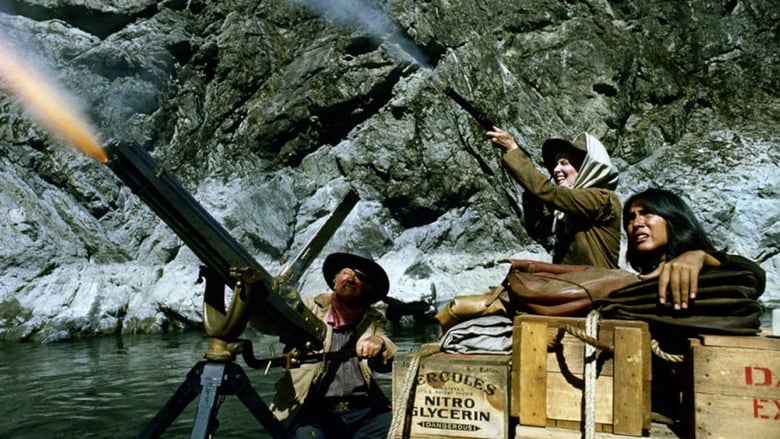
Rooster Cogburn (Stuart Millar, 1975) Stopped by the Renton* to see Stuart Millar's Rooster Cogburn. It was...pleasant. Not particularly exciting, but...pleasant. When I think of all the possibilities of a script involving John Wayne building on an earlier role and Katherine Hepburn....

I can even think of the possibilities of direction within the limitations imposed by the script....


Well, anyway, with the talent showcased there, let's just say the glass could have been cleaned a little better. The "Rooster Cogburn" character is described as "having gone to seed." I must agree. Cogburn is but a shadow of the characterization Wayne created in 1969, and as if to off-set it, Wayne overplays it, especially in the opening sequences, but his efforts come out looking like amateurish mugging.

Hepburn fares much better in her role but then why shouldn't she? She played the same type of character in The African Queen. The action sequences lack the punch that a more seasoned director like Howard Hawks or Henry Hathaway might've delivered. For example, the shoot-out at the Goodnight mission where a number of Indians and Eula Goodnight's father are murdered by a gang of desperadoes--the scene should have been frightening, a horrible thing to watch, as it must have been to the Hepburn character.. But after a well-used slow zoom into the growing commotion, Millar shows us the massacre from high overhead at least 30 feet away, showing all the action encompassed in the frame, keeping us at a safe and unparticipatory distance.
Another sequence that had great had great potential was the character "Breed's" (Anthony Zerbe) showdown with Hawk (Richard Jordan), as he is exposed for being a traitor to him. After a very lengthy series of shots between the two characters as Breed hesitates in handing over his gun, Hawk kicks him and he slides down the slope. Then, there's a shot of Breed's hat sliding down the slope (nice try, but it just doesn't work, symbolically or otherwise), and ALL OF A SUDDEN ** there is a shot of Breed falling over a cliff (I remember thinking to myself "Was there a cliff there?" Yes, but we didn't know that until the character fell off it!) There was no suspense in this scene, but there certainly would have been if Millar had told us, somehow, that there was a cliff behind him. We would have been able to think ahead even further than we had when "Hawk" asked to see "Breed's" gun. We would have seen what was coming and squirmed a bit for the character. This way, nothing. A momentary shock and it's over.***

Rooster Cogburn is full of missed chances like this, and it really is too bad.
It really was (and is). I remember reading about the trials and tribulations director Millar had with his iconic, and feisty and flinty stars out on location in Oregon, and how they'd do a scene, and not do a re-take if they thought it was good. Wayne wasn't in the best of health, but felt he had to do his own horse-riding in front of Hepburn--the male-pride thing. And though Wayne and Hepburn got along like a house afire—Hepburn told her pal Peter O'Toole that where he was a willow, Wayne was a great oak—it was just an unpleasant shoot. And Millar was more of a producer than a director. He was 44 when he directed Rooster Cogburn but his "legacy" stars treated him like a snot-nosed kid.
It is too bad. This is the only movie that Wayne and Hepburn did together—at this point in her career, she was starting to go the rounds of veteran actors with whom she hadn't sparred before, like Henry Fonda, Laurence Olivier...and Wayne—and it would have been nice to have a good, decent script instead of this hashed-together combination of The African Queen and warmed-over True Grit (written by "Martin Julien", but actually actress Martha Hyer, the wife of producer Hal Wallis, and though she was an arresting and competent actress, as an author-by-nepotism, she was basically "copy and paste"). And whatever talents director Millar had, he didn't know how to gather enough material to make a film that could be cut together smoothly, or build anything approaching dramatic tension. John Ford, Howard Hawks, Don Siegel were directors who could shoot economically having already edited the movie in their head before filming, but Millar—if he had a plan—was undercut by what he could accomplish on location.
Sometimes projects are brought together on a whim and star-power but without the good foundation of a solid script or a director who could find gold in a coal-mine, it'd be like building a cardboard house on the sea-shore. The whole thing collapses before there's any equity. It usually happens when a screen-couple are re-united after a big hit. Anybody remember John Travolta and Olivia Newton-John's second pairing after Grease? Yeah, me, neither.****
Still, when they're together on-screen Hepburn and Wayne take the creases and mugging out of their performances and produce something that feels like grace. But, it is far from either of their best work. Wayne is gentlemanly in her presence and Hepburn rather school-girlish. I don't know if either of those serve the characters very well, and one appreciates such things in small doses when the characters should be more sand than sugar. Impressed with the amount of the stunt work they did on the Rogue and Deschutes Rivers, though.
Wayne regrouped with a brilliant performance in his last film The Shootist, and Hepburn remained iconic even to her last film 19 years after this one.

* The Renton Cinema, demolished in the 80's, is now the AMC Renton Village 8. Same location, though.

** Emphasis, mine.

*** This is the basic "Hitchcock Rule:" A scene is much more exciting if you give the audience more information. If a bomb goes off on a train *BOOM* it's over, a little disorientation and shock and it's done. But tell the audience there's a bomb..show them where it is and what time's it's going to go off...and show all the people who might see it but don't, with the clock ticking down and you have a long period of suspense where people know the situation and are helpless to do anything about it. It's a much more effective scene.

**** Okay, I lied. Two of a Kind.

Sunday, January 19, 2020

Don't Make a Scene: Stagecoach (1939)

The Story: Nothing changes. 

Stagecoach was made by John Ford in 1939, but the opinions of banker Ellsworth Henry Gatewood could be uttered without alteration today. In fact, they are being uttered today. And they will be uttered more this year because it is an election year.

Hard to know where John Ford's politics lay (although writer Joseph McBride attempted to in a 2001 article in the Lose Angeles Times). He obviously thought this banker—an embezzler—was the worst of the bunch on the stagecoach. Ford's directorial sympathies lay with the "little guys" and outcasts and not with the big-wigs. He hated the studio brass, and would do a lot of his location work, starting with this film, in Monument Valley because he knew that none of them would show up in such a desolate location far away from Hollywood amenities. And he hated bullies, despite acting like a tyrannical autocrat on-set. He liked to act like a big-shot and being a big-shot while secretly hating the behavior he employed when others did it. Ford was a complicated artist and full of contradictions, just like his characters.

Yes, he was a Nixon supporter late in life, but that's because the turbulent '60's cast aspirations on his beloved military and he didn't like the youth movement, seeing it as anarchic and undisciplined. But, I would bet he voted for Kennedy rather than Nixon in 1960. Irish, you see. In 1937, he declared to his brother in a letter that he was a "socialist democrat—always left." Indeed in those days, he supported unionization in Hollywood and was considered a "fellow traveler" by the FBI's files on him. He vacillated depending on what winds blew against him. In another interview, he called himself a "state of Maine Republican."

He hated to pin himself down and professed to labeling others (although he was prone to do so): “I object to calling names. Right and left and center of the road. There is no such thing if we live up to the context of our Constitution. I mean we’re all liberals, because it’s a liberal Constitution. Thomas Jefferson was probably the greatest of all liberals, and he was considered a leftist at that time.”

Must have sounded good at the time. So, give Ford his due. Great director. Flawed man, idiosyncratic, hypocritical sometimes, contradictory, as prone to changing winds as his beloved 106 ft. ketch, the Araner.


The Set-Up: There's a stiff, dusty wind blowing into the stagecoach bound for Lourdsburg, and not all of it is coming from Monument Valley. All of the passengers are not what one would say are "model citizens," not even the woman in "a delicate position." Unfortunately, she's seated next to a lot of hot air—Gatewood, the banker, who, although he puts up a blustering façade of rectitude, he's an embezzler (hence his speedy retreat out of town). And having just been rebuffed by a cavalry officer, he wants everyone to know how affronted he is. The idea! Do you disagree, sir? The idea!

Action!

Inside the stagecoach, the passengers are seated in the same positions as during the morning. The heat is stifling and dust drifts in through the open windows. The coach jolts and bounces as it whirls along at fourteen miles an hour. Gatewood, seen in medium close-up with Dallas beside him, is playing the indignant man-of-affairs. 
GATEWOOD (blustering) I can't get over the impertinence of that young lieutenant! I'll make it warm for that shavetail! 
Doc Boone, again with the sample bag in his lap, is very thoughtfully attempting to rearrange Peacock's scarf round his neck. The wind is blowing it about so much that it is a futile exercise. 
GATEWOOD (off) I'll report him to Washington! We pay taxes to the government and what do we get? Not even protection from the Army! 
Peacock is now seen in close-up with Doc Boone just in shot, his hand rearranging the scarf so that it practically covers Peacock's face. While Gatewood continues to hold forth, Doc Boone cleans the dust from Peacock's face. 
GATEWOOD (off) I don't know what the government's coming to! Instead of protecting businessmen, it's poking its nose into business. 
Cut back to the same shot of Dallas and Gatewood. 
GATEWOOD Why, they're talking now about having bank examiners... (he snorts) ...as if we didn't know how to run our own banks. 
The stagecoach is going really fast and a stiff breeze is coming through the windows. Dallas desperately tries to rearrange her hat, which is being blown about. 
Cut back to Peacock and Doc Boone, who pulls a bottle from the sample-case and holds it up to Peacock ingratiatingly. Peacock does not protest. So Doc Boone takes a large swallow. 
GATEWOOD (off) I actually had a letter, from some popinjay official... 

GATEWOOD (off) ...saying they were going to inspect my books! 
GATEWOOD (off) I have a programme, gentlemen, that should be blazoned on every newspaper in the country. 
Gatewood now addresses his remarks to Lucy, as the most worthy of attention. 
GATEWOOD America for Americans! Don't let the government meddle with business! Reduce taxes! Our national debt is shocking... 
Lucy leans against the side of the coach, as far away from him as possible. Doc Boone is staring lovingly into Peacock's face. 
GATEWOOD (off) ...over a billion dollars! What the country needs is a businessman for President! 
DOC (amiably, holding up a bottle) What the country needs is more bottle. 
He points to the bottle. 
PEACOCK What? 
DOC (affably) Bottle! 
Dallas, sitting next to Gatewood, has her eyes closed and her head leaning against the back of the seat. 
GATEWOOD You're drunk, sir. 
Doc Boone's smile fades as he turns indignantly to Gatewood. 
DOC I'm happy, Gatewood. 
DOC Woof!

Stagecoach (1939)

Words by Dudley Nichols and Ben Hecht

Pictures by Bert Glennon and John Ford

Stagecoach is available on DVD and Blu-Ray from Warner Home Video and the Criterion Collection.

Friday, January 17, 2020

1917

Yea, Tho I Walk and Talk Through The Valley of the Shadow...
or
Last Man Standing, Notwithstanding.

One shot

That's the strongest take-away from Sam Mendes' 1917, based on stories told to him by his grandfather, and which Mendes adapted, along with Krysty Wilson-Cairns, to make an extremely inclusive World War I film, with that one difference—make it appear as one continuous "take," seemingly without edits.

Mendes had experimented doing this with the first sequence of his previous film, SPECTRE—part of the James Bond franchise—a four minute seamless tracking shot during the "Day of the Dead" celebration in Mexico City as Daniel Craig's Bond "makes" his target, goes up to a hotel room balcony and then saunters along the rooftops to a sniper position to take the terrorist out.

It's not continuous, though. There are moments where the camera "settles" for a split-second on something—free of human beings and any sky shots with moving clouds, something inanimate and stationary—where invisible wipe-edits can be made to complete the illusion of continuity. But, in 1917, that tack continues for the entire run of the movie (with one exception, where a soldier is knocked unconscious by a bullet to his helmet), which is some two hours.* 
This is not unique—Hitchcock did it in 1948 with his experimental Rope, essentially a play without the proscenium arch and the audience on stage with the actors, doing 10 minute continuous shots (which was the length of a film reel) until he could focus on somebody's back for the reel-change—and has been done more frequently of late thanks to digital photography (think of Birdman, Gravity, there's a list of them on Wikipedia now). The effect has been used to create tension—when is the scene going to "break"?—ala Orson Welles' long opening to Touch of Evil. And World War I is ideally suited to this conceit, given its emphasis on trench-warfare, where the viewer is hemmed in by the narrowness of the space, used to very good advantage in tracking shots by Stanley Kubrick in Paths of Glory and emulated here by Mendes.
The film begins—as it ends (no real spoiler alert necessary)—with a soldier relaxing under a tree; Lance Corporal Schofield (George McKay) is soon told to get up by Lance Corporal Blake (Dean-Charles Chapman)—there's a mission  that he's been called to carry out and he's chosen Schofield to accompany him. What's the mission? No idea, he's on his way to the bunker of General Erinmore (Colin Firth) to hear what it is. The two slop to the make-shift HQ and given the task—word is that the Germans have not retreated, as has been the thought, but diverted to the newly-formed Hindenburg line where that entrenched position will allow them to decimate the Devonshire regiment who have been planning an attack that will place them right in the path of the German artillery there. Phone lines and communication are down, so the two men must hand deliver a message to call off the attack scheduled for dawn the next day lest the 1600 men be wiped out, including Blake's older brother who is stationed there. 
Time is limited. The two have to leave the trenches, weave their way through No-Man's-Land, pick their way past the German trenches, evade whatever sparse troops might be there on the way—IF they have, indeed, moved—make it to the city of Ã‰coust, follow the river nearby and get to the Devonshires before the attack can happen. In other words, they have to go through enemy territory and any stray threats there to hand deliver written words that, they are warned before heading "over the top" by an embittered Lieutenant Leslie (Andrew Scott, always welcome) that the orders might not be believed, anyway.
The Devil of the trip is in the details and they come in the form of booby-traps, rats, blasted out landscapes, snipers, armed aerial reconnaissance and the general fog of war. Mendes' usual one-point perspectives keep a viewer focused on what's up-front, but the ever-moving camera has you exploring the edges of the frame, looking for hidden dangers that just might be slipping into view. 
The focus is constantly changing, although still hampered by the camera frame, giving one a 90° vantage of what is surrounding Blake and Schofield, immersing the audience in the step-by-step journey while also limiting the field of view. Yes, it "puts you there" but it is also frustrating that your vantage is from a letter-box.  At times, it has the feel of a FPS video-game (without the woozy headaches), but even then, you're controlling where the field of view looks. In this, you're just a prisoner.
Thank God, though, that the fellow who is controlling the view is Roger Deakins, one of those masters of light, a cinematographer who can make anything, even a pristine field, look magical. Technologically, the film must have seemed daunting—not just in the one-shot fluidity—but also in the various lighting situations—by candle, flash, flare, or flame—that Deakins has been honing over the last couple decades of working with demanding directors who were seeing the world a little differently from others and has managed to pull miracles out of the lenses he's been peering through. It's another wonderful example of Deakins excelling in an already crowded field of filming magicians who have moved the bar—or the f-stop—on what can be filmed, let alone imagined.
As beautiful as it is, though, one wishes there was more to it than that. For Mendes, of course, it's a personal tribute and a sentimental journey, a technical challenge well met, and impeccably done. At the end, however, one just feels a bit empty. Perhaps, that is as it should be, given that war, given that carnage, given its lasting effects on a generation—the "lost" generation, as it has become known in artistic circles. It is a story well-told, but not much of a story, as personally heroic as it might be. The monstrosity of that war and its futility has been better recounted for as long as there's been film...or near about's. Certainly as long as films have been giving out awards to itself.
It just pales in comparison to other WWI films, its technical prowess notwithstanding. And when one places it in comparison with...oh, let's say, They Shall Not Grow Old, which is also personal—interviews are with veterans, while memories are still green—and technically stunning—original Imperial War Museum footage, spit-and-polished up, sound-enhanced, digitized and colorized so as to seem new, not 100 years old, the effect historically, emotionally, viscerally is far more than 1917 can achieve. Yes, bravo for making it, but points off for making it an exercise rather than an experience.

* Slight time-error here: the mission is supposed to take six hours, so unless the soldier knicked is out for four hours this is some inevitable time-compression to allow for multiple showings at the cineplex—and that's assuming the time-estimate is based on the assumption of one or both of the soldiers being unconscious for four hours!

Sunday, January 12, 2020

Don't Make a Scene (Redux): Catch-22

For Buck...

The Story: Authors cringe when you talk about making a movie from their work. I remember seeing an author on the old "Dick Cavett Show" who grumbled that helping to write the movie's screenplay was akin to "holding the coat of the man who's molesting your child."

And so, Joseph Heller's "Catch-22."

I don't know how Heller felt about Mike Nichols' film of his most famous best-seller, overall, but I do know this: he loved this scene.

He loved this scene so much, he told its author, Buck Henry, that he wished he'd thought of it for the book.

High praise, and why this is the scene for the week.

The Set-Up: Every war movie has its "scrounger," the "get" guy, the "dog-robber," the "King Rat"—the one who can acquire the things that people need and want and sets up a black-market lemonade stand of his stores. Joseph Heller took the concept and used it to satirize the monstrous greed of 50's Corporate America in the character of Milo Minderbinder ("What's good for MM Enterprises is good for America"), who would sell the pilot's parachute silk for profits, leaving the air-crews with promisary notes for shares in his "Syndicate." Mike Nichols and Buck Henry took the idea a bit further and made Heller's Milo a wheeler-deeler turned fascist dictator. In this scene, Yossarian (Alan Arkin) confronts Milo (Jon Voight) over Milo's deal with the German government to bomb the Allied air-base, which managed to kill Nately (Art Garfunkel). Milo would have no trouble sitting on the board of Enron or Halliburton. Why, who knows how far he could have gone? Or would have gone?


Goldman Sachs, maybe?  Goldman Sachs, probably.

Action!


Yossarian runs after Milo's motorcade and attempts to board the jeep where Milo is standing in the glow of the klieg lights. Milo's police contingent hold Yossarian back.
Yossarian: Milo, I'm gonna kill you, you murdering son of a bitch!
Milo Minderbinder: Don't hurt him.
Milo: I know how you feel...
Milo: ...but it wasn't my fault.
Yossarian: Who's fault was it?
Milo: No one. Nately was the victim of certain economic pressures, the laws of supply and demand.
Yossarian: You unbelievable bastard! (The MMP's punch Yossarian in the stomach, and he crumples.) Uhhh!
Milo: Do you want me to take you to her?
Yossarian: (gasping) Who?
Milo: Nately's whore. Aren't you looking for her?
Yossarian: (gasping) You know where she is?
Milo: Of course I do.
(Milo gestures and the MMP's load Yossarian onto the Jeep)
Milo: You're AWOL, Yossarian. I thought you knew better than that. That's not smart. Nately wouldn't do anything that dumb.
Yossarian: He's dead.
Milo: It's too bad. He was a nice fellow.
Yossarian: And your boys made a nice direct hit on him.
Milo: But he died a rich man. He had over 60 shares in the Syndicate.
Yossarian: What good is that? He's dead.
Milo: Then his family will get it.
Yossarian: He didn't have time to have a family.
Milo: Then his parents get it.
Yossarian: They don't need it, they're rich.
Milo: Then they'll understand.
(Milo gestures to the MMP's and Yossarian is thrown out of the Jeep)

Catch-22

Words by Buck Henry

Pictures by David Watkin and Mike Nichols

Catch-22 is available on DVD from Paramount Home Video.


The scene begins about 3:00 in.