Showing posts with label World War I. Show all posts

Friday, February 16, 2024

War Horse

Written at the time of the film's release...

"The Lives That Pass Through a Horse"
or
"Come On, Joey! Come On!"

The one-two punch of two Spielberg movies opening within a week of each is almost an embarrassment of riches, and in going from Tintin to War Horse it's a journey from the ridiculous to the sublime. We've seen what happens when Spielberg tries to make a Kubrick film (A.I.: Artificial Intelligence), a David Lean film (Empire of the Sun) or cut up like Hitchcock (Jaws), but what happens when he makes a John Ford film?

The answer is War Horse, based on the 1982 children's book by Michael Morpurgo, which was subsequently staged as a play adapted by Nick Stafford at London's National theater. Somewhere on this journey, Spielberg got wind of it, and the tale of World War I told from a horse's point of view became Spielberg's second Christmas release. Horse movies have all the sentimental elements of fables, which is why children love them, but the circumstances of this one have little to do with childhood concerns, but have more to do with kinship between man and beast in an unsentimental, often brutal world of adults. 
It has all the elements of Ford:
the Irish flavor as it begins in Devon, with the Narracott family acquiring a noble, unbreakable horse for plowing their hard-scrabble field; the horse—named Joey—learning to trust its first master, young Albert (Jeremy Irvine); the family being threatened with eviction by an uncaring bank (personified by David Thewlis' examiner); the "it takes a village" atmosphere that Ford engendered in his films (and not necessarily to come together in a common purpose, so much as to comment and gossip on it); the low comedy relief of animals—Spielberg makes goofy use of a particularly belligerent farm-goose and Ford favored horses that acted against training and merely acted like horses. Even the town of Devon looks precisely like the 20th Century Fox back-lot recreation of the Welsh mining town in Ford's How Green Was My Valley.

But tough economics trumps sentimentality here
and the horse is sold into service in WWI to keep the family going, and The Great War passes the horse from hand to surviving hand, some gentle, some harsh as the battles change the landscapes and fortunes of those in the European theater.
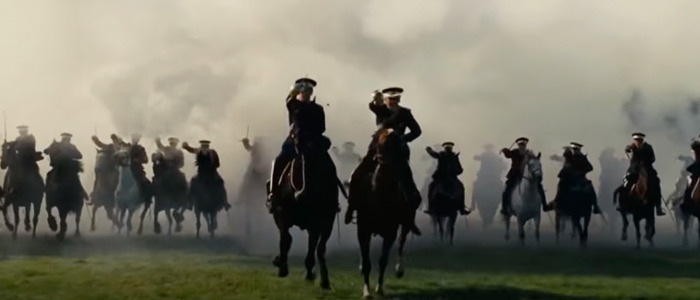
The war goes from planned charges to muddy trench warfare, Spielberg opens it up with a spirited run where, Joey, alone and ownerless for the first time in the film, makes a desperate gallop for freedom (something possibly learned by a former caretaker), through, over and past the soldiers huddled in the trenches and ironically ending his gallop in the middle of No Man's Land, where warring parties must watch and wonder at the sight between them that has nothing to do with the concerns of Man.

But, where War Horse most resembles Ford's work is pictorially—Spielberg sticks to close shots for moments of drama, but when he opens up, it calls to mind advice that the old Commander gave the young director when he was still dreaming of making movies (see video below). He's definitely paying attention to the horizon in this one, and the film,
especially in its final moments, seems to come from a different era, one more rich in design and purpose.

In its color, both in sentiment and photographically, War Horse hearkens back to another period of cinema, one that was simpler and more direct, but it never betrays anything less than sophistication of subject matter and maturity of purpose, while still maintaining a high level of entertainment value. At this point in his career, Spielberg is presenting a master class in film-making, evoking the past when it suits him, but maintaining a personal growth that seems to never flag.

Wednesday, April 12, 2023

A Very Long Engagement

Written at the time of the film's release in 2004. There have been a lot of movies about WWI since then. Now, you know what they were watching when preparing their movies.
 
A Very Long Engagement (aka "Un long dimanche de fiançailles") (Jean-Pierre Jeunet, 2004) Epic war film, reuniting Jeunut with his Amelie star Audrey Tautou, that tells the story of one woman's search for her lost lover who went to WWI and never came back. The film is full of story and incident (and Jeunet's wind-up mechanism way of telling a story) that it makes the 134 minute film feel a lot longer.The film starts as a story told in flash-back of five soldiers who were court-martialed for self-mutilation (shooting themselves in the hand by various means) in order to get themselves out of the war and the hellish existence in the trenches on the front line. One of them is the Manech (Gaspar Ulliel), lover of Mathilde (Tautou), whose fantasies and re-imaginings of the circumstances of the war make up the bulk of the film's realisation. By various means, she begins to piece together the story of her lover's court-martial and punishment (he and the others found guilty are thrown out of the trenches into "no-man's land" to fend for themselves), which are told "Rashoman"-like from different angles and perspectives.
The war-scenes are appropriately grisly, Jeunet displays his usual penchant for things grotesque--there's a murder of a rotund general by a prostitute that's particularly...interesting--that are part and parcel of his films, and there's the tendency to turn his films into little Rube Golberg-esque mechanisms, that can become tedious as much as they can delight (He always has to thrown in "the mechanism of sex" joke somewhere, too).*
Still, as distracting as his eye for the unusual shot can be, there are moments of "gee-whizzery" and CG-wizardry that are pretty wondrous, and stay in the head long after the details of the movie fade. Jeunet is a master of bending reality to meet his artistic goals, whether lighting and dressing an area to its maximum potential, or employing digital tricks to make it conform to his vision or the past's.

Examples of some of the amazing frames of A Very Long Engagement, some courtesy of Evan Richards and his wonderful blog "Cinematography, Etc.**
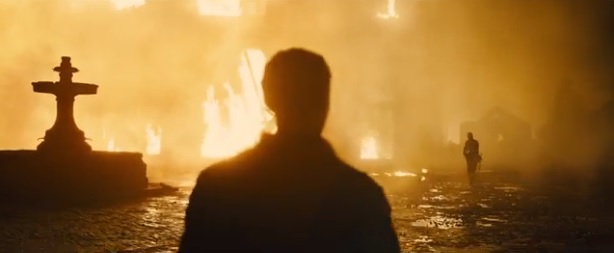
A make-shift field hospital set in a dirigible hangar is engulfed in flames
when a bomb sets off the contained hydrogen.
A sinister night meeting is made even more so in Jeuneut's composition
--as the one must come down to the other's level.
Going a long way for a visual pun-a farmer is met by gendarmes to join the war-effort,
and the wind from their car sweeps aside the tall grass leading to their wagon. "Draft," indeed.
Jeuneut makes incredible use of depth-of-field here, as Mathilde seeks out the wife of one of 
the condemned in a market-place (Yes, that is Jodie Foster, whose french is impeccable)
A Luhrmann-esque "post-card" shot told in lettered flash-back.
A CGI recreation of WWI-period Nice, France. Quite Nice, in fact
The crippled Mathilde must stand on her rickety wheelchair to reach for war records.
"MMM"--the initials "Manech's marrying Mathilde" --is a constant icon throughout the film. 
Here, Jeuneut cranes up from the carved initials to Mathilde's obvious bliss.
The shot will continue further up to include an albatross-symbol of tenacity.
The young Mathilde fantasizes that her new boy-friend will save her from falling from the lighthouse. 
The next scene will have them embracing as they gaze from the light in a mock-Hollywood shot.
Jeuneut makes the stair-way leading to the light-house lamp a literal "golden spiral".
From the impossibly soaring crane-move preceding it, it's obviously a set, 
but the breathtaking sun-set looks quite real, even if it is computer-enhanced.
Jeuneut makes Mathilde's family's home warm and earthy by accentuating the color palette of the scene.
The Fog of War--Jeuneut drains the color out of a stark battlefield to shades of gray.
A hospital is drained to a sepia tint, not unlike the jaundiced color of old medicine bottles.
The lighthouse stirs to life

Ultimately, it is such a polyglot of a movie that one can't help feel it might split any potential audience. Those wanting a purely romantic film will be put off by the war scenes and the occasional blunt sexuality, as well as the prolonged sense of hopelessness the film radiates. Those interested in the mystery aspect will be frustrated by the lack of momentum in the progress of acquiring facts and the diverging stories leading to blind alleys. What spurred me on was seeing the amazing scenes like the preceding ones, and seeing a new one around every splice.

It's an amazing film, if not everyone's cup of tea.

* It occurs to me that in the unlikely event Steven Spielberg ever wants to hand over the reins of the "Indiana Jones" films to another director Jeunet would be the perfect choice. ***
 
** Sadly, no longer a part of the Inter-webs. But, credit where it is due.
 
** Uh, yeah. He didn't.

Saturday, January 7, 2023

All Quiet on the Western Front (2022)

Butterflies Not Included
or
"Germany Will Soon Be Empty" (The Ever-Diminishing Perspective)
 
"We are not youth any longer. We don't want to take the world by storm. We are fleeing from ourselves, from our life. We were eighteen and had begun to love life and the world; and we had to shoot it to pieces."
Im Westen nichts Neues "Nothing New in the West" 

Erich Maria Remarque's "All Quiet on the Western Front"—not an exact translation of the title, but it's stuck in the vernacular—created a sensation on its publication (in magazines form November 1928 and in book-form January 1929). Within a year, the author's fictionalization of his time during the first World War had been bought by Hollywood and made into an Oscar-winning film (for "Best Production") by Lewis Milestone. There was a TV version in 1979, directed by Delbert Mann, which won a Golden Globe for Best TV Movie—it was filmed in Czechoslovakia—and an Emmy Award for editing.
 
There was considerable buzz in the air around the Holidays in its being mentioned for Oscar nominations—and not just for Best Foreign Film. Frequent Twitterers mentioned it as a contender for the Best Picture short list.
Now Netflix has sponsored a new version of All Quiet on the Western Front
(I guess you need 40 years or so to pass before doing it again—as if we weren't reminded enough that war is hell). The story of "Paul"* (played by Felix Kammerer—who seems genetically predisposed to have a "Thousand Yard Stare") one of a number of young German students, spurred by the patriotic speeches of their professors to join the German Army and to fight. Their teachers and academics fill their heads with dreams of glory and burnished reputations in protecting the Fatherland (who were the aggressors, if memory serves). But, once they tramp out to the trenches at the front lines, they learn different. They're stuck in shit-holes, where they arbitrarily wait for their generals (safely ensconced away from the battles**) to launch attacks that will gain them mere yards of ground, only to have them taken back when the French attack later. The absolute futility of the First World War was in how both sides traded time in each other's trenches.
Director-writer Edward Berger has changed a few things (from the novel). He starts—as with most of the segments—with beautiful shots of the terrain, forests, the natural world. Picturesque contrasts with what will come after—the grays and browns of the trench area punctuated with barbed wire strung on fallen crucifixes. The trenches are ramshackle caves where the soldiers huddle with the rats and offer little protection from aerial attacks. It's like the graves are already dug for the soldiers—they just don't know it yet.
After the beauty shots, Berger cuts to an attack—prior to Paul and his chums being sent to the line. It goes badly. The dead are catalogued, with their dog-tags broken in half (that's how they keep count of the kills and who's "winning"), graves are dug, and their uniforms recycled. Bullet holes and rips are repaired and readied for the next batch of soldiers—Berger will do a call-back on that later. But, it makes the point. The lives of the German troops are just as recyclable as the equipment. When one dies, another is put in their place. They're literally cannon fodder, indistinguishable from another. For small patches of ground.
But, there's an added element here. Ever since Francis Ford Coppola's Apocalypse Now, there has been an artistic dichotomy to supposedly "anti-war" films.*** They're beautiful. Films like Stanley Kubrick's Full Metal Jacket. Sam Mendes' 1917. There's horrendous, ugly carnage, absolutely (all wars look the same from the inside), but there is also a directorly effort to make some shots as beautifully lit as possible. Michael Herr mentioned it—that dichotomy—after working with Kubrick on his Vietnam film. And Bergen is no exception. One of the things that bothered me about 1917 was how beautiful it looked (thanks to cinematographer Roger Deakins) and wondered if that was enticing to potential recruits, the way the Top Gun movies are. Is this the film-making equivalent of shooting yourself in the foot?
Another thing got to me about the film. There is something called "One Point Perspective" Kubrick used it a lot in The Shining and 2001. Wes Anderson's films are masterclasses on one-point perspective. Here, Berger uses it to the extreme. At one point, there's a sequence in a train station with a slightly off-axis that I thought, "Oh, he's not going to center the train in the shot. Good choice."
I had thought too early. Within a minute, Bergen had moved the camera until, like it was on a track or something, the camera hit the mark so that the train was perfectly centered. Perfectly. Centered.
But, it is an interesting choice. Both Kubrick and Mendes used that technique to make an almost vertiginous experience, sucking you into the screen...and the story (when you're not distracted by all that symmetry, of course).

Berger does some interesting things with the script, as well. A whole section where Paul goes home and is repulsed by his household's fascination for the war is reduced to a single line in a bivouac sequence. And as persistent as he is with the perspective issue, he isn't as dedicated to the book's reluctance to show anything beyond Paul's perspective. He inter-cuts the scenes at the front with the attempts by Matthias Erzberger (played by Daniel BrĂĽhl) to sign an armistice with the French, which as protracted and stilted as it is, still manages to convey some tension about the outcome of our singular hero.

It's an odd push-pull kind of dynamic that the film presents: the country that launched the war makes a film about it, not neglecting the bloody carnage or the irresponsibility of its generals, but making pains to show its humiliation in negotiating the armistice; showing the waste and destruction, but also including decorously-lit sequences that romanticize it; criticizing the war and its costs, while also making it romantic and poignant. One can acknowledge a film's worth, but also be deeply cynical about it, at the same time.

I can my reaction to it can be briefly summed up in that I watched it with English sub-titles—the film, as it should be, is in German—that are none too subtle. And at one point, had the foresight to clue me in to what I was not hearing.

* "Paul," by the way was Remarque's real middle name; he changed his pen-name to "Maria" to honor his mother.
 
** See Paths of Glory. No. Really. See Paths of Glory. 
 
 *** Notice I didn't mention Oliver Stone's Platoon? Can the lack of romantic lighting in that film be because Stone actually fought in the Vietnam War.

Wednesday, May 20, 2020

Dark Journey (1937)

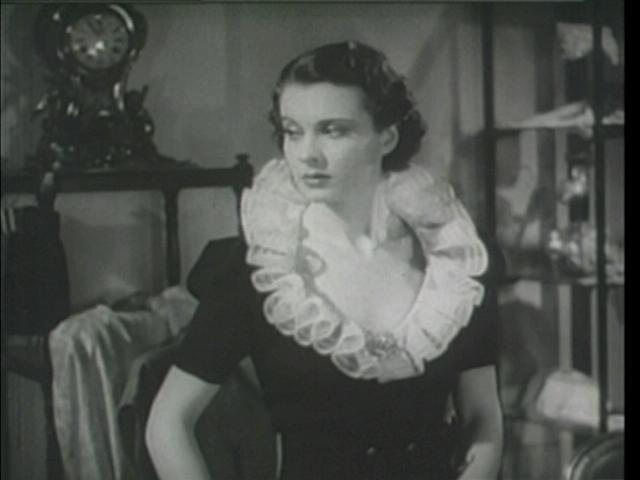
Dark Journey (Victor Saville, 1937) All's fair in love and World War I—but when love and war are running congruently, neck and neck, that's when things really get dicey. Especially when the warring lovers are spies, spying on each other. There's Madeleine Goddard (Vivien Leigh) is a designer and couture diva who regularly makes a shopping run between France and Switzerland, cloaking her activities as an agent for the British. She moves through the hoi-poloi (who never seem aware there's a war going on) attracting all the best customers, none of them suspecting that her decorative scarves and pattern swatches contain secret plans and schematics. Her assignment—find out who's the head of the German intelligence agency, Section 8. Enter the snakily charming Baron Karl von Marwitz (Conrad Veit), a German deserter who caddishly trolls the gargantuan supper-clubs with their high ceilings and higher society for the more low hanging fruit of females. It is through one of his companions that he becomes acquainted with Madeleine, becomes smitten and just a little stalkerish with her. For some reason, she finds this attractive and the two begin a wary relationship.
Yeah, well, hunt a tiger...and opposites attract, and all that. It isn't giving away any state secrets that the revelations that ultimately come about are a little less than surprising. Nor is it surprising that two intelligence agents so visibly hiding in plain sight might not actually be that effective (C'mon kids, it's called "undercover" for a reason). Imagine the dinner table conversation: "What did you do today?" "Nothing. And you?" "Same thing." Double crossing does not "go" with star-crossing.
Anyway, you thought YOU had a complicated relationship. This was a few years before Leigh would toss away such behavior with a dismissive "Fiddle-dee-dee." And it's fun to watch the complications that ensue when the two spies are a little too loose with their lips. It's amazing that WWI was won at all.
The costumes and sets are lavish (and very un-WWI era). Leigh and Veidt do very well conveying conflicting loyalties, but the plot is a bit spare in details as to be confusing. It's never really determined who has the upper hand—is Madeleine basically a "honey-trap" to seduce the German and get him where he can easily be captured, or is it all a misinformation campaign by either side. Whatever it is, the romance is the least charged of the themes in the film, even though Leigh and Veidt try their damnedest to be anything more than inscrutable. It's an interesting spy melodrama, it's just that there's not a lot to love.


Friday, January 17, 2020

1917

Yea, Tho I Walk and Talk Through The Valley of the Shadow...
or
Last Man Standing, Notwithstanding.

One shot. 

That's the strongest take-away from Sam Mendes' 1917, based on stories told to him by his grandfather, and which Mendes adapted, along with Krysty Wilson-Cairns, to make an extremely inclusive World War I film, with that one difference—make it appear as one continuous "take," seemingly without edits.

Mendes had experimented doing this with the first sequence of his previous film, SPECTRE—part of the James Bond franchise—a four minute seamless tracking shot during the "Day of the Dead" celebration in Mexico City as Daniel Craig's Bond "makes" his target, goes up to a hotel room balcony and then saunters along the rooftops to a sniper position to take the terrorist out.

It's not continuous, though. There are moments where the camera "settles" for a split-second on something—free of human beings and any sky shots with moving clouds, something inanimate and stationary—where invisible wipe-edits can be made to complete the illusion of continuity. But, in 1917, that tack continues for the entire run of the movie (with one exception, where a soldier is knocked unconscious by a bullet to his helmet), which is some two hours.* 
This is not unique—Hitchcock did it in 1948 with his experimental Rope, essentially a play without the proscenium arch and the audience on stage with the actors, doing 10 minute continuous shots (which was the length of a film reel) until he could focus on somebody's back for the reel-change—and has been done more frequently of late thanks to digital photography (think of Birdman, Gravity, there's a list of them on Wikipedia now). The effect has been used to create tension—when is the scene going to "break"?—ala Orson Welles' long opening to Touch of Evil. And World War I is ideally suited to this conceit, given its emphasis on trench-warfare, where the viewer is hemmed in by the narrowness of the space, used to very good advantage in tracking shots by Stanley Kubrick in Paths of Glory and emulated here by Mendes.
The film begins—as it ends (no real spoiler alert necessary)—with a soldier relaxing under a tree; Lance Corporal Schofield (George McKay) is soon told to get up by Lance Corporal Blake (Dean-Charles Chapman)—there's a mission  that he's been called to carry out and he's chosen Schofield to accompany him. What's the mission? No idea, he's on his way to the bunker of General Erinmore (Colin Firth) to hear what it is. The two slop to the make-shift HQ and given the task—word is that the Germans have not retreated, as has been the thought, but diverted to the newly-formed Hindenburg line where that entrenched position will allow them to decimate the Devonshire regiment who have been planning an attack that will place them right in the path of the German artillery there. Phone lines and communication are down, so the two men must hand deliver a message to call off the attack scheduled for dawn the next day lest the 1600 men be wiped out, including Blake's older brother who is stationed there. 
Time is limited. The two have to leave the trenches, weave their way through No-Man's-Land, pick their way past the German trenches, evade whatever sparse troops might be there on the way—IF they have, indeed, moved—make it to the city of Ă‰coust, follow the river nearby and get to the Devonshires before the attack can happen. In other words, they have to go through enemy territory and any stray threats there to hand deliver written words that, they are warned before heading "over the top" by an embittered Lieutenant Leslie (Andrew Scott, always welcome) that the orders might not be believed, anyway.
The Devil of the trip is in the details and they come in the form of booby-traps, rats, blasted out landscapes, snipers, armed aerial reconnaissance and the general fog of war. Mendes' usual one-point perspectives keep a viewer focused on what's up-front, but the ever-moving camera has you exploring the edges of the frame, looking for hidden dangers that just might be slipping into view. 
The focus is constantly changing, although still hampered by the camera frame, giving one a 90° vantage of what is surrounding Blake and Schofield, immersing the audience in the step-by-step journey while also limiting the field of view. Yes, it "puts you there" but it is also frustrating that your vantage is from a letter-box.  At times, it has the feel of a FPS video-game (without the woozy headaches), but even then, you're controlling where the field of view looks. In this, you're just a prisoner.
Thank God, though, that the fellow who is controlling the view is Roger Deakins, one of those masters of light, a cinematographer who can make anything, even a pristine field, look magical. Technologically, the film must have seemed daunting—not just in the one-shot fluidity—but also in the various lighting situations—by candle, flash, flare, or flame—that Deakins has been honing over the last couple decades of working with demanding directors who were seeing the world a little differently from others and has managed to pull miracles out of the lenses he's been peering through. It's another wonderful example of Deakins excelling in an already crowded field of filming magicians who have moved the bar—or the f-stop—on what can be filmed, let alone imagined.
As beautiful as it is, though, one wishes there was more to it than that. For Mendes, of course, it's a personal tribute and a sentimental journey, a technical challenge well met, and impeccably done. At the end, however, one just feels a bit empty. Perhaps, that is as it should be, given that war, given that carnage, given its lasting effects on a generation—the "lost" generation, as it has become known in artistic circles. It is a story well-told, but not much of a story, as personally heroic as it might be. The monstrosity of that war and its futility has been better recounted for as long as there's been film...or near about's. Certainly as long as films have been giving out awards to itself.
It just pales in comparison to other WWI films, its technical prowess notwithstanding. And when one places it in comparison with...oh, let's say, They Shall Not Grow Old, which is also personal—interviews are with veterans, while memories are still green—and technically stunning—original Imperial War Museum footage, spit-and-polished up, sound-enhanced, digitized and colorized so as to seem new, not 100 years old, the effect historically, emotionally, viscerally is far more than 1917 can achieve. Yes, bravo for making it, but points off for making it an exercise rather than an experience.

* Slight time-error here: the mission is supposed to take six hours, so unless the soldier knicked is out for four hours this is some inevitable time-compression to allow for multiple showings at the cineplex—and that's assuming the time-estimate is based on the assumption of one or both of the soldiers being unconscious for four hours!