Friday, July 27, 2018

The Illusionist (2010)

Written at the time of the film's release...


"The Disappearing Act"
or
"We Liked His Earlier, Funny Ones..."

The French comic/film-maker Jacques Tati left one un-produced screenplay when he died in 1982. That script, entitled "Film Tati NÂș 4," is the basis for animator Sylvain Chomet's first feature after The Triplettes of Belleville, The Illusionist (or L'Illusionniste). It is a lettre d'amour to Tati, with a main character resembling the French Master in size, style and manner (right down to the examination of the world with hands placed on the back of one's hips), directed in the same spare long-shot frame that allows disaster to occur from corner to corner.  It has the same errant mechanics (the sense that what could go wrong will go wrong), the ironic timing and "marking time" quality of Tati's films, in the elegantly focused manner of silent films with sound effects.
But, it is a special case. Tati wrote this after Mon Oncle and never made it, for whatever reason, coming down to mostly personal grief...but over whom is much in dispute. Tati had two daughters, a child-out-of wedlock whom he abandoned, named Helga, and his legitimate daughter Sophie. Tati was going to make the film with Sophie in the 1960's, but never did. His estrangement from his daughters weighed heavily on him, and the result—this melancholy little mea culpa—might have seemed as cheer-dousing as Charlie Chaplin playing MacBeth. Or, it was simply too "close" to commit to.
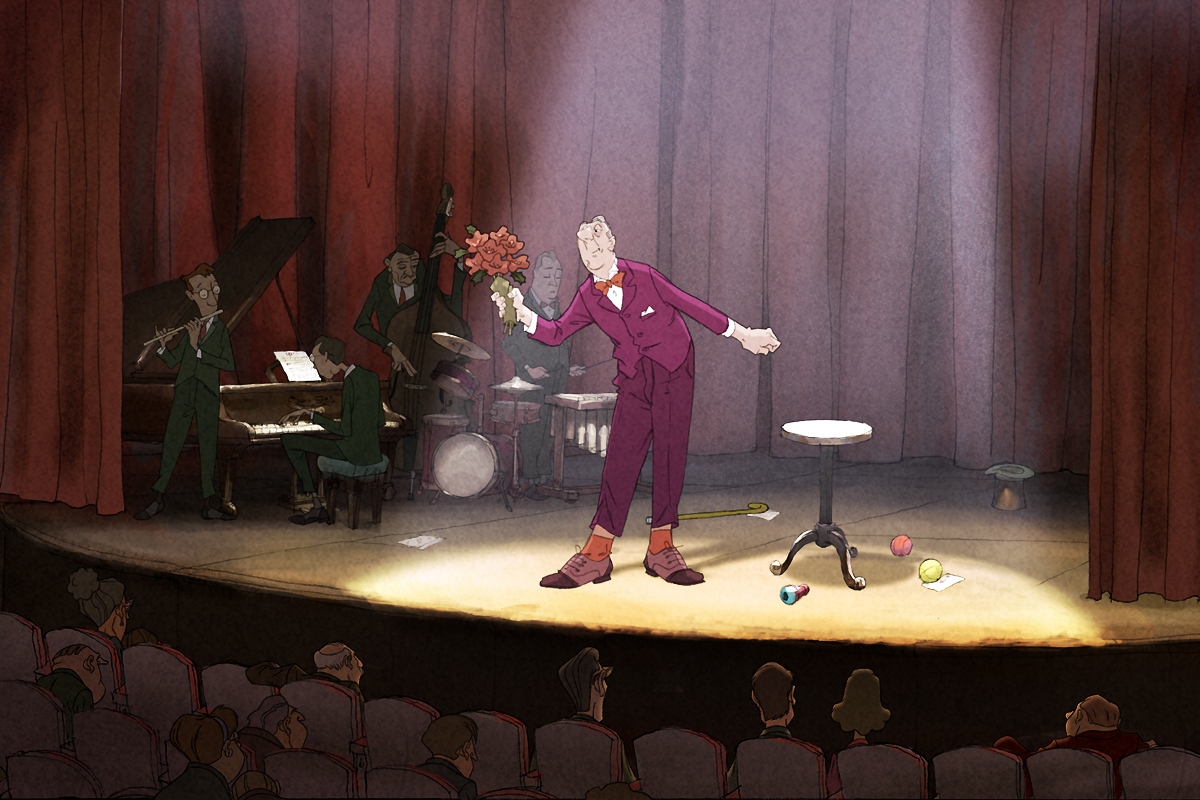
A not-too-well-considered prestidigitater, Tatischeff (Tati's real name, by the way) is pulling a living out of his hat on a low-rent club circuit. It is 1956, and rock n' roll is filling the theaters, and television is emptying the minds.  Tatischeff can't compete with his props and particularly ill-mannered rabbit (he bites!) and he plays empty halls to little applauseAn invitation to perform at a private party in Scotland turns out relatively well, and he stays, making the acquaintance of Alice, who works the tavern and sees Tatischeff as a genuine magician. Noting the condition of her shoes, he buys her a nice pair of red ones, leaving her convinced her that actual magic can happen.
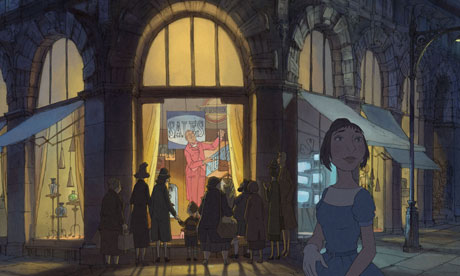
On a trip to Edinburgh,* he discovers that Alice has followed him without a ticket.  He buys her one, and the two travel the rest of the way together and settle in the city in a flop-house for performersWhile Tatischeff performs to the dwindling crowds at the Music Hall, Alice cooks, cleans, becomes the roving ambassador to the other performers and wanders the streets looking at the promises of a better life in Edinburgh shop-windows
The relationship between performer and waif is completely a father-daughter relationship. He is a bit aloof, but tries to provide for her dreams by taking on a series of increasingly demeaning jobs, which he manages to pull off with uneasy aplombShe cares for him, but looks to the horizon. At some point, his job is to let her go...to perform his own disappearing act in her life, if she is to have one. Bittersweet, to be sure.
The Illusionist also has up its sleeve the constant thread that everything is an illusion: performers and artisans put their best face forward, we hide behind masks, we project elegance, we learn as we go becoming expert only after trial and error, and there is nothing so false as the entertainment industry with its sad clowns, facile crooners and feathered chorines. There are no inner lives on stage, only the projection of illusion, a made-up false-front for reality.
Rich in detail and sub-text, it's the sort of quietly deep-thinking comedy that has mostly been absent since Tati passed, and though it has its laugh-out-loud moments, it is mostly a meditation on the transitory nature of life, how we dress it up, corral the chaos, change it, make it into reality only to see it fade and move on. It is partially performance, partially illusion, but we are constantly changing, turning something into something else. Life is what we make it and what it makes us.  


* I've been to Edinburgh—it's where Chomet's studio, Django films was located—and the recreation of the city is amazing.  There were all the places I'd seen, but all in the wrong place, a scrambled Edinburgh that doesn't lose any of its charm.

Thursday, July 26, 2018

Deliverance

Deliverance (John Boorman, 1972) Let me start with an anecdote: I had a dog who was as feisty as all get-out. There's not too much he was afraid of, other than missing a meal, and, a Blue Heeler, he could be quite aggressive in protecting his perceived territory. 

I would take him camping, which he enjoyed immensely. That is, until it came time to sleep in the tent. At that point, the dog would become quite agitated, especially because he could see through the tent's mesh to the outside world. He could hear what was scrabbling about outside. He could smell anything like it was in the tent with us. Of course, he kept acting as if the whole idea was absolutely insane: "Sleep? Out here? There's nothing but some fabric to protect us! Are you crazy?" He wouldn't sleep all night—and subsequently, neither did I—as he would dutifully pace around to make sure everything was safe, especially his idiot-master who thought a tent—in the wilderness—was the same thing as a well-constructed house in the suburbs. "Are you human beings mad??!"

And the answer was—and  is—"Yes. Yes, we are."
I tell that story only because the dog realized something only a non-biped would realize--that Nature is raw and rife with a thousand natural disasters and is entirely cruel in our scheme of things. Cruel in tooth and claw, as they say. But, even so, "human" Nature's got it beat ten ways from Sunday in finding new demonstrations of cruelty. For every natural disaster we see in the headlines, the disasters imposed by man can fill out the rest of any edition of the Sunday paper.
And so Deliverance, from the novel written by the poet James Dickey that I was quite fond of back in the day...when I was a kid. I was a skinny, un-athletic little nerd with anger issues limited impulse control—what I knew about life, I learned from the movies, so I knew more about melodrama than I did about what living was like. When I read the book, it seemed an indictment of macho posturing and of the inner strength that can be brought to bear when necessity forces it upon you. For me, it seemed a hopeful book—I, too, could find my strength, when confronted by the challenges of life, despite my lack of stature and the emotional immaturity I used to supplant it. What can I say—I was a kid.
At the time Deliverance appeared in theaters I was worried about its adaptation because the simple story, of four city-boys who take on the adventure of canoeing a river about to be dammed out of existence, could have been made into a very crude film. And it skirts that by being so direct and just a shade surrealistic. The actors did their own stunts, the make-up team did some bizarrely realistic injuries that, rather than repulse, seemed almost fascinating—it looked like it hurt like hell, but fascinating nonetheless. And, under the austere direction of John Boorman, it's themes of ecology and fool-hardiness, vain-glory and finding strength where none was expected are enhanced and made into an almost mystical experience by the film-maker.
Four rather complacent suburbanites—Ed Gentry (played by Jon Voight), Lewis Medlock (Burt Reynolds), Drew Ballinger (Ronny Cox) and Bobby Trippe (Ned Beatty), spurred on by Lewis, take a weekend canoeing trip on the soon-to-be dammed Cahulawassee River. For Lewis, there is some urgency because dam construction has already started and soon, the river will cease to exist, to be replaced by a reservoir. All four want to have a weekend with some thrills and a little bit of danger to it.

The mix will be different, and with lasting effects they never counted on.
They car-pool deep into the northern Georgia woods to the river's head-waters and pay some locals to drive their trucks down to the town of Aintrey at the river's mouth where they can find them at the end of their run. It's at this section of the film that the memorable "Dueling Banjos" musical segment occurs. It's fairly apparent that the visitors and the locals don't quite see too much of value in the other.
The animosity between the locals and the "city-boys" (Lewis takes umbrage at that) gets reflected among the four once they get on the river. Lewis and Ed have had outdoors experience, but pals Drew and Bobby are newbies. Drew and Ed are in one canoe, and Lewis and Bobby are in the other. Bobby's a "good ol' boy" but not much of a man, doughy, a bit too loud, a little too easy with talking but not too much with thinking. Lewis, who is posturing and on the macho side of vain, takes a dim view of the overweight and overbearing Bobby, who is also the first to panic and the first to not take anything too seriously. Anything can be bought with a couple bucks, and in a canoe, he's more freight than power. 
This causes a change of partners in mid-stream, and in a competition about getting through some rapids, Bobby and Ed make it through first and beach their canoe to wait for the others. They wander into the shade of the forest, not knowing when they'll show up.
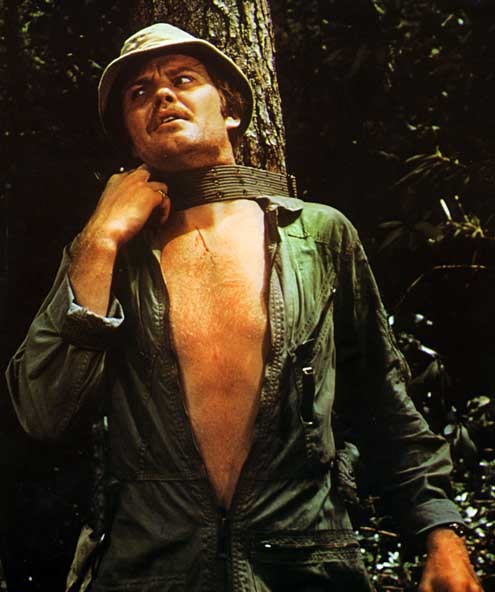
They find two hunters (Bill McKinney, Herbert Coward) who might be poaching but it doesn't matter. They have the drop on Ed and Bobby, and they take advantage of it, threatening with shotguns and attitude. Bobby tries to buy them off, but it just makes them more contemptuous. They take off Ed's belt and neck-tie him to a tree, rendering him immobile, and then they go after Bobby, ordering him to strip and man-handling him before assaulting him. Ed can only watch in horror, knowing that he's next, when he sees something in the trees.
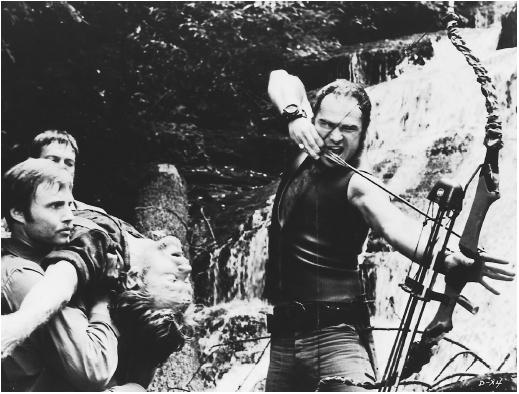
It's Lewis, bow drawn, taking aim. One of the men is shot full through the chest and can only look at the bloody blade of the arrow in disbelief, as he slowly staggers and dies, his accomplice running off into the woods. Lewis starts to think about the next step, as the other three try to pull themselves together. Drew is for reporting what happened to the authorities, but Lewis is against it, thinking they should bury the body instead, and let the reservoir complete the work hiding the body under tons of water. Drew is aghast, but Lewis argues that local justice and clan-vengeance will work against them. And he likes his freedom. Bobby is all for the burial, and Lewis leaves it up to Ed—if he sides with Drew, he'll abide by it, but if it's the burial, it's three votes to one. 
Ed chooses to bury the body. The four take the body of the hunter and bury near the edge of the river, where they're sure the reservoir will hide the body. Lewis fires the killing arrow deep into the river, and the four beat a hasty retreat for Aintrey through the roughest, loudest parts of the river. At one point, Ed looks back at Lewis and he's shouting something desperately, trying to be heard over the river, urging them to move fast through the rapids, and just when they approach the roughest part, drew suddenly lurches forward and is lost in the river.
Bobby and Lewis' canoe crashes into rocks and is split in two and Lewis is thrown into the river, breaking his leg in the process. Bobby and Ed drag him to the edge of the river and through his screams of pain, Lewis tells Ed that he saw something in the cliffs above him when they were going through the rapids, and he's convinced that Drew was shot. Perhaps it was the other poacher, but maybe not. Whichever way it turns, Lewis is sure they were targeted. If that's true, they're trapped there. Somebody has to climb the cliffs and confront the shooter. Given the circumstances, it can only be Ed.
Under cover of darkness, Ed makes his way up the cliff with the bow and arrows—if he falls, he could be killed. If he makes it to the top, he could be killed. But, the situation is desperate and there is no other choice. His friends depend on him, or everybody dies. 
At dawn, exhausted, Ed wakes up to see a distant man with a shotgun, looking down towards the river. Trying to escape notice (which he doesn't), he draws a bead on his target, but his hands shake and wobble under the strain of the bow and the act he must perform; he is not expert with the bow as Lewis is, and an earlier attempt to shoot a deer ended in failure, both because of his lack of strength and an unwillingness to kill. But that was then. This is now...more than ever.
It can't be Lewis, although Lewis would have carried it off. But, Lewis' skills are useless now. It has to be Ed, and there can be no weakness, no doubt, and no hesitation. The word "deliverance" has the meaning "the action of being rescued or set free." "Liberation." "Emancipation." And it comes down to one character to achieve it...for others and in himself.
The situation is simple, primal—man vs. Nature and man vs. man, but ambiguous, both morally and circumstantially, played out under extreme conditions with extreme consequences, and under duress, where hap-hazard thinking or action could doom them all. It must be carried out by one individual only marginally capable of it, and on whose shoulders, the solutions must weigh. 
Boorman accentuates the danger of the surroundings by avoiding clearings and staging so many scenes in the middle of the forest, with a restless camera that shifts perspective around trees, through brush, moving the formations of them around, to the point where you think you can see things in the patterns of the woods. at times you can't see the horrors for the trees, and it's as much a participant as the characters, so enveloping is its dark presence. 
And Boorman presents tangible, visceral horrors not present in the book-- a mountain man newly killed falling forward into the crotch of a small tree and remaining upright; macho Lewis pulling an arrow, slowly, excruciatingly, out of the breast-bone of a backwoods attacker ("Where'd the fletches go..." I thought when the act was done); the exaggerated horror of the men's injuries--the broken thigh-bone that pierces Lewis' leg (Reynolds does an incredible job undercutting his character's uber-stage-manliness with some of the most blood-curdling whimpering I've ever heard), the dislocated shoulder of Drew that has the man cradling his own head, sitting, weirdly on a rock out-crop, and Ed pulling an arrow out of his side to prepare for his final show-down below a sky that simmers in a yellow exposure-pushed sky. We won't even talk about how good and how brave Ned Beatty is. And it was his first film (as Reynolds generously points in interviews these days about what he considers the best work in the film).
If there is a weak performance at all in Deliverance it's by author Dickey as the seething Sheriff who's just a little too-unsubtle in his suggestions. Voight, Beatty, and Cox do great work, and, forgoing insurance, did their own rafting stunts. But Reynolds is terrific in his role, totally dominating the first half of the film, and, though out of action for the rest of the movie, still makes an impression. Hollywood may have a problem with him (doesn't take them...or himself...too seriously, perhaps?) but it would be nice to acknowledge that he can give gifted performances when gifted with good scripts.
In 2008, The Library of Congress chose Deliverance as one of the significant films to be added to the Film Registry.


Wednesday, July 25, 2018

The Hobbit: An Unexpected Journey

Written at the time of the film's release.

Getting to Be a Hobbit With Me
or
There and Back Again...and Again...And A-GAIN.

Peter Jackson returns to Tolkien's Middle-Earth, the scene of his greatest triumphs as a film-maker. And it hasn't been easy for him. "The Lord of the Rings" trilogy took the film industry by storm, changing all sorts of accepted things, like "sittable" film length, production timetables (filming three films simultaneously), elaboration of production design, and whether a "fantasy" film can ever be taken seriously by the Oscar Academy for anything other than technical awards. In fact, when The Lord of the Rings: The Return of the King won Best Picture a few years back, more than one gossip-monger (or as they're known, "industry press") suggested it was for the entire series of films, rather than for the merits of the final one. I believe that. So, pressure immediately started to bring Tolkien's "The Hobbit" to the screen in as much the same way as possible, with Jackson producing and Guillermo del Toro directing, a good choice, actually (and the film benefits from his bizarre creature designs).  
But, "The Hobbit"'s past caught up with it, and the several (animated) versions of it came into play over who owned the film rights, and so The Hobbit: An Unexpected Journey has a complicated production titles sequence with Warner Brothers the (North American) distributor and New Line Cinema and M-G-M as the production facilities. M-G-M's financial troubles (now long forgotten in the wake of Skyfall's nearly billion dollar take) caused del Toro to drop out, leaving Jackson and his orc-army of New Zealanders to once again handle the short-duties for the assembled hobbitage.
And how is it?  Much as you'd expect. It's as if they'd never stopped production on the first series, and so sure of the continuity are they, that the moments immediately preceding the start of The Fellowship of the Ring are presented, as if it was the easiest thing in the world to do. The film's been getting lukewarm reviews, and I can't can't quite fathom why. Nothing's really different. The supporting cast is uniformly the same (there's no Viggo, but Frodo is briefly there, and Martin Freeman takes over the role of the younger Bilbo Baggins in a way that seems to suggest a more spry Ian Holm with much faster and more comedic reaction-sense), but the main criticism seems to be a more leisurely pace. This, I don't mind. Jackson has always regretted not showing more of Hobbiton, which might have given "The Lord of the Rings" more of a sense of "home," and as something worth fighting for—a theme played in spades in TH:AUJ.*
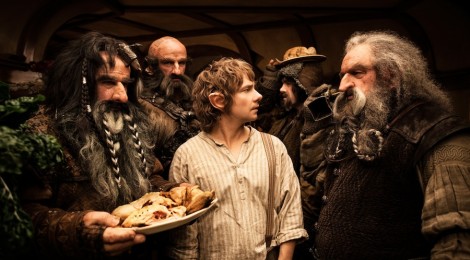
Seeing as so much of it is set in the Hobbit's land, and that the cast is dominated by a baker's dozen of knock-about dwarves (see below for a guide) that have a propensity for one-liners and malapropisms, the tone is considerably lighter and larkier (and dare I say "precious") than the Doom-laden "Rings" trilogy, and it is only once the band of adventurers get going that things change to the previous series' denatured color schemes, brooding skies, ugly thuggery and general bad-assery ensuing.** The pace may be slower, but the film is considerably richer for all of that, and with so many characters in this arc, it's rather a luxury to get to know them before they are threatened in all sorts of ghastly ways.
The other issue with this Tolkien adaptation is technological. Films, since the frame-rate has been standardized, have traditionally been projected at twenty four frames per second, the estimated time that an image is retained by the eye. Now that film is mostly passé, the video standard is 30 frames per second, but it's largely an arbitrary rate to match the traditional film experience. During the late 70's, special effects wizard Douglas Trumbull offered up something he called "Showscan" which was 70mm film projected at 60 frames per second, which produced a larger, sharper image with less "streaking" of movement, due to the higher frame rate. I saw one of these "Showscans" at the Vancouver World's Fair and the effect was like watching a richer, more beautiful version of videotape. It was still film, with its photo-chemical reaction to light, but far more relatable to a "life-image" than film.
TH:AUJ is photographed digitally, but at a frame rate of 48 frames per second (what is being called HFR, or "Higher Frame Rate"), twice that of standard film, and in 3-D (to make what Jackson calls a more "immersive" film experience). The effect, once one has adjusted to it, is quite magical. Jackson doesn't try to do the 3-D tricks that Ang Lee does in Life of Pi, but the faster frame rate does improve the effect of things moving close by in 3-D; there is no longer the "stutter" effect, if something is moving by in the "near-field" at any rate of speed, which is something of a relief. And given that Jackson employs even more helicopter shots over New Zealand terrain here than in the "Rings" trilogy (as well as parallel swooping "crane" shots during the many sequences underground), that's a big help. Where it has its drawbacks are in some scenes that make the CGI characters look like toys figures, some of the impressive building constructs look like play-sets, and a slight mismatch of CGI (particularly during flying scenes) melded with terrain.
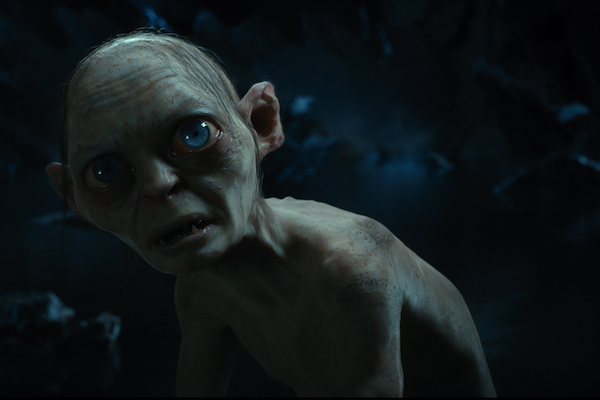
Still, it is hard to quibble when the image is so sharp, Jackson's color sense is eye-popping, and he still manages to keep a shimmering image through murky 3-D glasses. It doesn't look like videotape (as so many reviewers seem to think), as the lighting is more graded and subtle, but the movement recalls a better videotape image, and even something moving fast still has a better chance of being registered by the naked, or glasses-hampered, eye. It also allows the telling detail in even the CGI-est of images, like the moistness in Gollum's eyes, or the deep crags under Gandalf's. It is oddly transporting, and given the care that everyone has put into it, it's a very rewarding experience.

Wilhelm Scream Alert: at 02:05 and 02:35


Ya can't tell a dwarf from a halfling without a program.
* Thauj...sounds like a character name.

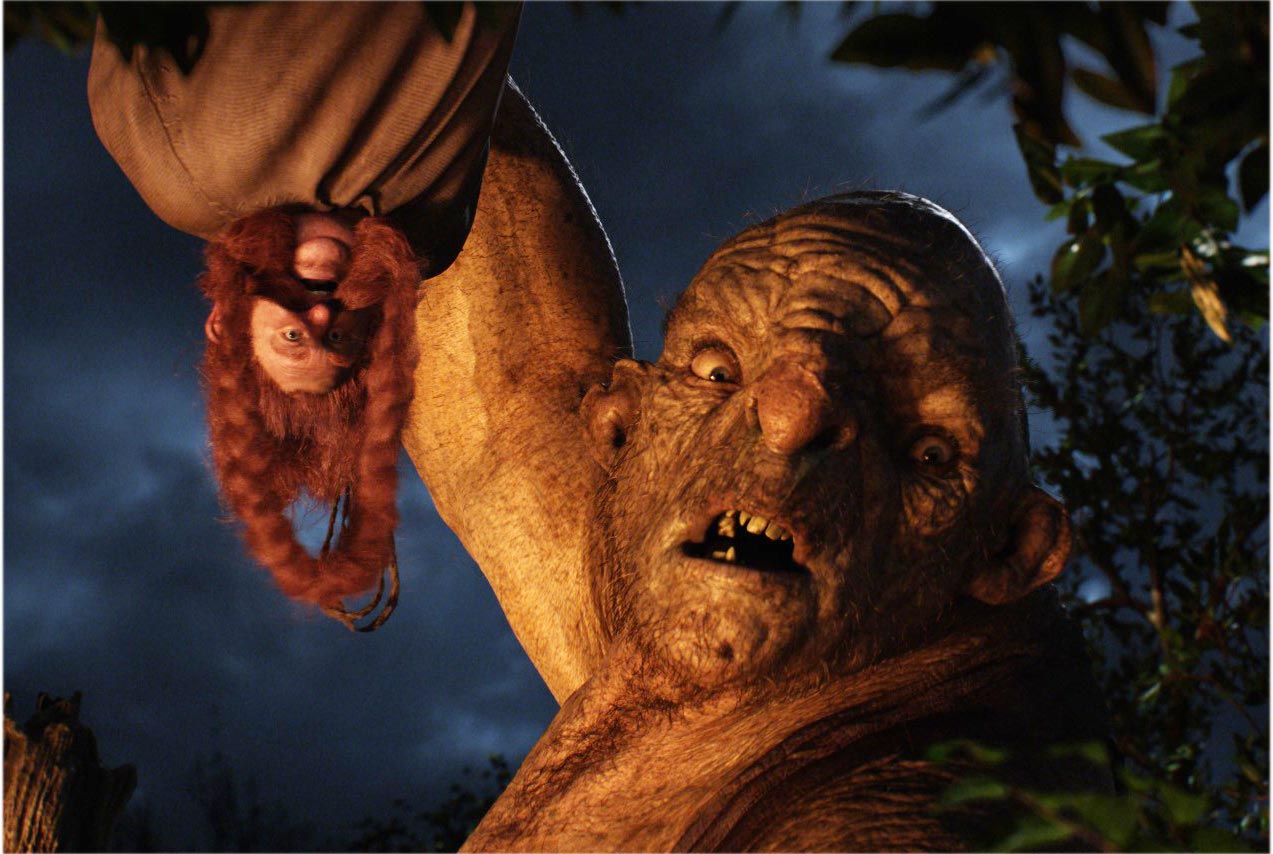
** Speaking of which, things have now approached and gone past the "Indiana Jones" threshold for physical believability here.  There's one particularly Rube Goldbergian sequence fighting trolls in an underground mine that strains credulity—but then, we're talking about a movie with dwarves, trolls, elves, ancient wizards, fire-breathing dragons, giant spiders, animated cliff-sides, and orcs riding big dogs.  That's enough to throw any griping fan-boys off their dyspepsia.  "Dude, this movie troll-kinged the bridge..."

Tuesday, July 24, 2018

Silverado

Silverado (Lawrence Kasdan, 1985) Director Lawrence Kasdan took his big box office successes with Body Heat and The Big Chill and parlayed them into a Big Gamble to revive the western genre with this "all-in" tale (co-written by himself and his brother Mark) of four travelling pilgrims who happen to collide and find enough common ground in skill sets and back-story that they end up resolving each others' business. Why they happen to find each other in all the empty space of the West is a bit of a mystery, but I have a feeling it would have been inevitable as the four of them seem to follow the directions of their own individual moral compasses. Despite their differences, they're going to end up in the same place.

Just like the country. Even though it starts out in the dry wilderness of the West, everything seems to be moving to civilizing and taming the wild, except that things aren't exactly going to plan.

"Nothing wrong with the land. It's just the people," says one of the settlers of Silverado. That settler's brother gets an example of that at the very start of the film: Emmett (Scott Glenn) is asleep in a shack—at least it has a wood-stove—when the door burst opens and guns start firing. A reach for a holster and one guy is dead, but bullet-holes start blasting through the walls, and the roof explodes from rifle-fire. Emmett fires sight-unseen, anticipating the movements and when he finally exits into the sunlight, three men are dead, two horses are on the loose, but one has stayed. That horse will come in handy twice in the movie: once as transport and once as a clue to why someone would want Emmett dead.
Title sequence. While Bruce Broughton's classic score* starts with the first tremulous chords as Emmett exits the shack (in a move not to dissimilar from the opening shot of The Searchers) to reveal a dawn landscape and the music blossoms into full-throated Americana with a chime announcing the title of the movie, Broughton's main theme is presented over shots of Emmett's character travelling with the two horses across various picturesque landscapes, finally reaching a desert, where he spies a prone figure baking in the sun....wearing nothing but long-johns, his legs nonchalantly crossed as if he'd fallen from the sky that way. Emmett takes out his canteen and tentatively offers the sun-roasted character some water. He croaks something unintelligible. Emmett leans closer and we hear the first words from Paden (Kevin Kline): "Pleased to meet you."
They're also the first words spoken in Silverado, and already it sets the pattern for the dialogue that acts as series of laconic, well-chosen ironic words that make up the bulk of the film's banter ranging from austere sentiments that can have hidden depths of meaning and lines that are clever for their brevity and what's left unsaid. Kasdan has written many impressive original scripts and adaptations over his career, since his first optioned script (for The Bodyguard, sold in 1980 but not filmed until 1992), but none is as rich as this collaboration between the two Kasdan brothers.

Over nighttime coffee—Emmett always seems to have coffee—the two men share some history—how Paden got into that predicament (robbed of everything and left for dead by some fellow travelers) and his first summation of his experiences with luck, and Emmett's shack shoot-out ("Aw, I had to get up, anyway" is Emmett's comment). Emmett, it seems, has just been sprung from Leavenworth ("Never been there," says Paden) and he's going to meet up with his brother to reunion with his sister's family.  He asks Paden where he's going, and Paden's reply is practically undecided:

"Where's the pinto going?"
To the nearest outpost, apparently. The two make an odd pair, riding into the fort—the dusty cowboy and the guy in his skivvies. Emmett flips Paden a coin to buy some clothes to make himself presentable "I'm good for it," he says, and absent-mindedly tips the memory of a hat at a shocked mother and daughter. He may not be needing that coin. Across the way, he recognizes his horse...and his pants...and his shirt...boots...gun-belt and guns. The guys getting ready to mount up, so Paden runs into a general store, grabs a gun, but is stopped by the proprietor—that gun doesn't equal that coin. "Well, what can I get for this?" says Paden in a hurry.
Not much. The gun he gets is falling apart, the cylinder falling out of it, plus a box of cartridges more destined for dirt than defense, given his firearm. He has just enough time to hastily assemble the pistol, load a couple of shots, while the guy who's second hand Paden is riding down on him, shooting from horseback—one shot takes out the business-end of his long-johns and he takes a studied aim and fires the guy right off his (Paden's) mount.
You don't shoot a guy in the middle of the street without attracting attention and the local constabulary has questions and they're not buying a bum's story about getting robbed "Can't you see this horse loves me?" The Cavalry Sergeant (Sheb Wooley, he of The Wilhelm Scream) isn't impressed. "I had a gal do that to me, didn't make her my wife..." But, Paden's name is on the inside of the saddle he says and when he's asked for clarification, a voice in the crowd speaks up "P-A-D-E-N"

That's what the saddle says, all right, just like the man says. The man is Cobb (Brian Dennehy) and he and Paden have history. "Where's the dog?" is practically the first thing he asks him. It goes unanswered. In Silverado, some things are best left unsaid, but you will find out about them...eventually, and if you're not in too much a hurry.
Despite the shared past and Paden's recent change of fortunes (or maybe because of them) Cobb offers him a job working with him again. "I've given that up..." Paden says evasively. "So have I," replies Cobb. "I have a legitimate job now." The two commiserate just long enough for one of the men that Cobb HAS hired to be released from the stockade. It's Tyree (Jeff Fahey), who also knows Paden...only too well. "Where's the dog?" he sneers as he rides past him.

Emmett and Paden (with his clothes hanging back on him, again, but still missing his hat) make their way to the town of Turley: Emmett's going to "meet a guy on the way to Silverado." Paden rides along once he finds out there's a saloon and women there. 

And breakfast. They're on their way to eat when they're mistaken for a couple of trail-hands supposed to lead a wagon-train to the town of Silverado. When the two actually show up, they eye the hands suspiciously when they actually don't count their pre-job half of their wages. Odd.
At breakfast, a tall, dark, dusty stranger named Mal (Danny Glover) walks in and asks for a drink of whiskey and a bed (he's been without either for ten days). He's served, but the place's owner comes out and gets ugly and demands the stranger leave, which he doesn't. That's when three rough types decide to interfere and the stranger makes quick work of them and is only interrupted by the Turley Sheriff Langston (John Cleese) with a Pynton-esque "What's all this, then?" Langston advises Mal that he is not welcome in Turley, as it is his job to keep the peace. "That ain't right," says Mal, but his only defiance is to take a long pull from his whiskey, satisfied.
Langston, charged with keeping the Turley peace, sits down with the other two strangers, Emmett and Paden, and asks their business ("We'd like to stay," says Paden meekly). Emmett inquires about the man he's looking for—"about my size, full of juice, wears a fancy two-gun rig." "I know where that gentleman is..." says Langston.
Next stop: jail, where Emmett's brother, Jake (Kevin Costner) is delighted to see him. But, there's an issue—Jake is in jail for, in his view, "kissing a girl." But that act resulted in unpleasantness escalating to Jake killing a man...for which he is scheduled to be hung the following dawn. Emmett opines that this will certainly disappoint their sister, and he and Paden leave the jail. On their way to the local saloon, Emmett says regretfully he'll have to spring Jake, and Paden tells him he can't be any part of that.
He's spoken too soon. Upon entering the saloon, he recognizes a familiar sight—his hat, on a particularly surly gambler, who, when challenged, briefly stands to draw and quickly sits down again, dead from a shot by Paden.

He does get his hat, but also a night in the pokey, at the very least. "It was self-defense!" he says lamely as the door swings shut and locks with a clang. "That what I said!" says his new cell-mate, Jake.

True to form, there is a jail-break made, despite previous protestations, an inside job between the men sharing the cell, and Emmett who has created a distraction by burning down Jake's intended gallows and been standing by the now-three horses to make their escape. They are pursued by a hurriedly pulled-together posse led by Sheriff Langston, but they are stopped in their tracks by some welcome interference from the banished Mal and his Henry rifle.

"Now, I don't want to kill you, and you don't want to be dead..."
And as, the four have mutual interests in the direction of the town of Silverado, they ride together and director Kasdan and composer Broughton make a big show of their side-by-side cantering as a unit, galloping across a magic-houred vista. It's mean to be a "Moment," showing solidarity and unification of purpose as four strangers become one, for a moment, galumphing to a common destination, even though, in their minds, anyway, heading for different destinies.
But, I've always found it amusing—one of those moments where Silverado invokes the overblown melodrama of the "horse-opera" days of the western, edging up to the fence of "camp," but not quite crossing over. The four guys are just too precise of marksmen, always have that "just-so" reply, despite some flecks of shadow seem to be compelled to be on the side of virtue...as when they come across that wagon train again, and volunteer to help recover the party's "stake" after it's been stolen by those very trusting trail-hands they'd encountered earlier. All four are all too willing to risk life and limb in a well-coordinated intervention for a bunch of strangers. Of course, they're the good guys.
That moment of equine synchronicity is always a matter of amusement to me—but not derisively, mind you—not only because it's a bit overblown, accompanied as it is with Broughton's tripletting trumpets, but also because it's just amusing for me to see these four New York Method trained actors riding four abreast like natural cowboys. They carry it off, but it still brings a smile to my face every time.
"After a while, I won't be so pretty. But, this land will be."
It's emblematic of a generally quirky, but nonetheless scrupulous casting that also includes Dennehy's Cobb, Cleese's Sheriff "not from these parts", Jeff Goldblum's snaky gambler (named "Slick"), Roseanna Arquette's prairie flower love-interest, and especially the character of Stella, as portrayed by 4' 9" Linda Hunt ("The world is what you make of it, friend. If it don't fit, you make alterations.")—none would be found at the top of the 8x10 stack as obvious choices for their characters, but there's something about their heft—or lack of it—that immediately communicates a contrast in their interactions that allows the realization of their principled places in the universe to an audience far beyond what the sometimes circumspect dialogue insinuates.
"Welcome to Heaven..."
That goes for The Big Four, too. As the story progresses, fortunes rise and fall, loyalties are tested—sometimes to their limits—but that shot of the four riding astride stays in the mind throughout the movie. You can't imagine these four hombre's of differing, but no less expert skills, going against each other, despite how each one handles (or man-handles) a conflict. But, you can imagine that they make a formidable team, each acting separately, but with similar intentions, choosing their battles and and taking care of them the best way they know how.
Take, for example, the big ending action-piece in the town of Silverado, where, once and for all, personal goals having been met, they take on the last remaining bad guys who have insinuated themselves into the affairs of the town, in a four-fronted military action, each to their own fashion (familiar ones to those folks who have seen a lot of Westerns): Jake goes in loud and flashy;
Mal goes personal with some close-order street-fighting.
Emmett goes street to street, using the whole town as a back-drop, a defense and a weapon;
and Paden—he gets the old-fashioned mano-a-mano gun-down.
Despite their different methods, personalities, and their personal battles, they are still bonded together as a unit as they approach the town of Silverado, where their stories and challenges center on family, loyalty, and their repercussions.
No matter what movie associated with Kasdan I've seen—and I've seen just about everything including the recent standalone Solo (written by Kasdan and his son and directed by Ron Howard)—the strongest, most fully realized, and least dog-eared movie he's made is Silverado (Body Heat comes in a close second). It's almost too perfect, with the dialogue pointed and full of call-backs and reflections ("Didn't have much choice," "Bad luck" "That ain't right..." "Sounds good...") and a sureness of direction that's direct, not too fancy, but does take advantage of the film's widescreen field.
And it is just fun, with nice touches of malice to raise the stakes and make it a bit less larky—to spoil the mood and make you root for the good guys to win. It's an entertainment machine, with heroes who are too competent to fail and rarely miss their mark, with either bullets or words, and all the actors—all of them—are enjoying the ride, and that's infectious.
Silverado feels like family.

*