Wednesday, November 22, 2017

Justice League

Everybody Knows
or
"Well, I'm All About Truth. But, I'm Also a Big Fan of Justice."

I'll try to stay on point here; my instinct in writing here is to explore the way "the voice of the mob" is so inconsistent when it comes to addressing what is actually IN the movie Justice League. What might have charmed before is now criticized, skewing to some different perspective in the space of one film's production history. I've read some reviews and just shake my head (there's a romantic scene between Batman and Wonder Woman? Where? The main villain is unknown is a complaint—and everybody knew all about Surtur from Thor: Ragnarok? Would they have preferred Starro the Conquerer, the space-starfish, or Kanjar Ro whom everybody is aware of*) What am I seeing that they are not? What are their prejudices, their already-made assumptions that I walked in without? One of Roger Ebert's most-used quotes in his writings was Robert Warshow's: "A man goes to the movies. A critic must be honest enough to admit that he is that man." Reading some of the reviews (after ACTUALLY seeing the movie) I'm suspecting a lot of hidden agendas and preconceived notions that made it into print. I'm suspecting dishonesty. Frankly, I'm not surprised. And disappointed. But, not in the movie...

Oh, yeah...there's a movie.
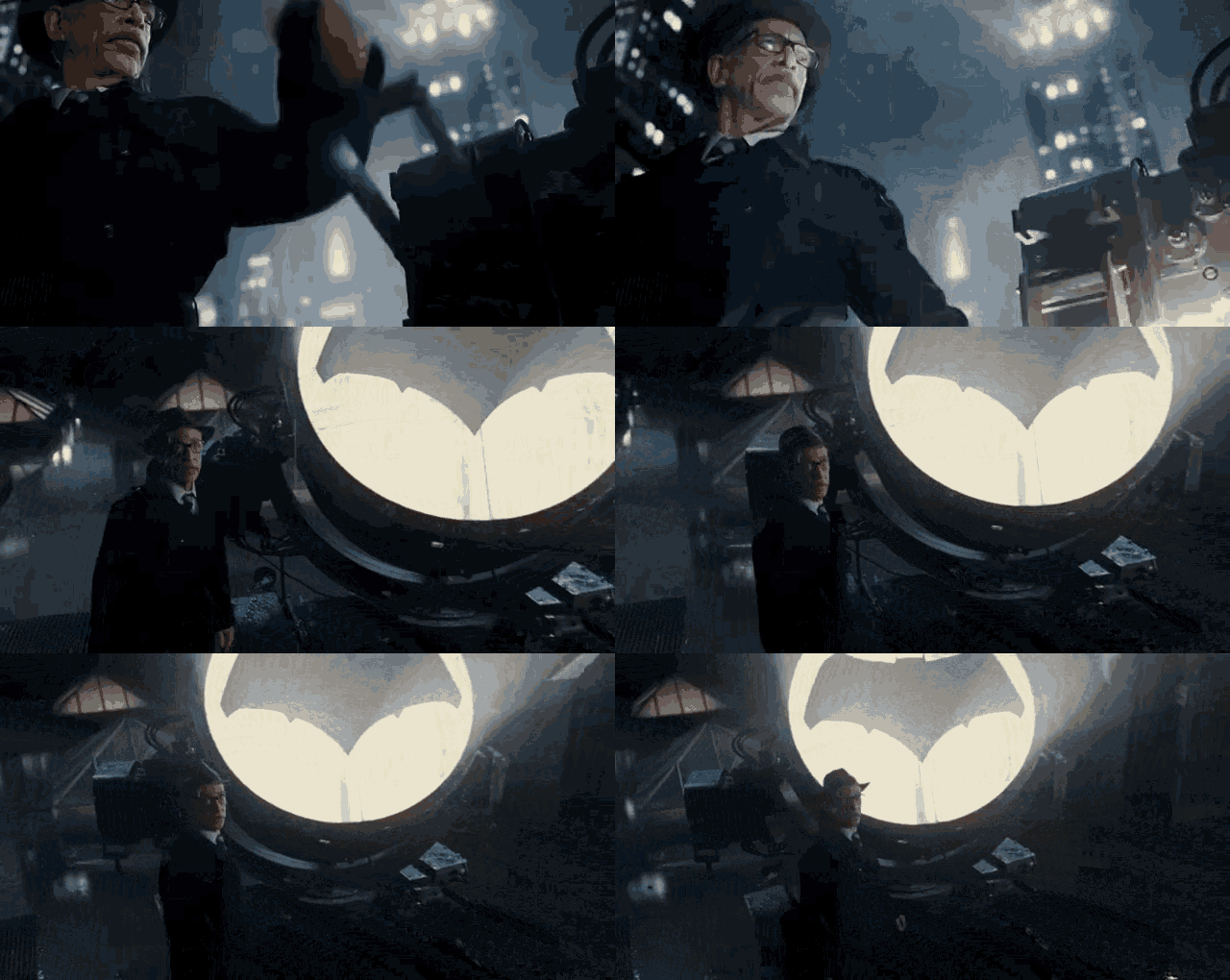
Justice League is short for a super-hero flick, especially for a team super-hero flick—just a minute shy of two hours.** For a film of the golden age it's a bit longish, but those films were a lot more 'tight" and thought out than today's multi-media extravaganzas with long lists of writers and several special effects studios involved, all trying to cram as much material into a movie as they can. There have been some changes in the scenario—what was planned as two films have been scoped down to one, which*** will streamline the first as a stand-alone film and do some shorter films, in the meantime, just to give the series some flexibility). It gives the first movie some "air" to flesh out new characters (three major ones are introduced, with some star-filled back-story) and keep things fairly simple. After all, we're just getting used to Ben Affleck as "The Batman," Jeremy irons as Alfred, and now we have J.K. Simmons as Commissioner Gordon.
All that business makes the movie start out a little messy, fluidity-wise. We have five super-people to visit and try to understand (there is a pre-credits sequence and an eloquent Main Title set to a Leonard Cohen tune, but we'll get to that): Batman is doing his usual thing terrorizing Gotham criminals on rooftops. but seems to have a hidden agenda here—using a mug's fear to attract a Parademon-one of Jack Kirby's Fourth World flying minions—which takes him on a night-flight he doesn't quite expect***; Wonder Woman takes down a group of zealous terrorists trying to blow up a bank; Wayne goes up north to investigate the story of a man named Arthur Curry (Jason Momoa) who helps a fishing town get through its tough winters; Barry Allen (Ezra Miller) goes to prison to visit his father (Billy Crudup), accused of killing his mother, in prison; and, Silas Stone (Joe Morton) a researcher at S.T.A.R. Labs, after accepting a co-worker's condolences for the death of his son, Victor (Ray Fisher), goes home to his apartment to find that his son—3/5 of his body replaced with an alien cybernetic technology—now has jets in his heels that allows him to hover. "Couldn't do that last night" says Victor. Things are changing.
Superman (Henry Cavill) is dead. The world mourns (because you don't know what you've got 'til it's gone). Lois Lane (Amy Adams) is working on fluff pieces at The Daily Planet. Ma Kent (Diane Lane) has moved from the Kent farm as it's been foreclosed. Batman is having nightmares that the world may be ending and has started trying to recruit a team of super-heroes to take the place of Superman, feeling guilty about the role he played in his death. "You're out of your mind, Bruce Wayne," says Arthur Curry when he rejects his offer.

"Doesn't mean I'm wrong," he counters.
He's not wrong. Things are starting to accelerate. The alien-tech "mother-box" Silas used to save his son's life has attracted a predatory group of parademons and boom-tubing right behind them is the Fourth World assassin Steppenwolf (voiced by Ciaran Hinds). There are three of those "boxes" Wayne notices from the scribblings of Lex Luthor (Jesse Eisenberg—stay for the second of two inter-credit sequences), but what they import he has no idea. While he works to try and decipher them, Steppenwolf attacks Themyscira, Wonder Woman's home, and captures the box in their safe-keeping. We're given their story—seems there was an ancient war between the Gods and the New Gods for possession of the Earth in which the three boxes played a hand. There was a battle of the Amazons and the Atlanteans—Arthur Curry's ancestors—along with the ancient Gods and even a Green Lantern to prevent the invasion. Steppenwolf having been stopped, the boxes were separated for safe-keeping—one on Themyscira, one in Atlantis, one on Earth—to prevent such dimensional-breaches from happening again.
If this all sounds like "The Fellowship of the Mother-Boxes" you would be right. But, whatever it seems like, Steppenwolf now has one of the three gizmo's and Queen Hippolyta (Connie Nielsen) uses a long-forgotten signal to alert the world of Man about the theft. But, it's not men who will understand the message, it will be her daughter, Diana. Meanwhile Curry (or Aquaman, if you'd rather) goes back to Atlantis just in time to see Steppenwolf take on Atlantean guards and Mera (Amber Heard—impressive until she talks) to grab the second Mother-Box. The two events are enough to amp up Bruce and Diana's recruiting efforts to form the Fellowship...er, Justice League, as they bring in Barry Allen's "Flash" and Vic Stone's "Cyborg" ("We're the two accidents," says Allen) into the fold.
But, it isn't enough. When the four barely escape being drowned by Gotham Harbor only due to a save by Aquaman, Batman comes up with a hair-brain scheme; just like Luthor brought Zod back to life and the mother-box brought Vic back to human form he wants to use it to bring Superman back from the dead. This is an idea that horrifies Wonder Woman, causing the two to start taking shots at each other culminating in Diana slamming Batman into a wall. But, it...could...work. "I was doing calculations while you were being an asshole," says Cyborg, and it quickly becomes apparent that his character is going to be a combination of a deus ex machina and a swiss army knife.
They do bring back Superman, and the Last Son of Krypton ain't too happy about it. In fact, he's so pissed he takes on the four super's, holding them at bay, knocking them all cold, leaving him to take a particularly good grip on Batman's throat and asking him "do you bleed?" He will, but not before he's confronted by another of Batman's ingenious counter-moves, this one far more empathetic than kryptonite vapors and piercing sonics.
"Oh, crap...he's not happy..."
A lot of detail there, but I've gone into just the basic stuff. The rest of the move entails how the Justice 5 deal with Superman, and how the Justice 6 deal with Steppenwolf. It is hard to see where director Zack Snyder (who left the project in mid-post-production) and Joss Whedon (who replaced him after scripting some scenes—and I would guess he did the first prologue, the inter-credit scenes, and some resolution once they'd determined not to follow up with a "Darkseid Invades" scenario) begins. That's good. If Whedon did—tops—20% of the movie (as official, non-speculating sources say), then a lot of what makes Justice League successful is Snyder's work (working from Chris Terrio's script). There are his usual sequences of "moments" rather than dramatically flowing scenes, but fewer of them, and while that causes some confusion in some places, for the most part things flow pretty well, and then really get going once all the hero- and wool-gathering cease to be a concern. Plus, the tone lightens considerably with the hero-interactions with some nice interactions that get to the bone of what makes these super-heroes unique.
There are things that annoy me, slightly, but few. The opening sequences are clunky and, though I can see why, dramatically, the director would put us back into his gloomy Snyderverse—so that we can emerge from it at the end—it creates a dread that he's going to keep us there and audience-defenses go up resisting it...and the movie. And I can't say enough what a bad move it was to start with what the movie's first scene is: a camera-phone's footage of Superman that does absolutely no good and goes nowhere. It ends with Supes being asked "What do you love about the planet Earth?" and an awkward pause while he looks off into space. That this is the footage they brought Cavill back for is a waste, not helped by the fact the CGI to hide his mustache doesn't completely work. Facial hair changes the way one's mouth moves and it is readily apparent he's "had some work done." To start off with such a faulty sequence smacks of arrogance and more than a little hubris (it should be noted, however, that this is where the effects are the most egregious—despite some internet "experts'" opinion to the contrary—Henry Cavill, if you've ever watched Man of Steel, some angles expose that he just has an odd upper lip).
Still, the movie is better than reviews and the prevalent click-snark would have you believe. The performances are great. There's been some grousing about Affleck's Bruce Wayne being a bit of a drag. Well, no shit. That's the character, the same one that was praised to the skies in Batman v. Superman, which was all of one movie ago (How soon we forget). How fickle we are. Gail Gadot, of course, steals every scene she's in, and that in itself is some sort of super-power beyond human ken. Jason Momoa has the unenviable task of playing Aquaman—the perpetual DC super-hero joke—but, darn, if he doesn't make it work, even if the character is less regally "The King of the Seas" and more WWE bad-ass. Ezra Miller is all hyper-kinetic neuroticism as Barry Allen and I wouldn't have thought that it would "play", if he wasn't so effective doing it. And Ray Fisher's Vic Stone could have been the piece's "gloomy gus" if the character's steel-enforced pluck didn't come shining through. 
So much of the criticisms are for what's not there—no black Super-suit (that was just internet speculation with no real basis in fact) or any other of the rumors that were mere fan-boy wish-lists, and no romance between Diana and Bruce—EW's Dana Schwartz (callin' you out for this bullshit) reported that a woman near-by in her screening theater moaned an anticipatory "oh no" for a scene when Wonder Woman "goes to dress Batman's wounds." Uh...no. She pulled his arm back into its socket. This was emblematic of "sexual chemistry" in her "tweet's". I don't know what "sexual chemistry" you have with your sports-therapist, but wrenching pain ain't normal. And, either a visit to the optometrist or a psychiatrist is in order before your next movie review (and I wouldn't go agreeing with random idiots, either). The quality of click-bait seems to be declining precipitously.
"oh no"....Yeah. No. 
The villain of the thing, Steppenwolf, was criticized for being "unknown." I think most critics could count on one finger what Justice League villains are "knowable"—that being Lex Luthor (as he's appeared in the majority of "Superman" movies). After that, google comes into play. That Steppenwolf is one of Jack Kirby's lesser creations**** is true, he's part of the "New Gods" ensemble, filled with all sorts of odd creations from his DC work. But he's functional, and one should only go back "to the well" of using the same antagonist rarely. The CGI work on the character is remarkable, though—it's amazing how jaded we've come about how computer graphics really can create uncanny life-forms, although I though Steppenwolf more often looked like Hugh Jackman (I have yet to see a representation of the character on the internet—most pictures have been of toys or "fan-art", another reason to not believing "the bait" and actually seeing for one self.
But, I'm spending too much time on the negative, especially the capriciously negative. What did I really like?

Finally, after three movies, "they" got Superman right. In Justice League, Bruce Wayne opines that Superman "was a beacon." I'm not sure how he knows this as, in the previous movie, Wayne spent his time horrified at the destruction the character caused in his wake (it's interesting to me that Snyder spends a lot of time in his follow-up's explaining the upsetting things in his past movies), and actively trying to stop and/or kill him. What 'beacon" is he speaking of? Not the gloomy, depressed outsider-alien of Man of Steel and Batman v. Superman. The "scary monster" dark-Superman that has been unfortunately fashionable and seemingly relevant of late? Maybe he's thinking of a nostalgic view of Superman—you know, Christopher Reeve's Superman, the one who fights for "truth, justice and the American way." Zack Snyder (and Christopher Nolan, let us not forget, who started these things and is still executive producer on Justice League) has never shown us "that" Superman, the inspiring one. Until now. When "that" Superman shows up late in the film, and Henry Cavill (honest to God) inhabits him like it's the easiest thing in the world, it is a breath of fresh air, a tonic, like a weight has been taken off the film and the DC Cinematic Universe. That's the guy we want to see. The guy who can make Vic Stone laugh despite the pain. The guy who can call "The Flash" "slow-poke" and spur him on. The inspiring one. The beacon. The one that has been sorely missed. Justice League gets that so right.

And it's about bloody time.


* sarcasm alert.

** Marvel's films and the DC films of Warner Brothers have been clocking in at 2 1/2 hours—the extended cut of Batman v. Superman ran close to 3 hours. Interestingly, Snyder's longer film "feels" less long than the cut version. This happens. I remember seeing a 2 1/2 chronological cut of Once Upon a Time in America (Paramount Studio interference) that seemed interminable, but Sergio Leone's 3 1/2 version never gave a sense of time passing...it breezed along, despite being an hour longer.

*** I suspect, with no evidence to back it up, that the makers were going to bring in Darkseid—the big bad "New God" in the DC Universe, created by Jack Kirby, for the second film but have backed off on the idea.

*** And here's an odd thing that I'll leave out of the upcoming "Things That Bother Me" section: After his little "Superman and Lois" flight through the Gotham night with the Parademon, some guy comes up to him and says "what was that?" and Batman goes into a long explanation to him. Is this some stranger?  But my assumption was it's the robber that Batman bat-lassoed before.This guy's a criminal, right? What's Batman doing "just" talking to him—shouldn't he be arresting him? If it's some random stranger on some random rooftop the Parademon dropped him onto, shouldn't the guy's first words be—"W'oh! Do you know who you are? You're The Batman! I thought you were a myth! Are you? I can't believe I'm talking to the Batman. Can I take a selfie?" This is one of those elements of sloppy film-making that either Snyder committed, or was created due to the re-shoot editing process (which, one would assume, is supposed to ELIMINATE such things).

**** Here's any interesting test for critics—name some other Jack Kirby characters. You'll basically be describing the vast output of the last few Marvel movies. The guy was "everywhere."

Tuesday, November 21, 2017

Murder on the Orient Express (2017)

The Laboriousness of Hercule
or
"Not No Much a WhoDunnit as a WhyDoIt?"

Agatha Christie was loathe (and that is the precise word) to have her books adapted by Hollywood. She wasn't crazy about the "Ten Little Indian" versions, and absolutely despised the Margaret Rutherford-starring Miss Marple films (especially when Tony Randall cameoed as Hercule Poirot in one of them). She reconsidered towards the end of her life after a personal appeal by Lord Mounbatten (father-in-law of one of the producers) that resulted in Sidney Lumet's 1974 all-star version of "Murder on the Orient Express", starting a series of fims and a flood of adaptations for British television, featuring Marple and Poirot. CBS broadcast a modern-dress version starring Alfred Molina (which was clueless and terrible and would have produced a train-like shriek from Miss Christie from beyond the grave).

When the "Poirot" series (with the dedicated David Suchet) did its adaptation a few years ago (with Barbara Hershey, Eileen Atkins, Hugh Bonneville, and Jessica Chastain among the suspects), it was head-and-shoulders more satisfying than the multi-million dollar film version. But, on the heels of that was announced a new film version to be directed by (and starring) Kenneth Branagh and one could only wonder what the possible reason might be.
The Detective
Having sat through the new version of Murder on the Orient Express, I can only guess that it was to provide work to a lot of film technicians and actors. It's product, but nothing Earth-shaking, and for that, it isn't even a great adaptation. The script is quite good—thank you, Michael Green, Hollywood's busiest script-writer/doctor—but the presentation leaves much to be desired. Maybe the film-makers were merely trying to attract a young audience to a version where the actors weren't aged or deceased (in which case, we'll always have Dame Judi Dench and Derek Jacobi), but I think the film will mostly appeal to the blue-haired matinee-goers, who have a history with Christie so that, even if the film does become a tent-pole production (they hint at a version of Death on the Nile next), it will probably suffer the same fate as the 70's movie series, which faded after a couple of lackluster productions.

It also might have been an attempt to resuscitate Poirot as they did with Robert Downey jr's steampunk Sherlock Holmes (directed by Guy Ritchie)—there are certain indications of this as this version of Poirot sizes up people with a glance ("You're a prostitute..." "Yes, I am!") and has a habit of anticipating events five steps ahead of his suspects. That's new, and certainly outside of Christie's envisioning. But, aside from purloining some aspects from other Christie stories, there's nothing very new—or original—except for getting the character a bit wrong.* Poirot is described as a mountebank (read "snake-oil salesman") by Christie, so although he might be fastidious to a fault, he is no tall, imposing presence. The mind is what is supposed to impress about Poirot, not his appearance. If anything, he shouldn't be too impressive at all.

And we'll get to "the mustache" in a few minutes.
The Victim

Poirot is in Jerusalem investigating a theft involving a priest, a rabbi, and an imam (like "the joke" he comments). Exposing his dramatic side by doing his presentation of evidence in front of a crowd at The Wailing Wall—seems a bit extreme—Poirot solves the crime. Given the ecumenical divisions of the suspects that's at least all-inclusive, but it's a fairly risky procedure to do this so publicly. Why would he do this in front of strangers who have no clue (literally) of the particulars of the case.

The show over and the exposed non-denominational thief caught, Poirot decides to take a last-minute trip back to London and uses his friendship with Bouc (Tom Bateman), roguish son of the director the Orient Express to gain passage. He takes the place of a "no-show" and in transit, strikes up a casual friendship with governess Mary Debenham (Daisy Ridley) and a doctor named Arbuthnot (Leslie Odom, jr.) who seem to be more than familiar with each other. It is enough to cause more than a tickle in his little gray cells, as the two are making pains to not seem familiar.

Once he gets to the Calais Coach, he makes note of the other passengers cutting across all sorts of ages and strata of society, princesses and practical men—the usual disparate suspects. He is approached by a dealer of art named Rathcett (Johnny Depp, channeling Ray Liotta in Goodfellas) who asks for Poirot's protection—he fears for his life, but Poirot, despite sharing a dessert with the gangsterish fellow, refuses for the most basic of reasons—"I do not like your face." In the middle of the night, he will be murdered, stabbed repeatedly and the train will be stopped by an avalanche, keeping the occupants conveniently trapped aboard. It will be up to Poirot to discover who aboard could have committed the crime before the train can be freed and continue on its way to waiting authorities.

There are clues aplenty and the reasonable assumption that the murderer is still on-board, as a couple of random attacks, none fatal, make it suspicious that one of the others could be next. But, who could be the perpetrator of such a vicious murder? As Poirot interviews everybody on the train, he finds threads and suspicions, but most of them seem to be distractions rather than real clues.

There are attempts to make the film less claustrophobic, but they seem a trifle desperate to create some action in a scenario that is mostly talking and thinking. And Branagh (the director) tries to inject some mystery and resonance by making use of the di-optic qualities of the glass partitions in the carriage—a bit too much, actually. Like most of the film it is mere obfuscation to a denouement that answers the questions, but creates an ethical dilemma that is the real center of the story. That dilemma is resolved by a tricky maneuver by Poirot (not in the book, which ends abruptly with the solution of the murder without any sort of hand-wringing about justice) that is a tad simplistic and more than a bit impractical in matters of weight. Versions had resolved it "similarly," but Poirot's deliberate entrapment creates a scene that makes him seem more decisive and conniving, and does so without a lot of talk. Personally, when the subject is justice and right versus wrong, I much prefer talk.

At least, Branagh's is not as perversely celebratory as the 1974 Sidney Lumet version—a murder is committed, after all—but it is not as brave and resolutely moral as the Suchet television version, which has the detective shaken and fighting tears by his own actions (or lack of them) in the service of what might be justice. The detective is trapped by his own catholic history (far beyond the aspirations of Christie) and feels complicit in the whole affair. Now, that is something of some import. "The Murder on the Orient Express" has one more victim; it kills something in Poirot.

Now...the mustache. A review can't seem to go by without a mention of the very large and ferret-like mustache that Branagh's Poirot sports throughout the movie. Such is the sort of thing that dominates internet criticism or what passes for it. The cliche is the dainty little handlebar curl of Albert Finney and David Suchet. Branagh's winding "extreme" Imperial is a distraction—maybe that's why it's there, dramatically. But, there is one other reason it might be a part of this film. Dame Agatha was alive at the time of the 1974 Lumet version and her one criticism of it was thus: "It was well made except for one mistake. It was Albert Finney, as my detective Hercule Poirot. I wrote that he had the finest moustache in England — and he didn't in the film. I thought that a pity — why shouldn't he?"

I guess that is the answer to the ultimate mystery—why do it?  I just wish the answer was something more than "why shouldn't they?"


* ...for instance, in a couple of scenes, Branagh is seen clutching a locket with a portrait of his lost love, Catherine. Who? No such person existed in all of Christie. The closest Poirot came to "the woman" (how Sherlock Holmes referred to the woman he most admired, Irene Adler) was the Countess Vera Rossakoff. Setting something up for another movie. Well, to do that the first one has to be good. 


Sunday, November 19, 2017

Don't Make a Scene: Patton

The Set-Up: The story is basically true with a couple of small details: It wasn't snow that was preventing air-cover for his Third Army, it was incessant rain; it wasn't only Patton using the prayer, but the entire Third Army reading from 250,000 cards Patton ordered printed of the prayer (with a signed Christmas greeting on the reverse—see below); and Patton ordered the prayer over the phone, not in person. Other than those details, its a true story.

And the rains did cease. They'd've goddamned better.

He did yell the "Let no man come back alive" threat—it was the sort of thing the real Patton did to get attention, and delivered in his high, reedy voice (instead of George Scott's gravel-bass) it must have sounded blood-curdling.

The other notable things are the mention of Patton as "actor," which, no doubt, informed George C. Scott's hailed performance. Patton was an actor, theatrical and florid, dressing impressively, giving off the air of authority and privilege, and absolute command. That was in the strategic palaces. With the troops, he was basic and personal and emotional. He was a disciplinarian, yes, but weaker than the accepted portrait that the Scott personification has embedded in the nation's consciousness—Scott wasn't one to show Patton weep, as he was known to do with the troops—indeed, Patton was a fairly anonymous presence to all but the soldiers and war historians up until the film's release. Those who hero-worship the movie-Patton are like prison widows who fall in love and marry inmates, as long as they're behind bars. They would probably run from the room coming in contact with the real general. Patton was hardly a complacent man. And he did not suffer fools.

The other aspect of this sequence is how it walks the tight-rope of presenting Patton as warrior and war as brutality during the height of the anti-Vietnam sentiment. That Patton was popular and a box office smash during those fevered days is fairly amazing and a testament to the filmmakers and promotion people who walked the edge of the razor blade to position the movie for both hawks and doves. And backed by Jerry Goldsmith's eerie score, the ambiguous nature of the fighting sequences can leave both birds with their feathers unruffled, thinking their side has been represented. The brutality of the action, the desperateness of the situation and the waste of a single human life are all represented.

The Story: The Third Army is making its way through The Battle of the Bulge, led by disgraced Lt. General George Patton (George C. Scott in his Oscar-winning role). But the fighting is not going according to plan. For Patton to continue advancing his troops, he needs support from the air and the winter weather has the planes grounded. If Patton can't get help from above, he's going to have to go up the chain of command over everyone's heads.

Action. Now, dammit!

Colonel GASTON BELL: Sir, Von Runstedt’s thrown another Panzer division against Bastogne. The first Airborne is hanging on by its finger-nails.

Lieutenant Gen. GEORGE PATTON: Damn air-cover is what we need. If we had 24 hours of decent weather we might make it.
Brigadier General HOBART CARVER: General Mason, sir!
PATTON: Hello, Mace? Listen, we’re short on foot-soldiers. I want you to cannibalize your anti-aircraft units and turn them into rifle-men. Yes, every damn last one of them you can find.
Lt. Col. HENRY DAVENPORT: Evening, General. I just got the weather report for tomorrow. More snow.
CARVER: There goes our air-cover. Sir, we may have to pull up and wait for better weather.
PATTON: There are brave men dying up there. I’m not going to wait. Not an hour. Not a minute. We’re going to keep moving!
PATTON: Is that CLEAR?! We’re going to attack all night.
PATTON: We’re going to attack tomorrow morning! If we are not VICTORIOUS...LET NO ONE COME BACK ALIVE!!
Lt. Col. CHARLES R. CODMAN: You know something, General? Sometimes the men can’t tell when you’re acting, and when you’re not.
PATTON: It isn’t important for them to know. It’s only important for ME to know.
CHAPLAIN: You wanted to see me, general?
PATTON: Oh, yeah, Chaplain. I’m sick and tired of Third Army having to fight the Germans, the Supreme Command, no gasoline and now this ungodly weather. I want a prayer. A weather prayer.
CHAPLAIN: Weather prayer, sir?
PATTON: Yes, let’s see if we can’t get God working for us on this thing.
CHAPLAIN: It’ll take a pretty thick rug for that kind of praying.
PATTON: I don’t care if it takes a flying carpet.
CHAPLAIN: Well, I don’t know how this is going to be received, general...praying for good weather so we can kill our fellow man...
PATTON: Well, I can assure you, sir, because of my intimate relations with the Almighty, if you write a good prayer—we’ll have good weather.
PATTON: I expect that prayer within an hour.
CHAPLAIN: Yes, sir.
(Leaves. Chaplain shakes head)
PATTON (VO): Almighty and most merciful father. We humbly beseech thee of Thy great goodness...
PATTON (VO): ...to restrain this immoderate weather with which we’ve had to contend.
PATTON (VO): Grant us fair weather for battle.
PATTON (VO): Graciously hearken to us...
PATTON (VO):...as soldiers who call upon thee...
PATTON (VO):...that, armed with thy power...
PATTON (VO): ...we may advance...
PATTON (VO): ...from victory to victory...
PATTON (VO): ...and crush the oppression and wickedness of our enemies...
PATTON (VO): ...and establish thy justice...
PATTON(VO): ...among men and nations.
PATTON(VO): Amen.

Patton

Words by Edmund H. North, Francis Ford Coppola and Chaplain James H. O' Neill

Pictures by Fred J. Koenekamp and Franklin J. Schaffner

Patton is available on DVD from Fox Home Video.