Woody? Won't He?
or
Ego Occidam, Ergo Sum (Et Non Est)
Immanuel Kant was a real piss-ant who was very rarely stable.
Heidegger, Heidegger was a boozy beggar who could think you under the table.
David Hume could out-consume Wilhelm Friedrich Hegel.
And Whittgenstein was a beery swine who was just as sloshed as Schlegel.
There's nothing Nietzsche couldn't teach 'ya 'bout the raising of the wrist.
Socrates, himself, was permanently pissed.
John Stewart Mill, of his own free will
On half a pint of shanty was particularly ill.
Plato they say could stick it away, Half a crate of whiskey every day.
Aristotle, Aristotle was a bugger for the bottle,
And Hobbes was fond of his dram.
And Rene Descartes was a drunken fart. 'I drink, therefore I am.'
Yes, Socrates himself is particularly missed;
A lovely little thinker, but a bugger when he's pissed.
by the Professors of the Philosophy Department
of the Australian University of Woolloomooloo
(Monty Python's Flying Circus)
There is no article in the title of Irrational Man, the 47th Woody Allen film*, indicating that the malady of the lead male of the film, a philosophy professor with no particular philosophy except self-absorption, named Abe Lucas (Joaquin Phoenix) is not limited to him alone. It expands the malady from the individual to mass phenomenon, and not so phenomenal as to be uncommon. It turns a human condition into a syndrome.
Abe has a reputation. He's well known to the philosophy department (and most other departments) of Braylin College, not only for his writings and well-regarded classes, but also for his behavior. He's a bit of a rebel, clashing with administrators and other philosophers. He's controversial, and good for livening up the rather staid atmosphere of upper class Braylin.

But Abe's in a bit of a slump and a funk. He's self-medicating, taking a swig from a perpetually available flask, which adds to the beer-gut he doesn't much care about, and that book he's writing isn't writing itself (not that, Abe admits, anyone will want to read it—"Who wants to read another book about Heidegger and the Nazi's?"). He's getting desperate—at one point, he drunkenly tries his hand at Russian Roulette, shocking his students. Nothing makes him feel alive. Even the de rigeur affair with a cougarish chemistry professor (Parker Posey—she's a little young for the role, but then we are talking Woody Allen here) goes a little...limp (you'd think somebody who knew chemistry might help). At some point, philosophy isn't enough.
 |
| "Not in front of the children..." |
In the world of Woody Allen, such a specimen of manhood would be a chick magnet, whether the setting is Manhattan or upstate New York. Not only does the chemistry professor start to become clingy, but so does one of his academically brighter students, Jill (Emma Stone), who goes so far as to break it off with her current stable boyfriend (Jamie Blackley) in order to pursue a relationship with Abe.

It is that relationship that puts the spark back into Abe, but not in the way a traditional romantic dramedy would have it. At a diner with Jill, he overhears a woman tell her friends how her life has been turned upside down by a bitter custody case and Abe is incensed. He investigates, finds the name of the judge and begins to stalk him, finding out his habits, his routines, and decides that, to make the world a better place, he is duty-bound to kill him. He plots, schemes, finally coming up with a fool-proof plan to get away with murder—all the time he thinks about the details, he never once questions the big picture—murder is not a rational solution to anything. And any time you come up with a fool-proof plan for murder, you're not looking in the mirror where the fool is.

To say anything more will just rob the movie of any suspense—there isn't much, and the results feel inevitable as the movie goes along, a lot of which is taken from Hitchcock in substance rather than style. That there is no "shadow of a doubt" runs counter to this film's basic source of inspiration. Style would have nudged the pace a little bit, but this is Woody Allen, so an awful lot of time is spent talking about things and not doing anything, but the players do manage to avoid the mannerisms that come with Allen's movies (it is surprising that nobody is the "Woody stand-in" in this movie, and the only time it feels like his work is during a particularly ad-libbed feeling argument ("I know, I know") and the unraveling of the plot seems that it might be missing a psychological component of believing the best in people even when you suspect the worst. The only jolt comes towards the end in a brief moment of ironic karma that catches you off-guard.
Ultimately it's a comedy about anything being perfect in a world ruled by chance, no matter what you do to understand it. It's also a caution about existing in ivory towers: the view from the cloister is great, but it's a long way down no matter how you go, whether you jump, are pushed, or just trip.
* Much debate about this, but I DO count What's Up, Tiger Lily?, Oedipus Wrecks (from New York Stories) and his TV-movie version of his play Don't Drink the Water.


 Announcement over P.A.: "There will be a full rehearsal in ten minutes time."
 GEORGE comes round the corner, looking for RINGO, then grins and walks past a sign saying "Canteen and Production Office Opposite."
 He comes to the exit door crosses to a modern building across from the theatre. He enters building. EXTERIOR, YARD IN THE THEATRE AREA GEORGE crosses the yard and goes to the Nissen hut. He opens the door and peeps in, then goes inside.
 It is the reception room that leads to an inner office. Behind a desk sits a smart young woman typing busily as GEORGE enters. He is surprised when he sees the girl; she looks up and speaks to him at once.
  SECRETARY: Oh, there you are!
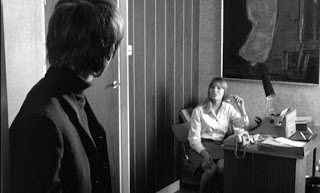 SECRETARY: (tartly) No you haven't, you're just late. (She rises and crossing over to him examines him critically.)
  GEORGE: Is he? Really?
 SECRETARY: Hello, I've got one . . .
 SECRETARY: Oh, I think so . . .

 SECRETARY: Yes, he can talk . . .
 SECRETARY: Well . . . I think you ought to see him.
 SECRETARY: (She smiles.) Yes, alright Of course, right away.
 SECRETARY: Well . . . come on.
 GEORGE: (looking at a piece of sculpture) You don't see many of these nowadays, do you?
 SECRETARY: (proudly) Will this do, Simon? Simon, will this do?
 SIMON: (looking at George) Not bad, dolly, not really bad. (he motions to George.) Turn around, chicky baby.
 SIMON: (George does so.) Oh yes, a definite poss. He'll look good alongside Susan. (he indicates the girl on the poster.)
 SIMON: Alright, Sunny Jim, this is all going to be quite painless. Don't breathe on me, Adrian.
 GEORGE: ...but I'm afraid there's been some sort of a misunderstanding.
 SIMON: (sharply) Oh, you can come off it with us. You don't have to do the old adenoidal glottal stop and carry on for our benefit.
 GEORGE: I'm afraid I don't understand.
 SIMON: Oh, my God, he's a natural.
 SIMON: We'd like you to give us your opinion on some clothes for teenagers.
 GEORGE: Oh, by all means, I'd be quite prepared for that eventuality.
 SIMON: Well, not your real opinion, naturally. It'll be written out and you'll learn it. (to secretary) Can he read?
 GEORGE: Well, I'll have a bash.
 GEORGE: Ta.
 A collection of shirts are produced and GEORGE looks at them. While he is doing this Simon briefs him.
 SIMON: Now, you'll like these. You really "dig" them. They're "fab" and all the other pimply hyperboles.
 GEORGE: I wouldn't be seen dead in them.
 GEORGE: They're dead grotty.
 SIMON: Grotty?
 SIMON: I think It's rather touching, really.
 SIMON: Here's this kid trying to give me his utterly valueless opinion when I know for a fact within four weeks, a month he'll be suffering from a violent inferiority complex and loss of status because he isn't wearing one of these nasty things.
 SIMON: Of course, they're grotty, you wretched nit, that's why they were designed, but that's what you'll want.
 GEORGE: I don't care.
 GEORGE: And who's this Susan when she's at home?
 SIMON: (playing his ace) Only Susan Campey, our resident teenager. You'll have to love her. She's your symbol.
 GEORGE: Oh, you mean that posh bird...
 GEORGE: ...who gets everything wrong?
 GEORGE: Oh, yes, the lads frequently gather 'round the T.V. set to watch her for a giggle. Once, we even all sat down and wrote these letters saying how gear she was and all that rubbish.
 SIMON: She's a trend setter. It's her profession!
 GEORGE: She's a drag. A well-known drag. We turn the sound down on her and say rude things.
 SIMON: Get him out of here!!
 The underlings hustle GEORGE to the door.
 SIMON: Get him out. (He stops in mid shout.) You don't think he's a new phenomenon, do you?
 SECRETARY: You mean an early clue to the new direction?
 SIMON: (rummaging in his desk) Where's the calendar?
 (He finds it.)
 SIMON: No, he's just a trouble maker. The change isn't due for three weeks. All the same, make a note not to extend Susan's contract. Let's not take any unnecessary chances!
 SIMON: Hmm?