Showing posts with label Will Forte. Show all posts

Saturday, May 13, 2023

MacGruber

Saturday is traditionally the night for "Saturday Night Live" and...."Take Out the Trash" Day

"Making Something of Spit and Bailing Wire, and Getting...Spit-Covered Bailing Wire"


The track record for any movie coming out of the sketch-comedy of "Saturday Night Live" is pretty abysmal. The Blues Brothers and Wayne's World did fine, but their sequels didn't. We won't bring up A Night at the Roxbury, The Coneheads, The Ladies Man, It's Pat!, Stuart Saves His Family, ad infinitude. The reason is as obvious as a Mike Myers first-draft (are there any others?)—a concept that can, at most, sustain itself for under 10 minutes has chances of "slim" and "none" of being any good stretched to 90 minutes, let alone two hours. Thank God we've never seen "Subliminal Man" made into a movie...or "The Continental."

As a 5-minute sketch idea,
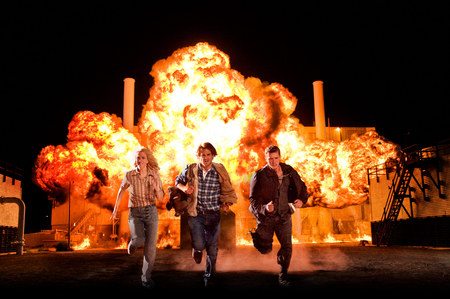
MacGruber fits the bill for an "SNL" skit, although it's concept is the same week after week, the minutest of details being the only things changing. Will Forte plays a dorky McGyver-type, who has mere moments to defuse a bomb by creating something...bomb-defusing...using icky stuff that no one wants to touch let alone re-configure. And, of course, there are complications while Kristen Wiig does a panicked clock-check. The sketch ends with a building blowing up. Cue the Band. Christine Aguilera comes up after the break.
Same joke, every week. If something works once on "Saturday Night Live," they'll keep doing the sketch until that comedian quits or is canned. Somewhere along the way, some exec thought it a good idea to turn that well-tread idea into a feature.
It's sporadically funny in a "I-know-you-are-but-what-am-I" kind of lameness. And it boasts
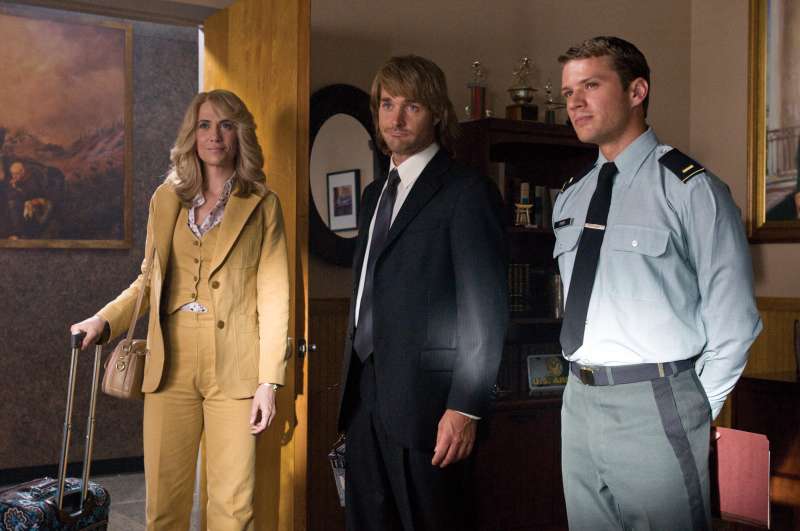
Ryan Phillippe (in slow-burn mode), the usually drop-dead-funny Wiig, and such good actors slumming as Powers Boothe (good to see him) and Val Kilmer, trying to re-capture his youth with a goofy comedy role (I'm suddenly waxing nostalgic for Real Genius and Top Secret!--the name of Kilmer's character is Dieter von Cunth, which shows you the level of humor, but doesn't clue you in that they will use it over...and over...and over...and over...for a rapidly declining chance of a laugh).
In this, MacGruber is coerced out of retirement ("I thought you were dead, MacGruber.." "So did I") in a remote native village (where he can find peace), when it's learned that von Cunth may be up to something no good.
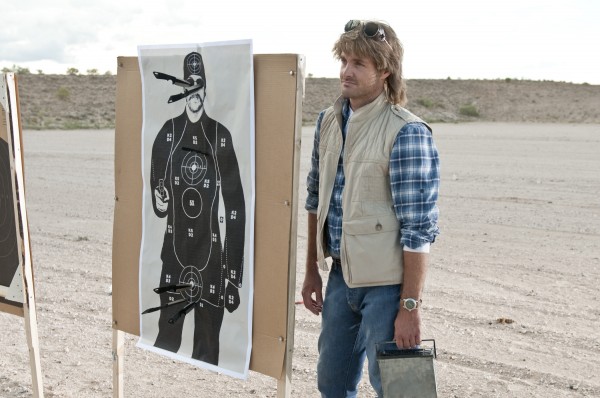
* Stuck in the 80's with his mullet, his plaid shirt, tan utility vest, and his Blaupunkt removable in-dash tape-player (he takes it everywhere). One wishes there were more entertainment value in seeing the usual action cliche's—the ones that turn up routinely (and straight) in Michael Bay films—played for laughs: the slow motion team walk, the fiery mega-explosions that have no hearing loss attached to them, the smug banter that passes for dialog, but the laughs are few and far between. You'd think given the time and budget they'd have come up with a grander concept—maybe even come up with a clever gadget or two—but there's nothing like that here. The best idea MacGruber (and the movie) can come up with is creating a distraction by going commando and parading around with a celery stalk up his ass.

No. Really. And they do it twice.

They couldn't even think up a "gadget." For pity's sake.
Save yourself. The clock is ticking. Don't go anywhere near this bomb, and watch these "MacGruber" video's instead.
* ...Like the rest of the movie.

Wednesday, August 21, 2019

Good Boys

F-Bombs (Out of the Mouths of Babes)
or
"Two Weeks in the 6th Grade and I'm a Social Piranha!"

The "R" rating is prominent in the promotions for Good Boys because, God forbid, kids the ages of the stars of it should go see this movie (at the premieres, do they escort them out? I mean, they ACTED the damn thing). But, then, I'm not sure what good it would do to actually let 11-12 year old's see this movie, other than to show them what adults think of them.

Because the movie isn't FOR the age-group it depicts, like a YAF novel. It's for adults to give them a nostalgic laff about the naivete and confusion of that time period between childhood and wanting to be an adult—you realize you can't do certain things adults can do, you're constantly told "you wouldn't understand," you see adulthood as a freedom you covet without realizing the responsibilities that come with it (that give you no freedom at all). It's the last flush of childhood that you can actually enjoy before the mantle of licenses, financial responsibilities and permanent records take away your childhood and make you nostalgic for the way things were.


Which is why they make movies like Good Boys for adults.

There's a grand tradition of this in the movies—"Our Gang," one of my faves The Sandlot ("You're killing me, Smalls"), where kids are trying to act like adults in an adult world, where the adults are almost absent (the comic strip "Peanuts" is like this where there are no adults and the kids talk—as cartoonist Al Capp used to carp—"like psychiatrists" or, as in the animated versions, adults squawk like muted trumpets). If it was a drama, it would be To Kill a Mockingbird—kids not understanding the frailties and failings of adults. But, in a comedy, it's kids trying to negotiate through the adult world without understanding it, and Good Boys takes it to the extreme.
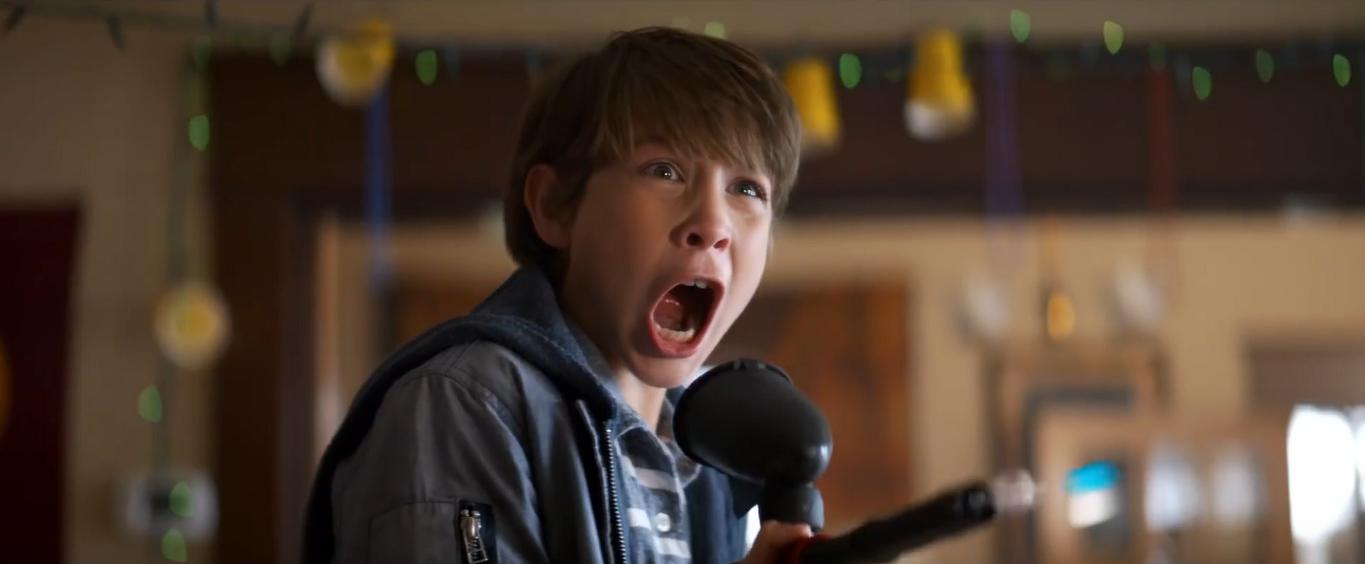
The story follows the issues of "The Beanbag Boys" (called that because...they all have beanbag chairs)—Max (Jacob Trembley, the brilliant young actor from Room), Lucas (Keith L. Williams, who's hilarious) and Thor (Brady Noon, who gives the most mannered performance, but has the most conflicted role)—friends since kindergarten, who are entering sixth grade, which for them is a highly transitional time. Their little clique runs the risk of fraying due to peer pressure, family crises, and the inevitable consequences of growing up and away from each other, but seem determined to stay bonded through thick and thin.
Thor is the most theatrical, but also the one most susceptible to peer pressure—despite his talents, he doesn't try out for the sixth grade school play because he'd be thought of "not cool." Max is starting to notice girls, particularly Brixlee (Millie Davis), who he can't look in the eye while also trying to be apathetic, at the same time the sight of her makes him weak in the knees. Lucas, is the tallest of the three, but is being cut down to size due to the impending divorce of his parents. These are the crises of children, because their stasis is being shattered and change is being forced on them without any regard to how they feel about it. They are completely messed up, but try to hide it behind a veneer of "cool" lest they humiliate themselves.
The events of the movie revolve around Max and his Brixlee fixation. The popular boys are giving them a hard time--Thor is being harassed  for his interest in theater arts, conflicting with Max, who wants to be popular because he thinks it will give him a better chance with Brixlee (an invitation to a "kissing party" That Brixlee is going to becomes his obsession). Big problem, though;  he's never kissed anybody. What if his kissing...well...sucks. To get an education--a horrifying encounter with porn doesn't work because "they never kiss, not their mouths"--Max takes control of his father's drone against his orders ("I use it for work!") to spy on two "old" girls, Hannah (Molly Gordon) and Lily (Midori Francis) in Hannah's nearby backyard. Hannah has a college boyfriend, so the boys "one-up" the traditional spying through the fence to go to aerial reconnaissance. They watch Hannah and Benji--the boyfriend--have a fight right after he delivers some "Molly" to Hannah for a concert that night. Just when the girls go in for a consoling clinch, Max loses control of the droid, allowing the girls to capture it...and hold it hostage.

This is not good. It becomes a hostage situation that goes seriously wrong with a confrontation where Max may have to 'fess up to his Dad and be grounded for the kissing party. But, Thor manages to steal one of the girls' gotcha bags containing the ecstasy (don't worry, the boys don't get access to it--they can't figure out child-proof caps). But, it begins a cat-and-mouse game between the Beanbag Boys and the "old girls" as each has something the other wants. There are the inevitable complications that divert this "Coming of Age" movie into an "Incredible Mess" movie (the kind where relatively simple goals become increasingly out-of-reach by increasing road-blocks, tangents and diverting sub-goals that keep the ultimate goal tantalizingly harder to achieve.
"Honey...yeah...we're not having kids."
The Beanbag Boys turn out to be surprisingly adept at navigating these smaller complications to achieve their ends, even as they risk fraying the fabric that binds them together.
They're not bad kids--in fact, their naivete and embedded anti-drug indoctrination makes them quite charming, despite the beer-sipping (four sips is a crowd-impressing record) and the F-bombs that explode out of their mouths.
They're just trying to make sense of a bizarre adult world that, more often than not, turns them into screaming meemies (and cry-babies--they are constantly crossing the line from sixth grade sophisticates to the behavior of kids in single digits). I'm not sure what kids would make of this if they were allowed to ss it (for one thing, a lot of the jokes will fly right over their heads). But, then, they're not the target audience. Older teens and adults are, and in that context, the movie is a nostalgic comedy as opposed to being about the loss of whatever innocence they still retain.

It's an odd movie. But very funny.


Wednesday, March 9, 2016

Nebraska

Making Things Right
or
And Everything Looks Worse in Black and White

There's a story that Peter Bogdanovich got sick of telling during all the press junkets he did for The Last Picture Show about why he shot in black and white rather than color. Truth was, that he started test-shots of the Archer City location (author Larry McMurtry's home town) in color, but the town always looked too good, and didn't have the sense of bleakness that he wanted. The story goes that he went to Orson Welles (who was staying at his house) and mused maybe he should shoot the movie in black and white. "Of COURSE you'll shoot it in black and white!" Welles barked back. After repeating the story over and over again at press interview after press interview, the last few times Bogdanovich simplified his answer: "Because Orson Welles told me to."
I don't think Alexander Payne shot
Nebraska in black and white for that reason, or because it might recall the cover of the same-titled Bruce Springsteen album.  But, I think the bleakness is there, running as an under-current through the film as a view of life—not rosy and pink with vitality, green with verdancy, but shades of gray and the occasional extreme of black or white—the palette for a story of folks with limited choices in the nuances of life...and truth. But, lest you think this one's about old folks with one foot in the grave, or Alzheimer's or something like that, it's not. Not really. It's about living life before you run out of it, and grabbing any kind of dignity out of that life, despite Nature's determination to take it away in any way it can.


And not to mention your relatives and acquaintances.

It's also a damned funny movie, in the same low-key, sometimes painful way that its writer, Bob Nelson, wrote sketches for the late, lamented "Almost Live!" show which seemed to focus more on human dysfunction, rather than Pacific Northwest eccentricities. The old saw "familiarity breeds contempt" is apt here, as the extended Gates family, long separated (for good reason, apparently), is blandly caustic, bringing up family histories and past imperfections as grist for the family grinding mill.

The Gates clan watch a baseball game: Rance Howard (far left);
Bruce Dern (asleep in the back) and Will Forte (placating, far right)

"Wow, this feels too much like real life" said one of the patrons in Nebraska's audience.

The story's simple and seemingly uneventful, but mindful of David Lynch's The Straight Story. Woodrow Gates (Bruce Dern) is picked up by the police walking the highway in Billings, Montana. "Where ya goin'?" says the Sheriff. "Headed down the road there,' says Woody, none too helpfully.
O-kay, there's a little detour to the police station, where his son David (Will Forte) comes to pick him up. "So you told the Sheriff you were walking to Nebraska..." Woody's wife (June Squibb) won't drive him, he doesn't have a car, and he won't be given money for the bus. The reason he wants to go to Nebraska (Lincoln, specifically) is because he got a certificate in the mail from a magazine promotion company saying that he could have won a million dollars. Woody doesn't "buy" that it's a way to get him to buy magazines; he thinks he's won it, so he's walking to Lincoln to get his million. Why didn't he just mail it in? "I'm not going to trust the mail with a million dollars." Makes perfect sense. Walking, though, doesn't.

There's no sympathy at home. Wife Kate won't entertain any of this "I didn't know the son-of-a-bitch wanted to be a millionaire! Know what I'd do with a million dollars? I'd put him in a home!!" Brother Ross (Bob Odenkirk) thinks Dad's senile and doesn't want to hear of it. Only David will entertain the notion of driving Woody to Lincoln, if only for the chance to connect with the old man. They set off with some hitches and fits along the way, eventually stopping at relatives' to get a breather from what would seem to be a continuing series of minor disasters. But, his old stomping grounds bring no comfort, as word soon gets around that Woody's driving to Lincoln to get a million dollars—a sum that strikes everyone dumb...and a little bit stupid. Old debts are brought up, and quite a few people want a part of that million dollars whether they deserve it or not...and for some reason, nobody thinks twice about how Woody might have come into that money—the amount leaves them a little blinkered. And envious. And opportunistic.

For David, it's an opportunity to gain some perspective (just the ability to see Woody's past surroundings adds a little knowledge) and, as he's stuck in a pattern of "getting by," some insight into both Dad and himself. By the time the two ride off into the last shot—one of the loveliest and most potent of the past year's movies, a black-and-white sunset—a nice, warming resolution has been reached. But not too warming. It is a sunset. And it is in black-and-white, lest it betray any cheer or a rosy sensibility. Payne, evidently, did make a color version of Nebraska to satisfy some niche contractual requirements for the studio (Paramount Vantage), but has expressed hope that it never sees the light of electronics.

OF COURSE, it won't. It would be a completely different movie, and a less effective one.