Showing posts with label June Squibb. Show all posts

Wednesday, July 3, 2024

Thelma (2024)

A "Going-Back-To-The-Buffet" Situation
or
Is a Bad Mother... (Shut Your Mouth!)

One suspects that I'm the perfect demographic for Thelma*, seeing as I'm on the waning edge of the Boomers and having looked at life from both sides now. One sees mentors and peers and Alphabet-gens in the cast and nods one's head in sage recognition. 

If only theater seats could rock it would be perfect.
 
I've seen movies about scammers and hackers and other denizens of the sight-unseen chicanery of cyber-criminality, which if my google search is correct is 2328 times a day, 8 million in a year. That's a lot of possible stories to tell, but at some point, one becomes numb to the stories as they seem so commonplace these days, whether its victims are corporations, infrastructures, or the most common among us. No one seems safe except those off the grid or those without cards of any kind, I.D. or credit/debit. And out rush to make things so "convenient" seems to have made us more vulnerable, oftentimes, ironically, with our enthusiastic permission.

When was the last time you read the "Terms and Conditions?"
But, I can't recall—except implied for heist movies, government conspiracy films, or spy flicks—of anyone telling the story about a victim of one of these things. But, then...my memory isn't what it used to be. Movies either, for that matter.
Thelma
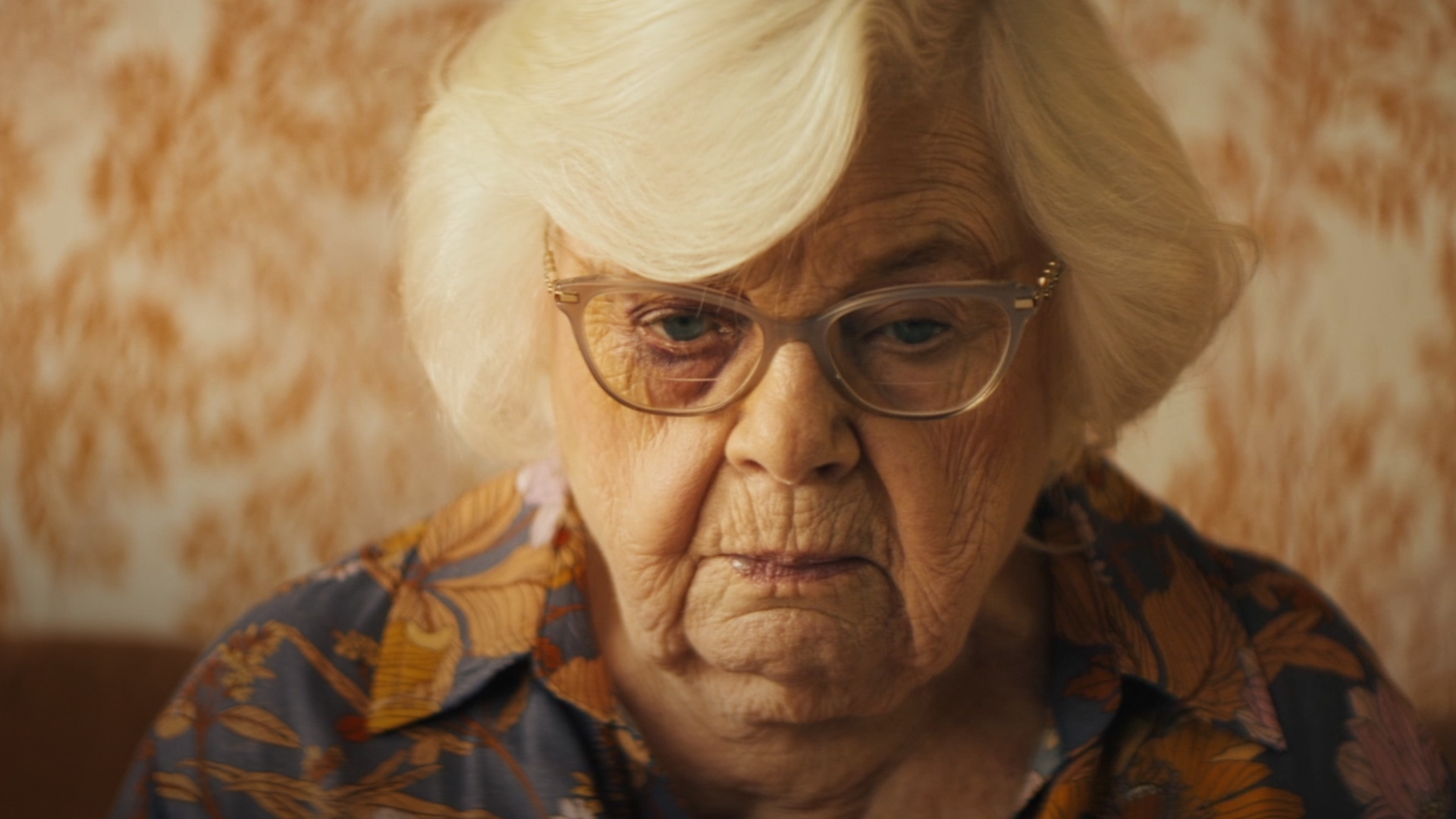
puts a face on the news stories of oldsters being conned out of their legitimately-earned savings and that face is June Squibb's, all 94 years of it, where she finally has a lead-role—and executive produces at the same time, no doubt for back-end compensation (way to go, June!)—playing the title character, who not only is getting "up there", she's reached the top and is looking down. She has a little trouble navigating new technology—she needs the help of her grandson, Daniel (
Fred Hechinger), who has his own issues, but loving gramms isn't one of them—she is a perpetual quilter, is ambulatory, and can take of herself. Not only physically but also in attitude. She plays mah-johngg on the computer and hates wearing that Life-Alert button. Her memory for trivia isn't good, but she's still sharp as a tack—her motivation hasn't dulled at all. She's a little creaky, but when she has a goal...
One day she gets a phone call. It's Daniel. He's been in an accident and he's in jail. He needs $10,000 to get out. She's given an address to a lawyer and she's to mail the money immediately to spring Danny. She calls her daughter Gail (Parker Posey), but she's in a therapy session and lets it go to voice-mail. Thelma can't drive, but gets a cab, gathers the money up and sends it. Gail gets the voice-mail, panics and calls Daniel—he's asleep—calls her husband Alan (Clark Gregg) and everybody tries to call Thelma, goes to her place and are alarmed that she's not there! When everybody manages to get to the same place, they all are relieved that Danny is safe...but, who called Thelma? They come to the realization that she's been scammed, but filing a police report does no good.
There is much discussion of what to do about Thelma—Danny feels responsible, but doesn't think he's good enough to take care of her and Alan and Gail, who are the most helicoptering of parents start to consider whether Thelma should be put in a home. Thelma, however, has one thing on her mind—getting the money back. The kids want to let it go, but not her, and while they're deciding what their next steps are going to be, Thelma decides what she's going to do. She has the address of where she sent the money, and all she needs to do is get some wheels. The kids aren't going to help, so she calls as many friends as she can, only to find that everybody on her contact list is either dead or incapacitated. 
Finally, she calls her friend Ben (the late, great
Richard Roundtree) who has an electric scooter and they embark on a journey across L.A. to find her money and get it back. Hilarity...and a substantial dose of what the hurdles the elderly face in this ultra-teched but indifferent world. It could be maudlin, it could be a shallow romp about "those frisky oldsters", but it deftly negotiates those pit-falls and turns into something funnier and a bit more life-affirming. Thelma's kids tend to lean toward caricature, but in the hands of Gregg and Posey, less damage is done toward the proceedings, and Roundtree and Squibb are delightful all the way through.
It's a better-than-you'd-think version of a geriatric heist movie, and, if you see it, stick around for the credits for a little surprise as to its inspiration. It'll bring a smile to your face and a warmth to your heart. And that never gets old.

* No, it's not Selma with a lisp.

Wednesday, March 9, 2016

Nebraska

Making Things Right
or
And Everything Looks Worse in Black and White

There's a story that Peter Bogdanovich got sick of telling during all the press junkets he did for The Last Picture Show about why he shot in black and white rather than color. Truth was, that he started test-shots of the Archer City location (author Larry McMurtry's home town) in color, but the town always looked too good, and didn't have the sense of bleakness that he wanted. The story goes that he went to Orson Welles (who was staying at his house) and mused maybe he should shoot the movie in black and white. "Of COURSE you'll shoot it in black and white!" Welles barked back. After repeating the story over and over again at press interview after press interview, the last few times Bogdanovich simplified his answer: "Because Orson Welles told me to."
I don't think Alexander Payne shot
Nebraska in black and white for that reason, or because it might recall the cover of the same-titled Bruce Springsteen album.  But, I think the bleakness is there, running as an under-current through the film as a view of life—not rosy and pink with vitality, green with verdancy, but shades of gray and the occasional extreme of black or white—the palette for a story of folks with limited choices in the nuances of life...and truth. But, lest you think this one's about old folks with one foot in the grave, or Alzheimer's or something like that, it's not. Not really. It's about living life before you run out of it, and grabbing any kind of dignity out of that life, despite Nature's determination to take it away in any way it can.


And not to mention your relatives and acquaintances.

It's also a damned funny movie, in the same low-key, sometimes painful way that its writer, Bob Nelson, wrote sketches for the late, lamented "Almost Live!" show which seemed to focus more on human dysfunction, rather than Pacific Northwest eccentricities. The old saw "familiarity breeds contempt" is apt here, as the extended Gates family, long separated (for good reason, apparently), is blandly caustic, bringing up family histories and past imperfections as grist for the family grinding mill.

The Gates clan watch a baseball game: Rance Howard (far left);
Bruce Dern (asleep in the back) and Will Forte (placating, far right)

"Wow, this feels too much like real life" said one of the patrons in Nebraska's audience.

The story's simple and seemingly uneventful, but mindful of David Lynch's The Straight Story. Woodrow Gates (Bruce Dern) is picked up by the police walking the highway in Billings, Montana. "Where ya goin'?" says the Sheriff. "Headed down the road there,' says Woody, none too helpfully.
O-kay, there's a little detour to the police station, where his son David (Will Forte) comes to pick him up. "So you told the Sheriff you were walking to Nebraska..." Woody's wife (June Squibb) won't drive him, he doesn't have a car, and he won't be given money for the bus. The reason he wants to go to Nebraska (Lincoln, specifically) is because he got a certificate in the mail from a magazine promotion company saying that he could have won a million dollars. Woody doesn't "buy" that it's a way to get him to buy magazines; he thinks he's won it, so he's walking to Lincoln to get his million. Why didn't he just mail it in? "I'm not going to trust the mail with a million dollars." Makes perfect sense. Walking, though, doesn't.

There's no sympathy at home. Wife Kate won't entertain any of this "I didn't know the son-of-a-bitch wanted to be a millionaire! Know what I'd do with a million dollars? I'd put him in a home!!" Brother Ross (Bob Odenkirk) thinks Dad's senile and doesn't want to hear of it. Only David will entertain the notion of driving Woody to Lincoln, if only for the chance to connect with the old man. They set off with some hitches and fits along the way, eventually stopping at relatives' to get a breather from what would seem to be a continuing series of minor disasters. But, his old stomping grounds bring no comfort, as word soon gets around that Woody's driving to Lincoln to get a million dollars—a sum that strikes everyone dumb...and a little bit stupid. Old debts are brought up, and quite a few people want a part of that million dollars whether they deserve it or not...and for some reason, nobody thinks twice about how Woody might have come into that money—the amount leaves them a little blinkered. And envious. And opportunistic.

For David, it's an opportunity to gain some perspective (just the ability to see Woody's past surroundings adds a little knowledge) and, as he's stuck in a pattern of "getting by," some insight into both Dad and himself. By the time the two ride off into the last shot—one of the loveliest and most potent of the past year's movies, a black-and-white sunset—a nice, warming resolution has been reached. But not too warming. It is a sunset. And it is in black-and-white, lest it betray any cheer or a rosy sensibility. Payne, evidently, did make a color version of Nebraska to satisfy some niche contractual requirements for the studio (Paramount Vantage), but has expressed hope that it never sees the light of electronics.

OF COURSE, it won't. It would be a completely different movie, and a less effective one.