Id, Ego, and Super-Ego ("The names have been changed to protect the innocent...")
or "Nothing's Too Good for 'the Man Who Shot Liberty Valance'"
I run hot and cold on director Quentin Tarantino. Because he runs hot and cold in his movies. He started out as a grand cribber of cinema, achieving success right out of the gate by using ideas that he'd seen in foreign films that few others had seen—his years as a video-store clerk stood him in good stead and he had a marvelous ability to see good quality, even in mediocre films, and parlay that in his films. I've always seen the Quentin Tarantino success story as a bit like "The Emperor's New Clothes," another of those where if you outlast the folks who remember your source material, you'll do just fine, and I've seen it happen time and again, not only in film-making but in music, as well. One can say that there's only so many notes in the scale and only so many ways you can photograph something, but that gives lie to those movie-story-tellers and composers who still somehow manage to make something unique, distinctive, and artistically personal. But Tarantino can surprise you. He does me. After being largely "ho-hum" about Reservoir Dogs and Pulp Fiction, I found his version of Jackie Brown impressive and heart-felt. There was hope. I thought his half of the "Grindhouse" double bill—Death-Proof—was a better version of the exploitation films he was trying to emulate, and I was amazed at what he did with Inglourious Basterds. I considered that the best movie he's ever made. Judging from the last line of the movie, Tarantino thought so, too. If it wasn't for mis-steps like the Kill Bill movies and junk like The Hateful Eight, I'd be more confident walking into one of his movies. And there were never any lingering doubts about what I'd just seen, good or bad with Tarantino. The fact that I HAD lingering doubts aboutOnce Upon a Time...in Hollywoodwas actually a good sign. The movie had enough good things—smart things—that it stuck like a burr in my cortex, and let me suss it out, rather than dismiss it.
Forget Inglourious Basterds (well, don't—it's a good absurdist film about movies with a lot of catharsis thrown in). Once Upon a Time...in Hollywood may be his best movie. Born of his love for that grimy corner of L.A. immersed in movie-making where he grew up, Tarantino has culled pertinent details and coalesced them into a tale of two Hollywood discards, who, despite their circumstances and their frailties, just might make a difference and do some good in the world, aside from the negligible jobs of making fantasies for themselves and others.
The film has the basic structure of Sergio Leone's Once Upon a Time in the West (a title borrowed by Tarantino and quite a few others) that set its own events in a fairy tale narrative setting. Disparate characters orbit around each other until an inevitable collision creates a unified favorable result. The interactions depend largely on Fate and the separate machinations of those involved. It so happens that they share the aspect that two individuals of experience act as agents to ensure the future of a third whose life is just beginning.
Rick Dalton (Leonardo DiCaprio) is a youngish actor having a mid-career crisis—too old to be thought of as in his young heart-throb days and too young to be considered a good character actor—having seen success starring on an early 60's western series called "Bounty Law." He could be Steve McQueen from "Wanted: Dead or Alive" but without the successful transition into big movies. Or Clint Eastwood ("Rawhide") without the Leone "spaghetti" westerns. Or Clint Walker ("Cheyenne") or James Garner ("Maverick") or Burt Reynolds ("Gunsmoke" and "Riverboat")—it really doesn't matter "who," DiCaprio's Dalton has aspects to all of them, but without the mainstream success transitioning to movies after TV. He has a narcissistic streak—he's an actor, after all—that sees more bad than good and he drowns the career disappointments (like losing the lead in The Great Escape to McQueen, which Tarantino has the generosity to show what it would've been like) with booze and smokes and self-recrimination.
He's done a couple cheap exploitation films, but sees them as a step downward, opting, instead, to guest-star on some TV shows—like "The FBI" and the upcoming pilot for "Lancer" starring James Stacy (Timothy Olyphant) and Wayne Maunder (Luke Perry—his last role before his death). Even this doesn't enthuse Dalton, who's just scraping by to make it to the next "Pilot season" where he might (but probably won't) score a lead in a series. Even an offer by producer Marvin Schwarz (Al Pacino) to go to Europe and star in some foreign films is seen by Dalton as giving up and "settling."
That actually sounds pretty good to Cliff Booth (Brad Pitt), who has moved from being Rick's stunt-double on "Bounty Law" to being the guy "who carries his load"—acting as go-fer, handy-man, and chauffeur for Rick (Rick can't drive owing to an earlier DUI). Cliff is the guy who gets things done, doing odd-jobs around Rick's house on Cielo Drive (while living in a trailer behind the Van Nuys Drive-In, where he dotes on his trained pit-bull, Brandy). Cliff abides. He's never had the chances that Rick has had and things that Dalton might be grieving over, he sees as a pretty good life. If Dalton thinks the glass is half-empty, Cliff is just happy to have a glass.
The two might be twins of each other, while polar opposites—like the twin aspects of Edward Norton in Fight Club—one self-involved and indecisive, the other pragmatic and decisive. It's not clear who's in charge of who, with Rick giving orders and Cliff giving pep-talks ("Hey, you're Rick fuckin' Dalton! Don't you forget it!"), but the two are close—real close. You can't have one without the other.
Cliff and Rick watch the latter's performance on "The F.B.I." (Burt Reynolds originally appeared in the featured episode)
The movie takes place over three days—Saturday and Sunday, February 8th and 9th, 1969, and then six months later, on August 8th, 1969 (a date that will live in infamy). The first two take a look at the day-to-day lives of Rick and Cliff, as the latter ferries Dalton to take a meeting with Schwarz and to the studio set of "Lancer" where the former series star is set to guest-star as "the heavy" in an attempt to expand the range of roles being offered to him.
For Cliff, it's a mildly frustrating experience as there won't be any stunt-work for him to do on the shoot, as Dalton's role doesn't require any—and because the stunt-coordinator (Kurt Russell) is reluctant to hire him, given Cliff's past—there's the incident about the death of Cliff's wife (of which Cliff was accused and acquitted) and the rhubarb that ensued when Cliff was stunting for Rick on an episode of "The Green Hornet" TV series, where he had a little too much of co-star Bruce Lee's boasting and roughed him up in a fight.*Instead, Cliff is assigned to fix Rick's TV aerial. We also get to see a bit of Cliff's solitary existence.
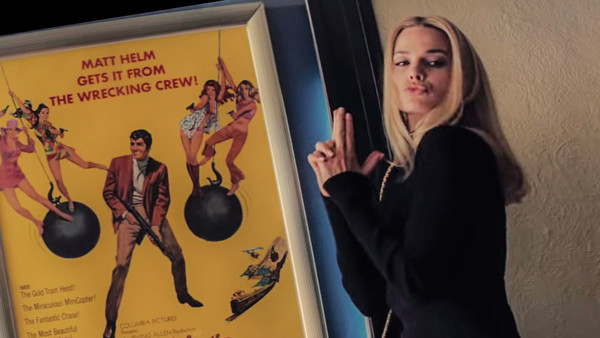
We also get to see a bit of the life of Rick Dalton's neighbor on Cielo Drive, Sharon Tate (Margot Robbie), who has come back to Hollywood after appearing in a movie for director Roman Polanski and subsequently marrying him. We mostly observe her, a beautiful young actress, returning to her roots and enjoying an upward spiral of success. At one point, she talks her way into a showing of the Dean Martin vehicle The Wrecking Crew (and Tarantino shows scenes of the movie featuring the actual Sharon Tate—not Robbie posing as her—which is a lovely touch) and basking in the reaction of the audience to her performance.
We also see her join Polanski at a party at the Playboy Mansion, dancing with the likes of Michelle Phillips and Mama Cass of The Mamas and the Papas while being observed by the likes of Steve McQueen (Damien Lewis) and Connie Stevens (Dreama Walker) and being speculated about in the bitchy coveting way of Hollywood—"Well, she has a "type:" prosperous men who look like ten year old boys, while McQueen offers a calculating scenario of how she broke off with hairdresser Jay Sebring, who's maintained a close relationship: "All he (Polanski) has to do is fuck up and she comes back to him." Hollywood isn't such a friendly town that it isn't covetous or catty.
So, these three—Rick the craving, Cliff the competent and Sharon, the girl in the spotlight. But, there are others. Not working towards a dream, but sponging off the spoils of it. At one point, a grungy looking Charlie Manson (Damon Herriman) appears at the Polanski driveway, looking for record producer Terry Melcher (his work with Paul Revere and the Raiders appears all over the film) and Brian Wilson, friends of his that used to live there. He's turned away. But, he's never far away.
For example, in his ramblings while Rick is at the studio, Cliff encounters a pack of young women, dumpster-diving and attracting attention. They're part of Manson's coven—"The Family"—currently squatting at the Spahn Ranch, a former movie set owned by an acquaintance (Bruce Dern) of Cliff's. Cliff's repeated encounters with one of the Manson followers (Margaret Qualley) makes him curious, and a bit concerned, leading him to go out there and try and check up on the old man, which is hostilely resisted by the "Family." Cliff doesn't care, brushing past objections and the defiance of Squeaky Fromme (Dakota Fanning) to find Charles Spahn blind, practically bed-ridden and entirely dependent on the Manson family.
Cliff's trip out there is the stuff of fears, intimidation and threat, a seemingly loving and organized group of free-thinkers, who, when challenged, become a mob of primitive zombies, brain-washed and untethered except to each other, and Tarantino does a masterful job of creating an underlying sense of primal dread in his shot choices and a creeping sound design that gets under the skin. Cliff is a skeptical observer, implacable in his mission to find out Spahn's condition and doesn't care what he has to do to accomplish it, and he doesn't care how many "dirty hippies" he has to go through to find out for himself.
The third day of the film's timeline is where the crux of the movie plays out. And given the "history" of the Manson "family," that date of August 8th, 1969 should put an anticipatory fear into any movie-goer. That date, six months after the first two days, sees changes in the lives of all three protagonists, and, in its history, signals the end of an era, of transitions from which nobody came back. That date, historically, has marked the end of the 60's and when L.A. changed from a dream factory to the end of dreams and free-love innocence—the death of "The Summer of Love," suffocated by a predatory, anarchic savagery.
But, this is Tarantino's movie and his love-letter to the Los Angeles of his youth. Just as he re-wrote history in Inglorious Basterds, he refuses to let that third act play out in reality, and subverts it into an equally savage last act, that manages to re-align the timeline, and keep Hollywood—HIS Hollywood—the stuff of dreams, rather than satanic nightmares.
It leaves one in a semi-happy Twilight Zone of hope, where...no, not everything is perfect, as the world can still be cruel and unfair, but it isn't turned upside down in favor of the devils, rather than the angels the city was christened for. Once Upon a Time...in Hollywood is a superbly realized, great film of slavish detail and loving devotion. It may even be better than its director, Quentin Tarantino, thinks it is—which, given his penchant for giddy self-aggrandizement, is something one never...ever...thought could be said.
The pilot—the original version—for the "Lancer" TV series directed, indeed, by Sam Wanamaker. Around about 27 minutes in, things will start to get mighty familiar to those who've seen OUAT...IH.
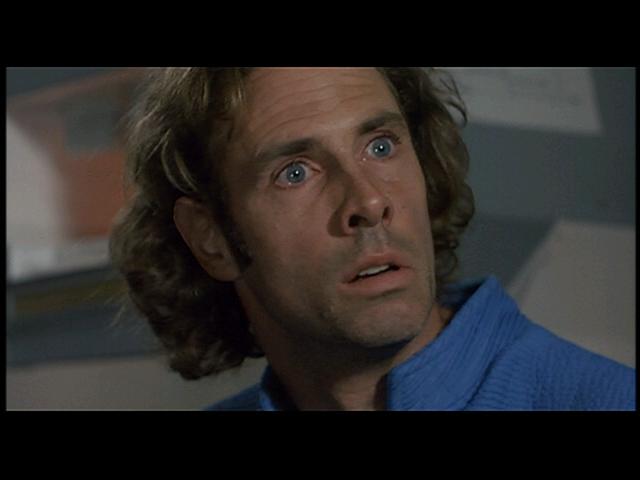
The actor is Joe Don Baker.
A gallery of Rick Dalton's Italian films
Sharon Tate...once upon a time.
* The incident is uncharacteristic of Lee and, at the behest of Lee portrayer Mike Moh and Brad Pitt, the scene was toned down considerably so that "The Dragon" isn't bested by Cliff in a fight, but it is interrupted in a draw.
Black Sunday(John Frankenheimer, 1977) From the twisted mind of Thomas Harris (who would later write "Red Dragon" and "The Silence of the Lambs") comes this entry in the "disaster movie" cycle of the 1970's. Only this one seemed entirely credible. Harris' first novel (and the only one that doesn't have Hannibal Lecter in it) conceived of a terrorist plot by a cell of the PLO called Black September (the group behind the Israeli athlete massacre in Munich in 1972) to kill everyone in the stadium hosting the Super Bowl. The film had the promotional tagline "It could be tomorrow!" Robert Evans bought the movie rights in his independent production deal with Paramount after leaving the studio, Ernest Lehman was contracted to write the screenplay (it would prove to be his last, with additions by Ivan Moffat and Kenneth Ross) and John Frankenheimer hired to direct—he had just finished a sequel to The French Connection and was starting to be noticed (again) as a gifted film-maker, especially when it came to thrillers. From the beginning, Frankenheimer wanted to set Black Sunday apart from the normal string of disaster movies in vogue during the 70's*by making it seem as true-to-life as possible, giving it an almost documentary feel.
The movie begins with a night-time raid on a September cell by a ruthless Mossad squad (led by Robert Shaw's agent David Kabakov) that is brutally efficient in taking out the terrorists, with one notable exception: catching September agent Dahlia Iyad (Marthe Keller) in the shower, he lets her go with only an appraising gaze.
Big mistake. Dahlia has a plan...and a means to carry it out. She has been "grooming" the aid of a court-martialed Vietnam vet, Michael Lander (Bruce Dern), who is on the psychological edge—suffering from PTSD as a Vietnamese POW, and by the resulting collapse of his marriage upon his return, he is chronically suicidal. Curiously, that hasn't stopped him from getting a job driving the promotional blimp for the Goodyear Tire company. Bad for them. Good for Dahlia. She convinces Lander that if he is going to commit suicide, he should do it in the most spectacular way possible, striking back at the country he's convinced has betrayed him, taking out as many Americans as possible in a terrorist attack on the Orange Bowl during that year's Super Bowl.
Meanwhile, the Mossad has brought in the FBI—in the form of agent Sam Corley (Fritz Weaver) on the results of the raid. Kabakov is starting to realize his error; Iyad is a former Baader Meinhoff member now offering her services to the PLO...and he had her dead to rights. She's now dropped off the intelligence radar and the Israeli's want the assassination mission completed, something Kabakov takes on as his personal responsibility. A recording that was found at the compound leads the investigators to suspect some sort of action is imminent and that the tape was meant to be discovered after the attack...but where and when the recording isn't specific.
The movie begins to take two parallel paths, following both the terrorists in their preparations and the FBI/Mossad investigation about what they might be doing. Their first idea that something is about to happen comes from a report from the Coast Guard to the FBI—twelve crates have been unloaded from a freighter to a man and woman wearing masks, but when the CG tried to intervene they were outrun. Kabakov travels to Long Beach and sneaks aboard the freighter under cover of darkness to interrogate the captain who needs a little persuasion to talk. But, when the captain answers a telephone, he is killed in an explosion and Kabakov is injured by the blast.
Those smuggled crates contain statues of the Madonna—made out of plastique that will be shaped into a large bomb to be brought into the Orange Bowl by the blimp and detonated, releasing thousands of steel flechettes, enough to kill everyone in the stadium. An initial test in the desert convinces Lander that the explosion will be uniform enough to cause the most devastation within the bowl-shaped stadium. With the plot proven in theory, Lander and Dahlia start work on the details to be ready for the next Super Bowl, while Kabakov and Corley are delayed by the Mossad agent's hospitalization. But, an aborted attempt by Dahlia to kill Kabakov in his room, convinces them that what could have been a few unrelated clues is a very real plot, one that their suspects are trying to see to completion by eliminating the investigators.
Upon Kabakov's release from the hospital, the investigation becomes more intense: Kabakov threatens a Los Angeles based importer to tell him that the shipment was for explosives to be delivered to a woman named "Kaza," then meets with an Egyptian intelligence official (Walter Gotell) who eventually tells him that this "Kaza" is actually Dahlia Iyad; when she is seen on January first in the Miami vicinity, the team start concentrating their efforts there and their suspicions begin to point to one target—the Orange Bowl, the Super Bowl.
The film then becomes a race against time and a fight against obstacles for both sides—the path is smooth for neither the terrorists or the security forces and one is kept guessing along the way whether the plot will come apart at the seams due to its own dicey nature or whether it will succeed in spite of it because the game authorities just choose to "bureaucracy" themselves into suicide. Both sides are firmly dedicated to a fanatical extreme and by the time Frankenheimer has ramped up the tension of the final denouement, you're just about willing to believe anything can happen.
And that's where director Frankenheimer is the biggest co-conspirator in the whole plot; he knows how to set things up to make the audience put the framework together, and by game-time, he has the audience both wanting to see the plot come together at the Super-Bowl, but also to see it quashed in as viscerally satisfying a way as possible. His editing has been moving at an ever-quickening pace culminating with a shootout on a Miami Beach, but, the realization of the target becomes known, the film settles into a complicated rhythm due to all the pieces coming together. And at that point, he pulls out every visual trick in the book to try to convince you that there is a goddamn blimp flying into the middle of the freakin' Super-Bowl and using every suspense trope right down to a sputtering, burning fuse.
It's pretty amazing what the film-makers got away with back in the innocent days of 1977: First off, yes, Frankenheimer did film at the genuine Super-Bowl game—Super-Bowl X (Steelers/Cowboys), to be exact—with permissions from the NFL and the two vying teams to use their logo's**—and the shots of the blimp hovering into the stadium were filmed the days before and after, with a lot of crowd cooperation going on for the scenes of panic. In fact, at one point, there's a shot of Robert Shaw sprinting along the side-lines where he is nearly strong-armed by a very real stadium security guard who didn't recognize Shaw and maybe didn't realize the movie was being filmed (the many film camera's were disguised to look like CBS-television cameras to ensure that one wasn't caught inadvertently due to all the footage being shot).
One or two effects shots are a bit dodgy amidst the hundreds it took to construct the sequence and some of the process work stretches credulity—as if the methods used to subdue a runaway blimp weren't incredulous enough—but, that last half an hour of the film does have one on the oft-cited "edge of one's seat." When I see a film of this nature (and it's successful in its purpose) my left leg has a tendency to bounce in a nervous response that would resist any amount of sticky gum on the theater-floor and Black Sunday had that effect (and it had nothing to do with matching John Williams' "thrummy" tension music at that point in the proceedings).
At the time of the film's release (it's opening was basically swamped by the juggernaut of the first Star Wars movie), the film and story was a competent, if fanciful, thriller of the paranoid variety on the cusp of the "disaster" cycle of films. Now, it's a cautionary tale, a blueprint for terrorists to some—it and Tom Clancy's "Debt of Honor" are regularly brought up in terrorism discussions—a call for vigilance by others, but, unfortunately, no longer fanciful. We've seen worse, for real. And it's tagline—"It could be tomorrow"—rather than a come-on, now sounds like a threat.
* After the heady rush of Irwin Allen hits ofThe Poseidon Adventure and The Towering Inferno, they were starting to ebb in popularity and ideas—another entry of that year was the rather ridiculous Rollercoaster (rather than a disaster movie, it might have been a "bad accident" movie) and a previous terror-in-the-football-stadium was the previous year's Two Minute Warning, which was "legacied" into the genre for the fact that it starred Charlton Heston. ** And, if we are trying to keep it in the real world, Frankenheimer used his clout with Goodyear Tire Company (he'd worked with them in filming 1966's Grand Prix) to get the actual Goodyear blimp—with the company's actual logo—to make it feel more like a credible event. Now, that is truly amazing. And a step above Harris' novel; the author sidestepped the issue by calling it "the Aldrich blimp," creating a fictitious and non-litigious company to sponsor the air-ship.
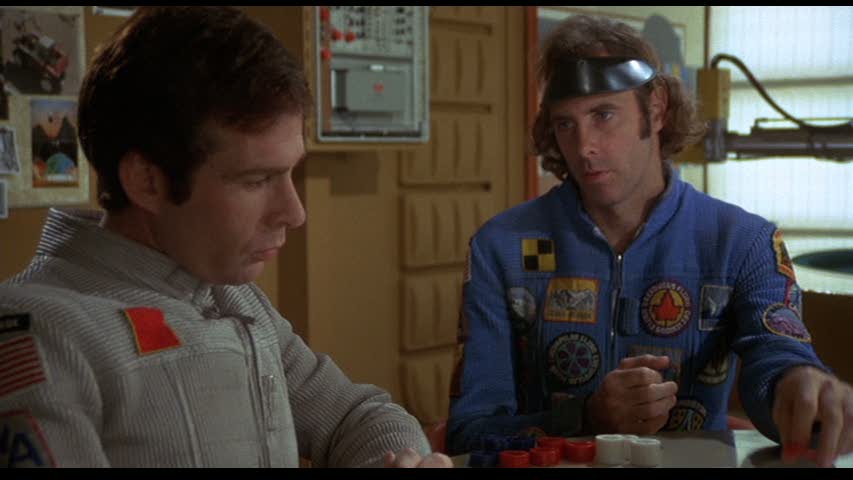
Silent Running(Douglas Trumbull, 1972) In the years before Star Wars, science fiction films were few and far between, even after the space-jump that had been accomplished with the film 2001: a Space Odyssey. Oh, there were a couple here and there—not counting the low-budget exploitation ones—and it seems I saw just about all of them. In 1972, though, one came out that combined concerns of both Earth and space in one earnest little package. Silent Running postulates a world so over-populated that the planet becomes overrun with cities, the flora (and some fauna) are rocketed into space in hot-house festooned transports until such a time that the Earth can find space for them again.
Questions immediately come up: no room for vegetation, eh? Where does the planet get its oxygen? It's phyto-plankton? It seems that if you take vegetation out of the equation that the Earth's food pyramid will pretty much collapse in on itself, and with it, the human population who are subsisting on...what?...space food sticks? Soylent green?
Things quickly go to seed when word comes up from Mission Control that Earth doesn't give a rip anymore—budget cuts or some such—so they should just jettison the space-green-houses, blow 'em up, and return home. Rather than commit planticide, Lowell chooses, instead to go all-PETA and decide that his fellow agro-nauts' best function would be as fertlizer. A bit extreme, maybe, but we are talking about Bruce Dern here. And, to hide his crimes, he sends the ship into a collision course with Saturn's rings to try and convince Mission Control the ship will be destroyed. However, pesky-persistent techies that they are, NASA manages to find him, and Lowell must come up with a way of saving the plants and allaying any suspicions.
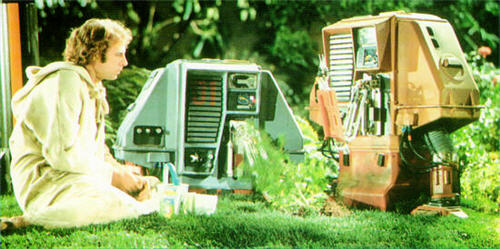
In Silent Running, Trumbull managed to make an ecological low budget sci-fi film, with illusion work that rivaled 2001—he even managed to make a realistic looking Saturn, something that wasn't possible years before with the Kubrick film. His robots were strange little non-humanoids forms that suggested walking amplifiers, and the story (and Dern's acting) makes them sympathetic little synth's. The ships designed for Silent Running were subsequently used for stock footage for years in such shows as "Battlestar Galactica" and Trumbull's considerable work served to influence the look and techniques that would be applied in Star Wars.*
Though Silent Running is not the greatest of films, it is not through lack of trying, as director, star and art team stretch their budget impressively and play it for all the drama it's worth. But the story is a little skimpy, the protagonist a bit bi-polar, and the conclusion not exactly rousing. A good study in movie-making, if not necessarily story-telling.
Making Things Right or And Everything Looks Worse in Black and White
There's a story thatPeter Bogdanovichgot sick of telling during all the press junkets he did forThe Last Picture Showabout why he shot in black and white rather than color. Truth was, that he started test-shots ofthe Archer City location(authorLarry McMurtry's home town) in color, but the town always looked too good, and didn't have the sense of bleakness that he wanted. The story goes that he went to Orson Welles (who was staying at his house) and mused maybe he should shoot the movie in black and white. "Of COURSE you'll shoot it in black and white!" Welles barked back. After repeating the story over and over again at press interview after press interview, the last few times Bogdanovich simplified his answer: "Because Orson Welles told me to."
I don't think Alexander Payne shotNebraskain black and white for that reason, or because it might recall the cover of the same-titled Bruce Springsteen album. But, I think the bleakness is there, running as an under-current through the film as a view of life—not rosy and pink with vitality, green with verdancy, but shades of gray and the occasional extreme of black or white—the palette for a story of folks with limited choices in the nuances of life...and truth. But, lest you think this one's about old folks with one foot in the grave, or Alzheimer's or something like that, it's not. Not really. It's about living life before you run out of it, and grabbing any kind of dignity out of that life, despite Nature's determination to take it away in any way it can. And not to mention your relatives and acquaintances.
It's also a damned funny movie, in the same low-key, sometimes painful way that its writer, Bob Nelson, wrote sketches for the late, lamented "Almost Live!" showwhich seemed to focus more on human dysfunction, rather than Pacific Northwest eccentricities. The old saw "familiarity breeds contempt" is apt here, as the extended Gates family, long separated (for good reason, apparently), is blandly caustic, bringing up family histories and past imperfections as grist for the family grinding mill.
The Gates clan watch a baseball game: Rance Howard (far left); Bruce Dern (asleep in the back) and Will Forte (placating, far right) "Wow, this feels too much like real life" said one of the patrons in Nebraska's audience.
The story's simple and seemingly uneventful, but mindful of David Lynch's The Straight Story. Woodrow Gates (Bruce Dern) is picked up by the police walking the highway in Billings, Montana. "Where ya goin'?" says the Sheriff. "Headed down the road there,' says Woody, none too helpfully.
O-kay, there's a little detour to the police station, where his son David (Will Forte) comes to pick him up. "So you told the Sheriff you were walking to Nebraska..." Woody's wife (June Squibb) won't drive him, he doesn't have a car, and he won't be given money for the bus. The reason he wants to go to Nebraska (Lincoln, specifically) is because he got a certificate in the mail from a magazine promotion company saying that he could have won a million dollars. Woody doesn't "buy" that it's a way to get him to buy magazines; he thinks he's won it, so he's walking to Lincoln to get his million. Why didn't he just mail it in? "I'm not going to trust the mail with a million dollars." Makes perfect sense. Walking, though, doesn't.
There's no sympathy at home. Wife Kate won't entertain any of this "I didn't know the son-of-a-bitch wanted to be a millionaire! Know what I'd do with a million dollars? I'd put him in a home!!" Brother Ross (Bob Odenkirk) thinks Dad's senile and doesn't want to hear of it. Only David will entertain the notion of driving Woody to Lincoln, if only for the chance to connect with the old man. They set off with some hitches and fits along the way, eventually stopping at relatives' to get a breather from what would seem to be a continuing series of minor disasters. But, his old stomping grounds bring no comfort, as word soon gets around that Woody's driving to Lincoln to get a million dollars—a sum that strikes everyone dumb...and a little bit stupid. Old debts are brought up, and quite a few people want a part of that million dollars whether they deserve it or not...and for some reason, nobody thinks twice about how Woody might have come into that money—the amount leaves them a little blinkered. And envious. And opportunistic.
For David, it's an opportunity to gain some perspective (just the ability to see Woody's past surroundings adds a little knowledge) and, as he's stuck in a pattern of "getting by," some insight into both Dad and himself. By the time the two ride off into the last shot—one of the loveliest and most potent of the past year's movies, a black-and-white sunset—a nice, warming resolution has been reached. But not too warming. It is a sunset. And it is in black-and-white, lest it betray any cheer or a rosy sensibility.Payne, evidently, did make a color version of Nebraskato satisfy some niche contractual requirements for the studio (Paramount Vantage), but has expressed hope that it never sees the light of electronics. OF COURSE, it won't. It would be a completely different movie, and a less effective one.
 Id, Ego, and Super-Ego ("The names have been changed to protect the innocent...")