Showing posts with label Wallace Shawn. Show all posts

Tuesday, October 5, 2021

The Addams Family 2

Oh, *Snap* *Snap*
or
National Lampoon Addams Family Family Vacation Negation
 
I've made plain my life-long love of "The Addams Family" especially the TV-series based on the macabre New Yorker cartoons of Charles Addams (not the worst source for a TV show...), which, for its short two year run, did a running black satire of family sitcoms—credit to Nat Perrin, who'd worked with the Marx Brothers and who knew "funny."

Attempts to revive the characters have been monstrously uneven whether in film, TV revivals or cartoon series. The best result was Barry Sonenfeld's film Addams Family Values, which managed to combine satire—and not sitcom-satire, real satire—and clever writing to make a wicked little movie on many levels. 
 
The same could not be said for 2019's The Addams Family, a CGI-animation version that knew exactly what it was supposed to do...but couldn't make it funny. With that title, you could immediately guess that cleverness was not going to be the spark that animated the thing to life.
 
Well, now everybody's back with...The Addams Family 2. Its biggest joke might be the "Submitted for Your Consideration" ad come Oscar-time.
Oh, technically, it's all fine. CGI being what it is these days, something (like, say, a waterfall) has to be really dodgy for it to be noticed. It's just that there is a sense of rote-ness to this, a feeling that the ambitions are so slim, the characters so known, that any effort besides the obvious isn't attempted, and in fact is avoided, lest it fall out of a PG category and betray the lack of sophistication expected in animated films. There's no shock, no envelope-pushing, and no sense of the black humor emblematic of the original Addams work in The New Yorker.
This one, like the last, focuses on Wednesday Addams (ChloĆ« Grace Moretz), who is going through all sorts of growing pains. For her school's science project, she's developed a way to transfer tendencies from one being to another (ala Freaky Friday (both of them) and God knows how many other films and television shows)—in this case, she transfers her pet octopus' higher brain functions to her sweet but diminished Uncle Fester (Nick Kroll). Fester will, as the film progresses, take on more and more octo-tendencies, which the family doesn't really notice too much (which is odd but not funny). Wednesday's work is noticed by a mad scientist named Cyrus Strange (Bill Hader, surprisingly uneffective) who would like to know her methodology, which she refuses to divulge as "a family secret." 
This starts a plot where Strange sets up a plot to convince the Addams Family that Wednesday was switched at birth with another child (as the joke that Addams used for Wednesday was that she resembled her mother this makes little sense and they have to do extra work to get past DNA issues). As Wednesday is already feeling estranged from her family, this sets too well with her, but not the others, and Gomez suggests they go on a family road trip to see the worst of America (planned stops are Salem, Sleepy Hollow, Miami, San Antonio, The Grand Canyon, Death Valley, and...Sausalito). If one did a little more research—or just had the cajones to risk offending people—they could have found a LOT of places to go.
It's not a lot of fun—there were two lines that made me laugh: When the family sits down to dinner, Fester starts to dig in and Morticia chastises him: "Fester, wait for the children..." to which he replies "I thought we were having CHICKEN!" And at a detour to Niagara Falls, Morticia asks Wednesday "Having fun, dear?" To which she replies "I'm looking at Canada, if that answers your question..." (just the phrasing of that I liked). There's also a nice shot of Gomez being so depressed, he can't even cradle his head on his hands. "Thing" has to do it. It's at the bottom of the review, as it graphically encapsulates how I feel about the film.
The cast does a good job for all they're asked to do: Oscar Isaac is the proper amount of latin dash as Gomez, but Charlize Theron seems to be under the impression that Morticia went to Bryn Mawr. Chloƫ Grace Moretz has the largest role as Wednesday, but doesn't do much to sell the humor of her depressed daughter, and Nick Kroll does a fine imitation of Jackie Coogan's TV Uncle Fester, but with considerably more saliva. And why the producers thought the sonorous butler Lurch would, when he sings (!!!), have a high singing voice I have no idea, but they do it. He sings "I Will Survive" which isn't funny and makes little sense story-wise.
But, then, that passes for the best you can expect from this milquetoast Addams Family series, which is the wrong format for the wrong audience and betrays and negates the peculiar charms of Addams' original work. It should be staked, coffined, chained, and buried 12 feet deep in salted, sanctified Earth never to materialize in this incarnation again.

Tuesday, May 26, 2020

The Princess Bride

The Princess Bride (Rob Reiner, 1987) The Princess Bride just misses being an "Anytime Movie"—I watch it whenever I see it appear while browsing through my cable list as it's a genuine crowd-please (this crowd, anyway)—but it barely doesn't make it because the direction is a bit...ordinary. Ordinary with enticing touches of brilliance.

The story of Princess Buttercup (Robin Wright) who meets, then loses her one True Love (caps) in the stable-boy Westley (Cary Elwes) at a time of turmoil in the lands of Florin and Guilder was written by William Goldman with the conceit that his version was merely the "Good Parts" abridgment of a longer tale by S. Morgenstern was released in 1973 and had a fabled history in not being turned into a film (by such as Francois Truffaut, Richard Lester, Robert Redford and Norman Jewison). Goldman found the process so frustrating that, at one point, he actually bought the film rights back to retain some measure of control.
When Reiner, after making This is Spinal Tap, and while filming Stand By Me, was asked about future projects, he mentioned "The Princess Bride" but was told it wasn't possible. Too many studios had tried. Too many had failed. But, with seed money from Norman Lear and Goldman's support and screenplay, the "unfilmable" book began production. 
The film only had moderate success at the box office—the distributor, 20th Century Fox, didn't quite have a handle on how to market it—but the film has achieved a cult following, buoyed by video distribution and an undeniable charm that is nearly irresistible, due to several aspects that strengthened the work, but may have made that marketing strategy somewhat "inconceivable."
1) The casting couldn't have been stronger, despite a lack of bankable stars. Wright was working on a U.S. soap opera, but when she showed up on Reiner's door-step back-lit by the sun, Goldman sealed her casting by saying "That's what I wrote." Elwes had a couple movies under his belt, was Errol Flynn-handsome, but also possessed a razor-sharp comic timing and sense of the absurd that conveyed a maturity beyond his years and nails both the romantic and slap-stick aspects of the character—you take him seriously even if the character doesn't always.
The rest of the film is suffused with wonderful character actors—and the charming Andre the Giant—who take the fairy tale seriously in ways both ironic and heart-felt (and then, Billy Crystal and Carol Kane shuffle in, throw all that out and ad-lib hilariously). Goldman's characters all have their particular quirks and the actors slot their performances neatly into place...to the point where the lines become distinctively quotable—in their precise inflections.
2) That melding of actor with dialogue goes a long way to making the film enjoyable and also indelible in the memory. It is a sure thing that you can quote at least five lines from The Princess Bride, probably stretch it to ten and even more. Any work place that starts with one line will insure a good ten minutes of others adding another. I've based two "Don't Make a Scene" posts on my favorites: "Life is pain, princess. Anyone who says differently is selling something" and "You fell victim to one of the classic blunders. The most famous is never get involved in a land-war in Asia." But, there could be others, many others. And there's enough grace in The Princess Bride that they all don't have to be laugh-lines or cynically charming. In fact, the best line paying off relying on audience memory is one used through-out and has its largest pay-off as the last line of the movie: "As you wish."
3) The structure of The Princess Bride is rather magical. Just as Goldman uses the conceit of an abridgment in the book version, the movie uses a narrative structure where a young boy (Fred Savage), sick and kept out of school, is read the book by his grandfather (Peter Falk), with interruptions and protestations about "kissing" scenes and lapses in logic that allows the movie to get to the "good parts" without bothering about transitions or belaboring sentiment. Those scenes are unique to the movie and give it an added emotional resonance, especially given Falk's duty as narrator of the story. The book-ending (no pun intended) structure buttresses the story, imbues it with the warm glow of parental story-telling and manages to link fable with life, in a shared secret of experience and affection. That's a master-stroke.
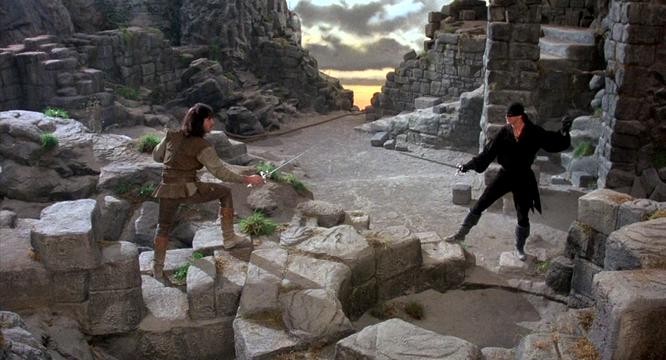
For me, it isn't perfect (but, that just me—I'm a curmudgeon). I wish that the whole movie could have the look of the picture above. There are times when the movie is just beautiful...and others when it looks a bit clunky, staged haphazardly and shot more for TV soap opera than fairy-tale. Some of the sets—I'm thinking particularly of the top of the Cliffs of Insanity but there are others—are so set-bound that it jars with the complex verdure found in a lot of the movie. There is an amateurish charm to some things, creatures and machines, that—if one were righting a defending thesis—could be just the limited imaginings in the child's head. But, that's making excuses when the most reasonable one is "budget." 
And the score. Mark Knopfler's themes are sometimes quite nice, but lose the organic feel and human touch as calculated on a synthesizer. An orchestra, or just a few mixed-in strings could have gone a long way to putting some breath into the music, instead of the mechanics that sometimes clash and distance. There's no resonance to it and an absence of the human touch.

Quibbles! Nit-picking! There's been talk of a musical version being done—all have come to naught. There's been speculation of a remake—to which Cary Elwes had the best tweet: "There’s a shortage of perfect movies in this world. It would be a pity to damage this one." 

This one succeeds so much that it would be best to just leave it be.

As we wish.