The Big Picture(Christopher Guest, 1989) Every film-maker who has ever made a film in Hollywood has had a sneaking desire to make a film about the absurdities of making a film in Hollywood. There's just a considerable smaller amount who have the balls to risk reprisals in the company-town. One doesn't shit where one eats. There's an even smaller amount who have the talent, wit, and lack of invective to point out the absurdities without making it a hatchet job...or a crashing bore.
Chris Guest's 1989 film falls somewhere in-between, retaining the wonder-lust of film-making with the soul-crushing corporate low-balling of vision. Having the creative impulse doused by a flood of compromises and bidding agendas.
Budding film-maker Nick Chapman (Kevin Bacon) is "hot", having just won a film-making competition and given the opportunity to pitch ideas for "projects." Taking a meeting with studio producer Alan Habel (J.T. Walsh) gives him flashing hope until Habel wants to make changes to his ideas more in line with Habel's peccadilloes. Then, there's the "Catch-22" of not having an agent—he can't be taken seriously without one but can't get one until he's taken seriously. So, he takes a lunch with a prospective agent (Martin Short), more interested in being seen than seeing what he can do.
Then, he gets invited to a Hollywood party given by Habel and his wife (Fran Drescher), but it's less about working than distraction—touring the house, socializing, networking. One of the biggest distractions is Gretchen (Teri Hatcher, her first film), aspiring actress, who further pushes Nick from his artistic visions by suggesting that he write his movie with her in mind. Her efforts further complicate Nick's life by making his girlfriend Susan (Emily Longstreth) jealous, driving a wedge in their relationship. Gretchen becomes the embodiment of every Hollywood enticement, moving him further from making HIS movie and compromising his aspirations. Pretty soon, his potential movie is so far afield from his intentions that his enthusiasm starts to wane, and ultimately, his film is canceled, forcing him to take entry-level jobs in Hollywood just to make ends meet.
Oh, how far the lofty intentions fall. It's hard to drum up much sympathy for Nick—sure, the Hollywood system is corrupt and capricious, but Guest at least makes his downfall as much about the weakness of Nick's character as the environment he's stepped into.
That story, thus, is not that involving, and it has a hard time competing with the opening of the showing of student films vying for Best of Show, which is a hilarious look at the pit-falls of student film competitions; they involve a film by an agent's son—loaded with recognizable stars, but clearly shot at a time when those actors are available, with mismatched shots showing that nobody was on the same set at the same time—or a full-of-itself vanity project by a young filmmaker with an outsized ego featuring himself in a starring role. The satire of the sequence is sharp and cruel and the rest of the film never lives up to the potential of the opening sequence—an inadvertent portent for what is to come for its hero.
The Princess Bride(Rob Reiner, 1987) The Princess Bride just misses being an "Anytime Movie"—I watch it whenever I see it appear while browsing through my cable list as it's a genuine crowd-please (this crowd, anyway)—but it barely doesn't make it because the direction is a bit...ordinary. Ordinary with enticing touches of brilliance. The story of Princess Buttercup (Robin Wright) who meets, then loses her one True Love (caps) in the stable-boy Westley (Cary Elwes) at a time of turmoil in the lands of Florin and Guilder was written by William Goldman with the conceit that his version was merely the "Good Parts" abridgment of a longer tale by S. Morgenstern was released in 1973 and had a fabled history in not being turned into a film (by such as Francois Truffaut, Richard Lester, Robert Redford and Norman Jewison). Goldman found the process so frustrating that, at one point, he actually bought the film rights back to retain some measure of control.
When Reiner, after making This is Spinal Tap, and while filming Stand By Me, was asked about future projects, he mentioned "The Princess Bride" but was told it wasn't possible. Too many studios had tried. Too many had failed. But, with seed money from Norman Lear and Goldman's support and screenplay, the "unfilmable" book began production.
The film only had moderate success at the box office—the distributor, 20th Century Fox, didn't quite have a handle on how to market it—but the film has achieved a cult following, buoyed by video distribution and an undeniable charm that is nearly irresistible, due to several aspects that strengthened the work, but may have made that marketing strategy somewhat "inconceivable."
1) The casting couldn't have been stronger, despite a lack of bankable stars. Wright was working on a U.S. soap opera, but when she showed up on Reiner's door-step back-lit by the sun, Goldman sealed her casting by saying "That's what I wrote." Elwes had a couple movies under his belt, was Errol Flynn-handsome, but also possessed a razor-sharp comic timing and sense of the absurd that conveyed a maturity beyond his years and nails both the romantic and slap-stick aspects of the character—you take him seriously even if the character doesn't always.
The rest of the film is suffused with wonderful character actors—and the charming Andre the Giant—who take the fairy tale seriously in ways both ironic and heart-felt (and then, Billy Crystal and Carol Kane shuffle in, throw all that out and ad-lib hilariously). Goldman's characters all have their particular quirks and the actors slot their performances neatly into place...to the point where the lines become distinctively quotable—in their precise inflections.
2) That melding of actor with dialogue goes a long way to making the film enjoyable and also indelible in the memory. It is a sure thing that you can quote at least five lines from The Princess Bride, probably stretch it to ten and even more. Any work place that starts with one line will insure a good ten minutes of others adding another. I've based two "Don't Make a Scene" posts on my favorites: "Life is pain, princess. Anyone who says differently is selling something" and "You fell victim to one of the classic blunders. The most famous is never get involved in a land-war in Asia." But, there could be others, many others. And there's enough grace in The Princess Bride that they all don't have to be laugh-lines or cynically charming. In fact, the best line paying off relying on audience memory is one used through-out and has its largest pay-off as the last line of the movie: "As you wish."
3) The structure of The Princess Bride is rather magical. Just as Goldman uses the conceit of an abridgment in the book version, the movie uses a narrative structure where a young boy (Fred Savage), sick and kept out of school, is read the book by his grandfather (Peter Falk), with interruptions and protestations about "kissing" scenes and lapses in logic that allows the movie to get to the "good parts" without bothering about transitions or belaboring sentiment. Those scenes are unique to the movie and give it an added emotional resonance, especially given Falk's duty as narrator of the story. The book-ending (no pun intended) structure buttresses the story, imbues it with the warm glow of parental story-telling and manages to link fable with life, in a shared secret of experience and affection. That's a master-stroke.
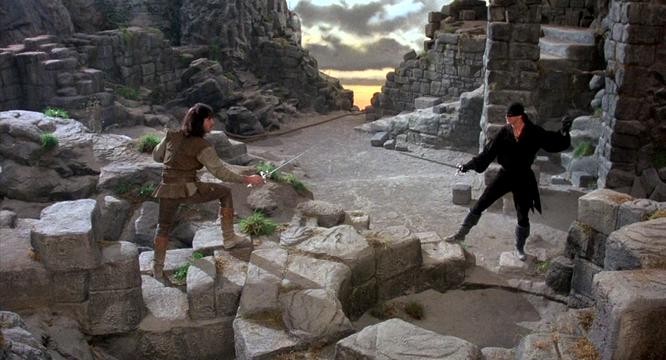
For me, it isn't perfect (but, that just me—I'm a curmudgeon). I wish that the whole movie could have the look of the picture above. There are times when the movie is just beautiful...and others when it looks a bit clunky, staged haphazardly and shot more for TV soap opera than fairy-tale. Some of the sets—I'm thinking particularly of the top of the Cliffs of Insanity but there are others—are so set-bound that it jars with the complex verdure found in a lot of the movie. There is an amateurish charm to some things, creatures and machines, that—if one were righting a defending thesis—could be just the limited imaginings in the child's head. But, that's making excuses when the most reasonable one is "budget."
And the score. Mark Knopfler's themes are sometimes quite nice, but lose the organic feel and human touch as calculated on a synthesizer. An orchestra, or just a few mixed-in strings could have gone a long way to putting some breath into the music, instead of the mechanics that sometimes clash and distance. There's no resonance to it and an absence of the human touch. Quibbles! Nit-picking! There's been talk of a musical version being done—all have come to naught. There's been speculation of a remake—to which Cary Elwes had the best tweet: "There’s a shortage of perfect movies in this world. It would be a pity to damage this one." This one succeeds so much that it would be best to just leave it be. As we wish.
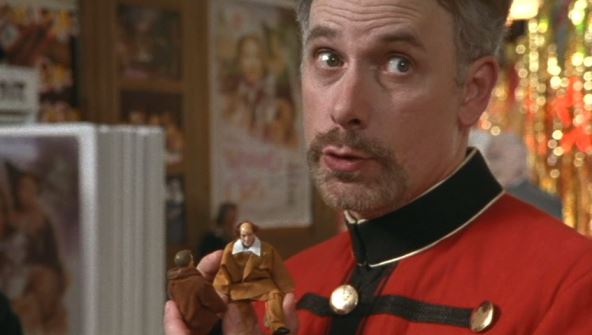
The Story:Merch. Shopping this Holiday season, you couldn't get away from it. One wonders if you ever could. But, I couldn't walk into any store this year without having to navigate through some monolithian display of Funko big-head vinyl dolls with increasingly obscure and arcane origins, yet still maintaining the style that reduced every subject to an expression-less big-black-eyed drone. Some you couldn't even tell apart. People buy these things. And, if one didn't have enough to dread about the future, one can only imagine that the Pop! figures are going to go the way of LEGO® and start showing up in films, so you can by the merch-based-on-the-movie-based-on-the-merch. Dante couldn't have created a more circular path to Hell. But, I digress... This is the coda to Waiting for Guffman, Christopher Guest's film of the preparations for the sesquicentennial celebration of the founding of Blaine, Missouri, complete with parade and a live-theater musical about the town, conceived and directed by Corky St. Clair, artistic director of the city's theater group. The cast puts a lot of hope into the apparent interest of a New York theater impresario named Mort Guffman, who might—just might—be interested enough to take it to New York. But, things do not go as planned, and the film ends with a review of what happened to the play's participants after its performance. The last segment—interspersed with the credits—is of Corky's post-Blaine activities, moving back to New York and opening a Hollywood-themed memorabilia shop, selling merchandise based on...well, let us say, "unique" productions. I found it hilarious and not entirely inconceivable. After all, I'm still eyeing that 2001 "Black Monolith" action figure. The Set-Up: Corky St. Clair (Christopher Guest) shows us around his memorabilia shop. Action!
CORKY ST. CLAIR: And I suppose that
the cake-and-eat-it-too part
of this whole story
is that another dream
of mine has come true,
which is that I've gotten
to open...
CORKY: ...this shop...
where I have all
my show business treasures
and all my memorabilia.
CORKY: This is without a doubt,
one of my favorite items.
Um, My Dinner With Andre
action figures...
CORKY: ...and what you can do,
which is so cute,
is you can reenact
the whole scene.
You know, where the two guys
talk to each other
and say, you know...
CORKY: "Boy, I'm sure glad
you found a good restaurant.
"You know, it's so hard
these days to get in.
Who do you know?"
CORKY: "Oh, I just called.
Made a call.
Spur of the moment."
"Ha ha! Oh, you, you can
always get a reservation."
CORKY: You know.
That's not from the movie,
but you can make up
your own dialogue,
which is one of the great things
about action figures.
CORKY: I'm trying to get...
it's very rare...
the one... the action figures
for Das Boot,
'cause I love to do that
whole claustrophobic thing
inside the sub
where they're, you know,
"Das kande, Das mushten...."
CORKY: That whole German thing.
Can't speak German,
but it sounds like
sort of a bunch
of barnyard animals,
"muck, muck, muck,"
making that noise and sweatin'.
CORKY: Uh, over here,
these are my big heads, I call 'em, starting
with Anthony Michael Hall,
one of the brat packers.
CORKY: ...and the kids,
they're just having
such a good time
with these, you know.
Kids don't like
eating lunch at school,
but if they're got
a Remains of the Day lunchbox,
they're a whole lot happier.
The election is over, didn't go the way I wanted or thought it should, but other than my impressions on the post-election, I'm not going to bitch about it. I'll, instead, hope for the best—reading what the new president wanted to put in motion his first day in office, there were, actually, some things I liked (Congress will never pass term-limits or restrictions on their post-term work, but, maybe...just maybe...)—so, fingers crossed, I hope for the best...but, I have made sure my passport is current (I'm not STUPID!). It has reassured me that the government will transition in a peaceful manner—as was the original intent of "the Fathers"—and, actually, the government is behaving graciously, which is refreshing after this particularly ugly political season, while the populace, on the other hand, is going a bit crazy. I understand people's frustrations and, also, wanting to gloat, but the reactions have been rotten—even by usual social media standards (which is something of an oxymoron, actually). Those reactions on both sides reminded me a bit of Corky St. Clair's hysterical and oddly-worded outburst in this scene. I've used these words often when I want to defuse a highly emotional situation, and it works...if the participants have seen the movie. If they haven't...well, things escalate. But, I still do it because i live in hope. Deluded hope, maybe, but I'd rather be half-full of myself than feeling half-empty. And, again, this one goes to Jana, who poked, prodded and coerced me into seeing this, to my everlasting appreciation. The Set-Up: In the mock-documentary, Waiting for Guffman, we are given a back-stage look at the preparations for a musical production celebrating the 150th Anniversary of the founding of Blaine, Missouri "The Stool Capitol of the World." The crew making the doc seems to have unlimited access as we get to see some pretty intimate moments in the history of the production, not the least of which is this scene as the play's director, Corky St. Clair, asks the Blaine City Council for more money.
This stuff is always dangerous, a high-wire act, often times merely achieving that most damning-with-faint-praise opinion of "clever." Not even director Guest (the Fifth Baron Haden-Guest) fires on all cylinders all the time, but Waiting for Guffman manages to hit the "funny" consistently, while also being affectionate about small-town foibles and eccentrics, and down-right sentimental in spots during the actual "show-within-the-show." For all the turmoil, for all the ineptitude and ego, the plywood set-pieces and papier-mâché heads, the actual presentation of "Red, White and Blaine" is something of a modest triumph over artistic (if the term can be used) hindrances. It may even inspire one to "put on a show." Couldn't be any worse than this. But, look how effective this one is, not just to the "expected-to-appreciate" movie audience, but outward into the audience once and twice-removed in the theaters and homes.
This scene is a favorite in the household, and has inspired the fall-back line of frustration when dealing with all forms of authority, real or imagined: "They're just BASTARD-people! I hate their ass-faces!!" In lieu of going home and actually biting the pillow, it actually helps, leavening the frustration in the reflected glow of the warm, funny "Waiting for Guffman."
The Story: The town of Blaine is celebrating their 150th Anniversary, and the City Council has asked the local theater's artistic director, Corky St. Claire (Christopher Guest) to oversee a musical theater presentation on Blaine's history to be called "Red, White, and Blaine." In an attempt to get back to his theatrical roots on New York, Corky has invited Big Apple theater reps to come see the show, and when one Mort Guffmann writes back expressing interest, Corky decides to go for broke and make a Broadway-ready show. It's time to up the budget.
Action! Corky St. Clair: What I need... Corky: - from you - because you're the bosses... Corky: ...of the town, essentially...and I know that...is... Corky: (sigh) This is so hard. I mean, there's nothin' easy about... Corky:...this. Ya know, this is like, when you're... Corky: ...gettin' your legs waxed and they RIP that thing off real fast? Corky: That's...what this is like. Corky: I need...more...money. Councilmen: Wow. We want you to have more. Glenn Welsch: Steve's right. How much you thinkin' of, now? Corky: Okay. Corky: (prepares) What I need...is $100,000. (Long Pause) Glenn laughs, and once he does everybody on the Blaine Council starts to laugh. Glenn: Oh, brother! He is good! Councilman: He is! Corky: Let me explain...let me explain what... Glenn: Oh, man. Am I...My heart stopped for a second. "I need money..." Corky: Alright, let me just explain what that entails... Glenn: I bought it all the way, by the way. (cackles) Steve Stark: It's no joke... Stark: ...he's serious about it. Glenn: He's not kidding... Steve: Corky, our entire budget...for the entire year...is, is $15,000...for everything! And that includes swimming! Corky: Well, I don't have any swimmin' in my show... Steve: No, no, I mean the pool...we have to keep up the pool...that's everything, the entire year, fifteen thousand... Gwen Fabin-Blunt: We have a manager... Glenn: A hundred-thousand dollars?! Look! You're a nice fellow, n' we're all glad you're here, but...if I, if I may be blunt...what's wrong with you? I mean... Corky: So...what I'm understanding here - correct me, if I'm wrong - is that... Corky: ...you're not givin' me... any money... Corky: ...so now I'm left basically with nothin', I'm... Corky: ...left with ZERO, in which, in which, what can I do with zero, you know? What can I... I can't do ANYTHIN' with it! I need to, this is my LIFE here we're talking about! We're not just talkin' about, you know, somethin' else, were talking about MY life, Corky: ...you know? And it's forcing me to do somethin' I don't wanna do. Corky: To leave. To...to go out and just leave and go home and say, make a clean cut here and say "no way, Corky," Corky: "...you're not puttin' up with these people!" And I'll tell you why I can't put up with you people: because you're BASTARD people! Corky: That's what you are! You're just bastard people! And I'm goin' home and I'm gonna... Corky: I'm gonna BITE MY PILLOW, is what I'm gonna do! (Corky walks out, leaving the Council-members stunned) Waiting for Guffman
Words by Christopher Guest and Eugene Levy (and Cast)

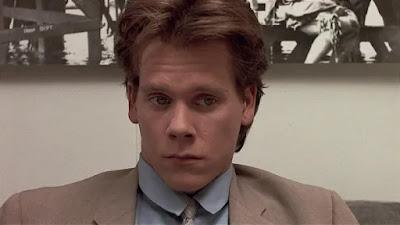 Budding film-maker Nick Chapman (Kevin Bacon) is "hot", having just won a film-making competition and given the opportunity to pitch ideas for "projects." Taking a meeting with studio producer Alan Habel (J.T. Walsh) gives him flashing hope until Habel wants to make changes to his ideas more in line with Habel's peccadilloes. Then, there's the "Catch-22" of not having an agent—he can't be taken seriously without one but can't get one until he's taken seriously. So, he takes a lunch with a prospective agent (Martin Short), more interested in being seen than seeing what he can do.




 Corky St. Clair: What I need...
 Corky: - from you - because you're the bosses...
 Corky: ...of the town, essentially...and I know that...is...
 Corky: (sigh) This is so hard. I mean, there's nothin' easy about...
 Corky:...this. Ya know, this is like, when you're...
 Corky: ...gettin' your legs waxed and they RIP that thing off real fast?
 Corky: That's...what this is like.
 Corky: I need...more...money.
 Glenn Welsch: Steve's right. How much you thinkin' of, now?
 Corky: (prepares) What I need...is $100,000. (Long Pause)
 Glenn laughs, and once he does everybody on the Blaine Council starts to laugh.
 Glenn: Oh, brother! He is good!
 Glenn: Oh, man. Am I...My heart stopped for a second. "I need money..."
 Glenn: I bought it all the way, by the way. (cackles)
 Stark: ...he's serious about it.
 Steve: Corky, our entire budget...for the entire year...is, is $15,000...for everything! And that includes swimming!
 Corky: Well, I don't have any swimmin' in my show...
 Glenn: A hundred-thousand dollars?! Look! You're a nice fellow, n' we're all glad you're here, but...if I, if I may be blunt...what's wrong with you? I mean...
 Corky: So...what I'm understanding here - correct me, if I'm wrong - is that...
 Corky: ...you're not givin' me... any money...
 Corky: ...so now I'm left basically with nothin', I'm...
 Corky: ...left with ZERO, in which, in which, what can I do with zero, you know? What can I... I can't do ANYTHIN' with it! I need to, this is my LIFE here we're talking about! We're not just talkin' about, you know, somethin' else, were talking about MY life,
 Corky: ...you know? And it's forcing me to do somethin' I don't wanna do.
 Corky: To leave. To...to go out and just leave and go home and say, make a clean cut here and say "no way, Corky,"
 Corky: "...you're not puttin' up with these people!" And I'll tell you why I can't put up with you people: because you're BASTARD people!
 Corky: That's what you are! You're just bastard people! And I'm goin' home and I'm gonna...
 Corky: I'm gonna BITE MY PILLOW, is what I'm gonna do!
 (Corky walks out, leaving the Council-members stunned)