I don't like those: they're rather arbitrary; they pit films against each other, and there's always one or two that should be on the list that aren't because something better shoved it down the trash-bin.
So, I came up with this: "Anytime" Movies.
Anytime Movies are the movies I can watch anytime, anywhere. If I see a second of it, I can identify it. If it shows up on television, my attention is focused on it until the conclusion. Sometimes it’s the direction, sometimes it’s the writing, sometimes it’s the acting, sometimes it’s just the idea behind it, but these are the movies I can watch again and again (and again!) and never tire of them. There are ten (kinda). They're not in any particular order, but the #1 movie IS the #1 movie.

 It’s a film that chills me right down to my bones and makes me cry every single time.* It throws itself into the deepest pits of despair and within moments, prat-falls into low comedy. It’s a western…about race relations, and in the house of mirrors of a “genre” piece deflects the self-righteous tone of a sermon. It stares into the soul of people at their worst, and exults in their best.
It is arguably John Ford’s best film (and he made many great ones). It is inarguably John Wayne's finest performance on-screen, while completely working against the image that Marion Morrison had built as “John Wayne,” American Hero.
Oh no. We’re talking about The Searchers—a “western” made during the somnambulant 50’s …and with John Wayne, ferchrissakes! How corny can you get?
Back up, pilgrim.
The Searchers has just been re-released (to mark its 50th anniversary**) in a gloriously re-mastered DVD, and has come under critical review for being too corny, too obvious, and more than a little dated.
Worse still, it has been branded a “film-school darling” that has skated too long on an undeserved reputation as a masterpiece.
 Bullshit.
Like Pauline Kael’s faulty detective work dissecting Citizen Kane and Elvis Mitchell’s naïve un-analysis of 2001, the work in Slate smacks of a critic either looking for something to write about or make a name for themselves bucking “conventional wisdom.” Having to spend a summer reviewing the third X-Men movie, the fifth “Superman” opus AND an entirely superfluous “Pirates of the Caribbean” sequel is bound to make anyone crabby.
But it shouldn’t lower one’s standards, and there’s enough slip-shod work in the article to indicate that’s the case. At the very least, it’s a terrible gloss-over.
 At the worst, it displays a film reviewer who hasn't even seen the film he was supposedly watching for the prejudices and pre-conceived notions that he would rather cling to rather than objectivity.
The Searchers is a masterpiece—the culmination of decades of film-making experience that John Ford had accumulated since the silent era—while crystallizing Ford’s growing disenchantment with the Myth of the West. In a time when westerns were still basically built around the simplistic formula of “Cowboys vs. Indians,” Ford was starting to speak out more explicitly for the latter sixteen years before such accepted “consciousness-raising” films as Little Big Man or Soldier Blue. Like any masterpiece, it displays the sum of a body of work and breaks new ground, paving the way for the future.
 The Searchers tells the story of an obsessive 10 year hunt for a lone family member taken in a violent Comanche raid. It’s led by the worst person possible: the child’s uncle--a hate-obsessed confederate soldier, self-exiled from his family, who still carries his saber on his hip, bitterness in his soul and his heart on his sleeve. Mix in a venomous race-hatred for all non-whites and you have the most flawed anti-hero to appear in movies. Ethan Edwards starts his search to bring his niece back alive, but as the years pass and she matures into womanhood, he gives her up as one of the Enemy, and sets out to kill her. At the center of the film’s black heart is that most archaic and useless word: miscegenation.
 It’s rough stuff. Rougher still are the attitudes of the settlers towards the Indians that border on hysteria. There’s a haunting scene late in the film where Edwards and his fellow traveler (played by future "Star Trek" Captain Pike and “Teenage Jesus,” Jeffrey Hunter) ride into a fort on the Trail of Tears to inspect some kidnapped white women who have been re-captured—"rescued" they would say—by the Cavalry.
* A comment on this post and movie—when it was stationed at another blog—asked: "The Searchers makes you cry?!?!? Is it because of all the dead Indians?" Sure. Go with that. But, a lot of settlers are killed, too, and the hunt in The Searchers is precipitated by one such massacre, the matriarch of which is the one woman that Ethan Edwards loves. It's what entwines his search into one of need and of vengeance.
Like Pauline Kael’s faulty detective work dissecting Citizen Kane and Elvis Mitchell’s naïve un-analysis of 2001, the work in Slate smacks of a critic either looking for something to write about or make a name for themselves bucking “conventional wisdom.” Having to spend a summer reviewing the third X-Men movie, the fifth “Superman” opus AND an entirely superfluous “Pirates of the Caribbean” sequel is bound to make anyone crabby.
But it shouldn’t lower one’s standards, and there’s enough slip-shod work in the article to indicate that’s the case. At the very least, it’s a terrible gloss-over.
The Searchers is a masterpiece—the culmination of decades of film-making experience that John Ford had accumulated since the silent era—while crystallizing Ford’s growing disenchantment with the Myth of the West. In a time when westerns were still basically built around the simplistic formula of “Cowboys vs. Indians,” Ford was starting to speak out more explicitly for the latter sixteen years before such accepted “consciousness-raising” films as Little Big Man or Soldier Blue. Like any masterpiece, it displays the sum of a body of work and breaks new ground, paving the way for the future.
It’s rough stuff. Rougher still are the attitudes of the settlers towards the Indians that border on hysteria. There’s a haunting scene late in the film where Edwards and his fellow traveler (played by future "Star Trek" Captain Pike and “Teenage Jesus,” Jeffrey Hunter) ride into a fort on the Trail of Tears to inspect some kidnapped white women who have been re-captured—"rescued" they would say—by the Cavalry. “It’s hard to believe they’re white” a sergeant says.
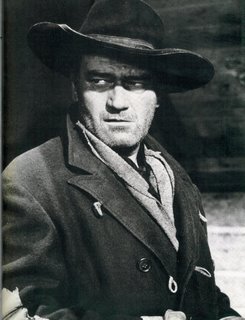
“They ain’t white,” spits Edwards, and at the sound of a shriek from one of the women, he turns to look at her. Ford trucks in the camera fast onto Wayne’s face (mirroring the shot he used to introduce Wayne in their first film together, Stagecoach) and it’s amazing. Wayne was always blessed with a mug that the camera loved***—it could read every emotion that played across it—and in a performance minus the “hero façade” and that turns on the full after-burners that usually blew his co-stars off the screen, this one quiet moment radiates a combination of hate, disgust…and abject fear. No words need to be said to make the point. No words could.
It's what made Ford a great director and Wayne a great actor.
And yet, for all its depths of despair amid bloodshed and the race-hysteria, Ford tries to balance it with entertainment. That’s quite the tight-rope walk. But then, it’s not a sermon. It’s a Western. Ford was never so pretentious to be caught lecturing. He’d say if you want to send a message, use the Pony Express. Better to sneak the lessons into the fabric of the story, and distract with shenanigans about wayward lovers, goony old men, and green cavalrymen with pointy swords. One of the incidents involves the unintended marriage of Hunter’s character to a portly Indian maid. It’s the source of raunchy comedy in the vein of Ford’s The Quiet Man—all roughhouse and bad taste. But when Ford’s good guys “The Cavalry” decimate a Native village and the luckless character along with it, Hunter is left to ask “What’d they have to kill her for? She never hurt anybody!” The question hangs in the air with indictments all around.
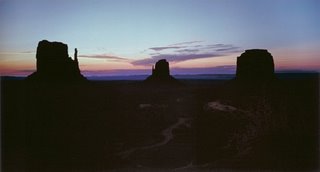 The Searchers begins and ends with a black screen. In the beginning, the blackness gives way to the vast magical vista of Monument Valley (which figures in two of my anytime movies. If God lives anywhere on Earth, I think it’s on that vast acreage of land overseen by the Navajo) that to Garry Wills suggests an irising lens, but to these eyes seems more of a proscenium arch. At the end it shuts out Ethan Edwards who is left out of the warmth of a family embrace to wander the desert (Of course, Wayne’s character is going to come in eventually and eat…but Ford chooses to leave Edwards outside). His prejudice does not belong with home and hearth...and society…and Civilization. Yet it is also Ford’s choice to leave the character alive, the wolf always at the door.
 It’s as if having made his plea for tolerance, Ford cautions us that it will always exist, somewhere.
Will we ever...finally...lose the hate?
“That’ll be the day.”
Anytime Movies:
The Searchers
“They ain’t white,” spits Edwards, and at the sound of a shriek from one of the women, he turns to look at her. Ford trucks in the camera fast onto Wayne’s face (mirroring the shot he used to introduce Wayne in their first film together, Stagecoach) and it’s amazing. Wayne was always blessed with a mug that the camera loved***—it could read every emotion that played across it—and in a performance minus the “hero façade” and that turns on the full after-burners that usually blew his co-stars off the screen, this one quiet moment radiates a combination of hate, disgust…and abject fear. No words need to be said to make the point. No words could.
It's what made Ford a great director and Wayne a great actor.
 |
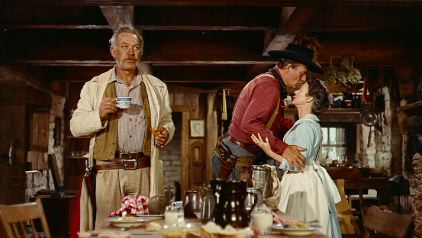
| "No, Ethan! No, you don't!" |
The Searchers begins and ends with a black screen. In the beginning, the blackness gives way to the vast magical vista of Monument Valley (which figures in two of my anytime movies. If God lives anywhere on Earth, I think it’s on that vast acreage of land overseen by the Navajo) that to Garry Wills suggests an irising lens, but to these eyes seems more of a proscenium arch. At the end it shuts out Ethan Edwards who is left out of the warmth of a family embrace to wander the desert (Of course, Wayne’s character is going to come in eventually and eat…but Ford chooses to leave Edwards outside). His prejudice does not belong with home and hearth...and society…and Civilization. Yet it is also Ford’s choice to leave the character alive, the wolf always at the door.Will we ever...finally...lose the hate?
“That’ll be the day.”
.jpg) |
| Robert McGinnis' portrait of Wayne in The Searchers. |
The Searchers
* A comment on this post and movie—when it was stationed at another blog—asked: "The Searchers makes you cry?!?!? Is it because of all the dead Indians?" Sure. Go with that. But, a lot of settlers are killed, too, and the hunt in The Searchers is precipitated by one such massacre, the matriarch of which is the one woman that Ethan Edwards loves. It's what entwines his search into one of need and of vengeance.
No, the thing that makes me cry is the act that comes right before the line "Let's go home, Debbie." That line. From that character. At that time. Despite all evidence to the contrary. It's what gives one a small tiny quantum of hope that belies the sentiment of "That'll be the day..."
** And now, it's a few years shy of its 70th. I wasn't even a year old when it was released. It's like an old friend that's grown up with me.
*** Screenwriter Robert Towne has a better term for it, the "camera-love" phrase implying a happy accident that doesn't give enough credit to the actors, their craft and experience. He says that actors like Wayne, Henry Fonda, and Gary Cooper are "ruthlessly efficient" in that they can communicate differing emotions with an economy of expression. Those words are particularly apt for Wayne's performance in The Searchers.
*** Screenwriter Robert Towne has a better term for it, the "camera-love" phrase implying a happy accident that doesn't give enough credit to the actors, their craft and experience. He says that actors like Wayne, Henry Fonda, and Gary Cooper are "ruthlessly efficient" in that they can communicate differing emotions with an economy of expression. Those words are particularly apt for Wayne's performance in The Searchers.
**** And, on Sunday, we'll put up a "Don't Make a Scene" feature from each week's film.




.jpg)