Showing posts with label Stephen Rea. Show all posts

Saturday, October 22, 2022

Interview With the Vampire: The Vampire Chronicles

Interview with the Vampire: The Vampire Chronicles
(Neil Jordan, 1994) I remember reading Anne Rice's novel of "Interview with a Vampire" many, many years ago and found it a dispiriting read. In fact, by the time I got around to watching the film, everything about the story had evaporated into the ether, like one of her vampires sun-bathing. I do remember the controversy of
Tom Cruise being cast as vampire-manipulator Lestat and that there was much consternation about it. My viewing of it made me think that Cruise was the best thing about it, one of his very few performances where he stretched as an actor and a personality. The rest of it, if you'll pardon the pun, sucked.

Certainly, director Neil Jordan isn't to blame. His direction and general look for the film is exemplary, giving the film an elegant if decaying look—after all, vampires are immortal, so why would they be concerned with daily chores (plus vampirism is 180° from Godliness). Casting is fine (even if some of the acting isn't), and Jordan even throws in a couple of touches of the surreal, if only for the sheer creepiness the effect has.
Daniel Molloy (
Christian Slater) is in a nondescript San Francisco apartment, waiting for his interview subject to arrive. Surely it will be an evening interview, as he is Louis de Pointe Du Lac (Brad Pitt), who is supposedly a vampire. Skeptical, Molloy quizzes him about the various vampire tropes, which he dismisses, the legends he says coming from "a demented Irishman". But, the coffins, yes.
Then, he tells his story—of how, in 1791, despite wealth and property in Louisiana, he falls into self-destructive depression when his wife dies during childbirth. During a drunken night, he is followed by the vampire Lestat de Lioncourt (Cruise) and after being attacked by him, is offered to be killed and turned into a vampire, "giving you the choice that I never had." The two become constant companions of the night-world, never again seeing the sun (in a neat little bit, Louis becomes obsessed with the sun, even going to see Sunrise: A Tale of Two Humans directed by F.W. Murnau, who, more famously, also directed Nosferatu, the first vampire movie).
But, the two have decidedly different ideologies of life...or after-life. Lestat is a libertine with no moral code, taking his victims at his pleasure, perhaps in vengeful bitterness for the way that he was turned without having any choice in the matter. Louis is appalled by this and regrets the taking of human life and would rather feed on animals, which is something that Lestat constantly mocks. He does make one exception. When a plague decimates the country-side, Louis finds a child (
Kirsten Dunst) whose mother has died of the disease and turns her, giving her immortal life. For him, this creates a sort of ersatz family. For the child, Claudia, it gives her immortality, but traps her forever in the body of a child. She may mature, growing older and wiser in her mind, but will remain at the age in which she is killed.
The novel and film have become favorites in the LGBTQ community for its metaphorical take on hidden societies and non-traditional families, and one can see that point of view. One rebels, though, that the metaphor is ensconced in such an anti-life trapping. These vampires are murderers, and even Louis, squeamish as he may be at homicide, loses his moral ambiguities when it suits his purposes. They seem more like a cult to me than a healthy representational metaphor. Your moral mileage may vary.
And, these vampires are also incredible narcissists. Everyone is selfish to a degree, but these nether-folk would be death at a party, fixating on themselves, bloviating their philosophies and negatively-lighted world-view and looking upon the lighted world as merely a buffet to exploit. Given the era in which it's set, one would half-expect them to become imperialist and invade other countries.
But, what leaves me as cold as a corpse about Interview with a Vampire is Brad Pitt's performance as Louis. Granted, that he was only a couple of years from his true break-out roles and was still finding his way to matter as more than a pretty face. But, his Louis is such an opaque presence that he seems at sea most of the time, not able to make depression, self-destruction, or even drunkenness very interesting. He internalizes so much as to make any emotion he's trying to convey invisible to the naked eye. He's turned into a phenomenal talent as actor. But, at this point, he wasn't.
And while I'm no fan of Tom Cruise, one has to give kudos to his Lestat, as grandiose and theatrical a performance as he's ever given. Sure, he can go too far in movies, but, his Lestat is such an unmitigated purveyor of debauchery (and loving it) that Cruise could never really go too far "out there" and not have it seem uncharacteristic. His Lestat simply wouldn't care, and it makes it one of Cruise's best works, horrific as it is.

Friday, February 14, 2020

The Crying Game

The Crying Game (Neil Jordan, 1992) "Who knows the secrets of the human heart?" 

It is my contention that this little "character" study, embedded within a terrorist thriller,  is one of "the" great love stories, as it deals, rather scrupulously, with "love" and doesn't stray into the sexual category.

Well, it does stray, but not too far from home.

Sure, the story surrounding the film is about "the secret," but that's just a device for setting up a story about the nature of love, and what this "crazy little thing" called love is, and why it holds such sway against our better judgments, even against—or even with—our natures, better or otherwise. And it does so in one of the better "traps" a film-maker has devised for its protagonist, worthy of a
Hitchcock or a Kubrick

When first we meet Fergus (Stephen Rea), he's a flunky of a foot-soldier in a radical IRA organization. He's not well-respected in the group, so he gets the low-tier job of guarding over the British soldier kidnapped for political concessions. Fergus doesn't have the spine, the bite, the drive, the Cause-fueled socio-pathic energy of Maguire (Adrian Dunbar) or Jude (Miranda Richardson, as ferocious a femme-fatale as has been created for the screen). And he's just not asshole enough to be a terrorist. Better the job of care and feeding, rather than the tough meat of strategizing and negotiating...or terrorizing.
Three days of holding Jody (Forest Whitaker) hostage in Thatcher's non-negotiating Britain makes Fergus and the soldier form a Stockholm-ish bond. So, when demands are not met, when it comes time for Fergus to dispose of the evidence—kill the hostage Jody—he can't do it. He's spent too much time with him, become too sympathetic. Too empathetic. Fate, however, isn't so discriminating. And Fergus is left with the pact he's made with the fallen soldier.
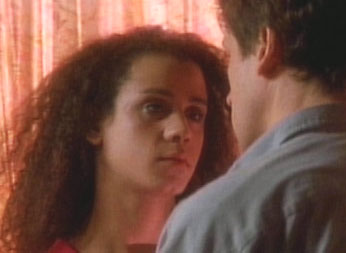
That vow is to break the news of his death to Jody's true-love, Dil (Jaye Davidson), and, when the rest of the group disbands to go underground, Fergus, instead, travels to fulfill his pledge and, along the way, becomes smitten with the hair-dresser/chanteuse with Dil.
The rest of the movie details Fergus's struggle to stay underground and protect Dil from his vengeful mates. It gets complicated. Very complicated.

As the bartender played by Jim Broadbent says in the clip below "Takes all types. Who knows the secrets of the human heart?"
What's love got to do with it? Everything. Like Vertigo, The Crying Game brings into the open the question of what "love" really is. Fergus, and Vertigo's protagonist both share a name fragment as well as a vision of love that is their own, one that may have nothing to do with reality. But, it's real in some way. It has to do with responsibility and commitment and loyalty and all the things that go along with love and the bonds it ties you up in.
At two points in the screenplay, writer-director Neil Jordan uses the fable of the frog and the scorpion and the bond they form to cross a river. Orson Welles used it in his film Confidential Report (aka Mr. Arkadin) to explain the unexplainable. For Fergus, it's acknowledgement that he's learned something...if only about himself. "It's my Nature" is the last line of the fable.

Well, that's half-right. But, there are no absolutes. As with the old debate, one has to acknowledge that "Nurture" plays a hand as well.

It's been years since I've seen The Crying Game—I saw it in theaters very early on in its first-run before it "caught on" and became a subject of water-cooler whisperings and specific plot-points that—really—have nothing to do with the crux of the matter. And what the film says about "the secrets of the human heart."
Today is Valentine's Day. I hope it is happy for you whether you are with someone or alone. 

There will be more love stories of the movies next week.


"She's... She's On!" Dil (Jaye Davidson) performs—
a sequence seamlessly designed and directed by Neil Jordan,
realized only after you've seen it a second time.


Saturday, December 30, 2017

Blackthorn

Written at the time of the film's release. Sam Shepard died this year at the age of 73.

The Long Return of Butch Cassidy
or
"The Blues They Send to Meet Me Won't Defeat Me"

Not that it matters, but this entire movie is pure speculation.

When the outlaws "Butch Cassidy"—Robert LeRoy Parker—and "The Sundance Kid"—Harry Alonzo Longabaugh—made their way to Bolivia (as was the story) they disappeared from the face of the Earth. There've been rumors (and popular movies!) speculations, conjectures (and just plain lies), but nothing concrete—or perhaps we should say calcium—has ever turned up. No one knows where the bodies are buried, or, indeed, if there are any bodies.

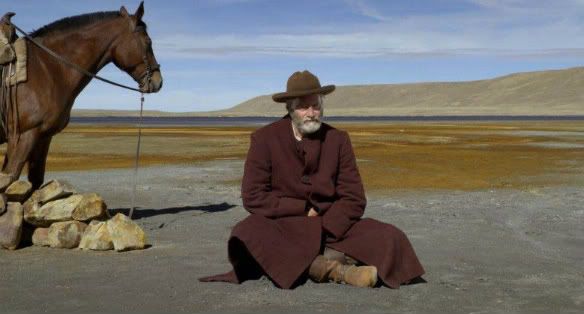
That distinct lack of evidence is the spine of Blackthorn—that perhaps Butch Cassidy, aka Robert LeRoy Parker, did the exact opposite of what made him famous by abandoning the outlaw lifestyle and going legit as a rancher and horse-trader in Bolivia, running for awhile with Longbaugh and Etta, but eventually finding himself alone (the fate of The Sundance Kid is speculated on and it is an intriguing possibility), finally fading into the Bolivian clay, respectable and unsought.
But, at some point, Parker—or James Blackthorn, as he's called himself in this tale—has the call to go home. Immediate family is the immediate reason, but the long trek from South America through Mexico to the American Southwest makes up the bulk of the film. The selling of stakes, the journey by horse, pursued by Pinkertons, posses and bandits and bad luck, in the company of a young, not exactly trusted, vaquero with a wealth of history and loot, is a perilous trip, and a constant source of loss, until all the man has left are his skills as a rogue, rider and sharp-shooter.
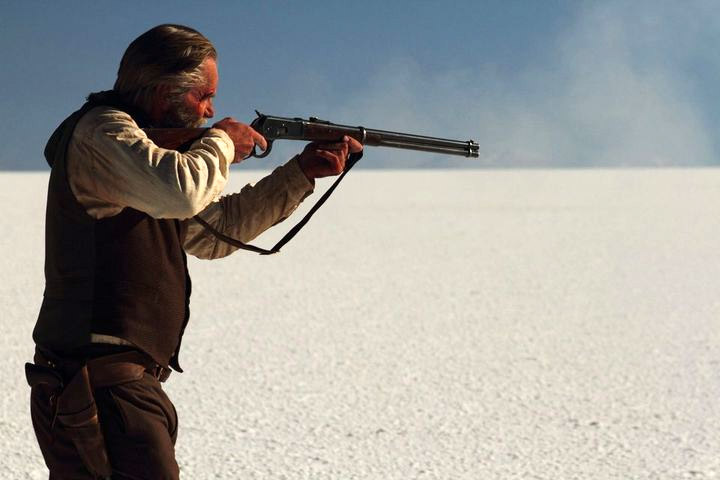
Blackthorn requires a lot of the actor playing Parker or Cassidy or Blackthorn, all measures of the man, and fortunately for the film, which relishes its flat, sun-blasted landscapes (and wouldn't be nearly as interesting without so wily an actor), it's dominated by a seemingly lived-in performance by playwright Sam Shepard. Tall, rangy, sun-scorched and grizzled, his Butch is always resourceful and perpetually prepared for whatever eventuality man and Nature can throw at him. Shepard is sunk down deep in the saddle in the role, squinting at the sun and the behavior of those around him—a lone wolf on the prowl and targeted on his goal, in a path, twisted and gnarled and certainly not on the straight and narrow.
It's a good yarn, if a little too cloistered in incident and character—the spaces may be wide and open, but we keep seeing the same characters over and over— and the kid (Eduardo Noriega) being something of an irritant, and just not interesting enough to be much against the lead. Director Mateo Gil (who wrote Abre Los Oros, The Sea Inside and Agora) has a nice spare style that really pays off in the salt desert scenes, but the best thing about the film is Shepard, who breathes life into the film whenever he's on-screen.

"The Sundance Kid" and "Etta Place" before South America

Friday, October 31, 2014

The Doctor and the Devils

The Doctor and the Devils (Freddie Francis, 1985) The film company Brooksfilms (established by Mel Brooks) had a bi-polar streak to it. Yes, they would do comedies, of course, like Mel's movies and To Be or Not To Be and My Favorite Year. But they would also make projects of The Elephant Man (the first studio film directed by David Lynch—now, there was a gamble), the Frances farmer biography Frances, and this film, adapted from a literary rarity, an original screenplay by Dylan Thomas (written in 1953), based on the true story of the mercenary ghouls Burke and Hare, who, starting in the year 1827, developed a lucrative trade in killing locals in Edinburgh and selling the corpses to an anatomy professor for display in his lectures.

The script was adapted by Ronald Harwood and the film directed by legendary British cinematographer Freddie Francis (The Innocents, The French Lieutenant's Woman, Glory, as well as The Elephant Man, Dune and The Straight Story for Lynch, and Cape Fear for Martin Scorsese). 
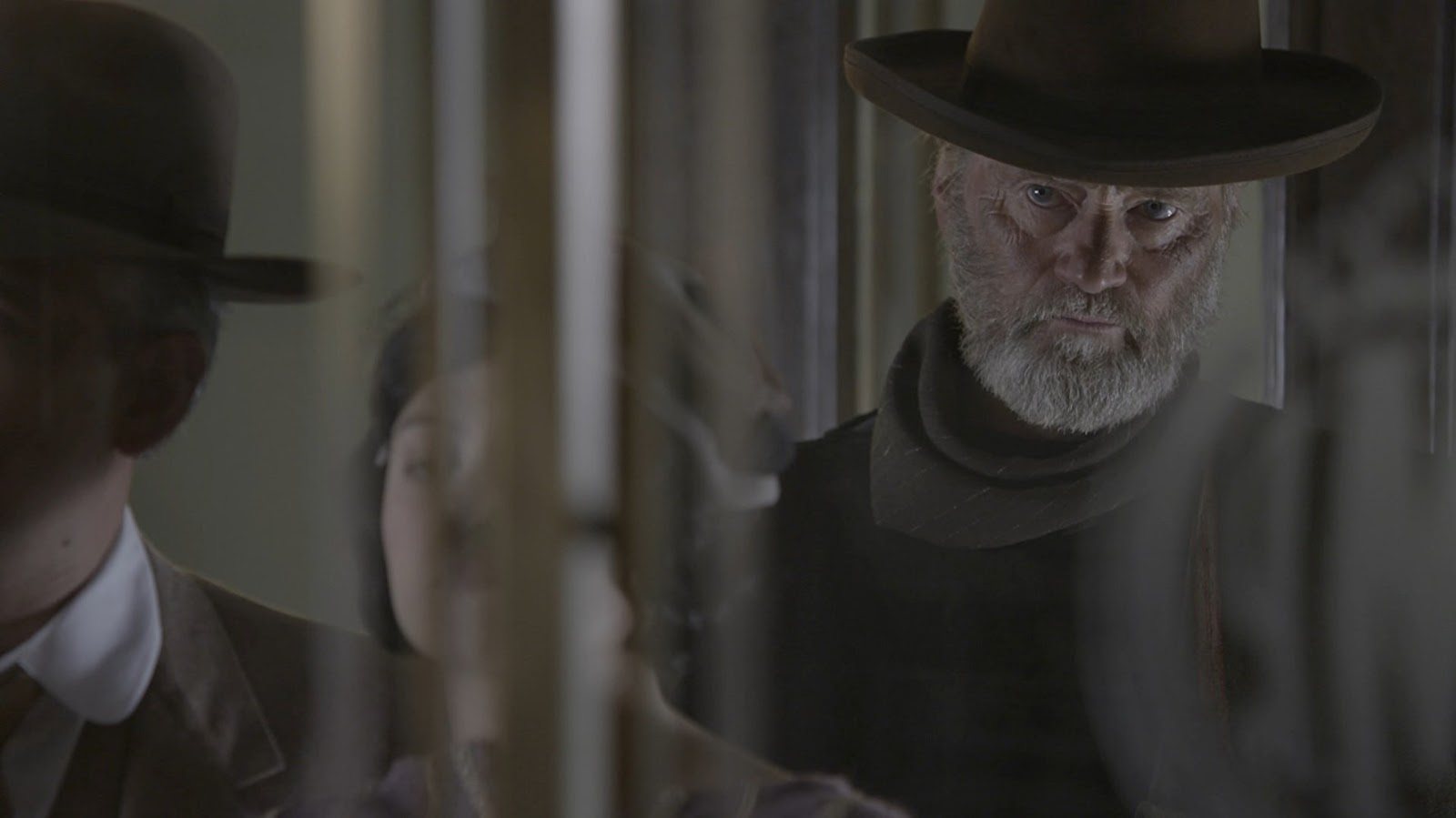
One can't say anyone scrimped on the cast. For all the loathsomeness of the subject matter, it attracted a great crew of British thespians with Jonathan Pryce and Stephen Rea as the psuedonymed Robert Fallon and Timothy Broom, who would liquor their victims up and then suffocate them for the betterment of science. Their customer is Dr. Thomas Rock (Timothy Dalton, just before his Bond years), who in some twisted idealism, looks the other way at the subjects brought to him by Fallon and Broom. He is opposed, and looked on with suspicion, at the Institute by Professor Macklin (played by a pre-Trek Patrick Stewart) and supported there by Dr. Murray (Julian Sands) who has his own secrets—he is in love with a bar-doxie (Twiggy), who may become one of the potential victims.
Great cast, maybe, but great movie it is not, despite the pains taken to present the squalor of London, both upstairs and downstairs. After starting out as a cinematographer, Francis became a director, doing a lot of pictures for Britain's Hammer Studios, a good prep for his work on this. It is atmospheric, alright, with a low-level discomfiture throughout, with Fallon and Broom being the lowest of the low, preying on the sick, weak and debilitated, and Rock turning a blind eye to the source (grave-robbing at best) of his demonstration subjects. 
There is a very large irony inherent in the script, not to far afield from the one Richard Matheson employed in "I Am Legend." But, the script, whatever it's pedigree (Harwood is an Oscar-winner, Dylan Thomas a writing legend) is the film's true down-fall.  It might seem a bit leaning to the pedestrian to say this, but there is no one to root for in all this, no one to sympathize with—not even the victims—and one watches with a dis-interest in the outcomes...for anyone.

There might have been a real reason no one dug up this script for so long.