Showing posts with label Robert Patrick. Show all posts

Saturday, September 2, 2023

Gangster Squad

Saturday is traditionally "Take Out the Trash" Day.
 
Written at the time of the film's release...
 
Manifest Density
or
The War for the Soul of Los Angeles (such as it is)
 
Ruben Fleischer's third film (after the very good Zombieland and the excremental 30 Minutes or Less) is Gangster Squad, a Hollywoodized version of the efforts by the LAPD to take down the efforts of Mickey Cohen, the lieutenant of Bugsy Siegel's Jewish mafia, who took over Siegel's interests when the mob kingpin was murdered in 1947.

If one is looking for a history lesson, one should look elsewhere. This is a glamorized, fictionalized version of the events set in some art-deco post-war version of Los Angeles that doesn't seem to have existed anywhere except the Warner Brothers gangster films and Brian de Palma's The Untouchables, to which this film owes a great debt. The gangsters all wear dark clothes with long coats (the better to identify them) and are all greasy and ugly, while the police are all good-looking guys in nice suits who bend the rules a bit (with the possible exception of Chief Parker, played with a gruff somnambulance by Nick Nolte, who headed up the similar "Hat Squad" in Lee Tamahori's Mulholland Falls).*

It all feels very false, from how the gangsters rarely hit anything despite the thousands of rounds shot from tommy-guns, and the Gangster Squad "hit" ratio usually fares better. The Squad (hand-picked by the leader's wife, played by Mireille Anos, for being rough-necks and not promotion-headed top-of-their-classers) consists of boss John O'Mara (who did exist, but did not run the unit) as played by Josh Brolin, Jerry Wooters (played by Ryan Gosling), Max Kennard (Robert Patrick)—a sharpshooter, Conway Keeler (Giovanni Ribisi) a surveillance/electronics expert, as well as two PC members for the 21st century audience—Anthony Mackie (so good in The Adjustment Bureau) and Michael Peña. Their target is Mickey Cohen (Sean Penn in a make-up that makes him look like he walked out of Warren Beatty's Dick Tracy), who's reputation is movie-inflated to make him seem like he's an empire-building Al Capone, rather than the cheap hood with star connections he ultimately was.
Fleischer is more interested in flash than being true to the source. His fights are surprisingly well-staged, one shot per flying fist, but not Bourne-edited so one can easily follow it—an early fight in an elevator borrows heavily from a similar scene in a James Bond movie but actually goes places the 007 film merely used for suspense. Once in awhile, he'll go for a Matrix-y slo-sloo-slooo-mo effect (rather than a fleeting Peckinpah image) just to make a point of something, like cartridges flying out of a machine gun, or a Christmas ornament exploding due to gunfire, but it's just slowing things down as opposed to telling a story. Brolin's fine, nuanced even, but Gosling's McQueen-ish hipster act is wearing a little thin, and the chemistry exhibited between he and Emma Stone from Crazy, Stupid Love is completely missing here. Mackie, Peña, and Patrick are far more engaging probably because they don't fit the established mold.
It's entertaining, to a certain extent, but one gets the feeling, after patterns have been set that bring to mind other films, that one is being sold a bill of goods, and we are.
The real-life Cohen was convicted of tax evasion (not murder) in 1950, serving four years. Upon his release, he established several businesses (the ones portrayed in the film) and was again convicted of tax evasion in 1961 and released (again) in 1972. Cohen died in his sleep in 1976.
The real Mickey Cohen, photographed in 1950
The real "Gangster Squad"

* Amusingly, his driver is Officer Darryl Gates (played by Josh Pence) who would be Chief from 1978 to 1992.

Tuesday, August 16, 2022

Trouble With the Curve

Written at the time of the film's release...

I Am, I Said/To No One There
or
Becoming Eastwood

Amy Adams is amazing, really. Clint Eastwood has had many female co-stars, from Shirley MacLaine to Meryl Streep, and directed a bevy of others, some of whom have given great performances—Laura Linney, Marcia Gay Harden, Hilary Swank, Angelina Jolie, two of them to Oscars—all have studied at the Eastwood school. The results have been a combination of actress' gifts and Eastwood guile. But, none of them have taken to heart that state of naturalness, the implacable restraint and mandarin ironic humor that the actor has demonstrated in the past like Adams does in Trouble with the Curve, Eastwood's latest project (produced but not directed—that job going to Eastwood's assistant director Robert Lorenz) about the relationship between an aged baseball scout and his estranged-but-not-fallen-far-from-the-tree daughter. Linney has played Eastwood's screen-daughter in the past, and she was terrific, but Adams imbues so much of Eastwood's game that one actually believes in the symbiosis, and their scenes together crackle with a lived-in familiarity, a mutual passive-aggressiveness, and a sense of shared past and unspoken tensions. 
Eastwood is the top-liner but it's the daughter's story. Mickey Lobell (Adams) is on track to partner at a law firm (nice line up of of Bob Gunton, George Wyner and Jack Gilpin—in fact, the film is top-loaded with good character actors, not only in the firm, but also in the Braves organization—Robert Patrick—and among the veteran scouts—Ed Lauter, Raymond Anthony Thomas, and Chelcie Ross) when she gets wind from family friend, Atlanta Braves scouting coach Pete Klein (John Goodman) that her scout father (Eastwood) is about to be brushed back in the organization—he's old, his eyes are going, and there's a new scout (Mathew Lillard) who's more into stats and remote-controlling his decisions than doing the leg-work of seeing and hearing what the talent can do (this one would make a fine double-bill with Moneyball if double-bills still existed). 
Lobell is given one last chance—check out a kid with a killer swing (Joe Massingill) who looks to be a high draft pick. Lobell's job is on the line, and Klein recruits Mickey to follow the old man on-deck and pinch-hit for him if necessary as a seeing-eye daughter. Against her better instincts, she heads to North Carolina to dog her father by day and work on her client-presentation at night (the film sends mixed messages on the thesis of remote-working, as it seems to be fine for her), the father and daughter trading mutual scowls and muted growls, trying to "get closer" while they couldn't seem more like each other.
That's a lot of scenario for a deceptively simple story about relationships and the importance of "being there" in them.  It is also complicated by the mutual interaction between a fellow scout (Justin Timberlake) that the older Lobell has a past with, and the younger might have a future with—Timberlake does fine, relaxed...even charming...work here, not so strong on the dramatics, but hitting solidly on the humor (best line: "Poor Bruce..."), finding a nice line between Eastwood and Adams and making the most of a convenience role to show growth between the two characters.
It works and works solidly if you, like Eastwood's character, don't look too well at it. And there's some late inning contrivances that come out of left field that tie everything up a little too conveniently and nicely, managing to retire the side and take care of every issue in only three pitches. I smelled a rigged game—we really didn't need a Grand Slam on the last pitch to put up a "W" for this one, and, to my mind, took away from the good things that had come before.

Maybe I was feeling that way, anyway. Personally, I'd've been happy if Clint Eastwood had stuck to his lack of guns and retired from acting (as he said he was doing) with
Gran Torino. The grace-note of that particular character's last act served as a "period" to the syntax of Eastwood's career, full of so many unrealistic face-offs with clusters of opponents throughout the years.  It was the perfect bow and the perfect statement. But, he had to do a friend a favor—get his buddy a director card—and so he came back. I found it a little disappointing to find out that even Eastwood didn't know when the quitting was good. But, his work here is good, even if the eyes are squinting down to a lack of expressiveness (he does a wink here that is probably only visible in HD), and the voice has been reduced to a burned-out husk. The gravitas and irony are still there, though, enough for Adams to latch onto and take advantage of. And it makes for a pretty good show, while it lasts.

Thursday, August 26, 2021

The Protégé (2021)

Da Nang, Girl!
or
"You Only Get Lucky Once"
 
Martin Campbell can be a hell of a competent director. He's introduced a couple of James Bond's (Pierce Brosnan in Goldeneye and Daniel Craig in Casino Royale) and directed the best of their movies. He did both "Zorro" films with Antonio Banderas and directed one of my "Anytime Movies", the mini-series "Edge of Darkness." But, the film version of Edge wasn't all that good. And he directed the mish-mash that was Green Lantern. When the material is sharp and focused, and when he has the right actors lined up, Campbell is top-notch (here's hoping the Broccoli kids hire him to premiere the next Bond—if the script is good). He's a fine director of action scenes and he also knows how to keep the movies zipping along at a brisk pace. He can also take complicated material and scrape it down to the bare essentials so it doesn't matter, and even add a stylistic flourish or two that gives it a certain style that can surprise the most jaded of movie-watchers, rising above the tendency of producers to jam through the latest craze of movie cliche's and hammer down the brass-tacks of what makes a good entertainment.
 
His latest film, The Protégé, has just opened, and it's nice to see that he can still, at the tender age of 77, show the young directing bucks how to stage an action scene, of which there are plenty.
It's a rainy night in Da Nang, Vietnam, and an operative named Moody (Samuel L. Jackson) is looking for bad guys. When he stealths through what appears to be a stronghold, he finds somebody beat him to the draw—all the well-armed baddies are bleeding out on the floor. A brief scan of bullet-holes leads him to open a cabinet to find a small girl pointing a gun at his head. She pulls the trigger on an empty chamber. He takes the gun from her, commenting that her choice of weapon was usually reliable, reloads the chamber, and hands it back to her saying "Now you're good to go." She does not kill him. They leave together.
It's 30 years later in Bucharest, Romania, and the son of a Romanian don is kidnapped. The ransom is €30,000 and when the drop is made, the woman picking it up (Maggie Q) finds herself looking down the barrels of several automatics. She is taken to the Don's palatial moşie, where he talks big, shows her the money, and slaps her around. She cooly states "I didn't come for the money...I came for you" and opens a hidden stilleto in the phone (there's an app for that?) and punctures his jugular, blood spraying everwhere, and kicking him into his indoor pool, then dispatches his guards. She ignores the money, and walks outside where guards come running up to shoot her *viiip* one's down *viip**viip* the rest fall.
Okay, this may sound spoilerific—it's only for this particular sequence—but it's indicative of the action strategy—the fight's are bloody, spurty, and require some gore make-up, and sometimes things happen that aren't explained until later. It requires some patience along with the visceral jolts. Just go with it.
But, the gist is that Moody and Anna—that's the Maggie Q character, but we don't learn their names until deep into the movie, and it feels like the makers don't care—are a hitman team ("We find people that can't be found") working globally and based in London, where Ana runs a rare book store, one is not sure why, but it's nice to have a day-gig. One day, Michael Rembrandt (Michael Keaton) ambles into the shop looking for a specific book for a birthday present. He and Anna trade cute reparteé, but ultimately it's no sale and he leaves. But, it's a visit by Michael Keaton, so it must be significant, and the ramifications of the visit, which is in reality a sort of recce, will drive the plot of the rest of the movie, and set Anna on a vengeance quest, one that will take her back to Da Nang "and a rendezvous with her past."
Not the sort of summary that would make an executive spill his Stoly and say "I've GOT to make that picture!" But, there are joys. Some of the dialogue is snappy and everybody drawls it out in a world-weary, dryly wisenheimer kind of way. There's a dinner scene between Q and Keaton where they taunt and banter while holding automatics under the table at each other that's a nice little essay on advancing the story-line, but also keeping repartee entertaining, like Nick and Nora busting wise over cocktails. Keaton can be off and on, depending on the material, but when he's on, he's an eye-magnet, and here, he's so simultaneously sharp and relaxed that you watch his every move. There's a shot where he bounces back into the scene to deliver some random comment that feels ad-libbed, like he caught the camera running and said "This'll be fun" and everybody just kept it. And Q is sleek and confident, even when she's jumping off a balcony. There is a list of absurdities in the film a mile long, but the director keeps it fast and punching, so the movie never stalls out. Not for a moment. Every movie drags in places. The Protégé is always light on its feet and pushes the momentum, if not exactly pushing expectations.


Tuesday, June 9, 2020

The Men Who Stare at Goats

Written at the time of the film's release...

"If Looks Could Kill"

Despite an opening graphic that cautions "More of this is true than you might believe,"  The Men Who Stare at Goats is more of a fantasia based on the reporting of Jon Ronson than an actual true story. Yes, the truth is in the details; during the 1980's there was an army troop training as psychic warriors tasked with perfecting ways of defeating the enemy beyond fighting. These included perfectly legitimate examples of psychological disciplines, like moving past one's fears and one's predilections (it's pointed out that 15 to 20% of "fresh" soldiers usually shot above the heads of enemy combatants—not wanting to kill anybody), heightening one's powers of observation, gaining a psychological advantage over one's adversary by one's actions and thoughts, and moved beyond that into training that was anything but basic.
Ultimately the goal of the so-called "First Earth Battalion" was to make "super-soldiers," "psychic warriors," or "Jedi knights"* who could intuit answers from prisoners, psychically deflect attacks, become invisible, "phase" through objects, and, most diabolically, stop the hearts of their opponents by staring at them.
*WARNING* If you start to feel light-headed...look away.
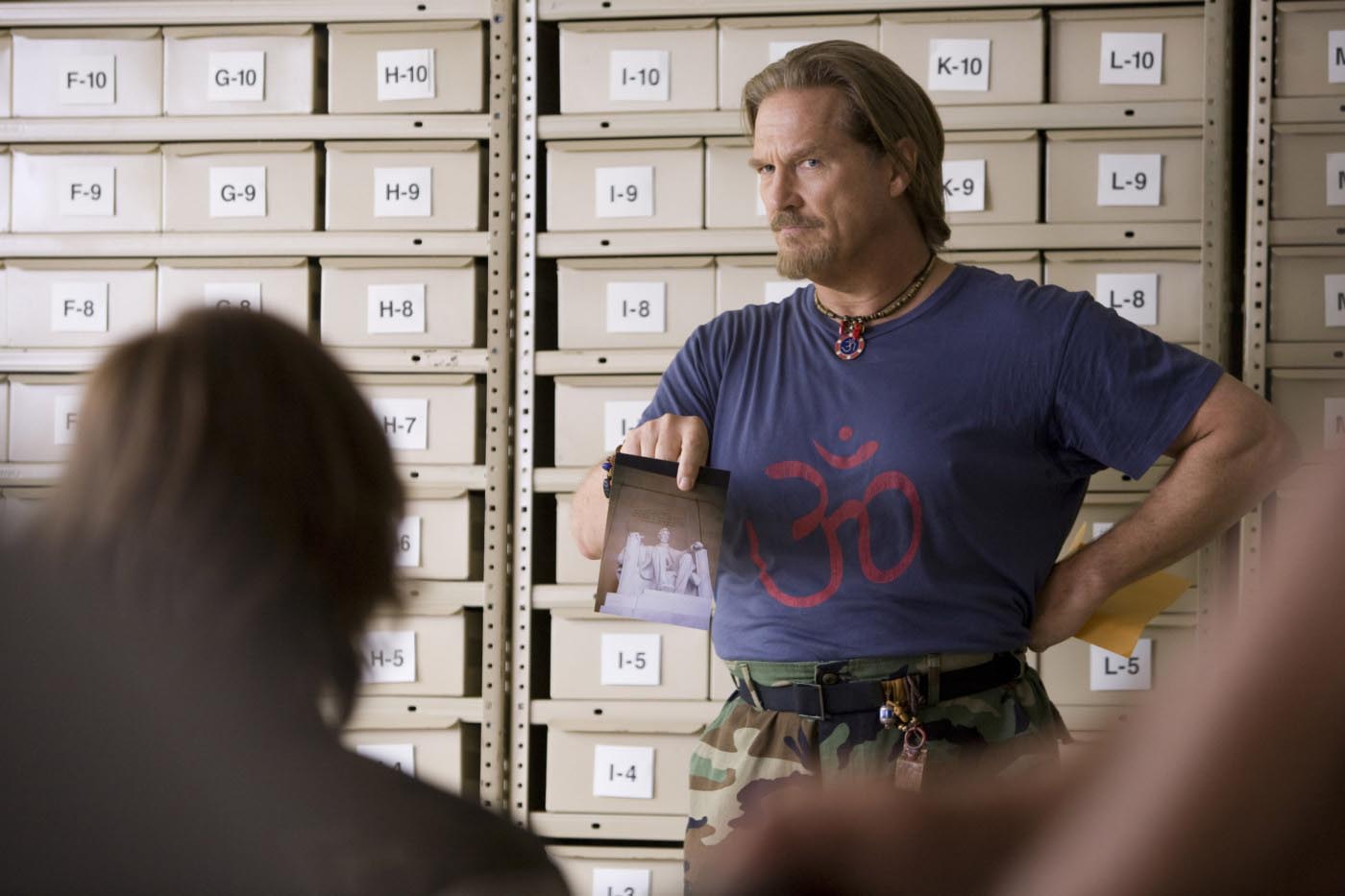
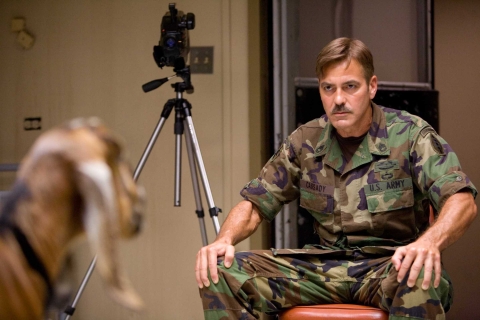
In the movie,Ewan McGregor's Ronson stand-in, Bob Wilton, gets wind of a "New Earth Army" doing some feature work for his local newspaper, but it isn't until he's in Iraq—trying to impress his estranged wife—that "the circle becomes complete" and he meets the closest thing to an adept among the psy-warriors, Lyn Cassidy (George Clooney, looking remarkably like Dennis Farina) who's "been re-activated" on a secret mission to find his former commanding officer and creator of the First Earth Army, Bill Django (Jeff Bridges, who perfects his Leibowskish "bubble-off-plumb" hippie personification and manages to make it poignant). Cassidy appears to be legit, capable of cloud bursting and the one Earther who could drop a goat with a look. He's less than expert in the "sparkly eyes" technique, despite being played by Clooney (who manages to play it completely straight while pulling off some of the strangest actions of his career).
Director Grant Heslov, Clooney's production partner and script-writer for Good Night, and Good Luck, keeps things moving at a good clip, moving fast enough to avoid analysis or deep thinking. The story is slight, owing much to, of all things, Ishtar (two clueless guys, out of their depth in a Middle East war-zone) while waving an anti-establishment freak-flag that reeks of M*A*S*H (with Kevin Spacey as the Frank Burns-type). The story, concocted of remnants of the original NEA operations in Iraq and Afghanistan, seems plausible (given the way those wars have been run), but the story merely exploits true concepts to spin the gauziest of screenplays, while poking fun at the "Be All That You Can Be" gonzo-ness of an Army that's trying "to be wonderful."
Semi-satirical movies are rarely more than semi-amusing. The Men Who Stare at Goats, however, delivers quite a few belly-laughs.


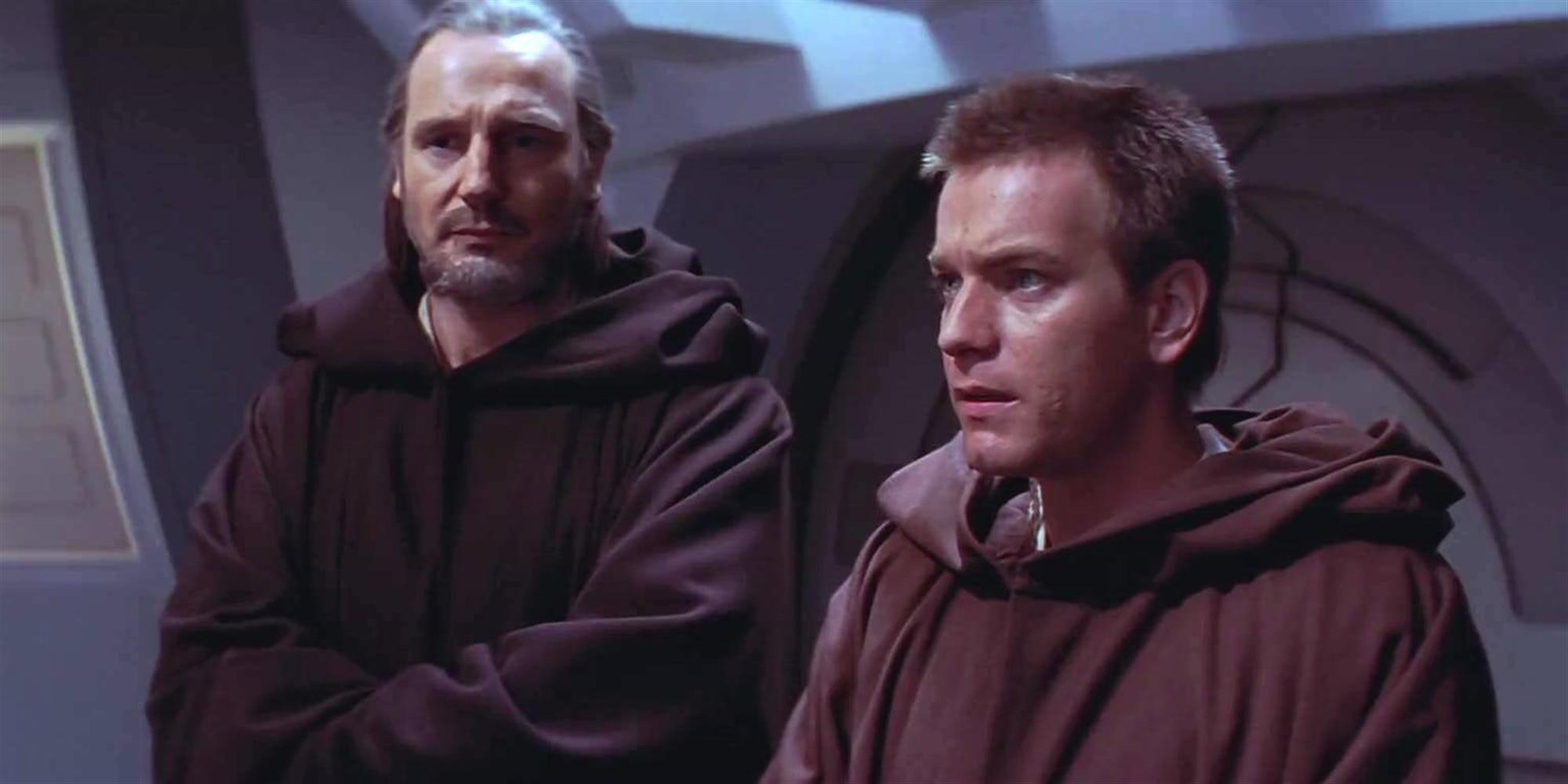
* The movie earns many—too many—knowing audience laughs by casting Ewan McGregor (the post/pre-Guinness Obi-Wan Kenobi) as the Ronson-surrogate reporter who is more of a "Doubting Thomas" than a "Padewan Apprentice." It's a little too "on the nose" and is, frankly, done to death, like some of the more winkingly obvious in-jokes in the "Ocean's Eleven" series.

One more Ronson doc: "Stanley Kubrick's Boxes":

Saturday, March 14, 2020

The Laundromat

That Clinking, Clanking Sound
or 
And the People All Said 'Sit Down. Sit Down, You're Rocking the Boat'

Steve Soderbergh has been experimenting with the ways of getting films distributed for years—he's worked out the mechanics of film-making (he does the cinematography and the editing himself, by and large), but the distribution has always been a challenge. Distribution means can affect what sort of movie gets made and how a good movie can be altered in order to maximize the investment. Sometimes it can alter it to the point where the mere vestige of the film's intent will make it onto the screen, as distribution will determine how much the money the film will make back to its investors.

It's a big deal, and Soderbergh, who has been careening from serious movies to fluff, has experimented with all sorts of distribution models. This is his first film for Netflix, and it worked out with a kind of serendipity. It involves Meryl Streep. And Mike Nichols.
Nichols had a close relationship with Soderbergh—the two frequently paired up to do commentaries for Nichols' films for DVD—and, before he died, Nichols suggested that Streep work with Soderbergh on a project, as she might find it a rewarding job. This project, The Laundromat, an exploration of shell corporations and the revelations that came from The Panama Papers leaks had been in the works for a few years, and when Streep signed on to star, it attracted the attention of Netflix—it seems they didn't have a lot of Streep's films in its collection. Voila! Netflix put up the money (theoretically).
The Laundromat is almost a perfect film for a streaming service like Netflix, as opposed to theater distribution. Not unlike the Coen Brothers' The Ballad of Buster Scruggs, it is not a star-driven story (and nobody wears a symbol on their chest) but a theme-based anthology, in this case revolving around the true "trickle-down" from a diversified and increasingly speculative economy. That subject won't beat a path to any multi-plex, but Soderbergh and his screenwriter Scott Z. Burns (Contagion, The Informant!, The Bourne Ultimatum) do a fairly comprehensive (and episodic) breakdown of what the issues are, demonstrations of the dangers of these issues, and consequences—the true "tickle-down"—to those who can't afford shells, shills, and hedge strategies to preserve the money but are still affected by them, nonetheless.
As such, it's a better film in both presentation and explanation than the lauded The Big Short, and it's as encompassing and cautionary as Soderbergh's extraordinary (and extraordinarily prescient) film, Contagion.

The Laundromat begins cheekily with a "Dawn of Man" sequence, ala 2001: A Space Odyssey and introduces us to its two most important characters, the narrators, Jürgen Mossack (played by Gary Oldman) and Ramón Fonseca (played by Antonio Banderas) of the now-defunct (but real, true-life) company Mossack Fonseca*, self-described as "white gloves—we keep hands from getting dirty." In this opening, they describe the history of money—while helping—and making life difficult—for some anonymous cave-men, their eyes masked by digital black bars. The introduction is simple and whimsical:
Ramón Fonseca: First of all, there are some things you should know before we begin.
Jürgen Mossack: For instance, we are real people, just like you.
Ramón Fonseca: Secondly, we did not write a word of this. To be perfectly frank, we would have preferred all of this remain a secret.
Jürgen Mossack: But we had no choice in the matter. We just woke up one day and everything changed.
Ramón Fonseca: There were stories about us everywhere: TV, newspapers, and the internet.
Jürgen Mossack: And now it is our turn to tell a few stories. Think of them as fairy tales that actually happened.
Ramón Fonseca:  Don't worry, these stories are not just about us. They're also about you.

Jürgen Mossack: And how is that possible? 
Ramón Fonseca: Because all these stories are about money.
Jürgen Mossack: The idea of money. The necessity of money. The secret life of money.

Ramón Fonseca:  Before money, there was only the barter system. You tried to trade what you had or what you could do for what you needed. You have bananas, but you need a cow. I have a cow, but I hate bananas, so, as you can imagine, there are limits to this system. Bananas turn brown over time and cows can, you know wander away. So, an agreed-upon medium of exchange was needed.
Jurgen Mossack: What is a medium of exchange? Well, it could be a nugget of gold. Or some other shiny rocks that are generally found to be scarce. It could be a...a slip of paper...with words on it...or pictures of powerful people. And if you read those words, you will see that they are arranged into a promise of value.
Ramón Fonseca: Slips of paper...which you cannot peel and eat or do not give milk...are what we all agreed to call "money." And these slips gave birth to many other pieces of paper with more writing on them.
Jürgen Mossack: And some of those words, they told the story of credit.
Ramón Fonseca: Oh...stay with us now. This is important.
Jürgen Mossack: Credit is an invention that meant you no longer needed to carry around, uh, millions of bananas on slips of paper.
Ramón Fonseca: So you now have something invisible, credit, standing in for something intangible, a cow.
Jürgen Mossack: Credit said that even if you didn't have all the bananas you need for what you want, you could borrow bananas...from the future.
Ramón Fonseca: So, credit is just the future tense of the language of money.
Jürgen Mossack: Speaking of the future...
Ramón Fonseca: Things have gotten a little more complicated. Actually, a LOT more complicated.
Jürgen Mossack: There is more money than ever before!
Ramón Fonseca: Our money has more names than ever before.
Jürgen Mossack: Commodities, loans, stocks and bonds. Funds and funds of funds.
Ramón Fonseca: Futures, equity, derivatives, securitized debt, shorts and margin calls. Financial instruments.
Jürgen Mossack: Words. Invisible. Abstract. Very different from cows.
That is a fun little primer on money—that, essentially, it does not exist. It is merely an agreement of value, and it has nothing to do with reality. Like the price of gold or platinum, the cost of a Rembrandt, the cost of a fake Rembrandt, or the salary of a CEO. Words. Promises. Abstract. The film is broken down into chapters sub-headed by financial "secrets" which have relations to the segment that follows, be it part of the main story of Ellen Martin (Streep's character) or short tales that might have some basis in true events or not.  
Secret 1: The Meek Get Screwed: Ellen Martin (Streep) and her husband (James Cromwell) meet friends for a little boat-cruise that ends up in disaster when the boat flips and her husband is killed. There is no insurance because the company insuring the excursion company has been resold to a foreign company based out of the island of Nevis in the Caribbean and is a trust held by Mossack Fonseca. The money cannot be touched.
Secret 2: It's Just Shells: Ellen relocates to Las Vegas where she has bought a condominium that overlooks the spot where she and her husband first met. But, her real estate agent (Sharon Stone) tells her the deal's off, even though papers were signed. Russian investors have paid double in cash for the property. Ellen goes to confront the managers of the company in Nevis, but, instead, finds only a post office box. She runs into the MF trust manager (Jeffrey Wright), who pretends not to speak English, but is planning to fly to Miami. 
Secret 3: Tell a Friend: When a trust-fund gets in trouble, it merely moves its assets to a more friendly nation for its benefit.
Secret 4: Bribery 101: Charles (Nonso Anozie) is an African billionaire who makes the mistake of having an affair with the friend of his college-age daughter, who finds out and threatens to tell her mother. To keep her silent about it, Charles offers her shares in one of his investment companies worth $20 billion, which she eventually finds out is worthless because it is only a shell company. When we see Mossack and Fonseco again, they'll reveal that shell corporations aren't illegal—tax evasion is a crime, but tax avoidance isn't and that everyone has shell corporations, and that The Laundromat's director has five of them (and even the writer has one).
Secret 5: Making a Killing: Based on a true incident, a Mossack functionary, Maywood (Matthias Schoenarts) tries to put pressure on a Chinese woman (Rosalind Chao) to maintain a laundering interest through his company, but for larger fees and winds up being poisoned by her for his trouble.
What is brilliant about The Laundromat is the emphasis and power of money's abstract properties. Yes, they may be only a promise of value, but that will still break down (I would say "trump" but I won't go for the cheap laugh) things that are more substantial, like law, contractual obligations, family loyalty, or the value of a human life (money, to no one's surprise, is more valuable). No wonder we've got billionaires—in their gilt-edged ivory towers—who, at the end of the day...or their lives...have merely acquired money "to hide behind" (in the film's phrase), and sold out any grip of reality. Money is more reliable than bimbo-wives, bratty irresponsible kids, and failing organs, particularly maxed-out livers and shriveled, atrophied hearts. The illusion of money is power, and, without it, you're just another human.

Can't have that.
And if you want power, then it's nothing without having people without it. Sen. Barry Goldwater (conservative Republican from Arizona) was asked after Watergate what would prevent another one. His answer was blunt: "Stop printing money." Damn right. The Laundromat ends with the words of the whistle-blower who leaked the Panama Papers intoned by three characters played by the same actor, ripping away artifice to get to reality and they make the leap that the only way to get rid of the problem is by campaign finance reform...because the guys allowing the problem and the fleecing of America are the ones taking bribes from the fleecers. They have the power to do it, but concede that power to the guys with bucks and the means to hide it for them. The bucks stop with them, and there the "trickle-down" stops.
* The two men and their company did exist and did extensive interviews with screenwriter Burns, but days before the film was to appear on Netflix, they issued a cease and desist to stop the film or they would sue. Netflix dismissed the threat as "laughable."