The Wrong Box*(Bryan Forbes, 1966) Bryan Forbes is a British director not known for a light touch, nor as a writer (and—in the few instances I saw him, not as an actor, either!). So to see him in charge of a comedy leaves one a bit nonplussed as opposed to amused (which should be the bloody intention!). The same can be said for this film, which tries very, very...veddy... hard to be funny, but ends up evoking feelings of something akin to pity (which just won't "do" for a comedy, much as Chaplin liked to use it in his bag of tricks). The story of a tontine—a trust created for a clutch of privileged school-boys that will go to the last man standing (and the controversies that ensue—The Wrong Box should have the same breakaway, mean-spirited greediness of, say, It's a Mad, Mad, Mad, Mad World(And one should say that with Stanley Kramer, you wouldn't think of being able to do a comedy, either, but look at that result!), Those Magnificent Men in Their Flying Machines, or The Great Race, but instead has a leaden lethargy sometimes punctuated by awkward transitions, ill-timed (and rather unnecessary) close-ups, and the frequent appearance of title cards (to explain something the direction does not adequately provide) in a black-out format that recalls silent movie transitions. However, they come in at souch odd times, they're more interruptions that transitons (Odd that one can even mis-time interstitials!)
It's Bryan Forbes imitating Richard Lester making an Ealing Comedy, but without Alec Guiness, and as slap-dash as the Lester's direction could be at times, he at least could tell a story, and give it the momentum so it would never flag or falter.As it is it's one of those 95 minute movies that seem to last forever.
The screenplay is by Larry Gelbart and Burt Shevelove, who wrote the book for the Broadway musical "A Funny Thing Happened on the Way to the Forum" (Lester's film of which was released the same year—coincidence?) John Barry's galumphing score works overtime to make it frothy, but this is one granite souffle. What is missing is whimsy, rather than desperate manicness, and it fortunately is found in Sellers' work, and in the odd performance of Wilfrid Lawson as the harried (not that you'd know) butler, Peacock.
John Barry's ultra-light waltz is lovely but at odds with the material.
* The asterisk is used so that it isn't confused with the silent version of Robert Louis Stevenson's novel (with Lloyd Osbordone i913—not that a lot of people have seen it.
They (Stanley Kubrick and Arthur C. Clarke) also screened many films, including Destination Moon, The Day the Earth Stood Still, and Forbidden Planet. Kubrick soon discovered that Clarke was far too forgiving of material he found embarrassingly shallow and badly made. When the author insisted he screen the 1936 British science fiction classic Things to Come, written by H.G. Wells and based on a number of his stories, Kubrick "exclaimed in anguish, 'What are you trying to do to me? I'll never see anything you recommend again!'" Clarke remembered in 1972.
I cannot imagine Stanley Kubrick "exclaiming in anguish" so much as mocking testily. But, if the director did indeed say that, he did have a point. Wells' later science fiction work in light of "The War That Ends All Wars" casts its eye less on the fantastical and more on the sociological, with the world's fate hanging on the desires of the gifted and the merely covetous. It may sound fine in the abstract, but Wells seems to forget that History is the slaughterhouse registry of the Powerful against the power-less.
It is 1940, and a Christmas party is being thrown by scientist John Cabal (Raymond Massey). But the festivities are overshadowed by the fear of an imminent war being radioed on the news. Cabal's fellow guest Harding (Maurice Braddell) is also glum, but Pippa Passworthy (Edward Chapman) is not so pessimistic, and looks on the bright side—even if it happens, it will spur technological progress, which is a good thing, right? Cabal sticks to the basics: "If we don't end war, war will end us." And, as if to mock everyone's sentiments, the attacks begin that night.
It turns out that everybody is right. The war does advance technology, at least in the sort of armored vehicles and flying battalions that reign terror. As for the people, they are literally bombed into the stone age, fleeing to underground bunkers and sewers for protection from the devastation, and, in their struggle to survive, allow themselves to be ruled by autocratic strong men—their proverbial man on a white horse—who fill the vacuum and their pockets as those craving power always do. In this case, it's "The Boss" Rudolph (Ralph Richardson), who has taken over the management of "Everytown" since the end of the war in 1966. But, the conditions have led to a pandemic of a final biological tactic, "the wandering sickness," and "The Boss" ignores the efforts of Dr. Harding (Maurice Braddell) with his own solution—shoot the sick down in the street, and expands his plans by ordering his mechanic, Richard Gordon (Derrick De Marney) to try to fix the remaining planes to bomb the outliers beyond his control in "The Floss Valley" and take over their deposits of oil and shale to turn into oil for the planes.
But, in 1970, an answer arrives from the skies. John Cabal arrives on a newly designed airplane and informs Harding and Gordon that he has come from Basra, Iran, where survivors of the war have established a new government, World Communications, where mechanics and engineers have formed The Brotherhood of Efficiency to bring new technology to the survivors to rebuild civilization and join the new government in banning war and advancing mankind. Sounds good, except to the guy in charge. Following the maxim that "Equality is seen by the privileged as oppression," Rudolph captures Cabal and forces him to work with Gordon on the old planes, but his plans are thwarted when the "Wings Over the World" contingent of World Communications is alerted to, and they fly over, releasing their "peace gas," which sounds like a bad euphemism, but merely gives the citizens a good night's sleep.
All except for Rudolph, who has a bad reaction to the "peace gas"—a fatal conflict of interest, maybe—and dies. It's a little convenient, but metaphorically apt, it seems. It allows Cabal to announce that old autocracies are as dead as Rudolph, allowing a new world to start, allowing "a new life for mankind." No one mentions that it also means no technological solution can be perfect.
And...scene.
There follows another montage of the building of that "new life" as the world's population moves underground and start building new bright and shiny civilization-cities, where people are able to progress and live in peace. So much so, that Cabal's grandson Oswald (Massey again) looks to conquering new worlds and expanding our horizons off the Earth with a planned moon-shot. But...there's always gotta be a critic. "Sure, you can Build Back Better," but how are ya gonna pay for it? In this case, it's the sculptor Theotocopulus (Cedric Hardwicke), who's pissed because he's lost an art grant of something because of all the money spent on Cabal's space-cannon, or something.
Actually, no. His argument is less practical. He believes that humanity is tired of progress. "All sorts of people" are saying it, I guess. Enough so that he forms a mob to try and storm the space-cannon to try and stop it from launching (wouldn't you volunteer to stop a rocket launch...like one of those Saturn 5's that turn the surrounding acreage crispy?). But, Cabal, having seen the rise of petty autocrats before, decides he's going to ignore the mob (in all his Randian objectivism) and is able to send the manned probe into space, despite the Luddite uprising, and looks to the audience and intones "All the Universe, or nothing? Which will it be? Which will it be?"
Me? I'd look for a third option.
I gently mock, but Wells' story is all vague philosophizing without any practical demonstrations or innovations. Things look nice, and all, in that futuristic Fritz LangMetropolis kind of way.*But, is everybody benefiting from the new technology? Is everybody housed and fed? Is everybody working...or do they need to work? And if they're working, are they working for bad bosses? And this "Brotherhood of Efficiency"...if they're using "metrics", you can count me out. There's no details here, just a sleek gloss-over. And the black and white of it isn't just in the photography, but in the binariness of choices. Is it always just a choice between progress and...(oh, what's the opposite of "pro?" Oh, yes) "congress?" And Wells' thinking seems to be that all the world needs to get along in technological advancement (if, of course, everyone advances equally regardless of class or income—if, indeed, there are such concepts in his utopia). One would argue that television, the computer, and the internet all have negative consequences, despite the best of intentions. Maybe even enough to tilt things out of balance. There's a limitation to what you can convey with a monolithic society...as opposed to extra-terrestrial monoliths
Kubrick did take something from Things to Come, though, and that is in the use of long stretches of montage, not to convey the passage of time (he did that in a single famous edit), but, rather, as a visual instruction manual on how things have changed and have become in the film (despite the technological advancements and accomplishments) every-day and banal. As a result, there are less moments of upturned faces and speechifying in grandiloquent tones. That seems less human to me and more autocratic, which, if I'm reading the film correctly, is just the sort of Coming Things Wells cautions against.
* One should put out that Things to Come is probably most influenced by Metropolis, which was made just nine years earlier, right down to the binary philosophical arguments, although Lang (and his scenarist Thea von Harbour) did come up with that third option. Mind? Heart? How about working in conjunction?
The Citadel(King Vidor, 1938) Dr. Andrew Manson (Robert Donat) gets off the train at the Welsh mining town of Blaenly in which he's been employed as an assistant, only to find the doctor he's working for, Page, is himself, lain up in bed. Not a good sign. He finds that in his new job he's poorly paid, and only has a small room to live in. And—as always in small towns—nobody trusts the new doctor or vet or priest or shopkeeper or whatever until he does them a good turn that seems miraculous. In small towns, trust is earned and then spread by word-of-mouth, just like a communicable disease.
That miraculous moment doesn't occur until, when he is called to a miner's home to deliver a child, he is confronted with the woman already having given birth, the child stillborn. But, Manson is able to resuscitate it and, for awhile, there is that trust in the community. Passed by word of mouth, trust is also communicable in small villages. He makes the acquaintance of another doctor, Denny (Ralph Richardson), who has been dealing with these issues longer and is quite cynical, a cynicism which is self-medicated with a healthy dose of alcohol. "No hospital, no X-ray, no ambulance, no anything. If you want to operate you use the kitchen table." The two compare notes on a pernicious cough that veteran miners have displayed while the two take patient calls.
A typhus epidemic, however, erupts throughout the town, devastating the community, and the two idealistic doctors decide that the best remedy is fight the source, trying to convince the mine owners of the danger of the sub-par sewer system, and then, when rebuffed, they decide to go to extremes, prescribe themselves some civil disobedience and blow it up, forcing the "do-as-little-as-possible" owners to have to replace it. The mine-owners had evidently taken a hypocritical oath. Denny tells Manson of a position to be filled in the mining town of Aberalaw, but holds little hope of being accepted as he's not a married man. Well, that's a bit of a problem. What's the remedy?
Well, it so happens the good doctor has made the acquaintance of the local school mistress, Christine Barlow (Rosalind Russell), who's seen the good works the doctor provides her students, and the two decide to (for the betterment of Aberalaw, of course!) get hitched. The two work together, helping patients by day and by night studying the debilitating effects the mining industry has to the lungs of the community. He publishes his findings which are hailed by the medical community, but the miners—much like the mine-owners in Blaeny—are more concerned with how their livelihoods might be affected. So, they take a note from the doctor's past and before he can (maybe) blow up the mine, they ransack his office...because...the studies they don't like have already been published. Angry mobs are not so much concerned with timing. This is why they are miners and not scientists (rocket or otherwise).
Well, being the pariah of the community doesn't do much for one's medical practice no matter how altruistic, so doctor and wife move to London, deciding to set up a clinic in one of the city's poorer districts, because...hippocratic oath and humanitarianism and all that bleeding heart stuff (come to think of it, that's something I would call a doctor for!) And this is where the movie gets very interesting because at some point, he is persuaded by a school-friend of his (played by Rex Harrison) to specialize in diseases of the rich and hypochondriacal—which is sort of a communicable disease among doctors...it doesn't blacken the lung so much as the soul.
Okay, it's 2022 and you're SO SUPERIOR for pointing out that a doctor specializing
in Black Lung Disease is so smoking so cavalierly.
How will it turn out? Will the doctor heal himself of his over-charging frivolous ways to patients who'll pay through the nose (or any other orifice), or will he go back to helping the poor who resent him for trying to help them with things they don't want help with?
Do you want the movie answer, or the "real-world" answer?
Woman of Straw(Basil Dearden, 1964) It wasn't much of a stretch for Sean Connery, in a filming break between From Russia With Love and Goldfinger, to play the cad Anthony Richmond in Woman of Straw (he also filmed Alfred Hitchcock's Marnie in the same period). His speaking voice is still "posh," the toupee is slightly fluffy (using the "drama" one, not the "action" one) and even the suits he wears would be reused in the third Ian Fleming adaptation. One who had seen Goldfinger first—a good bet as Woman of Straw did not do well at the box-office—could be forgiven for have a sense of deja vu watching him in this film and thinking he'd be drawing a Walther PPK and making a quip at any moment. There is the added atmosphere provided by the sets of Ken Adam, which give the film added size and sheen—they even reuse the ridiculously long dining table for an intimate dinner joke.
So, there's a distracting shadow of Bond throughout the film, even though it's a different boiling pot of intrigue throughout. Richmond is the nephew and prince-in-impatient-waiting to kingpin Charles Richmond (Ralph Richardson), an irritable man of means, bitter due to the death of his wife and his confinement to a wheelchair. Charles is in constant need of care, but keeping a nurse around, given his cantankerousness is a problem. His home staff (Johnny Sekka, Danny Daniels) are only consistent because they are minorities and lower class—they have no other option than to put up with his obstinance and impotent sadism.
So "Tony"—acting as his uncle's solicitor—brings in a new nurse, Maria Marcello (Gina Lollobrigida), and she's a bit different. She's "foreign"—Italian, to be blunt about it—attractive, and a bit more assertive than the home-grown "angels of mercy" who have been dispatched, no doubt under emotional duress, from the old tycoon's employ. And this angel has a bit of a devil to her. She won't put up with Charles' guff and is just about to walk out of the situation when Anthony makes a proposal.
What he proposes is this: stay in their employ, as "the old man" is less of an ogre with her, and maybe they both can profit by it. Tony's father was cut out of the family business by Charles and Tony knows that when the old man dies, he'll only inherit £20,000. But, if Maria marries the old man...and he dies...she'll inherit his fortune. The only thing Tony asks is £1M for providing the opportunity. Maria is attracted to Tony and her mother lives a poor existence in Italy and the money would certainly benefit her. So, she agrees to the plot.
Being a nurse is tough duty, even if one is a nurse in a gilded cage, but Maria sticks it out, doing battle with Uncle Charles about diet, exercise and medicine, while Tony purrs in her ear about the end-game. But, at one point, Maria decides that she's had enough and returns to Italy...only to be surprised that Uncle Charles travels there to ask her to come back. The old man evidently has a soft spot for her and so Tony's plan might actually work, so she relents, and Uncle Charles soon finds her to be indispensable. An extended yacht holiday cements their relationship, and Tony is pleased when Charles asks him to change his will—Tony will get£40,000 now—but Maria will become the new beneficiary, as he intends to marry her.
But, she'll only become the beneficiary...if he dies.
That's when the complications ensue and the film becomes one of small details and intricacies as opposed to personalities. The film falls off somewhat, despite adding a couple more characters—police investigators and such—and a murder plot that needs a bit too much suspension of belief to pull off.
And—spoiler alert (but is it really?)—the victim is actually the most interesting character—and player—in the movie. Richardson's thorny old coot is such an irascible sort that once he warms up, you miss him when he goes, leaving you with two conspirators, neither of whom you know too well and neither of whom are entirely trustworthy.
What's an audience to do?
The filmmakers clearly intend sympathies to go with Lollobrigida's Maria, who is set up to "take the fall" for Charles' demise, but the collapse of the previously strong woman we witnessed—and Lollobrigida's playing of it—leave one a bit suspended (with very little suspense) and leaves her a woman in peril with only the actions of people we don't know to get her out of it. That third act weakness is an issue with other Dearden films I've seen, which can have terrific set-up's but unsatisfying (no, that's too strong a word—let's say "troubling") resolutions.
Now, back to Connery. Turns out his Tony Richmond is the dark side of Hamlet—taking revenge against his Uncle who ruined and cuckolded his father—but is in no way a hero. In fact, although Connery, once "established" in his career, played killers, cads, and cons throughout, he very rarely played the traditional villain role—the only other I can recall post-50's is the movie version of The Avengers. That his "bad guy" is only a shade more serious than his portrayal of his James Bond says a lot about the actor...and that particular character.*
On the whole, Woman of Straw, is a slightly better film than a "for completist's only" watch. It may interest those who like their Hitchcock-type films with a froth of soap opera.
* This is so "inside" that it only rates an asterisk: Connery's villain meets his well-deserved demise by a stunt contrivance that would be echoed in a not-too-believable method of tripping up Bond's fight-partner in the opening of Thunderball. Deliberate? Like his mentioning of another of his films—Another Time, Another Place—later in that film?
Our Man in Havana(Carol Reed, 1959) A fascinating serio-comic counter-point to author Graham Greene and Reed's post-war classic The Third Man(made a decade earlier) in which the bold find they can make quite a killing in the cracks created in a transitional government. Reed's camera still swoops (courtesy of d.p. Oswald Morris), making sure that the distended Cinemascope frame is filled to the corners with detail, and the dark streets of Havana at night, (filmed after the revolution and with the quite mercenary permission of Fidel Castro*) could be mistaken for post-war Vienna. The sun shines brighter, though, and so most of the internecine work of spies is done in the relative low-light of bars and brothels.
Greene's book was a cynical look at how Intelligence forces can show a distinct lack of intelligence when confronted with mis-information, but it is Reed's nifty idea to cast it with comedic actors, though not always playing for laughs. With such as Burl Ives, Noel Coward, Ralph Richardson, Ernie Kovacs (he plays a corrupt Cuban police official straight, but it is still funny) and Alec Guinness, it seems more a comedy of errors: British ex-pat Jim Wormold (Guinness) is scraping by a living selling vacuum cleaners in Havana, while his daughter (Jo Morrow) is developing a taste for the expensive horsey set—something that could be provided by Captain Segura (Kovacks), who has an eye for the blonde girl. Wormold has other plans for her, like an expensive Swiss boarding school. But where to get the money?
He is approached one day by Hawthorne (Coward, out of place in his dark suit and bowler hat in the mid-day sun of Havana) of the British secret service—or, as he is known, Agent 29500—to set up a bureau station for the service. For Wormold, it is extra cash, an all-expenses paid membership to the exclusive country club, and a more lavish life-style, all for keeping his daughter close. All the Service wants is results, which Wormold has trouble setting up—he is, after all, only a vaccuum cleaner salesman. Soon, he starts filing bogus reports, recruiting strangers as fellow agents (without their knowledge), building his station in importance to the delight of Hawthorne and his superior 'C' (Ralph Richardson).
However, becoming an important secret agent draws attention. He is soon assigned a secretary (Maureen O'Hara) by his superiors, wanting to build him up, and targeted for assassination by his enemies, wanting to shut him up. Doesn't matter if the information he's sending is all wrong; with so many resources at his command, he's sure to dig up something sooner or later. Scrutinized from both sides, the spy-game stops being so rewarding, and turns downright dangerous.
It's all played with a bit of a wink, with great comic actors under tight rein to let the material be funny without goosing it. Definitely worth seeing for the literate script, Reed's classic direction and the fine performances. John le Carré would later use the basic subject matter for his book (and subsequent John Boorman film) The Tailor of Panama.
* Filming in Cuba with set-visits from Castro and Ernest Hemingway:
Time Bandits(Terry Gilliam, 1981) As a filmmaker, Terry Gilliam grew up with the making of Time Bandits, while still maintaining the childish sense of fun and menace that permeated his work before and during his days with the Monty Python flying circus. Time Bandits is a work of pure imagination, a four-ring freak show that just might kill you, where time is the scene of the crime, and even God and Satan are susceptible to the charms of a precocious little boy with a taste for adventure and the voracious team of avaricious little people that he happens to partner up with. One's tempted to say it's Gilliam's version of Snow White or a flipped version of The Wizard of Oz, but that would be taking the piss and anarchy out of it. Those others would not have the temerity or the audacity of just leaving their tween with a heart-warming life-lesson, but actually challenge him to apply it without the benefit of having a safety net. But, in Gilliam's mind, his hero's fate is unarguably better than the unquestioning materialistic zombie-hood that he would be subjected to with his parents.
11 year old Kevin (Craig Warnock) is fascinated with Ancient Greece, which some parents might find a sign of a curious intellect but inspires nothing but neglect in his parents. One night, the wardrobe in his bedroom is shattered by a horse-bound knight who bursts through it and gallops down a forest road that has suddenly appeared—clearly something is amiss in the space-time continuum! The next night, Kevin wants to go to bed early, but instead of a knight-errant, he's visited by a crush of six thieving "little people." They're demoted employees of The Supreme Being (voiced by Tony Jay, but will appear later as a dodderingRalph Richardson)—seems their previous job of designing trees and bushes was sub-par and they're now tasked with fixing rends in the fabric of space-time. But, being particularly (how should we say?) "entrepreneurial" they've seen that their map of black holes can take them to other Earth-eras, from which they can pillage whatever they can carry in a necessarily brief time.
"Necessarily" because they're being pursued by extremes of Good and Evil (aren't we all?), with T.S.B. wanting his map back and the personification of Evil (David Warner, clearly relishing the role) coveting the map, so that he can fix T.S.B.'s mistakes and make the Universe more to his liking.
Gilliam's film then hops and darts and falls into an episodic structure, where the diminutive fugitives "crash" various eras, including Sherwood Forest in the era of Robin Hood (John Cleese, doing a hilarious version of Prince Charles), a campaign of Napoleon Bonaparte's (a nearly incomprehensible Ian Holm), who is obsessed with puppet shows (because they're smaller than him), the HMS Titanic (served "neat"), and, to Kevin's delight, Ancient Greece, where he befriends King Agamemnon (Sean Connery*), who is first seen battling a Minotaur.
Most of it works and works hilariously, even when Gilliam veers into the surreal...and the budgetarily spare. Still, the low-tech miracles Guillam pulls off with limited resources (5 mil' financed by George Harrison's Handmade Films) are awe-inspiring, not only for their realization on film, but also for the sheer visual splendor—and squalor—Gilliam's considerable imagination envisioned (and still does). It's an amazing spectacle, and if the film stutters a bit pace-wise (especially during the Napoleon segment), the delights to the eye tend to gloss over any story-telling problems. Gilliam's pictorial eye would become bolder and his subject matter richer, but Time Bandits was the transition-point between a sketch-comedian/animator and a true film-maker and visionary.
What all the fuss is about
* The script (by Palin and Gilliam) reads: "The warrior takes off his helmet, revealing someone that looks exactly like Sean Connery, or an actor of equal but cheaper stature." Gilliam was shocked that not only had Connery read the script, he wanted the part, and even suggested a disconcerting cameo at the end. ** Northumbrian Tin Soldiers has made sculpts of the bandits, listed as "Dwarf Robbers:"
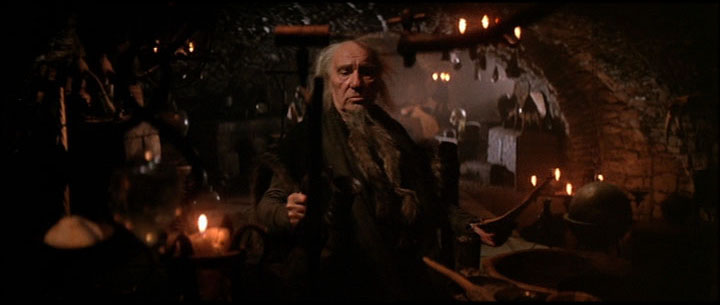
Dragonslayer(Matthew Robbins, 1981) In Hollywood's post-Star Wars frenzy to capitalize on that film's success, there was a resurgence of fantasy and sci-fi films hoping to find the same "magic formula" of George Lucas' effort, which, by the time of this film's release, had already spawned one sequel. Writers Hal Barwood and Matthew Robbins were inspired by "The Sorcerer's Apprentice" sequence from Fantasia (they were apprentices of a sort to Steven Spielberg) and pitched the idea, which was rejected by various movie studios until picked up by Walt Disney, which co-financed in conjunction with Paramount (the two had also produced Robert Altman's Popeye). Dragonslayer begins with a story already in progress. It is the Middle Ages and the King of Urland has made a deal with the devil, literally. In order to protect his village, the King, Casiodorus Rex (Peter Eyre) has instituted a lottery each solstice of all the virgin maids in the village to sacrifice one of them to a 400 year old dragon, Vermithrax Pejorative ("The Worm of Thrace Who Makes Things Worse"). As the film opens, a collection of Urland villagers have traveled to far-off Cragganmoor to implore its wizard Ulrich (Ralph Richardson) to kill the dragon, lest any more women be killed.
The group is led by young Valerian (Caitlin Clarke) who begs the old wizard to intercede on the village's behalf. After first being rebuffed by the sorcerer's servant Hodge (Sydney Bromley), the mage's young apprentice Galen (Peter MacNicol) convinces him to see the townspeople. But Ulrich is still reluctant, having just seen his own death in a vision, but deigns to meet with them, anyway. The meeting with Valerian and the villagers does not go exceedingly well; all the other wizards who might help are dead (by Ulrich's account) and it is because of them that dragons exist in the first place (well, almost—Vermithrax is the last dragon still alive).
Then, a soldier loyal to Casiodorus, Tyrian (John Hallam), who has been tracking the villagers on their journey intercedes, intimidating the party that what they're doing is against the King's policy, although he has no love for Vermithrax. He doubts the old wizard's power, and Ulrich offers a test. He gives Galen his mystic amulet and tells him to go back up to the tower of Cragganmoor and throw down a sharp dagger. Once that's done, the doors and windows of the room slam shut, trapping Galen inside, while Ulrich proves his powers to the doubting Tyrian—the test is to hold the dagger to Ulrich's heart and plunge it through.
...which does not go so well. Ulrich looks heaven-ward...and falls Earth-ward, dead. And magically, while Galen mourns his dead master, the doors and windows of the room that have trapped him slowly open. Tyrian laughs, having proven the wizard a fraud, and returns to Urland, followed by the villagers, their last hope dashed. But, Galen is plucky. He and Hodge have a proper funeral for their master, cremating the body on a pyre (the flames turning an unnatural green) and Hodge scoops the ashes in a pouch for safe-keeping. Galen takes Ulrich's mystical amulet and sets off to follow the villagers to offer his services as a wizard to kill the dragon and save the maidens of the village. When he reaches them, they are skeptical, but a trip to the mountain lair of Vermithrax inspires him to try a unique solution: using the amulet he creates a cave-in at the dragon's entrance, trapping the dragon there forever.
The village heralds the death of the dragon and its long reign of terror with a communal dance and celebration, where, the danger having passed, some of the villagers can finally let their hair down. A triumphant Galen is told by Tyrian that the King wants to pay his respects, and so they go to an audience with the King, who regards his skills and accomplishments with some skepticism, and defends his policy of appeasing the dragon in order to save the village. Galen upbraids the King for not trying to kill Vermithrax and sacrificing the daughters of the village, instead. For this insolence, Galen is thrown in prison.
With Galen locked up in the dungeon, the village goes on with its daily life. But, an earthquake that rattles the countryside sets everyone on edge. As well it should; Vermithrax is not dead and has found a way out of its entombment and, in anger, ravages the village, raking it over with blasts from it's fiery breath. Woe is Urland. Who can save them now?
At this point, you don't really care because the real star of the film begins to make an appearance in something more than glimpses and hints. Vermithrax Pejorative is an awesome creature of the movies. It reminds one of Ray Harryhausen's stop-motion mythical creatures, but with less of the empty stare of his creations. From afar in its attack on the Urlanders, it's a huge shape that blurs past, a dark shadow leaving fire and destruction its wake, untouchable and unfathomable.
It is when things come to close quarters, that it really gets interesting. When Galen makes his first...stab...at trying to subdue the creature with an enchanted lance and a fireproof shield made of the creature's own scales, Barwood shows it in aspects of those previous reveals. It is only when the dragon is revealed in its full glory, having snuck up behind Galen and waited until he's noticed, that we get a good look at the thing, scaled and breathing, puffing up its chest like a bellows to vomit a fireball at the presumptuous wizard that it becomes truly menacing in the real. The designers of Vermithrax give it a baroque look and a bit more personality than Harryhausen could evoke. But, to see it crawling around its cavern home like a bat, then it becomes truly unnerving and more real than previous dragons depicted on-screen. Vermithrax was a result of George Lucas' SFX house Industrial Light and Magic and their recent advances in stop motion animation they dubbed "go-motion," which they'd used to great effect in The Empire Strikes Back. Dragonslayer was the first non-Lucasfilm product they worked on.
Dragonslayer is not my favorite movie by any stretch. But, one thing I did like about it was it's tone that is as far afield from the more light-hearted "boy's adventure" feel that something like "Star Wars" and its clones offered up. Barwood and Robbins' Middle Ages are far less black and white (from an attitude standpoint as well as a lighting one) and more cynical in its sensibilities than you'd find in most fantasy films. The only character here who doesn't have a secret or some hidden agenda and is forthrightly acting on its instincts is Vermithrax. Everybody else is duplicitous, right down to that Disney icon, a princess.
Urland's visiting priest (future Emperor Ian McDiarmid) finds his own version of Hell
I like that. These people are in a bad situation and they're trying to "game" it to their advantage, despite the seeming invincibility of the magic dragon. That feels more like the real world than the fantasy ones of heroes and villains with clear demarcation points. And Barwood and Robbins aren't afraid to toss in sub-textures of the at-odds models of faith—magic and religion, set against the practical—appeasement and politics. They aren't afraid to hint at the heretical, either, no matter how vaunted the subject of their ridicule.
Casiodorus Rex isn't afraid to take credit for other peoples' work.
Dragonslayer is now rated PG-13 (it was rated PG when first released, as the "-13" designation wasn't adopted until after the second "Indiana Jones" movie), but even with that rating it is a very mature PG for 1981...and for Disney. Not only is there the barbecuing of several people, but there is also some hungry gnawing on parts of one of Urland's maidens, and both male and female nudity—and, yes, it's dramatically necessary. It was quite the shift for Disney, whose most well-known death up to that time was Bambi's mother. But, declining sales at the box-office made them start to produce more edgy material and eventually creating its own "mature" studio—"Touchstone"—for those films the "Disney" shingle did not fit. And they must have felt a bit burned that "the youth market" was lining up to see the "Star Wars" films, and not one of theirs.
Of course, today that point is moot.
Another fine aspect of the film is its unusual, weird score by film-music master Alex North (who'd written the scores for A Streetcar Named Desire, Spartacus, and Cleopatra, but who is probably best remembered as the writer of "Unchained Melody," which he'd composed for "B-movie" prison film). Brutal, other-worldly and tuneless, it rejected European romantic traditions and evoked a more primitive time, managing to keep any notions of swash-buckling out of this fantasy-realm. It also allowed North to recycle some of the music he wrote for his rejected score for 2001: A Space Odyssey.