Showing posts with label Porter Hall. Show all posts

Thursday, September 16, 2021

The Miracle of Morgan's Creek

The Miracle of Morgan's Creek (Preston Sturges, 1944) In the perpetual mating dance that writer-director Preston Sturges did around the blue-noses of the Breen Office, there was never a more sassy tango than The Miracle of Morgan's Creek, as sonorous a razz-berry, as flagrant a nose-thumbing as any director has done to his oppressive censors. 

Censors. It may seem odd in this "anything goes" era of film-making—where even dismemberment gets a pass for 13 year olds (but bare breasts get an "R"), where the foulest of epithets are uttered from the mouths of babes and fart jokes are de rigueur in kids' movies—that at the time this movie was made, you couldn't say the word "pregnant," or "virgin," men and women could not appear in the same bed, the subject of sex was merely metaphorical (as opposed to mythical in a teen movie) and represented by a camera pan to crashing ocean waves, burning fires, or shattered mirrors.

Yes, kids, we were Amish back then. At least, actresses weren't asked to wear veils...unless they were over 40 and the vaseline on the lens didn't hide the crow's feet.*
In this the script is an intricate little puzzle of studio "issues" that interlock to form a script that should have raised so many red-flags (and did), but take any of them out of the story and it would look like you were unpatriotic, immoral, or a perfect candidate for ex-communication
Of course, it's a comedy. Set and produced during war-time. And the sacred subjects of that war—God, Country, and The Troops—are all given a jaundiced eye that would come from living with a bellyful of bromides while just trying to eke out a living. Though clear-eyed and sentimental in the right places, The Miracle of Morgan's Creek can look at a manufactured convenience and still call it "bologna," and then acknowledge that, sometimes, bologna'll do the job. Even the movie poster has a conspiratorial wink in it. Like any good love story.  

Poor Norval Jones (Eddie Bracken). He's been in love with Gertrude Kockenlocker (Betty Hutton) since they were kids, and he's got it bad. "I wish you were in a lot of trouble, Trudy, so I can help you."

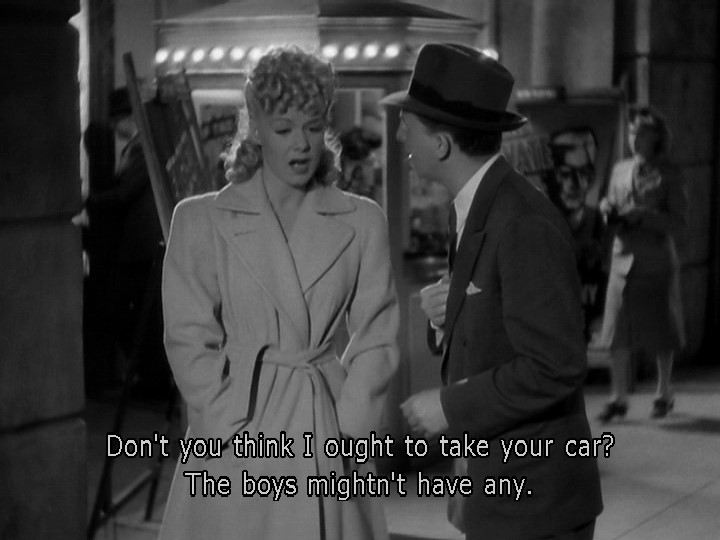
Note to Norval: You, uh...you've REALLY got to be careful what you want. Especially when it comes to Trudy. She's only got eyes for the servicemen going overseas. She wants to do her part for our "fine and clean young men" and to give 'em a good time before they go off to war, over the objections of her constable father (Sturges pillar William Demarest). He forbids her to go to the USO dance on Tuesday, because as a veteran of The War to End All Wars, he knows servicemen have their minds on only one thing. "Oh no," says Trudy. "They're not like that any more! These are good boys, noble boys." But Pappy is unconvinced. So she conspires with Norval to take her to the movies, and once there, she dumps him, takes his car, and does a pub-crawl with the "nice boys," telling Norvel she'll meet him back at the flicks at 1:15. 

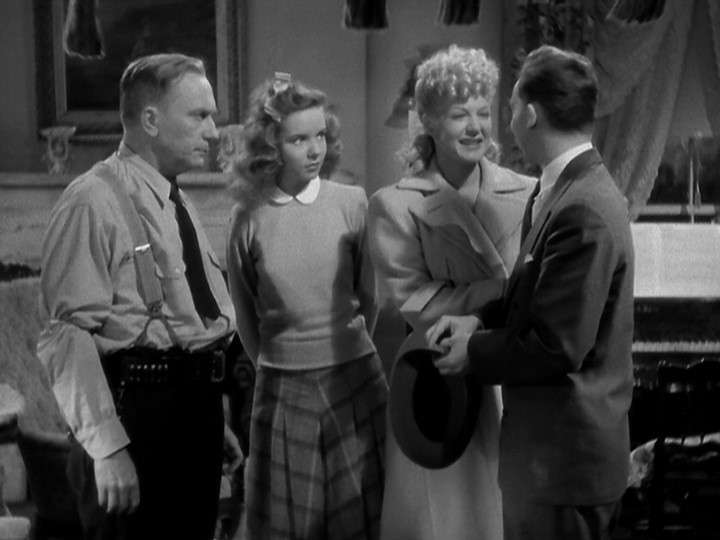
She doesn't make it back until 8:00 am, with the car in tatters, her memory a little shaky, and Norval in the Kockenlocker gun-sights to take the blame when they get her home. With legitimate reasons. 

Or even illegitimate ones.
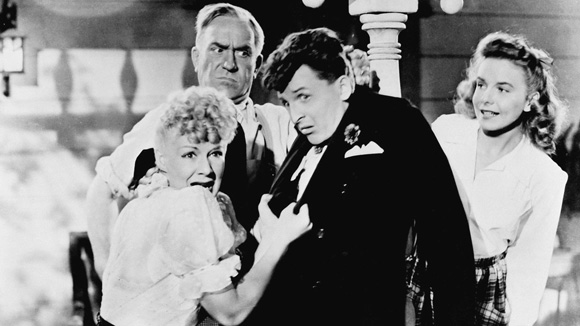
Evidently, she did more than her part for the troops. Trudy doesn't remember a lot about what happened that night, it's kind of a blur. She thinks she might have gotten married, but she's not sure—she can't remember the guy's name. So, she keeps it to herself—the boys are shipping out, who'll know? Then, there's the little matter of her being pregnant. So, there's a double puzzle: she can't tell anybody she's married without a husband, but she's pregnant without ever having been married. Maybe. What to do, what to do? 

It's a scandal. The kind that small towns hush up and don't talk about; but what fun would that be? There's a way out of the problem—don't even go there—but it can't go smoothly, and before the solution can be found, it has to get more complicated—at the top of its lungs. It even turns political, with guest appearances by The Great McGinty (Brian Donlevy) and "The Boss" (Akim Tamiroff), from Sturges' directorial debut. 
 
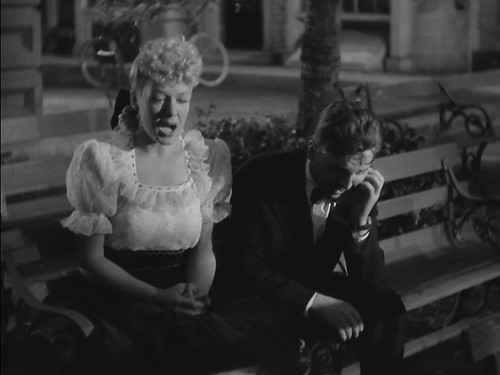
I've never liked Betty Hutton. I've always found her loud and grating and usually playing scatter-brained simps. Well, her Trudy Kockenlocker is a scatter-brained simp, but Hutton makes her sympathetic and funny, with a perpetual look of comic confusion, exhausted with dis-belief. She's all too willing to do physical comedy in an extremely unladylike fashion (one of which involves her getting clocked by one of those mirror-globes at an out-of-control jitterbug dance). She's a complete joy in this movie, whether by herself, matching stammers with the brilliant Bracken (who moves so fast in this movie, I'm surprised he's not a perpetual blur), or sharing sisterly woes with her wise-acre sister (the nifty Diana Lynn), who is the Horatio to her densley populated Hamlet. Never has a movie had such fun in being irreverent about such American ideals as The War Effort, and even Motherhood. 

In 2001, The Miracle of Morgan's Creek was selected for the National Film Registry. This American classic is also #54 on the AFI's "100 Years...100 Laughs" list of the funniest movies ever made. And it's somewhere near the top of the most boldly audacious movies ever created in a climate of repression. Add the caveat of taking such subversive gleefulness in its presentation, and it would be #1.


* It should be noted that once the Breen Office died the death of a thousand indignities in the late '50's and 60's, and subject matter was freed up for public consumption, There have been waves of motion picture permissiveness—we approach a line of the verboten and then back off, a few years later we creep up to the line and slink back in a cycle that seems more like evolution than revolution. There is still censorship, but the censor is the marketplace, and a film-maker must consider the box-office potential of his choices, as filtered by the specious and contrary dictates of the MPAA. Except for the screw-balls at the Ratings Board, it seems a more fair system: "Yeah, you can do that...but it's gonna cost ya."

Wednesday, August 25, 2021

Sullivan's Travels

Sullivan's Travels
(Preston Sturges, 1941) Entertaining 1941 "message picture"..."with a little sex in it."
 
Big Deal studio comedy director John L. Sullivan has a case of "Hamlet disease,"* and wants the studio to bankroll a serious picture (for a change!) about poverty—entitled "Oh Brother, Where Art Thou?"**—but while the brass haggle over whether they want to do it or not to appease their big bread-winner, "Sully" (Joel McCrea) decides to dress the part and go amongst the poor and down-trodden for a little research. After all, he's a rich Hollywood mucky-muck—what does he know about poverty (other than he's against it)? Early on in his plan, a girl (Veronica Lake, playing "The Girl"), who is down on her own luck trying to get acting jobs, uses her last thirty cents to buy the poor schlub some breakfast at a diner. Sully gets the guilts, and tells her of his idea, and ropes her into the scheme.
The two then skip the studio publicity-mill buttinski-bus that's been set up to track their moves as they spend the next few days hopping freights, eating at soup kitchens, and sleeping at flop-houses. The movie fairly careens like the Keystone Cops with changes of tone from earnest pathos to roaring comedy: the poor are saintly (though one thief is particularly verminous), while the rich Beverly Hills folk, they are a foolish bunch. And (one must admit) Sully's "experiment" falls a bit short in the stakes department when he and The Girl can easily abandon it at a moment's whim (although Sturges does insure a more authentic experience, just to ensure that his point gets made).
Ultimately, the film seems just a tad self-justifying in that a comedy film-maker is making a comedy about why comedies are needed. One would think that Sully could read the trades and see how well his movies were doing and come to the same conclusion. But, the point is made—and made often—that the well-to-do Hollywood types haven't a clue about a world that isn't butlered and chauffered and catered...to their every need.
But let's not quibble. The movie is a great construction with Sturges' rock solid writing delivering a punch or punch-line every third line or so, all delivered at a break-neck pace by his stable of regulars and
McCrea, whose sense of light comedy was impeccable, and Veronica Lake
, who was never better than the breezy blonde who goes along for the ride.
Sullivan's Travels is the brightest star of the Preston Sturges series of Paramount comedies. If it can lead one to seeking out the rest of this too-overlooked writer-director's films, then that's gravy.
Sullivan's Travels was voted into the United States National Film Registry in 1990 for being "culturally, historically, or aesthetically significant". It is all that and also damned entertaining. And sometimes that's all you can hope for in this cockeyed caravan.

 
* When a comedian yearns to play Hamlet to prove his range...and be taken seriously.

** Yes, this is where the Coen Brothers got it.
Hey, that's Preston Sturges in the background playing the director!