Showing posts with label Eddie Bracken. Show all posts

Thursday, September 16, 2021

The Miracle of Morgan's Creek

The Miracle of Morgan's Creek (Preston Sturges, 1944) In the perpetual mating dance that writer-director Preston Sturges did around the blue-noses of the Breen Office, there was never a more sassy tango than The Miracle of Morgan's Creek, as sonorous a razz-berry, as flagrant a nose-thumbing as any director has done to his oppressive censors. 

Censors. It may seem odd in this "anything goes" era of film-making—where even dismemberment gets a pass for 13 year olds (but bare breasts get an "R"), where the foulest of epithets are uttered from the mouths of babes and fart jokes are de rigueur in kids' movies—that at the time this movie was made, you couldn't say the word "pregnant," or "virgin," men and women could not appear in the same bed, the subject of sex was merely metaphorical (as opposed to mythical in a teen movie) and represented by a camera pan to crashing ocean waves, burning fires, or shattered mirrors.

Yes, kids, we were Amish back then. At least, actresses weren't asked to wear veils...unless they were over 40 and the vaseline on the lens didn't hide the crow's feet.*
In this the script is an intricate little puzzle of studio "issues" that interlock to form a script that should have raised so many red-flags (and did), but take any of them out of the story and it would look like you were unpatriotic, immoral, or a perfect candidate for ex-communication
Of course, it's a comedy. Set and produced during war-time. And the sacred subjects of that war—God, Country, and The Troops—are all given a jaundiced eye that would come from living with a bellyful of bromides while just trying to eke out a living. Though clear-eyed and sentimental in the right places, The Miracle of Morgan's Creek can look at a manufactured convenience and still call it "bologna," and then acknowledge that, sometimes, bologna'll do the job. Even the movie poster has a conspiratorial wink in it. Like any good love story.  

Poor Norval Jones (Eddie Bracken). He's been in love with Gertrude Kockenlocker (Betty Hutton) since they were kids, and he's got it bad. "I wish you were in a lot of trouble, Trudy, so I can help you."

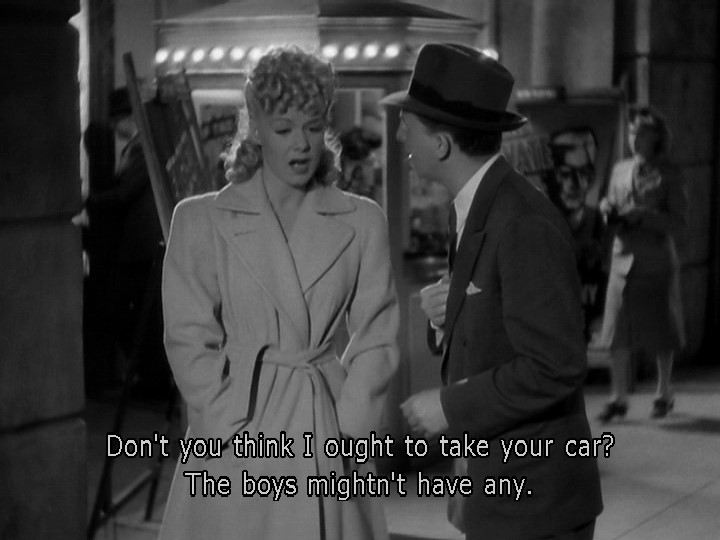
Note to Norval: You, uh...you've REALLY got to be careful what you want. Especially when it comes to Trudy. She's only got eyes for the servicemen going overseas. She wants to do her part for our "fine and clean young men" and to give 'em a good time before they go off to war, over the objections of her constable father (Sturges pillar William Demarest). He forbids her to go to the USO dance on Tuesday, because as a veteran of The War to End All Wars, he knows servicemen have their minds on only one thing. "Oh no," says Trudy. "They're not like that any more! These are good boys, noble boys." But Pappy is unconvinced. So she conspires with Norval to take her to the movies, and once there, she dumps him, takes his car, and does a pub-crawl with the "nice boys," telling Norvel she'll meet him back at the flicks at 1:15. 

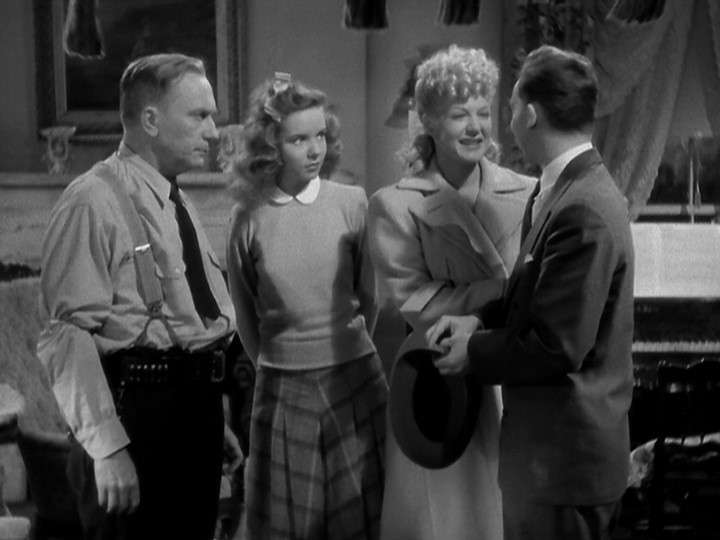
She doesn't make it back until 8:00 am, with the car in tatters, her memory a little shaky, and Norval in the Kockenlocker gun-sights to take the blame when they get her home. With legitimate reasons. 

Or even illegitimate ones.
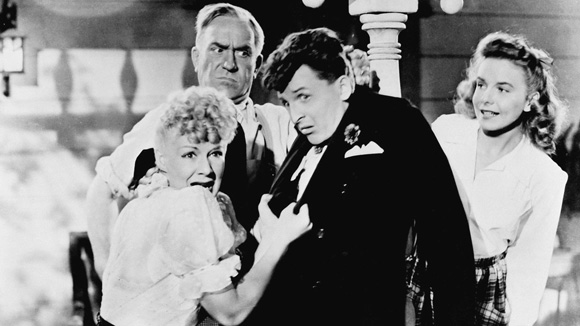
Evidently, she did more than her part for the troops. Trudy doesn't remember a lot about what happened that night, it's kind of a blur. She thinks she might have gotten married, but she's not sure—she can't remember the guy's name. So, she keeps it to herself—the boys are shipping out, who'll know? Then, there's the little matter of her being pregnant. So, there's a double puzzle: she can't tell anybody she's married without a husband, but she's pregnant without ever having been married. Maybe. What to do, what to do? 

It's a scandal. The kind that small towns hush up and don't talk about; but what fun would that be? There's a way out of the problem—don't even go there—but it can't go smoothly, and before the solution can be found, it has to get more complicated—at the top of its lungs. It even turns political, with guest appearances by The Great McGinty (Brian Donlevy) and "The Boss" (Akim Tamiroff), from Sturges' directorial debut. 
 
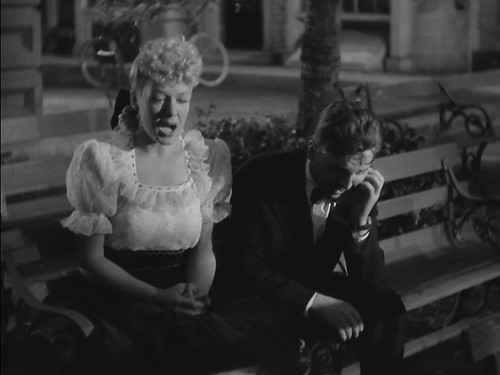
I've never liked Betty Hutton. I've always found her loud and grating and usually playing scatter-brained simps. Well, her Trudy Kockenlocker is a scatter-brained simp, but Hutton makes her sympathetic and funny, with a perpetual look of comic confusion, exhausted with dis-belief. She's all too willing to do physical comedy in an extremely unladylike fashion (one of which involves her getting clocked by one of those mirror-globes at an out-of-control jitterbug dance). She's a complete joy in this movie, whether by herself, matching stammers with the brilliant Bracken (who moves so fast in this movie, I'm surprised he's not a perpetual blur), or sharing sisterly woes with her wise-acre sister (the nifty Diana Lynn), who is the Horatio to her densley populated Hamlet. Never has a movie had such fun in being irreverent about such American ideals as The War Effort, and even Motherhood. 

In 2001, The Miracle of Morgan's Creek was selected for the National Film Registry. This American classic is also #54 on the AFI's "100 Years...100 Laughs" list of the funniest movies ever made. And it's somewhere near the top of the most boldly audacious movies ever created in a climate of repression. Add the caveat of taking such subversive gleefulness in its presentation, and it would be #1.


* It should be noted that once the Breen Office died the death of a thousand indignities in the late '50's and 60's, and subject matter was freed up for public consumption, There have been waves of motion picture permissiveness—we approach a line of the verboten and then back off, a few years later we creep up to the line and slink back in a cycle that seems more like evolution than revolution. There is still censorship, but the censor is the marketplace, and a film-maker must consider the box-office potential of his choices, as filtered by the specious and contrary dictates of the MPAA. Except for the screw-balls at the Ratings Board, it seems a more fair system: "Yeah, you can do that...but it's gonna cost ya."

Wednesday, September 8, 2021

Hail the Conquering Hero

Hail the Conquering Hero (Preston Sturges, 1944) You can take "Semper Fi" just a little too far sometimes. Small-town schnook Woodrow Lafayette Pershing Truesmith (Eddie Bracken) is drinking alone in a bar. Washed out of his beloved Marine Corps for chronic hay fever, he's been working in a San Diego shipyard ever since and writing letters, full of fiction, to his Mom, a Marine widow, that he's fighting overseas. He spots a group of jarheads (led by Sturges regular William Demarest) trying to buy a communal beer with 15¢ between 'em, and buys them a round.

When they hear his tale of woe and subterfuge, the Marines take sympathetic pity on Woodrow, and concoct a story that reads like an invasion plan. Just back from Guadalcanal, they pin their medals on the kid, insist on escorting him home, and make up a cock-and-bull story about him being a hero. Anything for dear ol' Mom. But, as things tend to do in Sturges comedies, things accelerate in a dither of cross-purposes and crushed dialogue. Caught up in the manufactured patriotic fervor, the whole town sings Woodrow's praises, the bank forgiving Mom's mortgage and nominating him for Mayor (with the election only two days away!). Woodrow's genuinely appalled, but the Marines are steadfast in seeing Woodrow's dreams come true, no matter how much he protests, no matter how much he whines. No matter how much guilt he feels.
It took some guts for Sturges to make a story about blind hero-worship and unquestioning patriotic fervor during war-time (it would be controversial today and must have been even more so during the time of its release during the second World War), but emboldened by a basic cynicism (and his typical questioning of tropes), Sturges does a strafing run on a veritable gallery of targets (with the military even cooperating with the filming!) Sturges takes pot-shots at bankers, small-town in-bred politicians and the insanity of mob-rule, yet still manages to make a fairly sunny picture with a lot of laughs and a hero who's anything but.
Part of the charm of Hail the Conquering Hero is Truesmith as played by Eddie Bracken. Not much to look at, kinda dumpy with a nose that follows the slope of his fore-head without benefit of eyebrow ridges, Bracken has the same voice and manner of Mickey Rooney, a ferocity of energy and a quick way of delivering lines with maximum inflection. That he spends the entire movie frustrated, bitter and cynical doesn't lessen his appeal one jot, which is, frankly, amazing—it's something even James Stewart couldn't pull off in The Philadelphia Story (despite winning the Oscar for it).
Hail, the Conquering Hero has a couple Pacific Northwest connections: the ingenue is played by Ella Raines, who was born in the little town of Snoqualmie Falls, Washington, and is something of a noir icon for her titular role in "Phantom Lady"; and one of the Marines is played by a mug with a mushed-in face named Freddie Steele.
 
Steele was a professional middleweight boxer in the Pacific Northwest with an astounding record of wins-losses and draws of 125-5-11. Noted for his pile-driver punches, he was known as "The Tacoma Assassin," before a punch broke his breast-bone (ouch!) and he gave up the ring for the movies. He ran a legendary restaurant in Westport for many years, and his role as the one Marine who thinks that Trueblood may not deserve the false-god praise he gets is the most satisfying of the emotional through-lines in Hail, the Conquering Hero.