Let's Face the Music and Dance
or
The Semi-Quavers in the Fugue State
I've had a bit of experience with the disease named Alzheimer's and a bit with strokes. Basically, it boils down to wires and chemicals. The precision with which one's life is led (or followed) gets gummed up, and the gears start to jam, corrode and fail and the dance-steps we've learned as adults fade away, leaving us mentally flailing and physically incapacitated.
Whatever dignity we've cloaked ourselves with unravels and we become as helpless as babes. Every mechanism fails, until we get to the core processes of eating, breathing, beating...which, one by one, give out...and we stop being. Not just being who we are. But just being.
I've also had enough experience to know that this process doesn't have a logical, linear progress. You don't "just go downhill" (were it that easy). Things run in cycles, like electric current: you're up, you're down. You have a good day, then boom, your legs go out from underneath you. Recovery takes longer and the "down" days extend and eventually, in one those valleys, you'll breathe your last. We don't have a choice when and how. We don't have any choice. No one born gets out alive.
It's the life we have a choice over, and the how of it. Until then, we hang on...for our dear life.

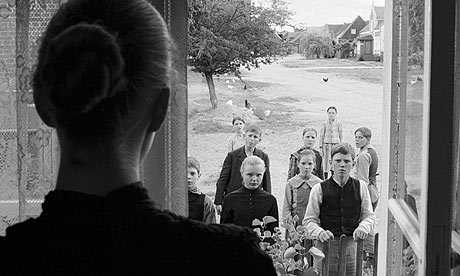
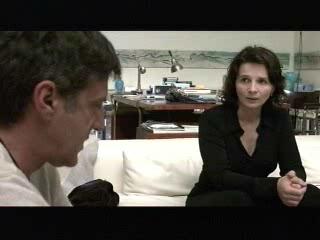
Michael Haneke's Oscar-winning film Amour ("Love," of course, in translation) starts with a puzzle. Firemen break down a sealed door in a Paris apartment and find the body of Anne Laurent (Emmanuelle Riva), laid out in death, holding flowers, her body ringed with cut asters. As with Caché and The White Ribbon, the first segment gives us a challenge the rest of the movie will answer (but not completely). Why is she there? Why is no one else? Where is her husband (Jean-Louis Trintignant), her main caretaker? What happened? Why this? Why does the daughter (Isabelle Huppert)—who visited often—not know anything about it? The late Anne Laurent was a music teacher (retired) and an acclaimed pianist. She takes joy in music—as does her husband Georges (also a retired music teacher). They take delight in the accomplishments of their former students, including Alexandre (Alexandre Tharaud) and, in fact, their last big outing together was to see him perform in concert, although, he is wont to pay a visit from time to time to their cubicled apartment to play for the two of them to their obvious joy and—let's face it, envy—as the two of them, both in their 80's, can't possibly play with the dexterity they used to have. The joy is in the witnessing, not the doing.
 The concert is a treat, quite out of the routine of their day-to-day of meals and reading and light chores. But, the night after the concert, at one of those typical meals, where there is the casual conversation—or not—Georges notices that Anne goes quiet and becomes absolutely still, not registering anything, not even when he attempts to get a reaction out of her. She sits there, catatonic, and doesn't revive until Georges is already trying to get help—something she refuses (she's fine!), certainly not any medical attention. And she resists any trip to a doctor's...until she finds that she is quite incapable of pouring herself a drink.


The strain is wearying, though. Their daughter insists that she be sent to a nursing facility, but Georges will not go back on his word to Anne, employing a nurse three days a week. Anne has a second stroke, leaving her bed-ridden and with dementia. For Georges, the promise he's made to her is inviolable, but it does not make it easy, having to contend with the quality of nursing—some are fine, but there's that one that's slightly abusive that he has to let go—and the gradual shrinking of life that goes with the shrinking of ability. It is gutting, and I can't imagine someone who hasn't lost someone to a protracted debilitating disease having any understanding of what transpires, like how some viewers who'd never known the reality of "survivor's guilt" trying to comprehend Saving Private Ryan. It's a tough movie to watch, but it's completely understandable if you've been a part of the roller coaster of emotions that rush at you when someone you love is becoming more still. It is not enjoyable, but you appreciate it because writer-director Haneke "gets it." All the conflicts, all the false hopes and truly dark places one goes when you see a love dying. It's a whirlpool that one can fall into if one isn't strong enough to beat back the current.

But, you appreciate that truth. Even if it opens a scarred-over wound.




.jpg)