Showing posts with label Mia Wasikowska. Show all posts

Tuesday, October 12, 2021

Stoker

Gosh, it's October 12th and I haven't started putting up the usual collection of Horror-style movies that have been moldering in the crypt...

Written at the time of the film's release...
 
"Creepy Carrie, Creepy Carrie"

or
There's Just One Hitch...

There is such an air of oppression in Chan-wook Park's Stoker ("from the acclaimed director of Oldboy") that it completely tractors over any pretensions of accomplishing what the intent is...to make a film in the style of Alfred Hitchcock.

Well, to do that you have to have an understanding of what Alfred Hitchcock did as a director...and you also have to have an understanding of what "style" is. Not the stylization of what we see here—all oblique angles  and off-kilter cutting, movie-making that "suggests" a story rather than just coming right out and saying it in movie terms. But, also you have to know that Hitchcock's "thrillers," when he made them, took the opposite tack of Stoker, presenting "normal" life invaded by aberration, rather than making it the norm. Hitchcock might have been obsessed with the creepy, but the gourmand in him knew that a steady diet of it would make it dull.


Which is what Stoker is.

On her 18th birthday, the father of India Stoker (Mia Wasikowska) is killed in an automobile accident, devastating her family, and introducing to them her father's brother "Uncle Charlie" (Matthew Goode) at the funeral. Charlie stays with the family inserting himself into every aspect of the Stoker household, still in shock over Richard Stoker's (Dermot Mulroney) death, taking a particular interest in gardening, the servants, and mother Evelyn (Nicole Kidman). Soon, the head caretaker goes missing, as does great-aunt Gwendolyn (Jacki Weaver), explained away by Charlie, who then turns his laser-like gaze on India.  As is the trait of Uncle Charlies, he sees a kindred spirit in his brother's daughter, and if the man had any sense, he'd be afraid of that, which is the only aspect of Stoker that doesn't pay homage to the Master of Suspense—this is a movie that has no redemption and no hope.

There's a child's primer of Hitchcock throughout: bad "mother" relationships, a creepy "Uncle Charlie," odd dispassionate deaths, the callow, uncomfortable-making young man, the swinging light, the "secret" basement, the masquerading gardening activities, the imposing staircase (circular), the rather irrelevant but "convenient" ability of India. It's a Hitchcock movie for those who've only seen Psycho, and are stuck in that film's deliberate pace and motivation. It's designed to shock, but not to move (and not even out of one's seat...unless of course, it's to walk out).
And there's no humor. Not even a nervous titter. Oh, sure, there is dark "irony" scattered hither and yon with all the subtlety of a hammer swing, but there is no lightness of touch anywhere, not even as an antidote to all the mock serious portent that shrouds the thing, that makes it travel the dead man's walk from too-heavy seriousness to unintended self-parody. It's as if Alan Ball had written Shadow of a Doubt, directed by a too-eager-too-please director who knows nothing about sub-text, and the fun ways that one can infuse the abnormal into normal, or what passes for it.

It's all in the trailer, kids.

Thursday, July 25, 2019

Alice in Wonderland (2010)

Written at the time of the film's release...


"Beautiful Soup"

Hesitant, I am, these days. Hesitant, I says.

After rushing
the review for Shutter Island and dismissing it as "minor Scorsese," I found it had stuck like a bur in my hair and remained in my thoughts and my brain for a longish time. I went back and changed my rating—it's a "Matinee" now*—but not the review, because my complaints are the same. But it's really good "Scorsese" and slots right into the body of his work, despite being unique in its qualities and unlike anything he's done before.

But, I can't tell you why. Curiously, this doesn't stop me from going on and on about it, because it's so rich, and after an essential second viewing, you realize what a dance it is with story-logic and the use of image to show you—and NOT show you—what's going on. It's a trip, and a breathless display of what a master of cinema can do with the form.

Which is why Martin Scorsese should have directed Alice in Wonderland in 3-D. Sure, your kid's head would explode. But it'd be a great movie!

I've been looking forward to
Tim Burton's take on Lewis Carroll. Seems like a match made in anyplace but Heaven. Burton's lapses in story-logic and not playing by the rules in past movies make him the perfect Carroll adapter; he's the "just go with it" director, as he frog-jumps from set-piece to set-piece. If you have to ask questions, you're going to slow the tour-bus down. And his arrested art-student sensibility is so dark that it keeps Alice exactly where it should be—underground with the muck and the weevils and the roots tearing at your extremities.

So it's a MAJOR disappointment that Disney's Alice in Wonderland in 3-D (A Film by Tim Burton) is such a wisp of a movie and—dare I say it—conventional, that it misses the mark of being a great movie (and a good representation of Lewis Carroll) by a hedgehog-croquet slice.**
Here's the problem. The "Alice" stories are stuff-and-nonsense. Charming stuff-and-nonsense that can make little girls giggle and college professors scratch their heads. Buried deep in its purple marrow is the satire of the vagaries of Society, not of adults, necessarily, but of Society—of class distinctions and petty politics—the Games People Play (when they're not playing games).
It shouldn't make sense. It is full of new words and language that fire the synapses of minds, like when Mommy talks about something called pilates, or you have to find out why you can't steal a base before the pitcher throws. It's all bright and shiny and new and simply incomprehensible, and Carroll is just as fantastical for trussed-up adults as it is for children. The glory of it is children have the upper-hand in connecting with it—they don't have so far to fall down the rabbit-hole.
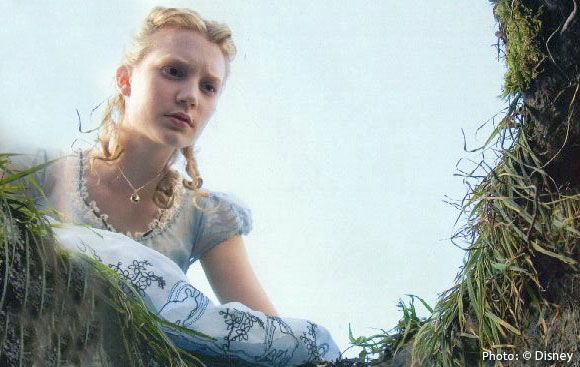
And Burton (and his screenwriter Linda Woolverton, who's worked on several Disney animations) know this to a point. When we first meet 19-year old Alice Kingsleigh (Mia Wasikowska, looking dark-eyed and sallow—a perfect Burton heroine), she has been invited to an engagement party—hers.** It's a surprise, but it's not, and it is not going well for the hostess, Lady Ascot (Geraldine James) the mother of the groom-to-be, as everything is not...perfect. And Alice has this annoying habit, besides being late, of being...unconventional...and distracted by anything. Alice likes to see the Nature of things. The party made by adults just uses Nature as a tightly-controlled back-drop. At the moment the question is popped, Alice excuses herself to the party (as they're all watching, and it's for their benefit more than hers) saying that she "needs a moment." (Did they "need moments" in the 19th?).

This is pretext to Alice wandering off from the party, in her moment of highest risk of being cosseted, to follow a white rabbit and once more stumble down a rabbit-hole, returning to "Wonderland."***
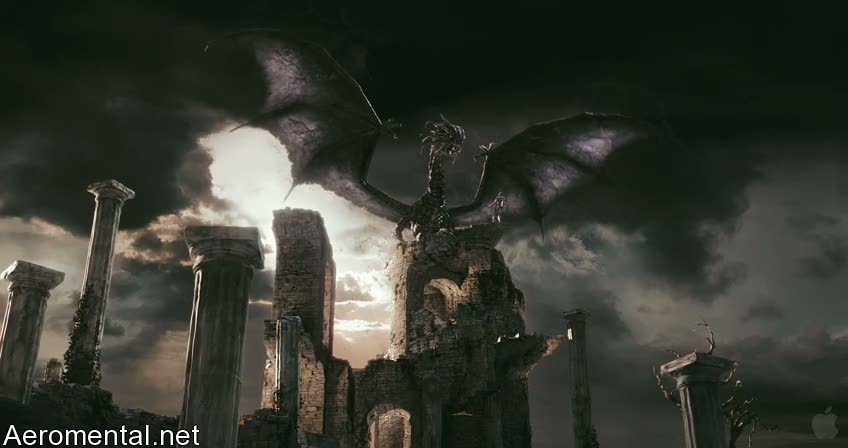
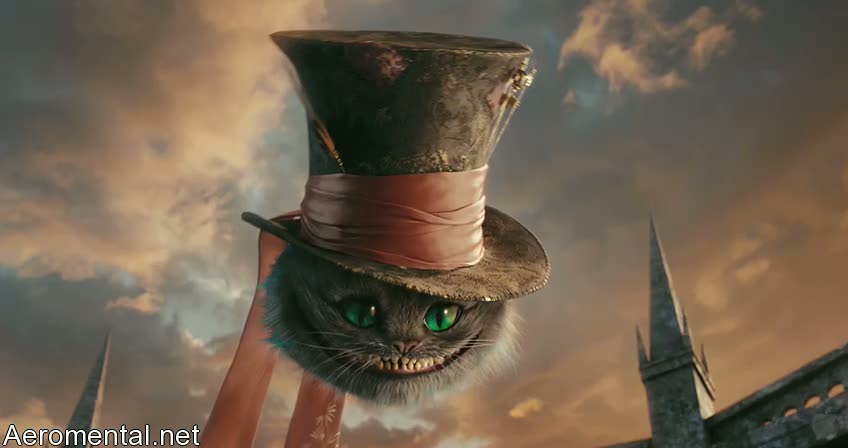
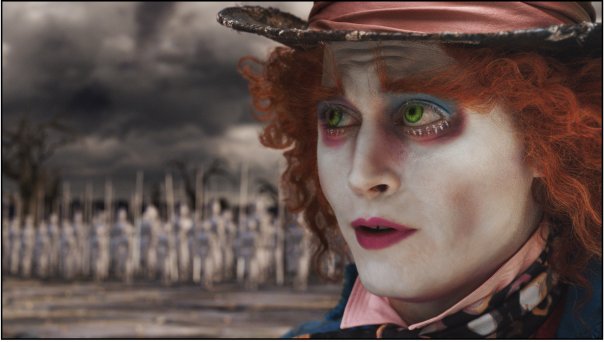
It's here, as you'd guess, that the movie takes off. The colors more vibrant, the effects-work (by four FX houses but primarily Sony) magical, even the 3-D has more depth. The characters adhere to a mixture of Burton and first edition illustrator John Tenniel, and more in that direction than the way the Disney animators drew the characters for their 1951 adaptation. The film is nicely cast with Burton's usual suspects (Johnny Depp—top-lined as The Mad Hatter, Helena Bonham Cartersimply delicious as The Red Queen, the voices of Alan Rickmanthe caterpiller, Timothy SpallBayard the hound, Christopher Lee—as the Jabberwock, Paul Whitehouse—as The March Hare, and Michael Gough—as the Dodo) New to Burton are Stephen Fry as the Cheshire Cat, Michael Sheen as the White Rabbit, Matt Lucas as Tweedles Dum and Dee, but most impressively, Crispin Glover as the evil knave Stayne, and Anne Hathaway as the White Queen. One wonders why Glover has never been in a Burton movie before—maybe Burton thought he was uncontrollable?—but he brings a hissing nastiness to what could have been a typical bad-guy role, and that Burton sets him up against Depp's Hatter is one of those movie match-up's you love to see. And Anne Hathaway proves once again that she's not afraid to explore her dark-side. Her creepy "Liza-Minelli-in-a-straight-jacket" White Queen evokes Burton's long-time exotic paramour Lisa Marie.
Quite the ingredients for a film, and with Burton doing the stirring, one salivates at the possibilities. There are lots of laughs, moments of exquisite beauty—wispy seeds occasionally enter the frame and at one point, we park in front of a dew-drop hanging underneath a mushroom (Robert Zemeckis would have shoved us through it)—the whole movie is filled with beautiful images and nice ideas to keep you in your seat. But, it has no staying power, and it might be because this "Alice in Wonderland" has the parts, but not the nonsensical sinew that has made "Alice" a classic.
Wolverton and Burton take the essential pieces and make a typical action-adventure story-line out of it. There is some half-sized satire about political squabbling, but mostly it's a cut-and-paste job, based on "The Jabberwock Poem." That classic piece of nonsense turns into a fable "that will make everything alright." And it involves one of the characters defeating the Jabberwock in battle with "the vorpal sword" to invoke "the frabjous day" and blah, blah, blah. It's a silly poem, people, not a video-game scenario. By the time we get to the climax, there's a "Lord of the Rings" dark-sky battle between the characters, and we could just as well be in "Narnia" for all it matters. And it has an after-school special message to it, that is nice and all, but is a bit like cherry-flavored medicine.****
This is a lot of talk for a movie I'm only luke-warm about, but the bottom-line is, it's fun while it lasts, but it's like eating cotton candy in the rain. So, yeah, take the kids, it's imaginatively done (when it is), and they'll love it. But don't be surprised if they get sullen and whiny an hour after. Rich it may be, but it's mostly empty calories.****

* A word of explanation: this was written for an old movie blog of mine, now consigned to pixel dust, but written at a time when I still believed that you needed to sum up your view of a movie with a "Rating" (you know, 8 stars of 10, or, the most egregious "Thumbs Up"👍 or "Thumbs Down👎." The way I pigeon-holed films was very basic—"How much money do I think you should spend on it?" So, the ratings went like this: 

1) Full-Ticket Price. The cost of a first-run evening show. The movie is worth seeing in a theater for whatever reason, even at full price.

2) Matinee Not worth a full-price ticket, but still worth seeing on the big screen, but save some of your money because it's no Citizen Kane.

3) Rental For whatever reason, pick it up on your own terms, in your own home. Not worth making an appointment or going out of your way.

4) Cable-watcher Less than Net-flix, because cable gives you more options for viewing. Don't schedule your life around this film, in fact, there are probably better options channel-surfing. If it's a distraction, and it just happens to collide with your eye-balls, this is it.

5) A Waste of Film (or video--don't get technical!) Don't waste your life along with it. There's nothing to get from this film, and the only thing the makers got was another notch on their resume/imdb site.


** Here's the rub: Alice in Wonderland dropped out of my head very fast. One trip to the hardware store and *POOF!* it was gone like a puff of hookah-smoke (or was that diesel?). Now, I waited to write this, fearing another Shutter Island mis-take, and I found the movie shrinking away—shrinking, shrinking, shrinking, waiting for a cake to say "Eat me" to bring it back to size. Never showed up.

*** There's a subtle joke there, as it's mentioned that the party has been in the works for twenty years...but Alice is only 19!

**** Woolverton and Burton add a nice touch that Alice is constantly questioned whether she's the "real" Alice—the Alice that showed up in "Underland" when she was six. She's grown up and the residents hardly recognize her as the strange child who changed the name of the place to "Wonderland." The original story's name was "Alice's Adventure Under Ground."

***** SPOILERS AHEAD: To show you how cookie-cutter this "Alice" is, somebody gets captured and has to be rescued, there's a last-minute save from an unexpected source, a character must claim an essential ingredient by facing danger, and a foe becomes an ally. Oh! And one character's actions provides the method for their eventual freedom. And there's no place like home. I may be a little harsh here, but "Pan's Labyrinth" showed that you could do something different with this sort of myth-weaving and still make a compelling movie.

****** See it in 3-D? I dunno. It will probably be brighter in 2-D, but betray the flatness of the images, and Burton has the same problem as James Cameron of bringing non-essential things on the frame-edge, like ferns and such, too close to prevent double-images. Zemeckis, Dreamworks and the Pixar folks are the champions of 3-D so far.


Wednesday, April 29, 2015

Maps to the Stars

Boo-ray for Hell-y-weird!
or
They Should Have Called the Town "Phoenix," instead.

Los Angeles is a suitable case for Xanaxing it's water supply in the way they used to fluoridate the waters for tooth decay; the Xanax is for the psychic decay of a town whose whose compass in mainly bi-polar. A town built on incoming heights of hope and the gravely-crushed dreams of the downwardly spiraling, L.A. and its tarty step-sister Hollywood have inspired many a cautionary tale since...well, since they started making movies there. Every decade sees at least one or two poison pen letters to Tinsel-town, be it A Star is Born (three versions), The Day of the Locust, Mulholland Drive, The Oscar, The Player, Barton Fink, S.O.B., Postcards From the Edge, The Big Knife, Whatever Happened to Baby Jane? (those by Robert Aldrich), and the most revered and stylish, Sunset Boulevard. Those are the most successful, but there have been others by lesser lights, hoping their screeds to the industry would get them noticed—it's that kind of thinking that might be at the root of their discontent.

David Cronenberg is the latest to poke the wasp's nest in Maps to the Stars (written by Bruce Wagner, who wrote a Nightmare on Elm Street episode, Scenes from the Class Struggle in Beverly Hills and the TV series "Wild Palms"), which is less about the movie business and what it creates and tears down, and more about the culture (or lack of it) swarming around the business. It's more of a self-contained soap opera that exposes the selfishness, egotism, neuroses, incestuousness, and just plain venality that provides the background stink to the town.*
"How's that therapy working out for ya, hun'?"
Like a soap, it's convoluted.  There are two spheres of influence, one is Havana Segrand (Julianne Moore, in the performance that should have won her the Oscar), child-star of a famous movie-star Mom (played by Sarah Gadon as a 20 year old ghost), who is starting to fade and is such a mess of conflicts she can't seem to get them straight—she's vying for a role in a remake of a film her mother starred in, despite the fact that she seems to have invented a past abusive relationship, when the abuse she seems to inhabit are of her own conjuring. Moore plays her with a valley-girl voice and a wild-animal stare that unnerves—one keeps thinking of Lindsey Lohan while watching her, which seems intentional, as the movie is steeped in name-dropping and gossipy in-jokes. She has visions of her mother that appear, only to break her down and throw her into an emotional melt-down.
Her therapist is a self-help guru of enormous ego named Dr. Stafford Weiss (John Cusack), who specializes in what mathematician-comedian Tom Lehrer used to call "diseases of the rich." He's very touchy-feely (especially with stars) and keeps up a running dialogue with them during his sessions—as opposed to them doing the talking—that encourages the wildest surface instincts. Weiss is married to Christina (Olivia Williams), a chain-smoker and manager of the career of their son Benjie (Evan Bird), a child-star with a franchise to keep up and a drug habit to keep down. Negotiations for him to star in the latest of the "Bad Babysitter" series of movies is going well, but things aren't going well for him—he's being haunted by a patient with Hodgkins that he visited in the hospital and subsequently died. Is she a vision of a flash-back—it's hard to differentiate.
And then (speaking of flashbacks) there's daughter Agatha (Mia Wasikowska), who's just come back to L.A. after "being" in Florida for many years. Why she was living there and not with the family is one of the many suspicions that get revealed eventually in the film (but not really revealed, and even then, circumspectly) but there might be some clue given the burns that she hides with her distinctive haircut and the black gloves that she constantly sports. Agatha meets up with a screenwriter/limo-driver—that's his order of importance, anyway, fantasy/reality—(Robert Pattinson) and lands a job as Havana's personal assistant (convenient!), while planning out how she will individually re-unite with her family, none of whom know that she has returned, as she is one of those many subjects the family avoids. 
There's a lot of back-story, some of which may be interconnected, but maybe not, but all of which explains why the people populating this movie might be crazy...now. All kinds of crazy, starting with the merely deluded to the criminally insane. Illusion is the normal—in fact, in L.A., it's business as usual—it's reality that no one has a grasp on, by choice or circumstance.
So, what are we to make of this cloistered, desolate finger-trap of a movie that has little to do with the illusion of movie-making, and more to do with the illusions of our own making. Movie-making is an art, even if it's the art of making a deal, but Maps to the Stars is all about lying to ourselves to get by. Just like movie-making, it takes imagination and a lot of work, but that's the extent of it. It is wasted effort. There's no art to kidding ourselves. All it takes is a bubble-world with no perspective other than our own. Movie-making is designed to leave a legacy. The tragedy of Maps to the Stars is that no one gets out alive, without any marker to show their existence
* I've done some work in L.A. and have mostly stayed in the safety of the studios and hotels, rather than do any sight-seeing.  The last time I walked down Hollywood Boulevard ("The Walk of the Stars"), I was so appalled, I couldn't get out of there fast enough.  Between the hustlers, screwballs, and weirdo's, the place gave off a vibe of cheapness that I've never been able to shake.