Showing posts with label Mathieu Almaric. Show all posts

Friday, November 5, 2021

The French Dispatch

"Just Try To Make It Sound Like You Wrote It That Way on Purpose"
or
The Good and the Adject-Evil (Not Necessarily in a Bad Way)
 
Wes Anderson's new little chocolate toy-box of a movie is The French Dispatch (of the Liberty Kansas Evening Sun)—written with Roman Coppola, Jason Schwartzman, and Hugo Guinness—centered around the arty-little adjunct magazine that resulted when the son of the editor of Liberty Kansas Evening Sun, Arthur Howitzer, Jr. (played by Bill Murray) spent an extended holiday in the French village of Ennui-sur-Blasé and never returned home, instead creating an supplement for Dad's paper—"a factual report on the subject of world politics, the arts, high and low, and diverse stories of human interest."
 
Already, the town's name had me giggling, as not only is it a hilarious name for a burg (especially in France), but it also is the perfect site (and attitude) from which writers could concoct articles in a "New Yorker frame of mind". The movie centers around that magazine on its final issue of publication, pursuant to the wishes of the editor upon his death, that it cease and all of its assets liquidated. Thus, it consists of "an obituary, a travel guide, and three short articles" that have been culled from the magazine's past.
The obituary is, of course, Howitzer's, and it is inextricably tied to the magazine's history with no future—and reassuring subscribers that they will be refunded for the remaining issues that will not be forthcoming.
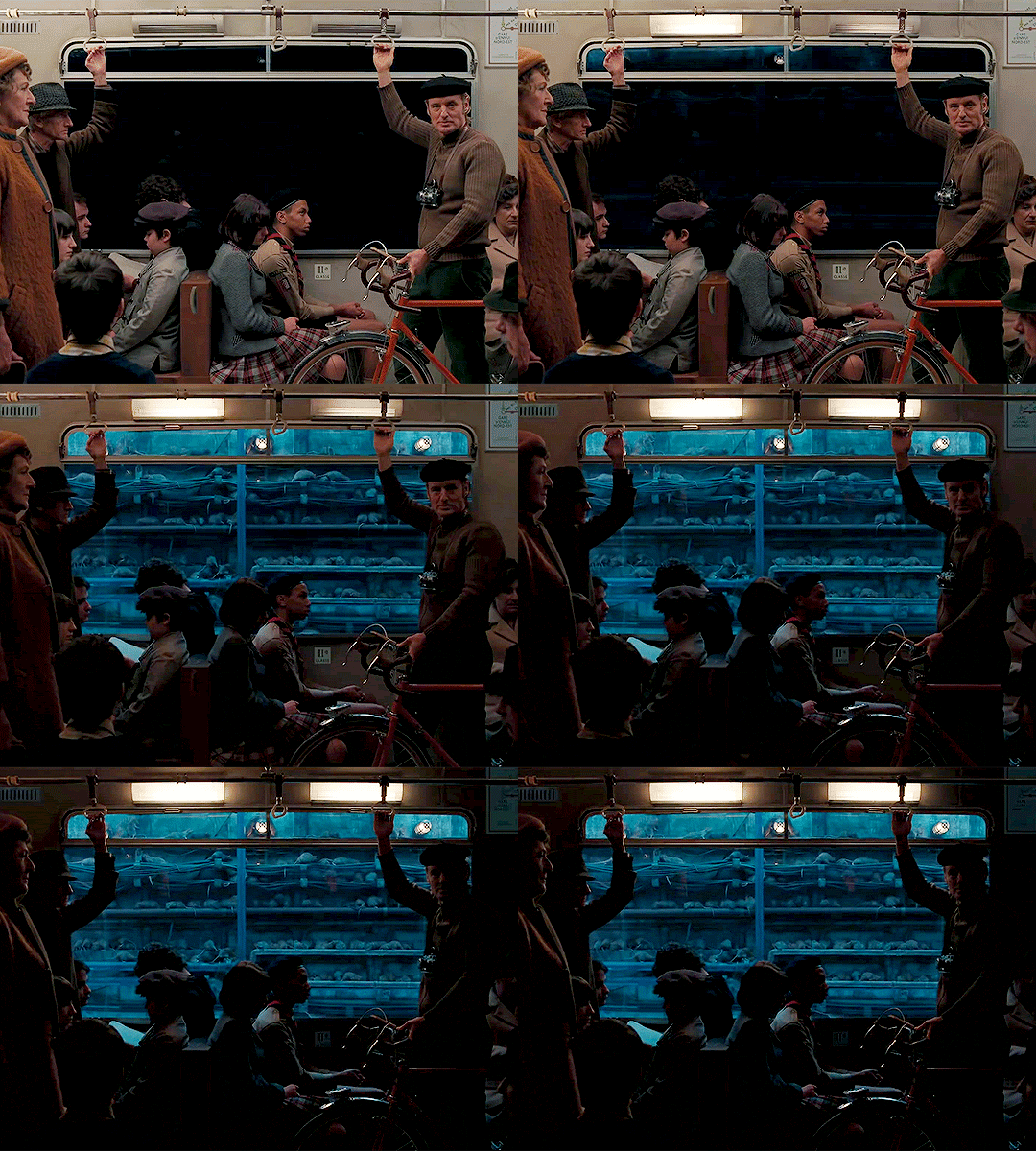
Next is a tour of Ennui-sur-Blasé with bicycling reporter Herbsaint Sazerac (Owen Wilson) who pedals about the village (often precariously) giving a guided overview of its piquant and sordid charms—for example, that it hides a vast population of vermin and scavengers (as illustrated above) and the curious statistic that 8.2 bodies are pulled from the local river every week.
The first of the stories—"The Concrete Masterpiece" tells the story of an art dealer (Adrien Brody), imprisoned for tax evasion, stumbling upon a masterwork by one of the mentally disturbed inmates, Moses Rosenthaler (Benicio Del Toro), inspired by his muse and lover (and guard) Simone (Léa Seydoux). He buys the piece and Rosenthaler becomes a sensation in the art world, but his methods are idiosyncratic to say the least and his latest work, three years in the making, proves problematic to its patron. The story is presented as a lecture by art historian J.K.L. Berenson (Tilda Swinton) and features appearances by Tony Revolori (from The Grand Budapest Hotel), Bob Balaban, Henry Winkler, and Lois Smith.
The second story is "Revisions to a Manifesto" in which a reporter/Witness to History, Lucinda Krementz (Frances McDormand) struggles with objectivity in her reporting of a youth revolt (called "The Chessboard Revolution") in Ennui, led by the charismatic Zeffirelli B. (Timothée Chalamet), who struggles with writing his manifesto—writing it in the cafe doesn't work, nor does writing it in his bathtub—and comes to rely on Lucinda to finish it.
The final story—"The Private Dining Room of the Police Commissioner"—is structured around a television interview (hosted by Liev Schreiber) with the article's author Roebuck Wright (Jeffrey Wright, no relation) who recounts the circumstances of a dining review of the exquisite meals prepared by the police lieutenant chef Nescaffier (Stephen Park) for Ennui's police commissaire (Mathieu Almaric) only to be embroiled in an investigation when the chief's son is kidnapped (by a gang that includes Edward Norton and Saoirse Ronan). It offers a chase sequence done in animation.
Still with me, there?
 
This may be the densest, most convoluted, detailed and realised of Wes Anderson's little confections, linked by his distinctive, reductive style of boxed-in, symmetrical (well, for the most part) compositions, and an acting style that would best be described as "Keaton-esque." The film zips along like a cartoon, heavily narrated and presented with layers of cascading framing devices and in a mish-mash of black-and-white and color in different aspect ratio's that have no narrative function other than to clash with the scene before it. Plus, reality is constantly challenged with animation (mentioned before), deliberate model-shots, and an extremely porous fourth-wall. The phrase I keep seeing in reviews is it's "the most Wes Anderson movie of his movies."
Of course it is. Even as he's stealing tricks and homages from shot-to-shot (but not for very long). It IS "The Most Wes Anderson Movie Of His Movies."
 
But not necessarily in a bad way.
You don't get lost, even when the director takes you down so many rabbit-holes your eyes might pop out of your head and your brain starts to take on a misty quality. Nor is one ever bored—unless one is so churlish as to ask "What's the point?" The film clocks in at an hour, forty-eight minutes and is so crammed with...."stuff"...that boredom seems impossible. Synaptic hemorrhaging, maybe, and a lot of such "stuff" is going to go right over your head, but it's so filled with detail—such as writerly nuance—that one can just absorb the layer of adjectival meticulousness until the next funny-bone prod comes along.
Call it a soufflé, if you will, filled with different textures and flavors, that might not be recognized as one is gorging on it, but might pop up with recognition when contemplated as a grand meal.

Tuesday, February 2, 2016

Hitchcock/Truffaut

Master Class
or
Tremble With Fear/Quiver with Love

I've done a LOT of writing about Alfred Hitchcock. I've seen all of the movies that anyone could see (the remaining ones from the silent era, if completed, may show up smoking in a warehouse somewhere) and written about them extensively.

So, I've been very much anticipating Kent Jones' documentary about one of the "bibles" of film makers and scholars, Francois Truffaut's "Hitchcock/Truffaut," which was published in 1966. It was the result of Truffaut's week-long interview with the director in 1962, and featured analyses of each film focusing on major themes and craft and was liberally illustrated with screen-shots of the films, sometimes even showing Hitchcock's elaborate cutting schemes for key sequences. At the time of the interview, Truffaut was 30 years old and had made three films. Hitchcock was 63 and would only make three more films. One was just starting his career and the other winding down, and Truffaut's intent was to do a scholarly work to rescue Hitchcock from a reputation as a brand-name creator of popular entertainment and show him to be a film artist of the highest caliber. And to shame American film critics for neglecting what they had right under their noses.


I bought my copy in 1974 at the University Book Store in Seattle, which had a good, if sparse, film section at the time—if a new book hit the shelves, it was immediately noticed. I still have it, now yellowed and a little brittle, scuffed and dog-eared. And it is one of the few books that I've carried through moves and marriages. It is indispensible. I've also listened to the interviews—they're available online—and have been amused at where the translation fails and where the measured script of the text in Truffaut's book does not show the moods of Hitchcock during the process—mostly engaged, sometimes sad, at times peeved, sometimes bored or perplexed where Truffaut was going with questions and analyses. Also, like outtakes, it's interesting (and sometimes telling) what was left out.
The book of the films is now a film of the book of the films, with film scholar Kent Jones' Hitchcock/Truffaut, which is a good primer on the book and does a nice job of collating interviews with many prominent film-makers about the influence the book had on their understanding of film (via Hitchcock) and their subsequent careers—Wes Anderson says his copy is now just a stack of pages held together with a rubber band. The film is a nice collage of remembrances by Truffaut, snippets of the interview itself, augmented by generous segments of illustrative film and a large dose of talking white guys weighing in on their own theories, some of which might be valid, but usually revealing more about the theorist than the subject.
James Gray says that there is no reverse angle on this shot, because the most
important elements from the observer's POV is the curl in the woman's hair
in real life and the painting.
As I said, I was anticipating this one and looking forward to it with great enthusiasm.

In fact, probably too much. It might be fascinating if you've never heard of the book or knew that it existed, and it's a nice little distillation of Hitchcock's career (as well as Truffaut's) and touches on the major themes that influenced The Master—his Catholicism, his exploitation of fears, use of color and architecture, the delicacy in finding the most illustrative and emotive angle (no matter what the actor was doing, acting) and matching it with the next, his dependence on film craft to the forsaking of performance and its nuances, and his focus on the audience and how they would respond in the acting of seeing and reacting.

Peter Bogdanovich says that on this shot, audiences could no longer be complacent
and "going to the cinema became dangerous,"

There's a lovely little section of tape where Hitchcock explains why "logic is dull," which is tied up with his artist's desire to surprise his audience, to one-up their sophistication of "I know what will happen next..." "My reply should be "Do you?" The puckish contempt in Hitchcock's voice at that point is lovely.

Moments like that made it worth seeing, but I found it slim. A highlights reel with extra emphasis in the later stages on Vertigo and Psycho, masterpieces of one sort or the other, as high art or manipulation—with Hitchcock, the two were part and parcel (it's just that he was so singularly GOOD at it). A digest for mass-audiences to absorb easily and without offense.
Gray considers this "the most important shot in motion picture history."
Don't get me wrong, it is good that it was made. Hitchcock, with his daughter Pat out of commission to protect his reputation, has taken quite some hits lately, mostly on the gossipy side, with attempts to tarnish and sully in broad strokes in mass entertainment (his favorite weapon). It was about time somebody came out and said "you can speculate all you want about the man, but look what he produced." There was a stringent discipline there in technique, a precision in craft. That he produced them out of his recognition of his frailties and being so attuned to them is rather amazing. For a man who exploited his own fears, he was, in many ways, quite fearless in using them.
I should face it, I wouldn't be happy unless there was a 12-part series, along the lines of "Cosmos," going over Hitchcock's career. He did, after all, create his own filmic Universe and attuned us to its idiosyncracies and peculiarities. He was a great communicator, sharing our knowledge and taking advantage of it. He was also (and this isn't mentioned in the movie except in example) just fun. Inventive to the extreme (and when some claim "typical Hitchcock" to his movies, they're not saying that it's atypically more sophisticated than most film technique), with an eye toward humor even in the worst circumstances, even a "bad" Hitchcock film is a jolly ride, even when it invites us to stare into the abyss. Even though the term "thriller" evokes a generic response, the films of Hitchcock still thrill, either by content or technique, which ever suits your fancy. 
James S. Wilson thinks this shot is emblematic of Hitchcock's innate desire
to satisfy audience's requirements in entertainment (half-jokingly)

Thursday, November 5, 2015

The Craig's: Quantum of Solace

Cutting to the Chase
or
"Once More into the Cuisinart, Dear Friends"


When last we left James Bond, newly double-0'd agent On Her Majesty's Secret Service, he was nursing a broken heart and the betrayal by his lover, by the one way that he knew to ease the pain—shooting someone in the leg with an assault rifle.

After the success of
Casino Royale, the last complete James Bond novel not to be given an "official" film version, and the revival of the franchise with the casting of Daniel Craig, one had to wonder what the producers would do for an encore.


Or a sequel.
Quantum of Solace* takes place 30 minutes after the ending of Casino Royale, (in mid-car-chase) with Bond going "rogue" and seeking revenge.**
It's the first "true" sequel in the Bond series--all of them previously being stand-alone stories, where for budgetary or scheduling reasons, the secondary characters (like CIA agent Felix Leiter) would be played by different people from movie to movie.
Here, things are consistent: Jeffrey Wright again plays Leiter, Giancarlo Giannini returns as Rene Mathis as does Judi Dench as "M." And the mysterious Mr. White (Jesper Christensen), behind so much of Bond's troubles last film is in the rather bumpy custody of MI6, where he drops the news that there's a world-wide criminal organization that the Brits aren't even aware of, presumably the one financing the bombing of the Skyway jet, the funding of "freedom fighters," and high stakes poker games from the last film. Apparently these activities are so "under the radar" that the world's network of spies—and in this film even Bolivia has a Secret Service—hasn't noticed. But that is just a wild goose chase to Bond achieving that quantum of solace about the events of Casino Royale.
One could go on and on with the trivial aspects of QOS, but in broad strokes, one can answer the entreaties of those who couldn't wait for the next installment last time. No, it isn't as good as the last one; Casino Royale was one of the best film in the series (this is No. 22 of the "official" Bond films), even after the perspective of a couple years.

Does Bond find out the answers to the questions he's seeking? Yeah, for all the good it does us. We spend 95% going down a blind alley--at 90 miles an hour, with a shaking camera pointed aimlessly and an average edit length of half a second. More on that in a moment.

Does Daniel Craig take off his shirt? Yes, all too briefly for some, I'm sure.
The dialog is crisp and also very, very brief. The acting is uniformly good, with particular mention of Craig, Dench, and Giannini. Even the "Bond girls," traditionally where the Bond films fall down in the presentation category, can act: former model Olga Kurylenko is quite good, using a cat-walk scowl as the basis of her performance; and Gemma Arterton is pert, spunky...and sadly disposable. Mathieu Amalric--so good in The Diving Bell and the Butterfly--makes the most of his reptilian looks, as a sort of bug-eyed Roman Polanski.***
All well and good. The film feels like a less goofy version of the Roger Moore Bonds where outlandishness is the order of the day, but without the obvious winking. There are some lighter moments (and Craig makes the most of them) but most of it is played with deadly earnest. One expects to get lost in some details along the way by the orange light of the explosions. Indeed, two of the major players in this film are brought up and never mentioned again.****
But there is a major problem with Quantum... which dims the viewing experience, that being the slap-dash way that director Marc Forster and his second unit director Dan Bradley (who stunt coordinated the "Bourne" and last couple "Spiderman" movies) have staged and assembled the action sequences--and there are a lot of them--on land, sea, air, and fire, by foot and all manner of motorized vehicles. These sequences are nearly incomprehensible, with a rapid pace that does not allow the distinguishing of any participant or the context in which they're being done. A good action director allows the time to register surroundings and environment, and provides the context of relationship--who's doing what to whom and where. It's that information that provides suspense. Without that information, it's just fleeting images that don't add up—in other words, a trailer. 
What Forster and Bradley may be trying to do is put the audience in the same dizzying, disoriented position as Bond, but even then, there are times when there isn't enough context to inspire alarm. At one point, in one of the hand to hand fights it becomes apparent that, suddenly, one of the combatants has acquired an axe. There was just enough time for me to register that perhaps the film would be better if it were edited with that. The shame is that a lot of work went into these sequences--QOS is the most expensive Bond film while simultaneously being the shortest--and a couple of marvelous shots that literally tumble along with Bond merely disorient, rather than thrill, as you're not allowed to see the original position from where these shots start. At the end of it all, you're left with a battered Bond but absolutely no idea how he got that way.
This is a major mis-step. These are suspense films, after all. But in pushing the envelope of how fast to take these action sequences, post-Bourne, the film-makers have reached the point where they are no longer telling a story, no longer communicating with the audience, at which point they've failed in their own mission.

I'm not even sure what is to be gained by seeing Quantum of Solace in a theater, even in the back row. The best way to get anything out of the action is to watch it at a slower speed on DVD.

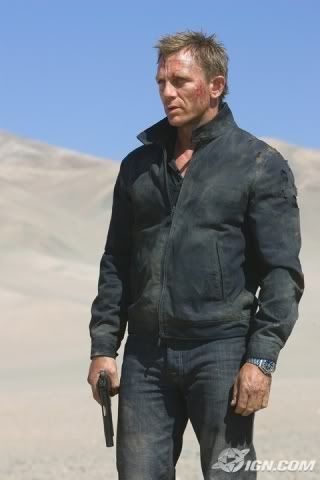
Two of examples of the subliminal editing style of Quantum of Solace.


* The name is taken from a Fleming Bond short story in which Bond merely sits and listens to a tale of a marriage turned ruinous, and a "quantum of solace" is the smallest particle of comfort one can derive to keep it going. The only Bond titles left to be used are "Risico," "The Property of a Lady," "The Hildebrand Rarity," and "James Bond in New York," none of which is a "grabber" of a title, or would make a good song-title. But then, who thought you could do anything with Thunderball? Passing a reader-board for another theater en route to the Cinerama, it read simply "007."

** "What, he's gone 'rogue' again?" is what a friend said after seeing the trailer. Bond had already done something similar in the Timothy Dalton-starring Licence To Kill, which combined equal parts "Miami Vice," Yojimbo, and elements of the Fleming novel, "Live and Let Die."'

*** Director Marc Forster used directors Guillermo del Toro and Robert Rodriguez as voice-actors on this film, and the "director" connection applies to a henchman called "Elvis" who reminds one a bit of Quentin Tarantino. What with the "colorful" names of the villains, ala Reservoir Dogs and the producers' history with Tarantino—he famously announced to whatever ubiquitous press agency he uses that he wanted to make "Casino Royale" with Pierce Brosnan and griped about not getting the chance—it wouldn't be too far afield to think the Broccoli kids were getting annoyed with his whining enough to tweak him a bit.


**** I've since been told by one of the "Opening Night Regulars" I see the Bond's with, that a sequence resolving their stories (all one minute of it) was left on the cutting room floor, giving the producers a chance to start afresh next film, rather than continue with yet another sequel.
A still from the "lost" Quantum of Solace sequence.

Saturday, April 5, 2014

The Grand Budapest Hotel

The Art of Artifice
or
"Faint Glimmers of Civilization in This Barbaric Slaughterhouse That Was Once Known as Humanity"

Wes Anderson's latest film, The Grand Budapest Hotel, takes him out of the contemporary U.S. (as was a visit to India in The Darjeeling Limited) and into pre-war Europe. But, just as Woody Allen's European adventures still feel like transplanted versions of his New York films, despite the change in venue, this one lies squarely in Andersonville.

The framing device is like a set of Matryoshka dolls (which, in turn, are shot in different screen aspect ratios as are illustrated below—a movie version of "nesting"): in the present day, we see the statue of a famous writer, then a filmed address by said writer (played here by Tom Wilkinson), who introduces the tale of how he (in the form of Jude Law) heard the tale originally: on a stay at the relic of a once luxurious hotel and spa for the rich, The Grand Budapest in the Republic of Zubrowka, he meets its reclusive owner, one Zero Moustafa (F. Murray Abraham), who, for some reason, habitually stays in the one closet-like room reserved for lobby boys. The man is monied, propertied, so what possible reason could there be for such a humble practice?

Over a long dinner in the Grand's nearly empty dining room, Moustafa tells the writer of the heady days of the Grand, pre-War in 1932, when he first arrived and took a position as a lobby boy under the tutelage of Monsieur Gustave H. (Ralph Fiennes, who takes the role between his teeth and wrestles it like a beloved chew-toy), the long-in-standing concierge of the Grand, whose adherence to societal protocol and near-psychic attendance to his guests' needs belies a roué's cynicism and a melancholic (almost necrophiliac) nostalgia for the past. The Grand's hoity-toity love him as he is unfailingly solicitous, calling everyone "darling," and because he will personally see to their whims and desires, even their carnal ones.

But, when one of his "ladies" (with the improbable name of Madame Desgoffe-und-Taxis, played by Tilda Swinton) is found dead after her visit to The GBH, Msr. H. is suspected of murder (a very slow one, evidently). He is accused (by the Madame's son, Dimitri, played by Adrien Brody) arrested and thrown into prison, which then throws the Hotel into disarray. It's a conspiracy of sorts, and it is up to the young lobby-boy to make it right. One does, after all, have to anticipate one's needs in hotelry.

Present Day: The Telling of the Telling of the Tale
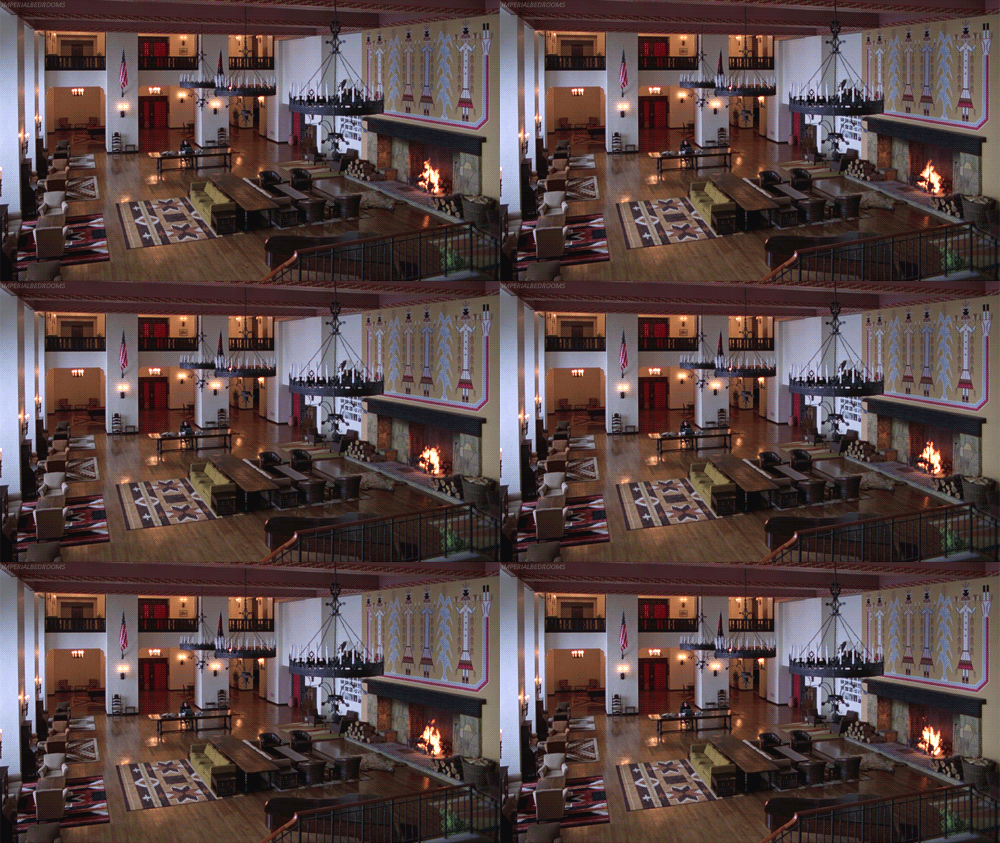
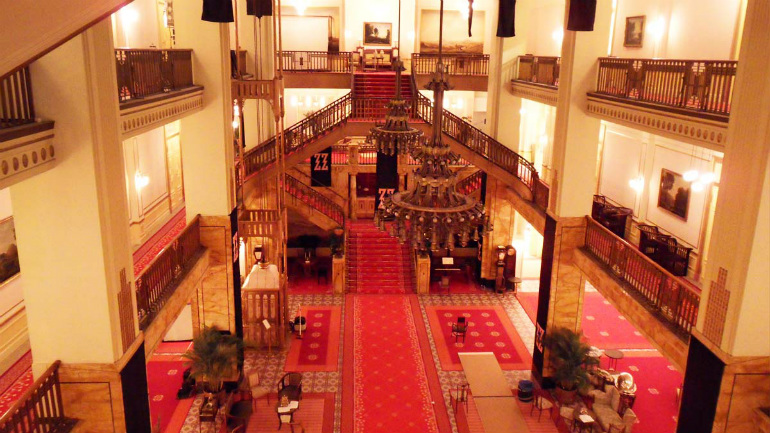
It's very fine (and fun) how Anderson takes us back in time, visually, without having to rely on a long "word-crawl," explaining who, what, where, when and how, but, instead taking us back in time (and scope) to present his world of large halls (that remind one of The Overlook in The Shining) and tiny details that are presented in life-size and miniature, 30 frames a second and stop-motion. It's not supposed to be real. It's supposed to be quaint, in a fairly demented way. And he's aided and abetted by his all-star cast, made up of a top tier of new faces with a taste for quirk, and cameos by the ever-loyal (and growing) Anderson stock company (Owen Wilson, Jason Schwartzman, Bill Murray, Willem Dafoe, Edward Norton, Bob Balaban, Jeff Goldblum).
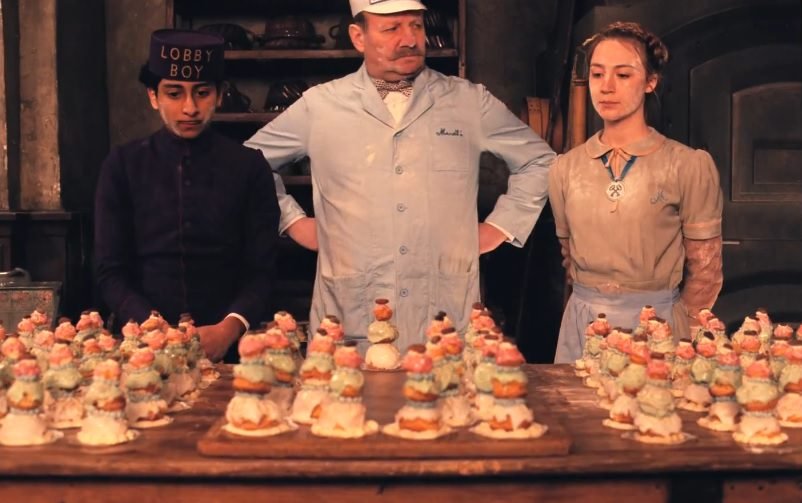
The word for this movie is "confection," more so than any other of Anderson's films, which have always carried an air of preciousness to them; for example, much is made of a certain baker's in Zubrowka, by the name of Mendl's, makers of intricate desserts in perfect little boxes that open at the pulling of a ribbon. Anderson's film has the same intricacy and fragility as those desserts (and one can't help looking at Anderson's framing as "little boxes"), but is played at such a savage and swift pace at times, it dares itself to fly off the rails, as if all that planning and detail was meant to be merely thrown in one's face for a laugh, like a carefully sculpted pie.

1968: The Telling of the Tale
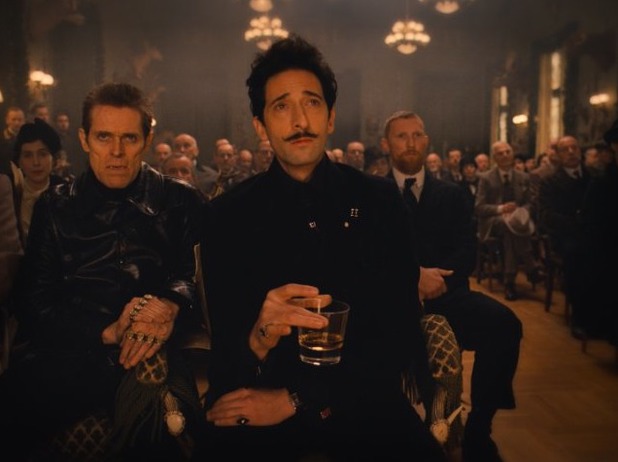
It never does topple, perhaps due to Anderson's now-customary one-point perspective framing, so controlled as to be mirthful in its own right. His elaborate right angle cross-cutting—at one point, in the 1968 sequence, he shows four different angles on the elder Zero Moustafa, north, south, east and west between shots of him being discussed—is focused so as to not jar the eye-line from shot to shot. That's some careful visual architecture working there. In fact, some of the fastest cutting and movement in the film is done with those strictly balanced shots, as if willing itself, by energy, to turn into a rudimentary 3-D film. Or a particularly aggressive cartoon.
1932: The Tale
It is precious, but not in the slow, self-satisfied way that Anderson's early films have often been, but snappily, stylishly, as if in a blur, like a passing fancy or a former way of life, run over by happenstance and the future's inexorable pace. The Grand Budapest Hotel waves a customary handkerchief as it passes by, but passes, nonetheless, blithely, chirpily, and entertainingly, zipping away with a fading laugh.