Showing posts with label Steve Park. Show all posts

Thursday, May 19, 2022

Morning Glory (2010)

Roger Michell died last year at the age of 65, before his latest film The Duke was released. It is out now and I recommend seeing it, especially in a theater, where it will do the most good. Michell's most popular film is probably Notting Hill, but he also made The Mother and Enduring Love (for you Daniel Craig fans), and Hyde Park on Hudson (with Bill Murray as Franklin Roosevelt). To sum up, he made movies that are usually placed in "art-houses" where films of a limited budget and less than frivolous subject matter, unsullied by hyperbolic press and saturation campaigns go to die...and merit consideration during Awards Season, where sometimes their fortunes are favored, but mostly forgotten. And he was darned good at it. 
 
This was written at the time of the film's release.
 
"You're Gon-na Make it After Alllll"*
or
"Will Someone Tell Me Why I Logged Off 'BangingGrannies.com' For This?"

Talk about quick turn-around. Plucky news-producer Becky Fuller (Rachel McAdams) has just rebounded from being fired from her New Jersey TV station to being hired to produce an in-the-ratings-dumper morning news-klatsch in New York City. The stipulation from boss Jerry Barnes (Jeff Goldblum, whose height advantage over McAdams is used to very good advantage) is that she has to turn the ratings around on the clunker or the venerable TV-institution called "DayBreak" will be cancelled.

But who wants to work in an institution?
The place is a televised mad-house. Goofy weatherman, clueless reporters,
a perv' anchor (he delivers the second headline above), and the Nurse Ratched of the place is the veteran house-mother-anchor (Diane Keaton) who views Becky as just one more producer for a show that's "a revolving door for cretinous morons." She's seen 'em come and go, while she's been "pulling the train up the hill (...with my TEETH!)" for fourteen years. "DayBreak" needs to be fixed.

Becky starts to shake things up, and her first job is to find an anchor a little less orange.
She goes the credibility route and seeks out Mike Pomeroy (Harrison Ford, who hasn't done this much mugging since Return of the Jedi**), a veteran news-man (he lunches with Chris Matthews, Bob Schieffer, and Morley Safer), grumpily living out his golden parachute contract, and has no desire to lower his standards working on a show with "half an audience who've lost the remote, and the other half are waiting for the nurse to turn them over." 
Warned that he is "the third-worst person in the world...after
Kim Jong-Il and Angela Lansbury" by the movie's obligatory boy-friend (Patrick Wilson...slumming***), Becky finds a loop-hole in his contract and forces the pro to "lower his standards," but raise the bar on passive-aggressive behavior (he refuses to "banter, from the Latin word for 'gibber like a moron'")...as if the show needed any more of that. Pretty soon, every surface at the station has Becky-forehead-sized dents from her beating herself into them—that and her seeming incapacity to open doors are the two consistent jokes of which no opportunity is passed.

It's got the TV-industry cynicism down, but raised to the bitchy level of the fashion industry (the writer, Aline Brosh McKenna, also wrote The Devil Wears Prada, ...and 27 Dresses , and Laws of Attraction, and Three to Tango...so this is the first movie of hers I haven't actively avoided...although I did see Prada, and admired it). Director Roger Michell can do rom-com fine (Notting Hill), but he's capable of doing better stuff, and he keeps everything lively and semi-sunny, despite the rampant cruelty tossed around like so much unnecessary paper-shuffling on a news-desk. But, he can't do much with the cliched material, from the "meet cute" to the "slo-mo run through new York." 

Morning Glory is okay, but it breaks no boundaries (or news, for all that), it's another "working girl" comedy in the revolving door of them.

* Cue the hat-throw. Give credit where credit is due: I didn't notice this was basically "The Mary Tyler Moore Show" (and a two-hour stretch of the half-hour pilot, at that) until Ford's crusty news vet says to the young producer "You have a repellent moxie" in the same way that Ed Asner's Lou Grant said "You've got spunk....I HATE spunk!"  Where's Betty White when you need her?

** ...which makes me think something is wrong.  Ford is the master of the subtle slow-burn comic performance, but this one is at a hard-boil. His lines delivered in a husky, phlegmatic drone, you start to wonder if Ford—like his character—just isn't happy to be there (y'know, like his narration in BladeRunner?). Then, he manages to take what should have been the movie's worst scene, and make it shine, giving it depth, resonance and heart...while still not betraying his character. Nice work.

*** Yeah, but on the other hand, I've felt so sorry for so many good actresses playing "the girlfriend" over the years, this is one for equal opportunity. 

Friday, November 5, 2021

The French Dispatch

"Just Try To Make It Sound Like You Wrote It That Way on Purpose"
or
The Good and the Adject-Evil (Not Necessarily in a Bad Way)
 
Wes Anderson's new little chocolate toy-box of a movie is The French Dispatch (of the Liberty Kansas Evening Sun)—written with Roman Coppola, Jason Schwartzman, and Hugo Guinness—centered around the arty-little adjunct magazine that resulted when the son of the editor of Liberty Kansas Evening Sun, Arthur Howitzer, Jr. (played by Bill Murray) spent an extended holiday in the French village of Ennui-sur-Blasé and never returned home, instead creating an supplement for Dad's paper—"a factual report on the subject of world politics, the arts, high and low, and diverse stories of human interest."
 
Already, the town's name had me giggling, as not only is it a hilarious name for a burg (especially in France), but it also is the perfect site (and attitude) from which writers could concoct articles in a "New Yorker frame of mind". The movie centers around that magazine on its final issue of publication, pursuant to the wishes of the editor upon his death, that it cease and all of its assets liquidated. Thus, it consists of "an obituary, a travel guide, and three short articles" that have been culled from the magazine's past.
The obituary is, of course, Howitzer's, and it is inextricably tied to the magazine's history with no future—and reassuring subscribers that they will be refunded for the remaining issues that will not be forthcoming.
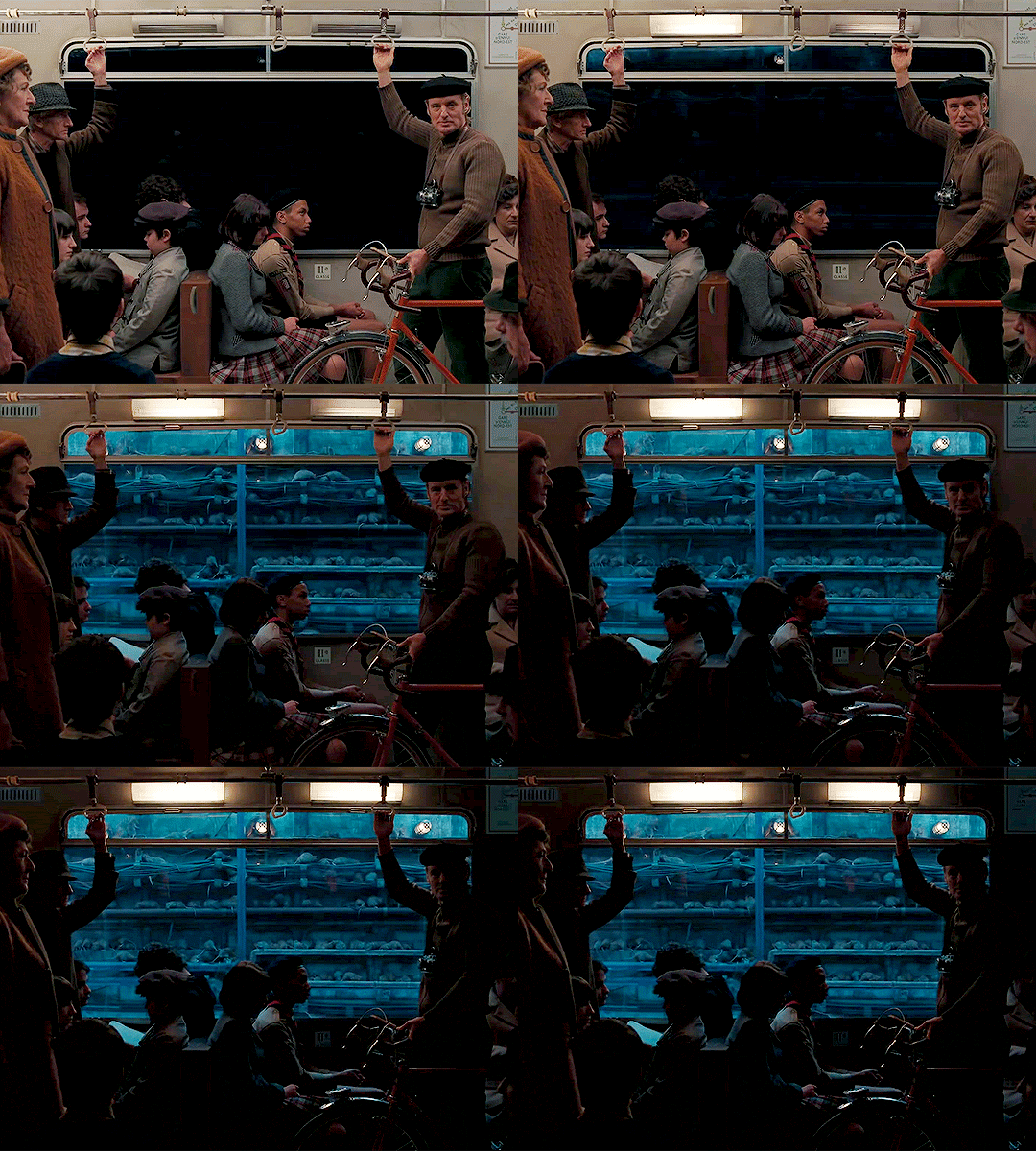
Next is a tour of Ennui-sur-Blasé with bicycling reporter Herbsaint Sazerac (Owen Wilson) who pedals about the village (often precariously) giving a guided overview of its piquant and sordid charms—for example, that it hides a vast population of vermin and scavengers (as illustrated above) and the curious statistic that 8.2 bodies are pulled from the local river every week.
The first of the stories—"The Concrete Masterpiece" tells the story of an art dealer (Adrien Brody), imprisoned for tax evasion, stumbling upon a masterwork by one of the mentally disturbed inmates, Moses Rosenthaler (Benicio Del Toro), inspired by his muse and lover (and guard) Simone (Léa Seydoux). He buys the piece and Rosenthaler becomes a sensation in the art world, but his methods are idiosyncratic to say the least and his latest work, three years in the making, proves problematic to its patron. The story is presented as a lecture by art historian J.K.L. Berenson (Tilda Swinton) and features appearances by Tony Revolori (from The Grand Budapest Hotel), Bob Balaban, Henry Winkler, and Lois Smith.
The second story is "Revisions to a Manifesto" in which a reporter/Witness to History, Lucinda Krementz (Frances McDormand) struggles with objectivity in her reporting of a youth revolt (called "The Chessboard Revolution") in Ennui, led by the charismatic Zeffirelli B. (Timothée Chalamet), who struggles with writing his manifesto—writing it in the cafe doesn't work, nor does writing it in his bathtub—and comes to rely on Lucinda to finish it.
The final story—"The Private Dining Room of the Police Commissioner"—is structured around a television interview (hosted by Liev Schreiber) with the article's author Roebuck Wright (Jeffrey Wright, no relation) who recounts the circumstances of a dining review of the exquisite meals prepared by the police lieutenant chef Nescaffier (Stephen Park) for Ennui's police commissaire (Mathieu Almaric) only to be embroiled in an investigation when the chief's son is kidnapped (by a gang that includes Edward Norton and Saoirse Ronan). It offers a chase sequence done in animation.
Still with me, there?
 
This may be the densest, most convoluted, detailed and realised of Wes Anderson's little confections, linked by his distinctive, reductive style of boxed-in, symmetrical (well, for the most part) compositions, and an acting style that would best be described as "Keaton-esque." The film zips along like a cartoon, heavily narrated and presented with layers of cascading framing devices and in a mish-mash of black-and-white and color in different aspect ratio's that have no narrative function other than to clash with the scene before it. Plus, reality is constantly challenged with animation (mentioned before), deliberate model-shots, and an extremely porous fourth-wall. The phrase I keep seeing in reviews is it's "the most Wes Anderson movie of his movies."
Of course it is. Even as he's stealing tricks and homages from shot-to-shot (but not for very long). It IS "The Most Wes Anderson Movie Of His Movies."
 
But not necessarily in a bad way.
You don't get lost, even when the director takes you down so many rabbit-holes your eyes might pop out of your head and your brain starts to take on a misty quality. Nor is one ever bored—unless one is so churlish as to ask "What's the point?" The film clocks in at an hour, forty-eight minutes and is so crammed with...."stuff"...that boredom seems impossible. Synaptic hemorrhaging, maybe, and a lot of such "stuff" is going to go right over your head, but it's so filled with detail—such as writerly nuance—that one can just absorb the layer of adjectival meticulousness until the next funny-bone prod comes along.
Call it a soufflé, if you will, filled with different textures and flavors, that might not be recognized as one is gorging on it, but might pop up with recognition when contemplated as a grand meal.