Showing posts with label Jason Miller. Show all posts

Saturday, October 15, 2022

The Ninth Configuration

The Ninth Configuration
(aka Twinkle, Twinkle, "Killer" Kane) (
William Peter Blatty, 1980) Blatty started out his colorful career as a writer—turning out "John Goldfarb, Please Come Home!", "I, Billy Shakespeare", and the first version of this story ("Twinkle, Twinkle, 'Killer' Kane!") before turning to screenwriting for films with Blake Edwards and others. He went back to novels after flirting with Hollywood, and his first, "The Exorcist" became a best-selling phenomenon, and the resulting film, which was the first horror film to be nominated for a Best Picture Oscar, won him the Best Screenplay statuette that year.
 
Blatty returned to writing, taking his 1966 "'Killer' Kane!" book and re-configuring it as "The Ninth Configuration," shopping around a screenplay for a potential film but with the caveat that he direct it. There were no takers. So, Blatty put up his own money for half the film's budget—the other half funded by Pepsi-Cola*—and Blatty began shooting in Hungary without a distribution deal.
Which is crazy. But, then, crazy is what The Ninth Configuration is about. And some of it is inspired craziness.

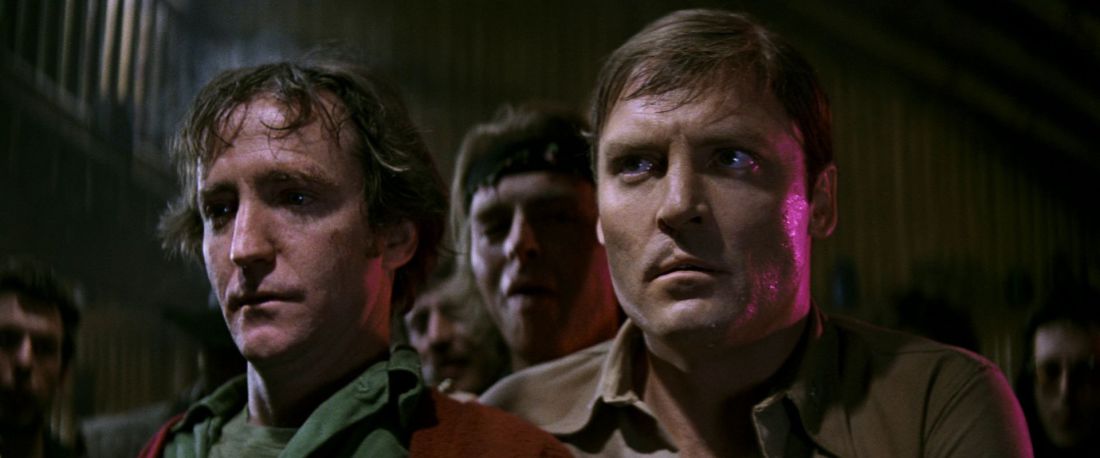
"Some time in the 1970's" Colonel Hudson Kane (Stacy Keach) is being assigned to oversee an overcrowded veteran's mental health facility in the Pacific Northwest, with the mission to determine who's genuinely insane and who's faking it to get out of service. He is informed by the acting head Col. Fell (Ed Flanders) that the patients are all eccentric. Kane knows this already; when he arrived, the first guy who claimed he was in charge was an inmate and he was pretty convincing. It's no wonder the military staff is having a hard time keeping order. But, order is just an idea that a group of people agree upon. These guys can't agree on anything.
There's Lt. Reno (
Jason Miller), who wants to put on a production of "Hamlet" but performed by dogs ("Someone has to do it!"). Maj. Nammack (Moses Gunn) thinks he's a super-hero. Then, there's Billy Cutshaw (Scott Wilson), former astronaut, who, on the way to the Moon, suffered a mental breakdown. Kane takes a particular interest in him, as Cutshaw engages him in arguments about the existence of God and who seems to really want answers and challenges Kane on his own beliefs. When Kane asks Cutshaw why he aborted his mission in space, Cutshaw merely gives hima St. Christopher medal.
Kane decides that his best strategy is to let the lunatics run the asylum, which may not be effective, but is very entertaining. Blatty has an interesting trope in his writings and The Ninth Configuration is no exception—he starts out funny, softening the audience up, and then turns deadly serious into matters that far outreach whatever set-up he has. Blatty's Configuration stretches the scenario as far as it can possibly go before it snaps. The film has divided its very niche audience for decades (a problem compounded by the various edits of the film over the years), but it has some ardent supporters among the larger film community.
It also has some fairly amazing shots, that, at times, makes you snap your head 360° with just how audacious they are (Blatty was a first-time director when he made the film) and reminds one that his later film of Exorcist III was as good as the original, and probably better. If there is a weakness, it might be in Stacy Keach's performance that was directed to tamp down any telegraphing of what was going on at the film's core. 
And there is, at the core, that theological question—why is it easier to believe in the devil because evil exists, than it is to believe in a God with the presence of so much good. That's the central theme (as in The Exorcist) and it persists here, as well, with Cutshaw challenging Kane to give an example of a purely unselfish sacrificial act to prove the point of a deity. Kane doesn't have much of a response, but his deep dive for memory may be what causes later issues.
But, there is a neatly framed argument that he gives for the existence of God:
"In order for life to have appeared spontaneously on earth, there first had to be hundreds of millions of protein molecules of the ninth configuration. But given the size of the planet Earth, do you know how long it would have taken for just one of these protein molecules to appear entirely by chance? Roughly ten to the two hundred and forty-third power billions of years. And I find that far, far more fantastic than simply believing in God."
Blatty may be fudging on the numbers, there—it's something to ask Neil de Grasse Tyson—but it's an interesting argument, even with an infinite amount of space. It's certainly easier than getting dogs to play Shakespeare...or monkeys to write it.


* Pepsi had funds in Europe that could not leave the country of Hungary, so the filming took place in Budapest, rather than the location stipulated in the Pacific Northwest.

Thursday, October 20, 2016

The Exorcist III

The Exorcist III (aka Legion) (William Peter Blatty, 1990) An odd little experiment in horror, more compelling than William Friedkin's chest-thumping original,* with more humor—Blatty had, previously in his career, written some quite funny scripts for Blake Edwards in the 1960's—and some genuinely unnerving moments that may not make one jump out of one's seat (well, one thing will), but will certainly creep one out.

It begins with a little bit of catch-up and two fine actors who did not appear as these characters in the original Exorcist—but probably should have. Lieutenant Kinderman (
George C. Scott) is meeting up with old friend Father Dyer (Ed Flanders). It has been 15 years since the events of the original Exorcist, and the two men have had a steady friendship with shared lunches and grousing about their work-lives—Scott and Flanders are so good that they milk laughs out of lines that are as dry as a dessicated bone. When we see them, they're both trying to cheer each other up, remembering their mutual friend, Father Damian Karras (Jason Miller) on the anniversary of his death, sacrificing himself in the act of an exorcism. 

It's an off-kilter, unnerving way to start a horror movie, a little bit like starting a corporate speech by laying off your employees with a joke. And that odd humor occurs often, with stray one-liners and the bizarre visual touch, sometimes lurched into the foreground, sometimes folded into the cracks of a frame. It walks arm and arm with Blatty's atmospherics of weighted...pauses in conversations, shifting shadows, slight zephyrs of wind, and the occasional breath of laughter. Odd and unnerving are the two words that best describe The Exorcist III.
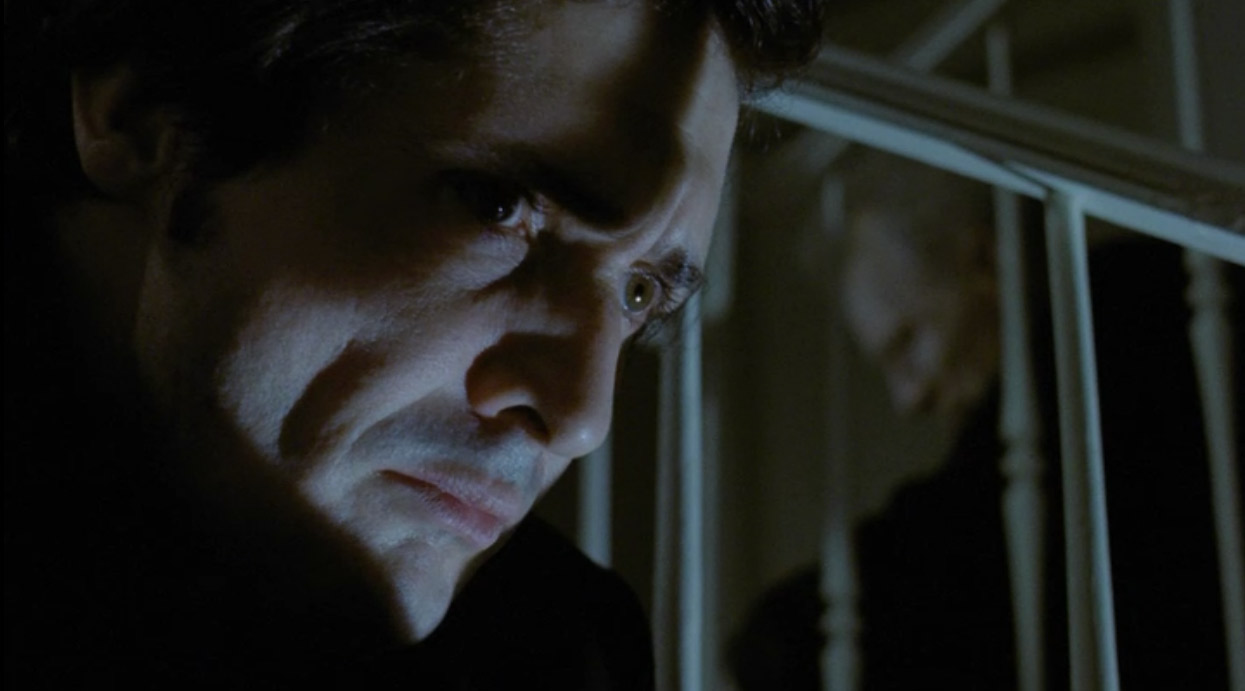
Kinderman is investigating a bizarre series of murders that have ties to the exorcism of Regan McNeil, and that bear the un-publicized M.O. of "The Gemini Killer," who had been executed 15 years before. As if that wasn't bizarre enough, the murderer leaves behind a different set of finger-prints at each murder scene. There is more than one killer with secret knowledge, and the investigation soon zeroes in on Georgetown's Catholic hospital, where in the bowels of the psych ward sits a chained amnesiac, named "Patient X," found wandering aimlessly 15 years before. When Kinderman's investigation takes him to this room, he finds the form of his friend, Fr. Damian Karras.
What is Karras doing there, and why? Kinderman soon finds that he's not just talking to Karras, but also the form the "Gemini," who to serve his "patron" exacted revenge on Karras by taking over his body and, now, with consciousness regained, the "Gemini" prowls the hospital looking for new hosts and new victims. 
It sounds absurd, utterly bonkers when relaying it in outline, but one cannot deny how effectively all this plays on the screen. What makes the film work is Blatty's assured direction, his devilish (if you will) humor and the total commitment of all the actors to the film and grounding it in some filmic reality. If you're going to believe in the spirit-world (as The Exorcist certainly does), you've got to wonder what happens when even a bound devil takes the gloves off and takes advantage of a truly evil spirit. Bonkers, yes, but not the way Blatty plays it.
The film was compromised somewhat by the studio's insistence that there be an actual exorcism (by Nicol Williamson's cameo priest), thereby muddling up the finale, but the film up to then is disquieting and in a far less bluntly hammering way than Friedkin's head-spinning original. Blatty's direction makes you not trust the film, and to be wary of what awaits on the other side of every edit he makes (and just when you think you have his pattern figured out, he will do something different).
He's not afraid to harness Scott's penchant for untethered behavior in his performances, but the kudo's for the best performance of the film belong to Brad Dourif. Quick as mercury, quirky as Hell, his performance as "Patient X" (a role shared by Miller and the voice of Colleen Dewhurst, the former Mrs. Scott), is a tour de force played mostly to the camera in long unbroken takes, with the odd touch of a tear that slides down the left side of his face, and the electronic manipulation of his voice to drop it into the lower depths. The movie starts to fall apart once Dourif departs (and when the studio-influence starts), but for most of its running time, it manages to rise above the other films in the series.


* And miles ahead of John Boorman's "sexy beast" movie, the deservedly reviled spawn of satan: The Exorcist II: The Heretic.

Saturday, October 8, 2016

Olde Review: The Exorcist

This was part of a series of reviews of the ASUW Film series back in the 1970's. Except for some punctuation, I haven't changed anything from the way it was presented, giving the kid I was back in the '70's a break. Any stray thoughts and updates I've included with the inevitable asterisked post-scripts.


The Exorcist (William Friedkin, 1973) When Ellen Burstyn was in Seattle last year, she was asked why she had chosen to star in The Exorcist. She replied by calling attention the film's first scene after the blood-red titles--the scene which is predominated by an Iraqi morning prayer. That, Ms. Burstyn said, was what she thought the film was about--a call to prayer.

Now, Ellen Burstyn struck me as being a brilliant and sensitive individual. But I'm afraid she was duped, as a lot of us were, by the writer and director of The Exorcist, and by the Warner Brothers promotion department.
 
When The Exorcist came out we were pummeled by newspaper and magazine articles on the authenticity and "religious significance" of the movie. A major "debate" erupted amongst Christian theologians about the devil's existence and the validity of the movie as a "Christian" document.
Well, in the three years since the film was released the furor has died down, so I think I can say what I'm about to say without fear of ex-communication: The Exorcist is nothing more than a horror movie. What is worse it's a horror movie with religious pretensions. This isn't to say that religious ideas can't enter into a horror movie. It can and can be done well. James Whale turned Frankenstein's Monster into a psuedo-Christ figure in The Bride of Frankenstein, and the religious or anti-religious qualities of Dracula have been dealt with very extensively in the Hammer films with Christopher Lee. But these films' religious associations were in the background of the film, or at least are cliche items with the genre so we don't notice them so much. 
They were also done by directors who knew what they were doing. William Friedkin is so hap-hazard about things in this film that he badly slips up with one of his "devices" - a medallion that keeps cropping up in the film, something Friedkin said in an interview would give his film "resonances," has since been the subject of an intelligent article that, because of the medallions' sloppy usage, sees "The Exorcist" as a marriage between Satan and the Church, exactly opposite to the film's supposed religious intentions. Hap-hazard work and a definite lack of thought on Friedkin's part are to blame.
So, The Exorcist is a horror movie with religious pretensions, not unlike 1976's The Omen. The writer of The Exorcist (William Peter Blatty) stated that the film's intention was to "waken" our dormant fear of Satan and sleeping love for God and the innate goodness of man. Instead, The Exorcist sent a number of people to mental institutions and sickened many to the point of vomiting in the theater. Blatty said that the sickness was "healthy, for the film worked on these people's guilts." Many clergymen, notably those who appeared in the film leapt to the film's defense.
One can see by this how religious pretentiousness can pile up like manure in a stable. People didn't throw up because of their sins, they threw up because the film was revolting, disgusting, and at the very least, unsubtle in its depiction of demonic possession and although one can admire the performances of the actors and the very original use of sound in the film, those are about the only things for which the film can be praised.
And looking at the film as a Catholic, I can say that the film did not make me change the belief that there is no personified evil, only the innate evil in various degrees within ourselves. But it did make me lose the belief I held since The French Connection that William Friedkin was a brilliant director.

Broadcast on KCMU-FM on January 21, 1977
Not much to add here, except to say that I am shocked, SHOCKED that Warner Bros. would try to legitimize their little puke show rather than just come out and say "We wanted to scare you so much that you'd plotz, and make a LOT of money!" The Exorcist seems tame these days. The film has had, what, four sequels? (two of them prequels, from the same source material--one from Renny Harlin after Paul Schrader's directed version was considered "not very marketable" (read "didn't have the same amount of gore, violence or queasiness-inducing stuff as in the original") and both were ultimately released to video so folks could judge for themselves, plus there was a "re-possessed" version of the original, with a minimum of new material released domestically which made $40 million) and any number of rip-off's and devil-tail riders in recent years. The immediate sequel—The Heretic—was an unintended laff-riot directed by John Boorman, and Exorcist III was written and directed by Blatty himself, and was—actually—quite good--in fact, the best of the series. All of them experienced studio interference to up the "split-pea soup factor." Christian Document. Call to prayer. Right. Pass the collection plate.
Disclosures about the pedophilic activities of priests and their cover-up by Church authorities does make it seem like there's been a marriage between the Church and Satan to me, and made me lose Faith in any organized religion. Rather than a "lapsed" Catholic, I consider myself a "recovering" Catholic. More fervor was created watching Deliver Us From Evil than The Exorcist. And not the good kind.

And Ellen Burstyn practices Sufism.

Meet the New Boss...