Showing posts with label Ellen Burstyn. Show all posts

Tuesday, April 13, 2021

The Fountain

Written at the time of the film's release...

Tapping a Dry Well

First off, this is the best-sounding film I've heard from 2006, with a subtle, supple sound design that makes great use of the stereo field to direct your attention. Secondly, it's one of the most beautiful--a truly different looking set-bound "green-screen" film that doesn't go for vast (and busy) pixilated papier-mache-feeling vistas ala Sky Captain or The Lord of the Rings. There is a perpetually claustrophobic feel to it, despite the exotic locales that extend from an ancient Mayan temple to "the vast reaches of space."

And yet....one expects great things of a Darren Aronofsky film—not just in the images, but also in the ideas. Both Pi and Requiem for a Dream were visually and thoughtfully stunning, so one wanders into The Fountain expecting to be transported to new places, not only visually and aurally, but within the mind as well.

That's why I found The Fountain very disappointing. Though trying to say something profound, it offers up an idea so obvious that it occurs to me only every time I sit down for a meal, and that is: Out of Death Comes Life. To make its point, there are three time-lines in the film: the first takes place in the present day as a researcher named Tom studies treatments of brain tumors in a frenzied race to save his wife Izzy's life. He is so bent on finding a cure that he loses all the precious moments he could be sharing with her. 
Izzy is writing a fanciful book of a Spanish explorer named Tomas (wait, wait...don't get too far ahead yet. I mean, you're right. it's that obvious, but bear with me for a couple more sentences) who invades a Mayan tribe trying to find a fountain of youth (which is actually the sap of a specific tree) for his doomed queen Isobel—the story's a sort of parallel-o-gram to the researcher to wake up and see what he's missing. 
The next time-line features an older Tom, beneficiary of his research that has found the secret of long life (which involves the bark of a certain South American tree), in space-transit to restore his wife...from a tree...by means of the energy of a star (Xibulba) that figured in the Mayan legend of the explorer...well, everything relates--all the elements fall back on themselves in a self-referential heap.
* 
All the Tom's of the film (portrayed by
Hugh Jackman) are after Eternal Life in some form or another for their Queens...but mostly for themselves, while the Isabel/Isobel's (played by Rachel Weisz) know they will never achieve it. It takes him a near-eternity to learn that life is an eternal process (only not individually!) and that death is a necessary ingredient for it. 
The only original idea in the film is to state that to aspire to immortality is, rather than overcoming death, to deny the process of life and renewal. The idea
should be profound, but it comes across as simplistic...and obvious. And dramatically inert. The tag-line for the film is "What If You Could Live Forever?" and the answer appears to be "Then You'd be a Selfish Bastard!"

Still, there is a sense of relief in, for once, seeing a film where death is the inevitable conclusion and you don't start whispering "So DIE already!" underneath your breath (curiously, part of the gorgeous sound-design has the film saying it for you...though not those exact words...frequently through the movie), but it did plant the seed of Elton John's "The Circle of Life" in my head for days for which it must be held accountable. And needless to say, The Fountain won't be at the top of the NetFlix list for the Schindler household.

The View from 2021: Aronofsky has gone on to make The Wrestler (which we'll re-post a review of tomorrow), Black Swan, Noah, and mother! and I'll still go to see any of his movies in a theater because even if he doesn't deliver on story, he does deliver on image, making him one of the more interesting film-makers working. And when he delivers on story...well, the movie will haunt you for days, maybe the rest of your lifetime. Aronofsky is one of the really good ones, even if individual movies are less than satisfying.

* The Fountain had a troubled production history. Millions of dollars were wasted in the first attempt at it (when it starred *shudder* Brad Pitt and Cate Blanchett—they would subsequently star in Babel and The Curious Case of Benjamin Button). One can only wonder if, when re-started with half its original budget, whole sections of the screen-story that might have given it depth, were ash-canned (I haven't read Aronofsky's graphic novel, which ala Neil Gaiman's "Signal to Noise" might be closer to his original vision) which is a pity. But I don't know. Aronofsky was supposedly inspired to attempt this film by The Matrix, which is just one more thing that overrated geek-flick needs to answer for.

Thursday, July 12, 2018

Olde Review: Alice Doesn't Live Here Anymore

This was part of a series of reviews of the ASUW Film series back in the '70's. Except for some punctuation, I haven't changed anything from the way it was presented, giving the kid I was back in the '70's a break. Any stray thoughts and updates I've included with the inevitable asterisked post-scripts.

Alice Doesn't Live Here Anymore (Martin Scorsese, 1974)
is Scorsese's most sedate film as far as camera movement. It lacks the restless aimlessness of Mean Streets, or the paranoid powerfulness of Taxi Driver's tracking shots--but that does not keep it from being dynamic. The power of Scorsese's camera is very much in evidence whether tracking confidently accelerating circles around Ellen Burstyn as she auditions in a bar, or as it takes on a home-movie-ish, jittery energy in a family squabble, the jitteriness due not to a home-movie-maker's inexperience, but seemingly shaken by the ferocious energies thrown out by the domestic combatants.

Scorsese is a director you should watch in the next few years, for, sooner than you think, Scorsese will direct a superb film (his next film, if you can believe this, is a post WWII musical called New York, New York--the main Scorsese stamping ground--which stars Liza Minnelli and Robert DeNiro?). It's sure to be the first musical in a long time that has an energy to itself, instead of the re-heated left-overs we've been getting from Broadway lately. Scorsese will give it that energy--a bizarre, scary energy that is an essence of the man himself. For the cameo appearances he assigns himself to--the punk-assassin who firs the last life/hope-shattering shot in Mean Streets, and that particular taxi-rider who directs Travis Bickle to a house and to a female silhouette in the window and asks him what he thinks a .38 will do to her head, are bizarre self-roles to be sure.
But enough of Scorsese. There is another creator to Alice..., its star, Ellen Burstyn, who had the tenacity to get what the producers scornfully refer to as a "women's picture" into production. And when she was in Seattle last year, she made it painfully clear that, without her, the film would have gone woefully wrong-headed in its intentions. The original ending had newly-widowed Alice Hyatt settling down to another life of house-wifely drudgery, instead of letting her continue with an uncertain, but certainly more adventurous future. Thank Ellen Burstyn for that, and thank her for the humanity she imbued in this film, not glossing it over, and bringing out very real performances from the vast majority of the cast. Her humanity, and Scorsese's power combined to make Alice Doesn't Live Here Anymore a film that not only excites, but also leads to the lesser shocks of every-day recognition.
Yeah, yeah, one of these days that Scorsese kid's gonna make a superb film (that would be, at least, Raging Bull (1980)...and another (New York, New York) wasn't bad, it was an interesting Scorsese experiment in studio film-making...and another (After Hours, his low-budget experiment) and another (The King of Comedy)...and then Taxi Driver's going to start looking like the classic that it is, and the guy won't be awarded the Oscar by the Academy of Motion Picture Arts and Sciences until he does a star-heavy re-make of a Chinese film that was inspired by one of his own films--that being The Departed—not that great a Scorsese film, but a better than average thriller.
There was no prescience here, Scorsese was—and always is—an exciting film-maker, and bull-headed enough to stick to his aggressive kind of movie-making and not compromise even during the lean times. Scorsese films never "direct themselves." You're always aware of his hand on your shoulder directing your field of view, not unlike Hitchcock. And the man keeps re-writing the film language which keeps everybody—critics and audiences alike—on their toes, and keeps the art fresh and new. If he isn't our Great Director right now, he's One of the Two,* and both men eye each other's work, influencing each other's creations, like Ford and Hawks, or The Beatles and The Byrds.

Now, if Scorsese could just lose that DeCaprio kid...
Update: With Hugo and Silence, it looked like the Scorsese/DeCaprio partnership might be over...and in his next film, The Irishman, Robert DeNiro is back. But, then the next two projects in pre-production are both DeCaprio vehicles.

*

Saturday, October 8, 2016

Olde Review: The Exorcist

This was part of a series of reviews of the ASUW Film series back in the 1970's. Except for some punctuation, I haven't changed anything from the way it was presented, giving the kid I was back in the '70's a break. Any stray thoughts and updates I've included with the inevitable asterisked post-scripts.


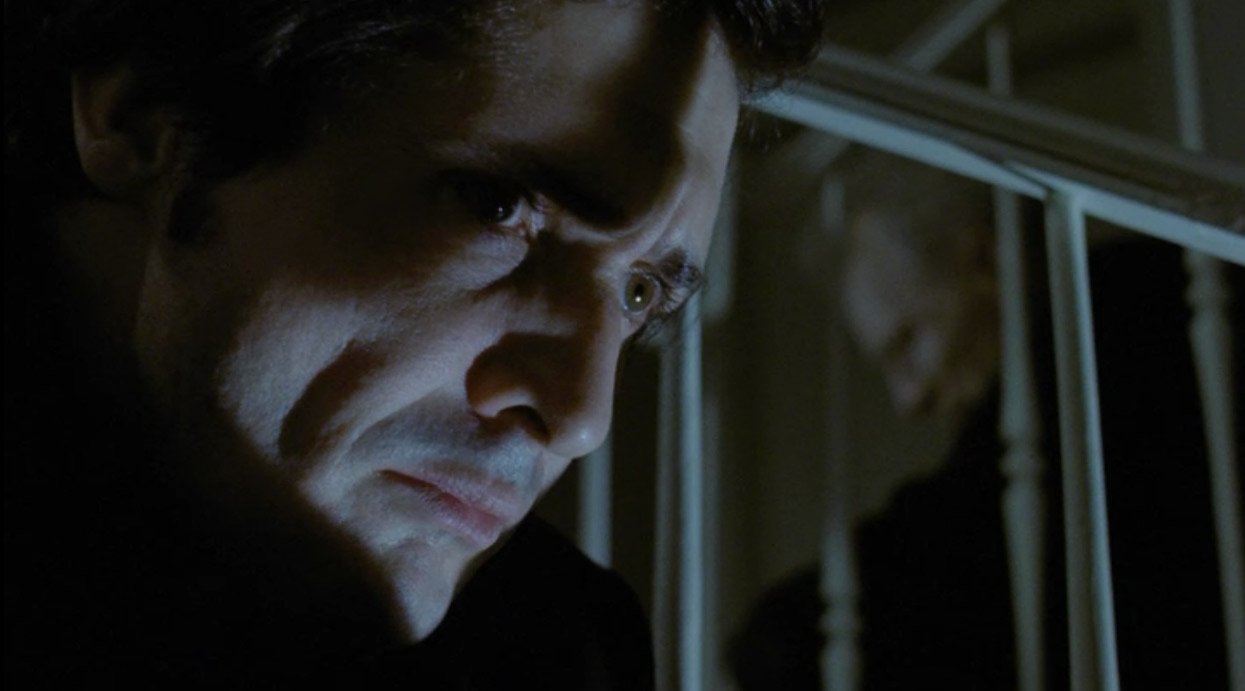
The Exorcist (William Friedkin, 1973) When Ellen Burstyn was in Seattle last year, she was asked why she had chosen to star in The Exorcist. She replied by calling attention the film's first scene after the blood-red titles--the scene which is predominated by an Iraqi morning prayer. That, Ms. Burstyn said, was what she thought the film was about--a call to prayer.

Now, Ellen Burstyn struck me as being a brilliant and sensitive individual. But I'm afraid she was duped, as a lot of us were, by the writer and director of The Exorcist, and by the Warner Brothers promotion department.
 
When The Exorcist came out we were pummeled by newspaper and magazine articles on the authenticity and "religious significance" of the movie. A major "debate" erupted amongst Christian theologians about the devil's existence and the validity of the movie as a "Christian" document.
Well, in the three years since the film was released the furor has died down, so I think I can say what I'm about to say without fear of ex-communication: The Exorcist is nothing more than a horror movie. What is worse it's a horror movie with religious pretensions. This isn't to say that religious ideas can't enter into a horror movie. It can and can be done well. James Whale turned Frankenstein's Monster into a psuedo-Christ figure in The Bride of Frankenstein, and the religious or anti-religious qualities of Dracula have been dealt with very extensively in the Hammer films with Christopher Lee. But these films' religious associations were in the background of the film, or at least are cliche items with the genre so we don't notice them so much. 
They were also done by directors who knew what they were doing. William Friedkin is so hap-hazard about things in this film that he badly slips up with one of his "devices" - a medallion that keeps cropping up in the film, something Friedkin said in an interview would give his film "resonances," has since been the subject of an intelligent article that, because of the medallions' sloppy usage, sees "The Exorcist" as a marriage between Satan and the Church, exactly opposite to the film's supposed religious intentions. Hap-hazard work and a definite lack of thought on Friedkin's part are to blame.
So, The Exorcist is a horror movie with religious pretensions, not unlike 1976's The Omen. The writer of The Exorcist (William Peter Blatty) stated that the film's intention was to "waken" our dormant fear of Satan and sleeping love for God and the innate goodness of man. Instead, The Exorcist sent a number of people to mental institutions and sickened many to the point of vomiting in the theater. Blatty said that the sickness was "healthy, for the film worked on these people's guilts." Many clergymen, notably those who appeared in the film leapt to the film's defense.
One can see by this how religious pretentiousness can pile up like manure in a stable. People didn't throw up because of their sins, they threw up because the film was revolting, disgusting, and at the very least, unsubtle in its depiction of demonic possession and although one can admire the performances of the actors and the very original use of sound in the film, those are about the only things for which the film can be praised.
And looking at the film as a Catholic, I can say that the film did not make me change the belief that there is no personified evil, only the innate evil in various degrees within ourselves. But it did make me lose the belief I held since The French Connection that William Friedkin was a brilliant director.

Broadcast on KCMU-FM on January 21, 1977
Not much to add here, except to say that I am shocked, SHOCKED that Warner Bros. would try to legitimize their little puke show rather than just come out and say "We wanted to scare you so much that you'd plotz, and make a LOT of money!" The Exorcist seems tame these days. The film has had, what, four sequels? (two of them prequels, from the same source material--one from Renny Harlin after Paul Schrader's directed version was considered "not very marketable" (read "didn't have the same amount of gore, violence or queasiness-inducing stuff as in the original") and both were ultimately released to video so folks could judge for themselves, plus there was a "re-possessed" version of the original, with a minimum of new material released domestically which made $40 million) and any number of rip-off's and devil-tail riders in recent years. The immediate sequel—The Heretic—was an unintended laff-riot directed by John Boorman, and Exorcist III was written and directed by Blatty himself, and was—actually—quite good--in fact, the best of the series. All of them experienced studio interference to up the "split-pea soup factor." Christian Document. Call to prayer. Right. Pass the collection plate.
Disclosures about the pedophilic activities of priests and their cover-up by Church authorities does make it seem like there's been a marriage between the Church and Satan to me, and made me lose Faith in any organized religion. Rather than a "lapsed" Catholic, I consider myself a "recovering" Catholic. More fervor was created watching Deliver Us From Evil than The Exorcist. And not the good kind.

And Ellen Burstyn practices Sufism.

Meet the New Boss...

Tuesday, November 11, 2014

Interstellar

The Lo-ove Dimension
or
The Play Fails in the Tesser-act

The must-see movie of the past weekend was Interstellar, Christopher Nolan's new space film with Matthew McConaughey, Anne Hathaway, and a surprising number of good actors, who pop up almost as a surprise. Welcome ones, at that.

For a year or so, Steven Spielberg was attached to direct this, but he let it go, presumably because he could not crack the story and a problematic last act.* Christopher Nolan, the new Spielberg in regards to Hollywood clout, took it over and he and his brother Jonathan re-shaped the screenplay, and unfortunately, this is where the movie fails, and fails rather spectacularly.

For, despite all the research, all the attempts to work with current space-time theory, all the concessions to be...you know, accurate about the science (for instance, no sound—finally—in space—if only one could say the same for Hans Zimmer's interfering, and even dialogue-drowning score), the film is only sporadically interesting, often is eye-rollingly obvious in telegraphing its resolutions, and has a deus ex machina that is so sloppily sentimental** that you have to suspend a little more than belief; you have to practically believe in magic. Or think the whole thing is a time-transplanted conspiracy theory.

It starts off intriguingly. We see a person (Ellen Burstyn in elderly make-up) talk about the Earth's new "Dust Bowl"—with just enough minutiae to place it in the future and mix it in seamlessly with other interviews taken from Ken Burns' The Dust Bowl. Earth is losing its sustainability and bio-diversity, crops are failing into extinction one by one—first wheat, then okrah, with corn being left,*** but for how long no one can say. Budgets and high-tech industries have mostly failed with agriculture and farming replacing them to try and maintain a starving population. That's the history of Cooper (McConaughey), a former NASA test-pilot and engineer who now maintains a vast farm caretaken by automated combines.  But, as has happened before, the top-soil is taking a toll and the country is periodically overtaken with large dust-storms that blanket everything with dirt.
Meanwhile, at home, Cooper is dealing with domestic issues:  a widower, living with Grampa (John Lithgow), Cooper is caring for his son, who, rather than going into a higher earning field is slated for a career that is more necessary in the current day—farming; his daughter is having difficulty with abandonment issues and has a secret friend—a "ghost" who pushes books off the library-shelves. An odd detail like that telegraphs that it will pop up later in the proceedings. It will, so much so that you begin to wonder if you're watching a remake of Signs.
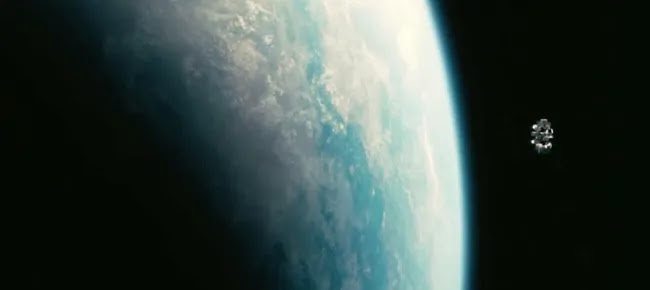
Never mind how they get there, but Cooper stumbles upon a facility which is the last remaining vestiges of NASA, headed by Professor Brand (Michael Caine—Nolan's most regular cast-member) and a team of theoretical physicists and engineers. Their goal is the most lofty one imaginable—Earth's eco-system is so far out of balance that the only way for the human race to survive is to find another Earth and transport the population to that other world. That's Plan A. Plan B is to repopulate the designated planet with a "population bomb" of new humans to that planet in the hopes that they can re-populate without the need of nannies. Both plans are more than a little far-fetched, as is the means to exploring those planets—a wormhole has opened up in the orbit of Saturn, and exploratory teams, twelve in all, have been dispatched to planets visible in the wormhole to send back blips of information about each planet, and Cooper, along with a minimal team of specialists, including Brand's daughter (Anne Hathaway) rocket away to reach those teams, and discover for themselves the viability of human life on those planets.

Saturn's wormhole—a snow-globe full of worlds.
That mission will take years—for how long no one can speculate—and it is further complicated by the presence of the black hole that has caused that wormhole in space-time. The closer they get to it, the more the crew will be out of time-sync with Earth. They will age slower than the people of their home-planet. This, frankly, is the best concept in the film (and similar to the different time-rates of the various dream-worlds in Nolan's Inception) and produces the best line in the film about their precious commodities of food and water being added to by time. 

But Cooper going on the mission—no matter how important it is to the species—does not sit well with his family, especially daughter Murph (Mackenzie Foy), who's already lost one parent, and at 10 years old does not want to lose another.  His decision to go anyway, creates a rift between them that time and space only increase, not transcend. But, it will inspire them both on their separate journeys.
Cooper receives messages from home
There are complications—very big complications—that makes one wonder if humans are even worth saving at all. Meanwhile, the uncaring Universe rolls on, completely indifferent to whether you'll be able to make it to your kid's soccer matches...or their weddings...or their funerals. There are wormholes, black holes and more engulfing plot holes. There is an adherence to science theory, but only so far as writers' desperation will allow, and then a lot of fudging goes on in the interest of drama and closure and coincidence...and a banal lack of imagination in its realization of the penultimate act is displayed.  
Ambitious it is, in its limited way, and in places, beautiful. But, for all the dialogue about man (or woman) being an explorer and that, even though humans are born on this planet, they're not destined to die there—ultimately the film falls back to Earth in its focus and its intentions. Opportunities for saying something more, about our place in the Universe and maybe beyond, are lost, for domestic concerns and earthly desires. Interstellar's sights are in the Heavens, but rarely gets off the ground.


* The reason is much less interesting than that.  The property was attached to Paramount, but Spielberg moved his production company Dreamworks from there to Disney.  And, if based on what this article reveals, it's just as well this version wasn't filmed, as the current version is a bit more focused.

** Spoiler Alert: To sum it up, it is "Only Love Can Escape the Sun-Crushing Gravity of a Black Hole."  Really?

*** Rice is never mentioned, which makes one wonder if it's just America that's having these issues and wants to leave the planet.